Using Video Game Logic to Structure ADHD Workdays
Gamified task systems deliver the immediate rewards ADHD brains need to start and finish work.

Gamified goal tracking works for ADHD adults because it replaces distant, abstract rewards with the immediate, concrete payoff the ADHD dopamine system needs to start and sustain a task. Apps like Mindflow, Todoist (through its Ramble feature), Goblin Tools, and Focusmate each apply a piece of this logic, and video game structure itself, quests, XP, levels, checkpoints, offers the clearest blueprint for why some systems hold an ADHD brain's attention and others lose it by lunchtime. The rest of this piece walks through the neuroscience behind that failure, the game mechanics that answer it, and which tools already put the logic into practice.
Why the ADHD brain cannot sustain effort on conventional productivity logic alone
Standard advice treats a stalled to-do list as a discipline problem, something a better planner or a sterner deadline will fix. The failure is structural. ADHD is now understood as a disorder of dopamine signal strength rather than dopamine quantity, driven by variation in D2, D4, and D5 receptor function, per a 2025 editorial in Psychiatry and Clinical Neurosciences Reports. The ADHD brain is not simply short on dopamine: it struggles to generate a clean, strong signal at the moment a signal is needed most, right as a task should begin.
That signal lives in specific circuitry. An integrative neurocognitive model published in Frontiers in Psychiatry in July 2026 locates the trouble in fronto-striatal and fronto-limbic networks, spanning the dorsolateral prefrontal cortex, the anterior cingulate cortex, the amygdala, and the ventral striatum. These are the regions responsible for anticipating a reward before it arrives, and anticipation is the specific function that underperforms in ADHD. A task list has no mechanism for supplying that anticipatory charge. Neither does a deadline three weeks out. Both assume a brain that can manufacture its own motivational pull toward something distant, and the ADHD brain, by its wiring, often cannot do that reliably.
That gives the problem a clean practical shape. If the internal signal is unreliable, the external system has to generate it instead, supplying frequent, concrete, immediate markers of progress rather than waiting for a single payoff at the finish line. Everything that follows in this piece is an attempt to build that kind of system deliberately.
Why this is not one problem but three: the heterogeneity that one-size-fits-all systems ignore
Treating ADHD as a single executive function deficit misses how unevenly that deficit actually distributes across people, and a workday system built for one profile will stall out for another before it ever gets used. Some adults carry broad impairment across most executive domains at once. Others show sharp deficits concentrated in inhibitory control while planning and working memory stay relatively intact. A third group struggles mainly with sustaining attention over time rather than with initiating or inhibiting action in the moment. Each profile calls for a different kind of support: different task granularity, different reward timing, different tolerance for friction before a system starts to feel like more work than the work itself.
This is the structural objection to any single gamification framework handed out as a universal fix. A reward schedule generous enough to engage someone with broad impairment may feel patronizing or slow to someone whose deficit is narrow and specific. This heterogeneity is why so many ADHD productivity systems work for a few weeks and then quietly get abandoned: the calibration was never built in. Video games, as it happens, solved this exact problem decades ago. Difficulty scaling, adaptive challenge curves, and variable reward schedules let the same underlying game serve a beginner and an expert without either one feeling patronized or overwhelmed, which is the precise kind of calibration a three-profile condition demands.
How video games are engineered to solve exactly the dopamine problem ADHD brains face
Video games are engineered, deliberately and at great commercial cost, to supply an immediate, concrete reward signal strong enough to pull a player from one action to the next without requiring that player to sustain motivation on their own. That engineering happens to target the same circuitry the Frontiers in Psychiatry model identifies as impaired in ADHD, the fronto-striatal reward pathway responsible for anticipating payoff before it lands.
The clearest evidence for this comes from a randomized controlled trial in which the content delivered to two groups was held identical and only the mechanics differed. Because the subject matter did not change between arms, any difference in engagement or completion traces back to the game mechanics themselves, not to anything about what was being taught or practiced. That detail elevates the claim from metaphor to mechanism: it is not that games happen to resemble a good ADHD intervention, it is that the specific structural choices inside games, discrete goals, visible progress, immediate feedback, are doing the neurological work directly.
Games also address the heterogeneity described above without needing three separate products. Difficulty scaling and adaptive challenge mean the same underlying framework can serve a player who needs frequent small wins and a player who needs a harder, more spaced-out challenge, simply by adjusting parameters. This dopamine-signal gap is precisely why generic productivity tools fail ADHDers, and why tools built specifically for ADHD brains, like the gamified voice-first app Mindflow, replace distant deadlines with immediate, concrete reward signals that the fronto-striatal circuit can actually process.
The core game mechanics and the ADHD workday failure points they address
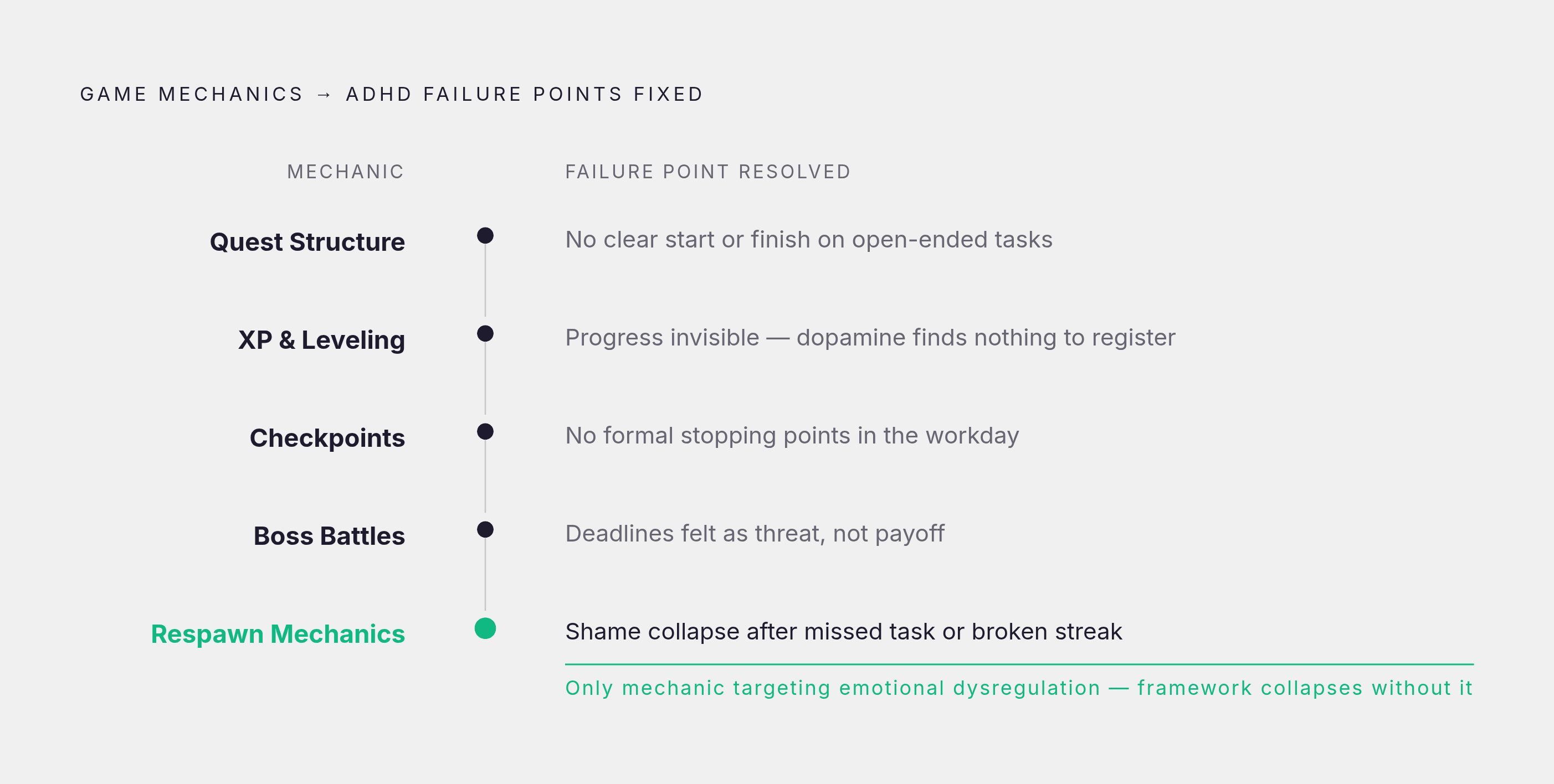
Applying the mechanic is a direct intervention aimed at the failure itself.
Quest structure fixes open-ended task lists that give the brain no clear place to start and no visible finish line, both of which are required for the ADHD reward circuit to generate anticipatory dopamine in the first place. A quest, by contrast, names a discrete mission with a defined start, a defined completion state, and a reward attached to that completion, so the brain can calculate the payoff before committing effort.
XP and leveling solve the invisibility of ordinary work progress. A project can move forward for days without producing any signal the brain registers as a win, and the ADHD dopamine system does not reward effort it cannot see rewarded. An XP system makes every completed micro-step numerically visible in real time, and leveling turns the vague idea of "getting better" into a concrete state change that functions as a legible event.
Checkpoints solve the absence of formal stopping points in most workdays. Without them, work reads to the brain as one continuous, undifferentiated demand with no signal that effort has been recognized or that rest has been earned. Checkpoint logic, complete a block, save the progress, take the break, carves the day into arcs with recovery built in.
Boss battles reframe the deadline. A deadline under conventional framing registers as a threat, and threat activates anxiety in many ADHD brains. Recast as a climactic challenge at the end of a level, prepared for by the quests and XP that came before it, the same event becomes a payoff the brain has been working toward.
Respawn mechanics solve the collapse that follows failure. In a game, dying is not an ending, it is the designed response to failure, which makes trying again the default rather than something the player has to talk themselves into. For ADHD adults carrying years of accumulated shame from systems that failed them before, treating a missed task or a broken streak as a respawn rather than a verdict addresses the emotional layer that otherwise causes people to walk away from the whole system. That reframe sets up the piece's closing argument: none of the mechanical fixes above hold if the emotional one is skipped.
Movement breaks as mid-level checkpoints: the neurochemical reset between work blocks
Brief physical movement between work blocks belongs inside this architecture rather than outside it, functioning as a mid-level checkpoint that resets the reward circuit before the next challenge begins. The neurochemical effect of movement is acute and fades quickly, matching the shape of a workday built in blocks: a block of focused work, a short burst of movement, then the next block starting from a restored baseline.
That framing matters because it separates this from generic wellness advice. Movement functions as a scheduled mechanic inside the system: the work block ends and that is the checkpoint, the movement resets the circuit and that is the level transition, and the next block begins because the system scheduled it, not because the person had to talk themselves into standing up. Built into the architecture this way, movement stops depending on willpower and becomes something the schedule simply does for the person.
Tools that already run on game logic and fit an ADHD workday
A handful of existing tools already put pieces of this architecture into practice, and the most useful ones target the exact friction points named above rather than adding generic features on top of a standard task manager.
Focusmate pairs a user with a partner over video for sessions of 25, 50, or 75 minutes, operating on body doubling, one of the more reliable interventions for the task-initiation paralysis common in ADHD. The social presence of another person supplies an external accountability signal that substitutes for the internal dopamine signal the brain is not generating on its own.
Todoist's Ramble feature targets the capture stage directly, converting a spoken, unpunctuated thought into a structured task with a project, a due date, and a priority attached. That matters because capture friction is arguably the single biggest failure point in ADHD task management: if a thought has to wait for someone to type it out properly, it is often gone before the typing starts.
Goblin Tools breaks a single task into smaller steps, addressing the paralysis that occurs when a task is technically clear but too large to start, and it is free to use and requires no account to begin.
Mindflow was built specifically for ADHD brains, and its voice-first design removes the same typing friction Ramble addresses, as the app's core interaction. Its goal plans break down into guided milestones rather than a single open-ended target, directly addressing the paralysis that vague goal-setting creates for ADHD users, and every conversation earns XP that compounds into visible progress over time. The same principle underlies ADHD-specific apps designed with behavioral science: immediate feedback, earned rewards, and level-based challenges on a reliable schedule are not gimmicks but direct interventions on dopamine dysregulation, and variable reward schedules mean the same framework can adapt to different executive profiles, exactly as games do.
Where game logic can backfire
The same novelty-seeking tendency that makes game logic effective also makes it possible to chase the game itself instead of the work underneath it, so game mechanics can work against themselves when implemented carelessly. Streaks are the clearest example. A maintained streak motivates, but a broken one can flip into shame fast, and a user who feels they have failed the system often abandons it entirely, which recreates the exact failure cycle the mechanic was supposed to interrupt.
The heterogeneity described earlier in this piece is the deeper reason a single calibration will never work for everyone. An adult with broad executive impairment and an adult with a narrow, specific deficit in inhibitory control need different reward schedules, different task sizes, and different tolerance for friction, and a system tuned for one will either bore or overwhelm the other. Three safeguards keep the architecture intact against these risks: tie rewards to completion of real work rather than engagement with an app's interface, build streak forgiveness into the system so a missed day costs nothing permanent, and keep the complexity of the game layer below the complexity of the work it is meant to support. Handled that way, the risk does not disqualify the approach, it just sets the terms for building it correctly.
Why the framework only holds if it also addresses shame
None of the mechanics described in this piece survive contact with the ADHD emotional experience if they organize tasks without validating the person attempting them. A single missed day got treated as proof of a deeper, personal failure rather than as one data point among many, and that shame is the mechanism by which nearly every prior productivity system has failed this population.
The respawn mechanic answers this directly. It is not only a productivity design choice, it is an identity-level one: it encodes the message that a missed day is information rather than a verdict, which is the same reframe clinicians and the ADHD community have been pushing for years. That matters clinically as well as emotionally. The same Frontiers in Psychiatry model that locates ADHD's cognitive deficits in fronto-striatal circuitry also identifies emotional dysregulation, rooted in fronto-limbic disruption, as a core feature of the condition. A system that fixes task structure and reward timing while ignoring emotional reactivity has addressed, at best, two-thirds of what ADHD actually involves.
What game logic offers, done well, is a quiet shift in how the ADHD brain gets framed by the systems built around it: not a broken version of a neurotypical brain that needs correcting, but a brain with a different operating logic that responds to a different kind of design. Any system that still treats a missed checkpoint as evidence of personal failure will get abandoned as fast as the plain to-do list it replaced, which is the actual condition under which any of this gets used past the first week. The architecture described across this piece, quests instead of lists, XP instead of invisible progress, checkpoints instead of undifferentiated demand, respawns instead of collapse, is a structure built around how that brain actually generates motivation, which is the only kind of structure likely to still be in use a year from now.