Gamification and the ADHD Brain
Gamified rewards activate the dopamine pathways ADHD brains struggle to trigger alone.
ADHD is a difference in how specific brain circuits generate and sustain goal-directed effort rather than a deficit of willpower. A 2025 review in The FASEB Journal locates measurable structural differences in the prefrontal cortex, the basal ganglia, and the cerebellum, three regions that together carry out executive functioning and behavioral control. That detail moves the conversation out of character judgment and into circuitry: these are physical structures doing measurably different work, rather than a moral failing dressed up in clinical language.
The basal ganglia deserve more attention than they usually get in popular discussion of ADHD. One might argue that if the prefrontal cortex is where planning happens, the basal ganglia are where plans turn into repeated action, and a disruption at that junction explains a great deal about why good intentions in ADHD so often stall before they become habits.
A 2026 integrative review in Frontiers in Psychiatry frames ADHD as a disorder of hierarchical self-regulation, in which dysfunction at the level of neural circuitry cascades upward through metacognitive and emotional regulatory systems before it ever becomes visible as a behavior someone else can observe. The forgetfulness, the procrastination, the unfinished projects, the uneven focus: these are downstream effects, several steps removed from the actual malfunction, which occurs earlier and lower in the system. A Frontiers in Psychology review adds that executive functions, including planning, reasoning, goal-directed behavior, monitoring, sustained attention, and problem-solving, show impairment across all age groups in ADHD, tied to delayed development of the fronto-cerebral network rather than a fixed or permanent ceiling.
Russell Barkley's unifying theory, cited widely across this literature, organizes the impairment into four executive function domains: working memory, internalization of speech, self-regulation of affect, motivation, and arousal, and reconstitution, the capacity to break behavior down and recombine it into new sequences. The fourth domain, reconstitution, is the one that matters most for understanding why reward and engagement sit at the center of this piece. If the brain cannot easily analyze a task, break it into parts, and resynthesize those parts into a plan, then the question of what makes each part worth doing becomes the whole battle. That question has one answer in the brain's chemistry: dopamine. The next section follows that thread directly, because the dopamine reward pathway is the keystone that explains why gamification functions as compensation rather than decoration.
How dopamine dysregulation makes delayed rewards functionally invisible to the ADHD brain
Dopamine availability in the ADHD brain runs lower than typical, and that single fact explains why tasks without an immediate payoff do more than feel unappealing. Effort initiation, in other words, is a structural problem rooted in neurotransmitter signaling, not a character flaw rooted in laziness. The 2025 FASEB Journal review identifies imbalances in dopaminergic and norepinephrine systems as central to the attention and impulse-control impairments observed in ADHD, and the 2026 Frontiers integrative review goes further, implicating the ventral striatum specifically, a core part of the brain's reward circuitry, alongside the dorsolateral prefrontal cortex and the anterior cingulate cortex, through abnormalities in dopaminergic and glutamatergic signaling.
Picture the gap concretely. A neurotypical brain faced with a task due in three weeks can generate a trickle of dopamine tied to the idea of finishing it, enough to make starting today feel worthwhile. An ADHD brain, faced with the identical task and the identical deadline, often produces no such trickle. The deadline exists as a fact the person can state out loud, yet it carries no felt pull. That gap between knowing a thing matters and feeling that it matters is the entire story: the signal that is supposed to encode "this is worth doing now" is too weak to move behavior forward. Telling someone in that position to just try harder, or to think about their future self, asks the brain to do the one thing its wiring makes difficult: let a reward that hasn't happened yet drive an action that has to happen now.
But what if hyperfocus seems to disprove all of this? Doesn't that undercut the whole premise? Not quite. It's the reliability of dopamine generation for tasks that are mundane and whose payoff sits far in the future. That distinction raises the obvious next question: what happens if a task's reward signal could be supplied from outside the brain, manufactured rather than waited for?
Why gamification supplies exactly the dopamine signal the ADHD brain cannot generate internally
Points, progress bars, XP rewards, and completion feedback work because they manufacture an immediate reward signal from outside the brain, and that external signal activates the same dopamine pathways the ADHD brain struggles to trigger on its own for low-stimulation work. This is the center of the argument this piece is built around: gamification compensates for a specific, documented neurochemical gap rather than simply making tasks more fun to look at.
Each small win, a point earned, a task closed, a streak extended, sends a dopamine pulse that reinforces the behavior just completed and lowers the threshold for starting the next one. That is the loop an ADHD brain needs and cannot reliably generate for itself when the task at hand offers no built-in stimulation. Because the basal ganglia drive habit formation through repeated reward-paired behavior, each cycle of task and reward strengthens the neural pathway that produces it, so gamification built well enough gradually shifts a behavior from effortful to automatic. The 2026 Frontiers integrative review's identification of the ventral striatum, working alongside the dorsolateral prefrontal cortex, the anterior cingulate cortex, and the amygdala, as central to reward processing in ADHD gives this mechanism a specific anatomical target: gamification mechanics are aimed directly at a structure known to respond to concrete, immediate reward.
This isn't a claim resting on theory alone. A 2025 randomized controlled trial published in Frontiers in Education tested a gamified educational application against a non-gamified digital program matched for content and time spent, and found that the gamified version significantly improved sustained attention in children with ADHD. Breaking a large goal into milestones belongs in this same category of intervention, not as an organizational nicety but as a conversion mechanism: it takes one distant reward too weak to move the dopamine system and turns it into a series of near-term rewards, each one strong enough to register.
Critics sometimes describe gamification as a short-term engagement trick, one that builds dependency on external prompts rather than cultivating what they'd call real, intrinsic motivation. The neuroscience here points to a different reading. The measure that matters is whether the behavior gets sustained, and the mechanism that achieves that is valid whether the reward signal originates inside the brain or comes from an app. Understanding ADHD as a circuit-level difference rather than a discipline gap opens the door to tools built around that premise directly. Voice-first AI apps like Mindflow apply this science in practice, calibrating gamification mechanics to the dopamine and executive function challenges that produce task avoidance in ADHD, instead of handing users a generic productivity framework built with a neurotypical brain in mind.
Task Paralysis as a Reward-Circuit Failure
Anyone who has sat staring at a blinking cursor, fully aware of what needs writing and utterly unable to begin, knows the feeling this section is about: the body in the chair, the mind circling the task without landing on it, minutes passing with nothing to show. That frozen state isn't deliberate avoidance; it is the executive system stalling because the reward signal needed to initiate action is too weak, at the exact moment that the cognitive load of evaluating options exceeds what working memory can hold. Both failures hit at once, and either one alone might be survivable; together they produce the standstill.
Research in this area describes three overlapping forms of paralysis, mental, task, and choice, that all trace back to the same cluster of executive function impairments: planning, prioritizing, organizing, and regulating emotion. Three distinct failures, occurring together, produce one experience: being stuck.
The fix follows directly from the mechanism, rather than from habit advice layered on top of it. Decomposition breaks "write the report" into "open the document," then "add a title," then "write the first paragraph." Each micro-step is small enough to finish quickly, and finishing quickly means the reward hit arrives before attention has a chance to wander elsewhere. Each completed step then becomes the cue that starts the next one, a chain of small ignitions rather than one impossible launch. That is why milestone-based goal structure functions as a core intervention rather than a mere productivity convenience: it reshapes the reward landscape itself so the brain encounters a dopamine signal before engagement has time to collapse. External scaffolding, visible timers, written checklists, working alongside another person, all operate on the identical principle: they move structure out of a working memory that can't reliably hold it and place it somewhere external and visible, lowering the cognitive load that produces paralysis. Delayed rewards fail to generate a motivating dopamine signal in the ADHD brain, so immediate feedback is a structural requirement, and instant-reward mechanics like XP and milestone completion can bridge the space between intention and action in ways a plain task list cannot.
Emotional Dysregulation and the Stakes of Gamification Design
Emotional dysregulation is built into the same circuitry that governs attention and reward, and that fact changes what counts as responsible gamification design. A system that triggers shame or rejection sensitivity in its users does not simply fail to help them. It actively damages the executive function it was supposed to support, a system that fails this way doesn't just underperform, it undermines the very capacity it exists to support.
The 2026 Frontiers integrative review points to reduced prefrontal regulation over limbic structures, the amygdala and the ventral striatum chief among them, as a key mechanism in ADHD, one that can raise emotional reactivity and increase impulsive behavioral responses. These are circuit-level vulnerabilities, not personality traits, and that distinction matters for anyone building a product around them. A tool that penalizes a missed deadline, displays a broken streak prominently, or frames a lapse as a failure state ends up reinforcing shame and anxiety, and research on emotional dysregulation in ADHD shows that shame and anxiety, once triggered, worsen executive dysfunction in a feedback loop that works against the product's own purpose.
Rejection Sensitive Dysphoria, described in the clinical literature as episodic attacks of physical and emotional pain, intense shame, and a feeling of being ostracized in response to perceived rejection, gives this problem a name. That raises an important question for anyone designing around ADHD specifically: what does a forgiving system actually look like in practice? It looks like re-entry without penalty, an absence of failure-state framing, and language that doesn't scold. This is where Mindflow's approach to design becomes a useful illustration of a broader principle rather than a product feature standing on its own: building in forgiving re-entry, with no punitive streak mechanics or shame-based messaging, follows directly from the neuroscience of amygdala-prefrontal dysregulation rather than from a stylistic preference about tone. Good gamification for ADHD brains needs two things at once: reward density high enough to supply the dopamine signal the brain is missing, and emotional safety robust enough that a failure state doesn't set off the limbic reactivity that undoes the very executive function the system exists to support.
What the neuroscience requires from any gamification system built for ADHD brains
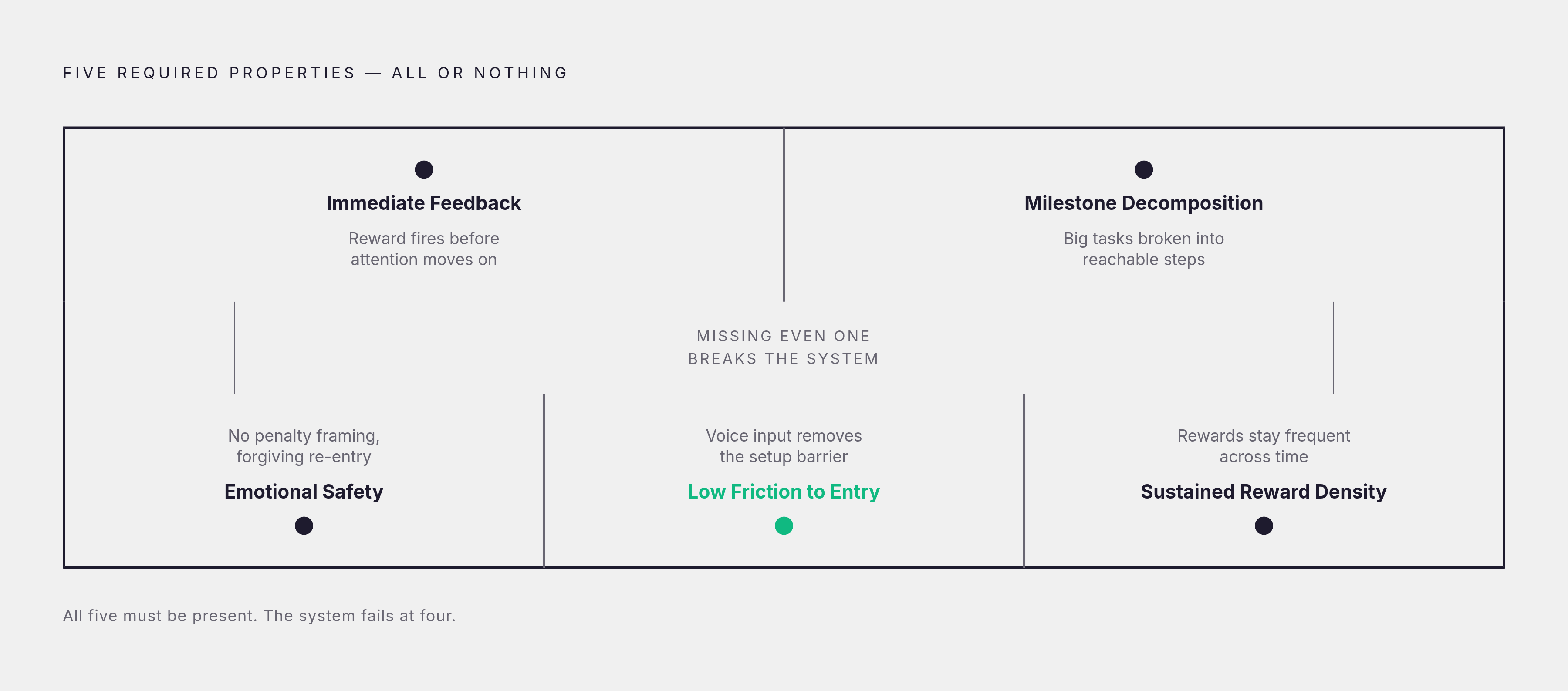
The evidence gathered across these sections points to a specific, checkable standard rather than a vague sense of what helps. Five properties need to be present together: immediate feedback, milestone decomposition, emotional safety, low friction to entry, and sustained reward density. A system missing even one of these is not built for an ADHD brain, no matter how many points, badges, or levels it awards on the surface.
Immediate feedback means the reward has to arrive close enough to the completed action that it fires before attention has already moved on to something else. Emotional safety, covered in the previous section, is not a cosmetic UX choice but a requirement grounded directly in the amygdala-prefrontal dysregulation documented in the 2026 Frontiers integrative review: forgiving re-entry, no penalty framing, and language that doesn't carry judgment all follow from that same evidence. Low friction to entry matters because the same review identifies metacognitive monitoring and goal maintenance as compromised functions in ADHD, and any system that demands significant setup before a user reaches the first reward loses that user before the product has done anything for them; voice input, rather than typing, removes one of the more common points of friction at exactly that entry stage.
This is the checklist against which any gamified goal-tracking tool for adults with ADHD should be measured, and it is the standard this piece has tried to build, fact by fact, from the neuroscience itself rather than from marketing language about what feels motivating. Apps built around ADHD behavioral science, gamification moving from a feature into a compensatory mechanism, use points, progress tracking, and real-time feedback to supply, from outside the brain, the immediate dopamine reinforcement that lets someone with ADHD build consistent habits and sustain effort on tasks that offer no built-in stimulation of their own. The brain architecture described across this piece doesn't change from one app to the next. What changes is whether the system built on top of it was designed with that architecture in mind.