Why Habit Building Is Hard With ADHD
ADHD disrupts the brain circuits that habit formation depends on.

15.5 million adults in a large country currently carry an ADHD diagnosis, roughly 6.0% of the adult population, according to a study by Staley et al. drawing on National Center for Health Statistics data. Most of them have been told, at some point, that building a habit is a matter of discipline. That advice is backwards. Habit formation runs through a specific set of brain mechanisms called executive functions, and ADHD disrupts those mechanisms at a structural level. The standard advice about willpower and streaks was never going to work for this population in the first place.
The numbers that make up that population, shown by the breakdown of diagnosis timing and treatment access below, tell their own story. Over half, 55.9%, were diagnosed as adults, meaning millions spent decades without a framework for why consistency never stuck. About a third, 36.5%, had no access to treatment at the time they were surveyed. Most people managing ADHD are doing it without a clinician's help. And the downstream cost, according to separate estimates, comes to $122.8 billion a year in lost productivity, unemployment, and added healthcare spending. That figure serves a fairly narrow point about scale. It's there to make a fairly narrow point: a large, underserved group has been handed generic advice for a brain that doesn't run on the same operating system.
What executive function actually is and why ADHD disrupts it at the root
Executive function describes a set of effortful, top-down mental processes, the ones that activate, organize, integrate, and manage every other brain function in service of a goal. It's what lets a person hold an intention across time and act on it later, instead of losing it the moment something shinier grabs attention.
Two researchers dominate how the field talks about this, and CHADD's framework draws on both. Russell Barkley breaks executive function into four areas: nonverbal working memory, internalization of speech, self-regulation of affect and motivation and arousal, and reconstitution, the brain's capacity to take a behavior apart and build a new one from the pieces. Tom Brown, working from a different angle, describes six clusters instead: organizing and prioritizing and activating; focusing and sustaining and shifting attention; regulating alertness and effort and processing speed; managing frustration and modulating emotion; working memory and recall; and monitoring and self-regulating action. Brown treats these clusters as integrated rather than separate, so impairment in one tends to ripple through the rest rather than staying contained.
Barkley's inhibition cascade model ties the whole picture together above the others. It proposes that impaired inhibitory control is the central causative factor in ADHD: a deficit in inhibition ties up attentional resources, which triggers a downstream cascade across every other executive function. One weak link at the top of the chain drags the rest down with it. The model holds that impaired inhibition produces trouble with working memory capacity, with the internal language that normally regulates behavior, with reconstituting new behaviors, and with regulating emotion, arousal, and motivation.
Barkley also maps this onto four brain circuits, laid out in ADDitude's coverage of his work. The "What" circuit runs from the frontal lobe to the basal ganglia and striatum, tied to working memory, where a thought becomes a plan aimed at a goal. The "When" circuit connects the prefrontal area to the cerebellum and functions as the brain's timing system; its impairment explains the chronic time management struggles so many adults with ADHD describe. The "Why" circuit runs from the frontal lobe through the anterior cingulate to the amygdala, the emotional and motivational decision-maker that picks an action based on how it feels in the moment, not how it pays off later. The "Who" circuit, running from the frontal lobe to the posterior hemisphere, is where self-awareness sits.
Research suggests the large majority of adults with ADHD struggle with executive dysfunction on a daily basis, and none of this is a character flaw. That's the norm inside the diagnosis, not the exception. That's close to the norm.
The specific executive functions that habit formation depends on, and what ADHD does to each one
Habits get assembled link by link, through a chain of executive functions that has to fire in sequence, and ADHD interferes with several links at once, not just one.
Working memory has to hold the cue, the intended behavior, and the reward all at the same time, long enough for someone to act on it. When that capacity shrinks, which it does in ADHD, intentions evaporate before the action ever starts. Inhibitory control has to suppress the competing impulse (the phone check, the task switch, the pull toward something newer) in favor of whatever the habit actually calls for, and Barkley's cascade model names this the root of the whole problem. Task initiation, the simple act of starting a behavior even when it's small and familiar, requires a burst of mental activation that costs structurally more in an ADHD brain than in a neurotypical one.
Then there's time awareness, tied to that "When" circuit, which governs whether a person senses elapsed time, judges when a habit is supposed to begin, or feels any urgency about a routine slipping. Self-monitoring, falling within Brown's sixth cluster around regulating action, governs whether someone even notices a habit is happening, faltering, or being quietly avoided. When it's impaired, a broken streak might not register until days after it broke. And emotional self-regulation, one of Barkley's core skills, means the frustration from one missed day can feel wildly disproportionate: rejection sensitivity can turn a single slip into grounds for scrapping the whole habit.
What matters most is that these functions don't fail on their own. A lapse in working memory weakens task initiation. Weak task initiation compounds time blindness. Time blindness undermines self-monitoring. It's a system, not a set of independent parts, so one glitch propagates through the whole chain. The standard habit-building model assumes a brain running all of these systems in sync. The ADHD brain runs the identical process on structurally different hardware, and expecting matching output from different hardware was never a reasonable ask.
The standard "66 days" habit advice and ADHD brains
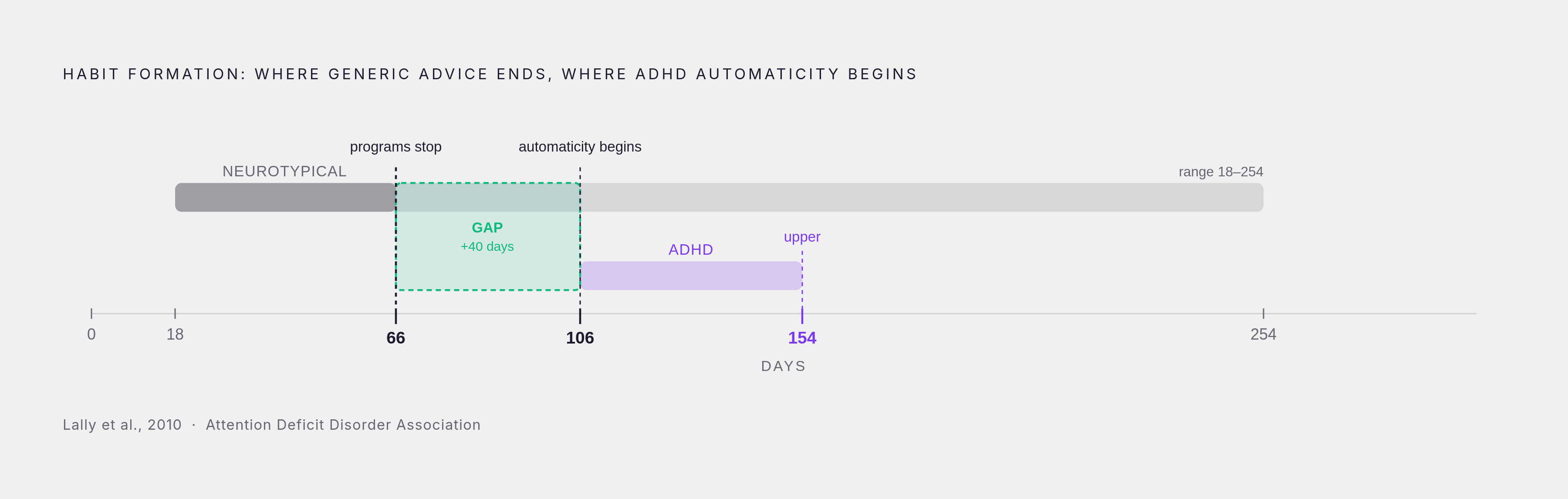
The number everyone cites is 66 days, the average from Phillippa Lally's 2010 study at University College London, with individual cases ranging anywhere from 18 to 254 days depending on the person and the behavior. That figure ends up in nearly every productivity article and self-help book on the shelf, and it was never built with ADHD in mind, which makes it close to useless as a benchmark for this population.
Clinical estimates from the Attention Deficit Disorder Association put automaticity for adults with ADHD, the point where a behavior stops requiring conscious effort, at 3 to 5 months, or roughly 106 to 154 days. Why the gap? Automaticity depends on exactly the executive functions ADHD impairs. The neural pathways that turn repetition into routine consolidate more slowly when inhibitory control, working memory, and task initiation are all constrained at once, so the same repetition simply takes longer to encode into something automatic.
A novelty problem sits on top of that timeline. ADHD brains are tuned for novelty, not repetition, so a habit that isn't immediately rewarding or urgently necessary tends to get buried under mental clutter before enough repetitions accumulate to make it stick. A planning trap follows close behind: hours spent researching the perfect habit tracker or the ideal system, which delivers its own small dopamine hit without the habit itself ever getting performed. What gets reinforced there is the planning, not the doing, and that's a subtle but consequential distinction.
Stacking multiple new habits at once only makes this worse, since each one adds its own load to a working memory system that's already stretched thin. The difficulty is rooted in neurodevelopmental differences in executive function, not in character, and treating it as a discipline problem is the exact mistake that keeps failing.
So the ADHD brain gets handed a process, and a timeline, built for an executive function system it doesn't have.
How dopamine shapes motivation and why long-term rewards don't move ADHD brains
ADHD is associated with lower dopamine activity in the brain regions responsible for motivation, attention, and reward. That's a neurological fact, not a motivational one, and it shapes what feels worth doing before a person even decides to act.
The consequence appears constantly in tasks without an immediate payoff, which feel uninteresting, sometimes almost invisible, even when the person understands intellectually that they matter. Being healthier in five years, or more productive next quarter, doesn't generate a strong enough motivational signal to compete with whatever feels good right now. That's precisely why standard habit advice, the kind that says picture your long-term goals, misfires so consistently here. The circuitry required to feel moved by a future outcome runs at a lower baseline to start with, so telling someone to "just visualize success" is asking a weak signal to out-compete a strong one.
Barkley's "Why" circuit is the mechanism at work. That emotional-motivational decision point runs through the anterior cingulate to the amygdala, and when it's impaired, the pull of a future reward is too faint to reliably beat an immediate alternative. The desire to build the habit isn't missing. What's missing is the neurochemical signal that makes starting, right now, in this exact moment, feel worth it.
Which raises an obvious question: if internal, future-facing motivation isn't structurally sufficient, what fills the gap? External, immediate reward systems do, and calling them a workaround undersells what they're actually doing.
Immediate rewards and external structure as the actual mechanism
Gamification uses game-like systems (points, levels, visible streaks, instant feedback) to create external rewards that stand in for the internal motivation an ADHD brain struggles to generate on its own. When feedback lands immediately, a point earned, a progress bar that visibly moves, dopamine gets released, and the task starts to feel worth finishing. Pull that stimulation away and attention drops off fast, often within minutes.
A 2021 study in Cognitive Therapy and Research found that breaking tasks into micro-goals improved focus duration by up to 47% over a four-week period. Small wins produce small dopamine boosts, and those boosts are what keep motivation up and procrastination down. Separately, research on implementation intentions by Gawrilow and Gollwitzer found that specific planning techniques, structured as "when X happens, I will do Y," brought ADHD performance on executive function tasks up to neurotypical levels. The mechanism there is an external cue doing the job an internal decision can't reliably do on its own.
Milestone-based planning works on the same principle, and it goes straight at the working memory and task initiation barriers rather than around them. Breaking a large goal into small, concrete steps cuts the cognitive load required just to begin, and it removes the paralysis that comes from not knowing what "starting" is even supposed to look like.
One caveat matters here, and skipping it would be dishonest. Gamification's motivational effect tends to fade over time, as novelty wears off and extrinsic rewards lose their charge. That's a design constraint, not a footnote: systems built for ADHD have to refresh their rewards, vary the challenges, and keep introducing new stimulation, or the exact mechanism that worked in week one goes flat by week six.
One more friction point gets overlooked constantly. The effort required just to open an app, click through a menu, or type out a task is itself an initiation barrier for an ADHD brain, not a minor inconvenience. Voice-first interaction removes that friction, lowering the threshold at which someone actually starts the task instead of stalling at the interface. XP systems, streak tracking, milestone completion, none of it is gimmick dressed up as design. It's a dopamine delivery mechanism, timed to land at the exact moment of action, built to compensate for a real deficit in how delayed rewards register. Call it behavioral science applied to a neurological reality. It is not productivity hacking, and treating it as such misses the point.
What breaks a task paralysis freeze
Task paralysis in ADHD is a freeze response, not a choice, and the two get confused constantly. The person often wants to start. The brain simply won't move, particularly when the task feels too large, too emotionally loaded, or too poorly defined to grab onto.
Separate this clearly from procrastination. Procrastination implies a deliberate delay, a choice to put something off. Paralysis is a neurological freeze, triggered by overwhelm, decision fatigue, or perfectionism, where the brain crashes rather than postpones. Rejection sensitivity tends to compound the freeze further: a small mistake, or even the anticipation of one, can escalate into a wave of emotional pressure that makes starting feel dangerous rather than merely effortful.
Certain triggers occur again and again, including a task too vague to get a grip on, a task with too many sequential steps visible at once, and a task that carries emotional weight from some past failure. And certain responses reliably make things worse rather than better. "Just start" doesn't help. Vague encouragement doesn't help. Piling more planning onto a brain already in cognitive overload doesn't help either; it just adds another layer to get stuck under, which is the opposite of what a frozen brain needs.
What actually breaks the freeze tends to follow the same pattern each time. Shrink the task to its smallest possible first action, not "exercise" but "put on shoes," and the brain finally has something small enough to grab. Environmental cues and implementation intentions, deciding in advance what triggers the first step, remove the in-the-moment decision. External accountability, a prompt that doesn't rely on the person remembering or deciding anything themselves, does something similar from a different angle. And an immediate, visible reward for that first step, not the finished task, just the act of starting, gives the brain something to register right away.
Every one of these interventions works the same way: by lowering the demand on the exact executive functions ADHD impairs. Memory gets externalized. The decision gets removed ahead of time. The reward arrives now instead of later. That's the whole mechanism, repeated across every version of the fix.
What this means for building a support system that fits the ADHD brain
Every barrier covered here, the inhibition cascade, time blindness, the dopamine deficit, task paralysis, points toward the same conclusion. Generic habit advice fails for ADHD not because people aren't trying hard enough, but because that advice assumes an executive function system that isn't the one actually running the show.
An ADHD-compatible system doesn't patch over the deficit. It gets built around the brain's actual architecture from the ground up, and a few principles fall directly out of the science above. Entry points need to cost as little as possible, since forms, menus, and typing are all friction, and voice interaction strips out a layer of that friction. Rewards need to be delivered at the moment of action itself, not after some distant goal gets hit, because that's where the dopamine actually has to fire. Big goals need to arrive pre-broken into milestones, not as a nicety but as a direct countermeasure against the overwhelm that triggers paralysis in the first place.
The timeline matters just as much as the mechanics. Systems need to sustain engagement across 3 to 5 months, not 66 days, because that's the realistic window automaticity takes to form in this population, and any program built around the shorter number is setting people up to quit right before the habit would have stuck. Structure has to run external rather than internal: environmental cues, implementation intentions, prompts, visible progress, standing in for the internal willpower an ADHD brain can't reliably summon on command. Novelty has to stay in rotation too, since gamification's pull fades with repetition, and a system that never refreshes its rewards or varies its challenges eventually goes quiet on its own.
None of this describes a brain that has failed at building habits. It describes a brain handed tools built for someone else's wiring. Understanding the neuroscience doesn't just validate the difficulty, though it does that too. It tells you, in concrete and specific terms, what kind of support to look for, and what to walk away from.