Evening Wind-Down Routines for ADHD
Brain biology, not willpower, drives late-night wakefulness in ADHD adults.
About 6% of adults carry a current ADHD diagnosis, per CDC figures, and a 2024 study in the Journal of Attention Disorders found that roughly 60% of adults with ADHD screen positive for some kind of sleep disorder. That's a diagnosis, not a coincidence sitting next to one. It's a predictable outcome of how the ADHD brain is built to run after dark, and most of what gets marketed as wind-down advice fails because it was written for a brain that doesn't have a 90-minute-delayed melatonin signal and a dopamine system still hunting for a payoff the day never gave it. This piece breaks down the actual mechanics: what's happening in the brain at 10pm, why the clock itself is running late, and what an evening routine has to do, structurally, to work with that wiring instead of against it.
What executive dysfunction actually does to the brain at the end of the day
Executive function breaks into three core pieces: inhibitory control, working memory, and cognitive flexibility. Research shows measurable deficits across all three in ADHD adults compared to neurotypical adults, and evenings are where those deficits show up hardest. Russell Barkley's inhibition model treats impaired inhibitory control as the primary driver of ADHD symptoms, with downstream effects on planning, working memory, and related regulatory functions. Stopping is the hard part. Not starting, not doing. Stopping.
That's the piece most advice gets backwards. A wind-down routine asks a brain to stop the stimulating activity, resist the urge to check one more thing, and quiet the mental chatter enough to let sleep in. Every one of those is an inhibition task, and inhibition is precisely the resource that's been drawn down all day. Telling someone to "just relax" at that point is asking a depleted system to perform its most expensive function on empty.
There's neural evidence behind the depletion. A 2025 systematic review in Frontiers in Neuroscience, covering 68 EEG studies conducted between 1971 and August 2024, found a consistent upward trend in resting-state theta power among adults with ADHD. Elevated theta tracks with weaker cognitive control and poorer arousal regulation, a clinical way of saying the brain struggles to downshift once it's been running hot all day.
Dopamine explains most of the rest, and it's the part generic advice ignores completely. ADHD links to reduced dopamine receptor and transporter density in reward-related brain regions, per research from Volkow and colleagues cited in PMC reviews, and Work by Plichta and Scheres shows reduced activation in reward-related brain regions during reward anticipation in ADHD brains. Translate that: the reward system didn't get its payoff during the day, so it keeps hunting for one at night, right when the body is asking for rest. That's the actual mechanism behind "one more episode," "one more scroll," "one more idea I need to write down before I forget it." Not weak willpower. A dopamine system still searching for a hit the day never reliably delivered.
Put it together and 10pm looks nothing like winding down, neurologically speaking. It looks like elevated arousal riding on depleted inhibitory reserves, a combination that makes "just relax" close to meaningless as advice. And the timing itself works against ADHD brains well beyond just the depletion.
How ADHD shifts the body clock and why evenings feel like the brain's peak hour
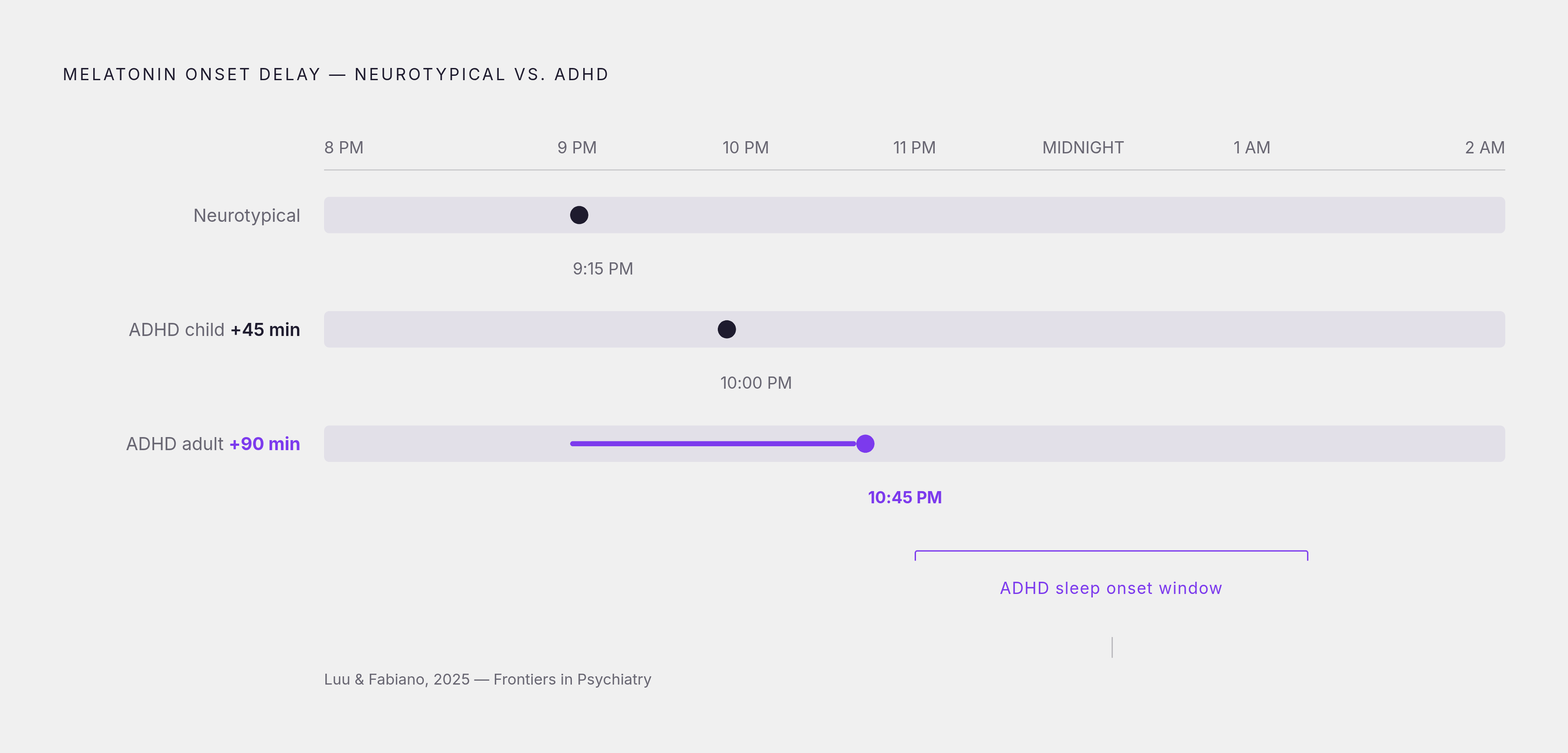
A 2025 paper in Frontiers in Psychiatry, by Luu and Fabiano, argues that circadian rhythm dysfunction is a core feature of ADHD, a clinically significant phenotype present in a substantial subgroup of people with the condition. The numbers back that framing: insomnia and sleep disturbance affect up to 80% of adults and up to 82% of children with ADHD, and delayed sleep-wake timing shows up in as many as 78%.
Here's the figure that reframes everything: dim-light melatonin onset, the biological signal telling the brain it's time to feel sleepy, is delayed by roughly 45 minutes in children with ADHD and by around 90 minutes in adults, according to the same paper. Ninety minutes changes the whole argument. It means a large share of ADHD adults are biologically cued to start feeling sleepy well after midnight. What looks like defiance or poor discipline at 11pm is, for a lot of these brains, the circadian peak arriving exactly on schedule. Just not the schedule the rest of the world runs on.
The same research describes blunted and delayed cortisol rhythms, reduced pineal volume, and dampened rhythms in peripheral clock genes like BMAL1 and PER2 accompanying these delays. The same research describes disruption at the level of peripheral clock gene expression, not a scheduling preference.
The delayed cortisol rhythm has a morning consequence too. Cortisol is part of what wakes a person into readiness, and when the rise is delayed, the "can't get going" mornings that follow a bad ADHD night make a lot more sense. The body's ignition switch is turning over late.
Worth being straight about the limits here, and this is where a lot of circadian-focused advice overpromises. A May 2026 commentary at neurodiversity.directory points out that while the observational evidence for circadian involvement is strong, correlation isn't causation, and circadian-focused interventions on their own tend to produce modest improvements in symptoms. The mechanism produces measurable effects; the fix is neither simple nor complete. Still, knowing that late-night alertness has a name, circadian phase delay, does something useful. It moves the story out of shame and into biology, and it points toward concrete levers, light exposure and wake-time consistency chief among them, that later sections build on.
Why generic wind-down advice doesn't work for ADHD brains
Most wind-down advice assumes a brain already drifting toward sleep, one that just needs the interference cleared away. Wrong model. At that hour, a lot of these brains are doing closer to the opposite: accelerating into hyperfocus, looping through impulsive urges, or spinning through racing thoughts that pick up speed rather than lose it.
Take "just put the phone down," probably the single most repeated piece of sleep advice on the internet, and probably the least useful one for this population. That instruction skips the actual reason the phone got picked up. The dopamine deficit described above means the brain is actively hunting for stimulation to regulate itself, and yanking the stimulation away without giving the regulatory need somewhere else to go tends to leave the nervous system more agitated, not less. Wind-down guides keep treating the phone as the problem instead of the symptom, and that's the mistake to name.
Multi-step wind-down checklists run into a similar wall. By evening, inhibitory control and working memory, the very resources a checklist depends on to get executed, are already worn down. Asking a depleted executive system to run a five-step routine is asking it to spend the resource it doesn't have in order to conserve the resource it needs. That's a design flaw baked into the advice itself, not a compliance failure on the part of whoever's supposed to follow it.
Screen advice has a second layer that's easy to miss. Blue light does suppress melatonin production, and that's well documented. But for someone whose biological DLMO is delayed by 90 minutes, dimming screens at 9pm may do very little if the melatonin signal itself is already running significantly later than the rest of the world's schedule. The advice is more or less right. It's aimed at the wrong clock.
Then there's the racing mind at bedtime, described in ADHD sleep resources as the brain turning into "a whiteboard full of reminders, anxieties, ideas, and half-finished tasks." People often mistake this for anxiety when it's closer to a cognitive offloading failure: working memory is dumping its contents, and there's nowhere for them to land.
The scale of the gap shows up in the numbers. Research by Bjorvatn and colleagues, cited in a Psychscenehub review, found 26.6% of adults with ADHD sleep fewer than six hours a night, versus 7.6% of adults without ADHD. Generic advice hasn't closed that gap, because the gap was never about motivation in the first place.
A working ADHD wind-down routine has to handle three separate jobs at once: cut environmental stimulation, provide a structured place for cognitive offloading, and signal the circadian system that the day is actually ending. Generic advice usually attempts one of the three, rarely more, and that's the real failure point, not any single tip being bad advice in isolation.
The environmental layer: what the physical evening context needs to do
Light runs the circadian clock, full stop, and the Luu and Fabiano paper places evening light restriction and screen hygiene among the key behavioral targets for managing ADHD-related sleep disruption. Given the delayed DLMO already at play, even modest late-evening light exposure risks pushing that delay out further.
In practice, that means dimming overhead lighting at least an hour before the target bedtime, not just screens. Any bright, overhead light source tells a phase-delayed circadian system that it's still daytime, whatever the clock on the wall says. For people who genuinely can't step away from screens in the evening, blue-light glasses offer a workable compromise.
Sensory design matters just as much, because ADHD nervous systems tend to track ambient noise, visual clutter, or sudden stimuli as potential sources of stimulation. Exactly the kind the dopamine system is hunting for. Clearing visual clutter removes the "oh, I should deal with that" cues that hijack attention right when the brain needs to disengage. A consistent auditory anchor, white noise or soft music, gives the brain something steady to lock onto instead of scanning the room for the next interesting thing.
A brief evening prep step adds a different kind of leverage: handling a handful of small logistical tasks before bed. That's not tidiness for its own sake. It moves decisions that require executive function to the evening, when that function, though depleted, is still more available than it will be at the groggy moment of waking, whatever that prep looks like in a given household.
Visual timers help too, showing exactly how much time is left before the next step in the sequence, which directly targets time blindness, a well-documented feature of ADHD attention. And a bedtime alarm, not just a wake alarm, functions as an external prompt to actually start the wind-down sequence. Left to intention alone, "one more thing" wins, most nights.
The cognitive layer: giving the ADHD brain somewhere to put its thoughts
The racing mind at night is doing exactly what working memory does when it detects unfinished business: it keeps surfacing that business, a pattern resembling the Zeigarnik effect operating through a system with weaker inhibitory brakes than most. The thoughts follow a discernible logic, even when they feel like noise. They're incomplete tasks refusing to file themselves away quietly.
A brain dump, writing or speaking out everything sitting in the mind, worries, half-formed ideas, tasks left dangling, gives working memory permission to let go, because the contents have moved somewhere external. Timing matters here specifically: doing this at wind-down, rather than saving it for morning pages, clears the buffer before sleep instead of carrying the backlog into it. For anyone who finds writing itself a chore, speaking thoughts aloud into a capture tool gets the same offloading effect without the added attention and motor cost that typing demands.
Some tools lean into this directly. Low-friction capture tools get cited in ADHD productivity resources as preferable for people who find that complex project management systems become their own procrastination trap. One more system to manage rather than a way out of managing.
There's also what CHADD's Attention Magazine describes as the calm-mind piece: finding something that holds attention without exciting it, a specific podcast episode revisited on purpose, say, functioning as a thought anchor. That's managed engagement, giving the dopamine system a low-stakes target so it stops hunting for a bigger one. Prayer and meditation serve a similar settling function for some people, though they tend to work best once already a habit. Starting a brand-new mindfulness practice cold, at bedtime, with no scaffolding, asks too much of a system already running on fumes.
What to keep out of this layer matters as much as what to put in it. High-stakes problem solving, emotionally charged conversations, open-ended creative work, all of it engages the same executive circuits the evening is supposed to be powering down. Save the hard conversation for daylight. It will still be there in the morning, and the morning brain can actually handle it, which is more than can be said for the 11pm version.
The body's role in transition: movement, timing, and physical cues that signal shutdown
Mental hyperactivity isn't the whole picture at night. Physical restlessness runs alongside it for a lot of ADHD adults: restless leg syndrome and periodic limb movement disorder show up in about 29% of the ADHD population studied by van der Ham and colleagues, and that kind of residual motor activation competes directly with the parasympathetic state sleep depends on.
Gentle movement before the wind-down proper, stretching, easy yoga, gives that residual energy somewhere to go without over-stimulating the system further. Vigorous exercise still belongs in the toolkit, just earlier in the day, where it builds healthy sleep pressure. Saved for the evening, it works against the exact shift the body needs to make, and it's one of the more common mistakes in ADHD sleep hygiene: exercising late because it's the only free hour in the day undercuts the outcome the exercise is supposed to produce. Move the workout, not the goal.
Chronotype deserves treatment as diagnostic information, not a personality quiz result. CHADD's Attention Magazine points to frameworks like Michael Breus's four-type model (Lion, Bear, Wolf, Dolphin) as a way to set a bedtime that fits a person's actual biology rather than a neurotypical average. An ADHD adult with a confirmed evening-leaning chronotype fighting for a 10pm lights-out is fighting their own circadian phase directly, and that's a fight biology tends to win. Managing light exposure while holding a fixed wake time steady does more work than forcing an early bedtime ever will.
That fixed wake time deserves the last word here. Research on circadian disruption in ADHD points to a consistent wake time as a key anchor, one of the zeitgebers a person can control directly regardless of what time sleep actually arrived. Bedtime, for a phase-delayed brain, is hard to force. Wake time is not, and holding it steady is often the lever that eventually pulls bedtime back into a more livable range behind it.