Working Memory and ADHD
People with ADHD don't forget information—their working memory fades before they can use it.

Working memory is not a storage compartment. It is an active workspace: the cognitive system responsible for holding information in mind while you use it, manipulate it, and act on it in real time. It is what lets you remember the first clause of a sentence while you parse the second, or hold the earlier steps of a process in mind while executing the current one. Long-term memory is the archive; working memory is the open document on your desk, and in ADHD, that document keeps closing itself.
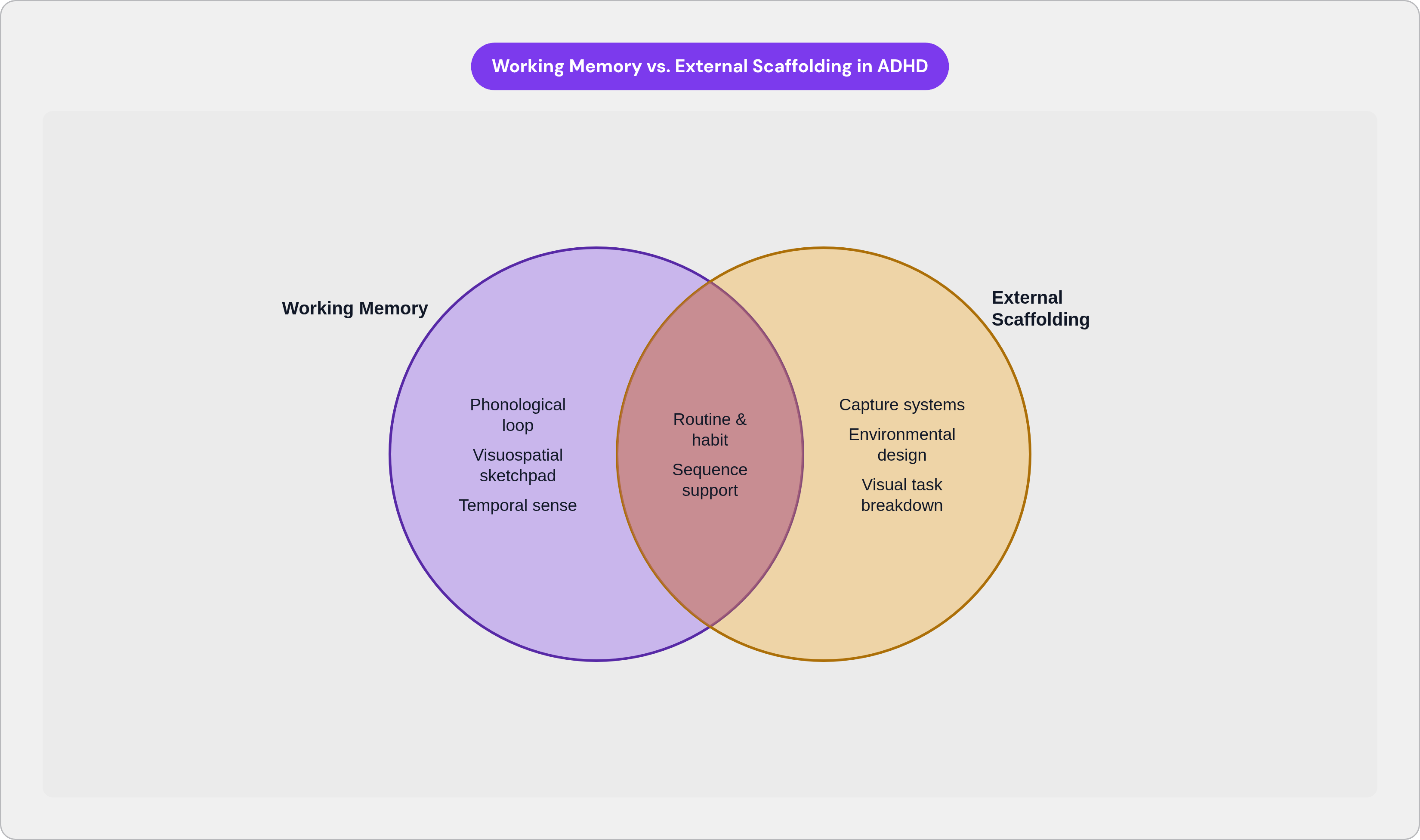
The system operates across at least two subsystems: a phonological loop for verbal and auditory information, and a visuospatial sketchpad for spatial layouts and visual sequences. Both depend on synchronized activation across multiple brain networks simultaneously. It is dynamic and effortful. Capacity varies across individuals under any conditions; in ADHD populations, it is consistently and significantly impaired, in ways that hold across presentations, genders, and IQ levels. It is not explained away by co-occurring conditions or subtype distinctions. That robustness is exactly what you would expect from a core mechanism rather than a secondary symptom.
Russell Barkley's framing cuts through a lot of noise here. He has argued for decades that ADHD is fundamentally a disorder of executive functioning and self-regulation rather than primarily of attention, and one of his central constructs, "temporal myopia," follows from that. The tendency for behavior to be governed by what is immediate and present rather than by future demands or consequences. Working memory is what holds the future steady long enough to act on it. When that system is impaired, the future collapses into abstraction. Plans and intentions exist somewhere, but they are not available at the moment of decision in any operative sense.
The problem is not that information fails to get in. It is that information fades before it can be used. But what if the real cost of that fading isn't just forgetting — what if it's that the brain never gets a chance to act on what it already knows?
How a Leaky Working Memory Produces the Specific Frustrations ADHDers Know by Name
No single statistic captures what a compromised working memory costs across a day. The better frame is recognition, and once you see the mechanism, the familiar failures stop looking like character defects.
Task paralysis is the most misunderstood. From the outside it looks like avoidance. From the inside it feels like standing in front of a locked door with no idea where the key is, or even whether there is a key. What is actually happening is that the steps required to begin a task cannot be assembled in sequence fast enough to initiate. The moment step two arrives in the workspace, step one has already faded. The task is not unknown; the sequence simply cannot be held together long enough to act on it.
Losing the thread mid-conversation works the same way. The thought was there, the phonological loop failed under load, the workspace refreshed, and it is gone. For the person experiencing it, it feels like chasing something that just vanished. For the person watching, it reads as inattention. Both interpretations are wrong in the same direction.
Time blindness operates through the same mechanism. Working memory is partly responsible for holding a sense of elapsed time and remaining time as a felt interval, not just an intellectual concept. When that function is impaired, an hour and five minutes can feel subjectively indistinguishable until the deadline arrives. This is why warnings like "we leave in ten minutes" produce no visible behavior change: those ten minutes are not being held as a meaningful operational interval.
Multi-step instructions collapse for a related reason. Each new step can overwrite the previous one before it has been executed. By step four, step two may simply be gone. Treating this as a listening failure causes real damage, because the intervention it implies is wrong.
Overwhelm from complex tasks is the aggregate of all of this. When you cannot hold the full architecture of a project simultaneously, the project presents as an undifferentiated mass. Every large task looks like a wall with no visible door, and the cognitive overhead of mentally assembling what needs to happen before anything can happen is itself exhausting. For a system already running at reduced capacity, that overhead may exceed what is available before the first action is taken.
Why Working Memory Impairment Also Undermines Inhibition, and What That Means for ADHD Behavior
The standard model treats attention and inhibition as the two primary ADHD deficits, with working memory as a downstream concern. I am less certain that hierarchy holds. That raises an important question: if working memory is doing more structural work than the standard model assumes, what does that mean for how we interpret ADHD behavior?
Working memory and inhibitory control are not parallel, independent systems. Working memory plays a directional role in inhibitory performance: it holds the rule, the plan, the anticipated consequence, long enough for inhibition to engage. A 2024 study from Florida State University raised explicit concern about interpreting inhibition task results in children with ADHD precisely because working memory deficits confound those results. Poor performance on inhibition tasks may reflect, in part, a working memory failure rather than a separable inhibitory deficit.
The practical implication is not subtle. Impulsive behavior in ADHD is also a problem of the knowledge that should engage the brakes failing to remain active at the moment it is needed — it is more than just a weak-brakes problem. ADHDers frequently know the right thing to do and still fail to do it. That pattern gets misread as willful defiance or moral indifference. More often it represents a working memory system that failed to keep relevant knowledge available at the decision point.
This reframes what effective intervention actually needs to target. Strategies addressing only attention or only impulsivity are working around the edges of the real bottleneck. If working memory is the mechanism through which consequences, plans, and rules become operative, then the bottleneck is upstream of the behavior itself.
What the Research Says About Improving Working Memory, and What It Can't Promise
Cognitive training in working memory produces measurable gains. Those gains are mostly near transfer: improvement in the trained task and closely related ones, not broad cognitive uplift that reliably changes daily functioning. The person gets better at the training; the training does not reliably improve the person's life in the way a general capacity increase would.
It is also worth considering a meaningful exception here. Training multiple cognitive processes simultaneously, rather than working memory in isolation, has shown reduced inattention symptoms in meta-analyses, including work by Cortese and colleagues in 2015 and more recent analysis through 2024. Multiprocess approaches appear to produce more generalizable benefits than single-domain training alone. That finding is real, but it should not be oversold.
Exercise is a genuine lever. A 2025 systematic review and Bayesian meta-analysis found dose-dependent effects of exercise on executive function in children with ADHD, including working memory. The effect requires consistency and sufficient volume. This is a "structured, regular exercise produces measurable benefit" finding, not a "some movement helps" finding. The distinction matters for whether someone actually builds the habit or treats it as optional.
What the research does not support is normalization. Working memory capacity in ADHD cannot be corrected to non-ADHD levels through any currently available intervention. Modest improvement at the margins is achievable. That conclusion redirects the productive question away from repair and toward design: "how do we build around it" rather than "how do we fix the workspace."
The Logic of External Scaffolding as a Working Memory Prosthetic
If the working memory workspace is unreliable, the most durable approach is to move as much cognitive work as possible outside the workspace entirely: into the environment, into written systems, into cues that do not require internal holding to function.
This is the underlying principle behind virtually every ADHD productivity strategy that holds up over time. The point is not willpower. The point is that the brain's internal scaffolding cannot be trusted to hold what it needs to hold at the moment it needs to hold it, so the scaffolding must live elsewhere.
Capture systems catch information before working memory drops it: voice notes, immediate written capture, brain dumps before the thought evaporates. The assumption is not that working memory will hold the idea until a convenient moment arrives. The assumption is that it probably won't, so capture is non-negotiable, not aspirational.
Sequence externalization makes multi-step processes visible so the brain does not have to hold the chain. Written checklists, habit stacks anchored to prior behaviors, visual task breakdowns. The sequence exists outside the brain, which means it does not compete for working memory capacity to survive.
Environmental design arranges physical and digital space so that the next step is obvious without retrieval. Night-before preparation, reduced friction at initiation points, objects placed where they will cue the behavior they belong to. The environment is doing the remembering.
Routine, understood in its proper function, is itself a working memory prosthetic. A well-practiced sequence runs on procedural memory rather than active working memory at each step. Procedural memory bypasses the executive function bottleneck that makes initiation expensive. This is why the same person who cannot reliably remember to take medication without a cue can drive a familiar route on autopilot while thinking about something else entirely. The procedural system is intact. The working memory-dependent system is what needs the support structure around it.
Practical Strategies That Work with a Limited Working Memory, Not Against It
Brain dump as relief valve. Before trying to work, offload every active thought: write, speak, or capture without triaging. The goal is not an organized list; it is to remove the cognitive cost of keeping unfinished thoughts alive in working memory while simultaneously trying to execute. Every item held in the workspace competes for capacity. Emptying it first makes more of the workspace available for actual work.
Breaking tasks into explicit, sequenced steps. The wall experience is not a motivation problem; it is a working memory assembly problem. Pre-broken milestones eliminate the requirement to assemble the full picture at the moment of initiation. Each step should be granular enough to execute without referencing anything else. "Work on the report" is not a step. "Open the document and write the first paragraph of section two" is.
Habit stacking to reduce initiation cost. Anchoring a new behavior to an existing, practiced one means working memory does not have to generate the cue; the previous habit generates it. Taking medication immediately after pouring morning coffee is a working memory design choice, not a lifestyle hack. The sequence is no longer a retrieval problem.
The night-before protocol. Morning is generally when executive function is most depleted, before stimulant medication peaks and before the day has generated any momentum. Decisions made the night before do not consume morning working memory. Laying out clothes, packing bags, writing the first concrete task of the following day: each removes a live variable from a workspace that will already be running close to capacity at the start.
Time blocking and visual structure. An open-ended to-do list requires working memory to continuously re-prioritize and decide what comes next. A time-blocked calendar externalizes that prioritization before the day begins. The "what now" question is answered before it needs to be asked.
Shorter working intervals. Intervals calibrated to realistic working memory duration, rather than idealized focus spans, match the task structure to actual capacity. Structured breaks allow the workspace to reset rather than degrade mid-task under accumulated interference.
Hydration and protein. Even mild dehydration, at approximately 1.59% body mass loss, has been shown to impair working memory and increase fatigue in adults. Protein-forward breakfasts, which CHADD recommends for morning attention support, reduce blood sugar volatility that competes for the same limited cognitive resources. These are not solutions. They are variables that remove unnecessary drag from a system already operating under constraint.
What Consistent Small Wins Do to a Working Memory-Limited Brain Over Time
External scaffolding is not a static workaround that the brain passively tolerates forever. Practiced sequences gradually shift from working memory-dependent to procedural, reducing cognitive load over time. The habit that required deliberate effort and active recall in week one runs more automatically in month three. This is not recovery of impaired working memory. It is the brain routing around the bottleneck through a different system, which is less inspiring-sounding but considerably more accurate.
Completed tasks matter disproportionately in this population. Completion triggers dopamine release, and that dopamine functions both as reward and as a momentum cue for the next action. Small, finished things generate forward motion in a way that large, complex goals organized around eventual completion cannot. A system built around achievable units is not lowering the bar; it is engineering the fuel.
The overbuilding trap is real and common. A twenty-step morning routine fights against ADHD executive function from day one; the system itself becomes the working memory load it was supposed to reduce. Fewer live variables means more capacity available for actual execution. Simplicity here is load management.
The all-or-nothing consistency failure is its own working memory problem. Holding a rule like "I must complete every step every day or the system has failed" is cognitive overhead that makes the entire structure fragile. Systems with built-in recovery, with explicit permission to skip a day and return without narrative, are more durable precisely because they do not require the brain to manage a failure story on top of everything else.
Understanding working memory as the mechanism changes the frame from "why can't I just do this" to "where is the actual bottleneck, and what is the smallest thing I can put there." That shift does not fix the underlying impairment. But it identifies where the leverage is, which turns out to be considerably more useful than the advice most people with ADHD have already received.