Free vs Paid ADHD Apps Value Comparison
Paid ADHD apps address neurological failure modes that free tools systematically exclude.
Describing executive dysfunction from the outside produces symptom lists. Experiencing it from the inside is closer to watching yourself fail to do something you want to do, with no coherent explanation for why.
Task initiation failure is the most misunderstood piece, and the most consequential for evaluating any productivity tool. It is not procrastination in the colloquial sense. It is opening a task management app, seeing a list of things you care about completing, and being unable to select one and begin. The decision cost of an open-ended list — where everything is nominally equal and nothing signals a starting point — burns through executive resources before a single task is touched. The list doesn't help. Sometimes it makes things worse.
Time blindness compounds this in ways a plain calendar cannot touch. There is no felt sense of duration, no internal pressure building toward a deadline until it is nearly upon you. A meeting at 3 p.m. exerts no gravitational pull until it is happening. Tasks expand to fill whatever space they are given, not from laziness but because the throttle that should be governing effort is unreliable. I have spent forty minutes on a task I estimated would take five, not because I was distracted, but because the part of the brain that was supposed to be tracking elapsed time simply wasn't.
Working memory drop-off means the task you intended to log evaporates between intention and input. Two navigation steps, a loading screen, a form field: these are not inconveniences but exit points. By the time the interface cooperates, the thought is gone.
A meta-analysis published in Nature and Science of Sleep found that more than 75% of individuals with ADHD experience significant sleep problems. The practical implication is underappreciated: most productivity systems are designed to be reviewed and initialized in the morning — precisely when ADHD executive function is at its most depleted. Any tool that demands meaningful cognitive effort to set up each day is already fighting the hardest hour.
These are not feature preferences. They are the specific failure modes that determine whether a tool survives its second week.
What Free Apps Actually Offer and Where Their Floors Are
Free apps are not useless, and framing them that way would be condescending to people who have made them work. The more honest assessment is that their limitations tend to fall exactly where ADHD users need the most support.
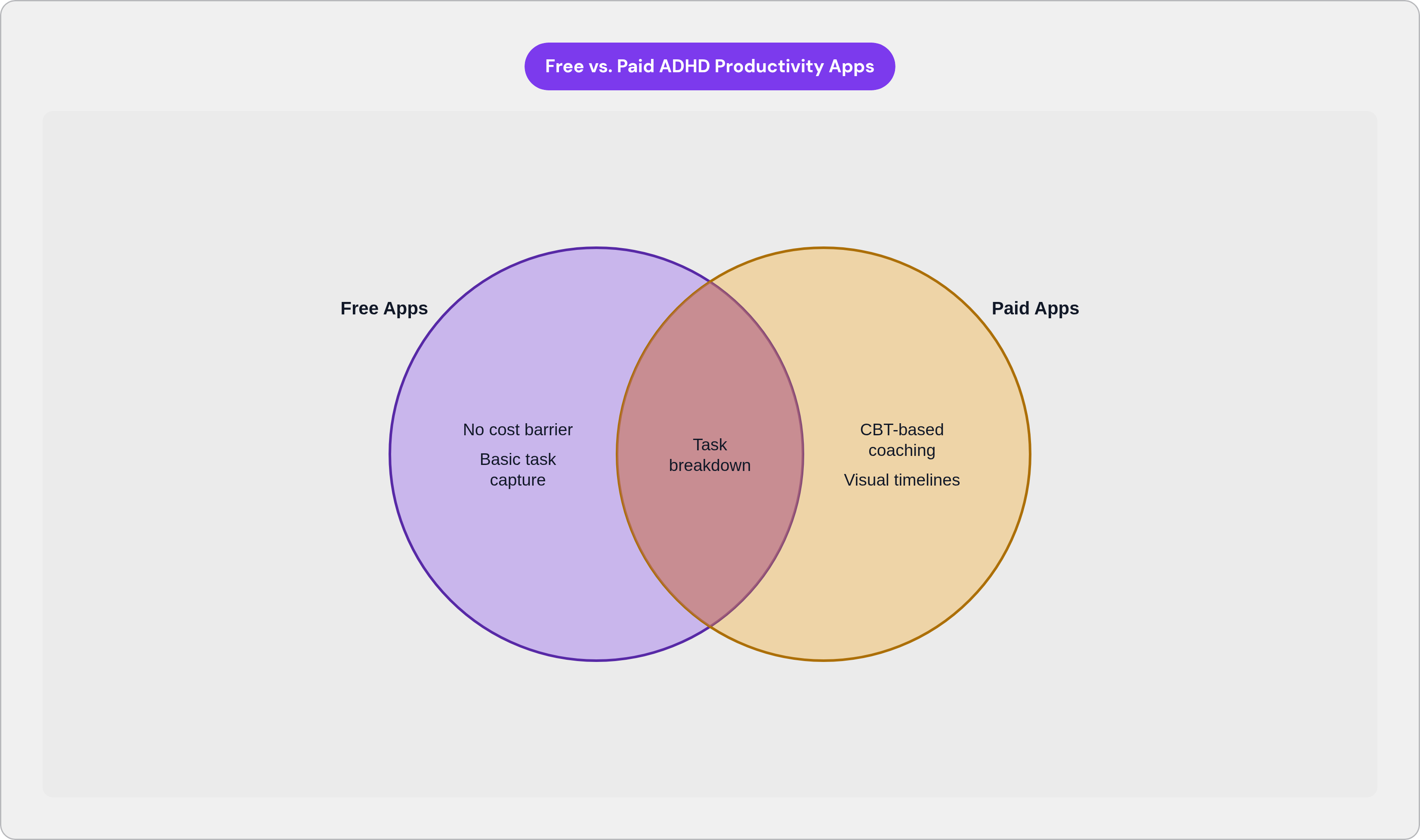
Habitica's free tier is fully functional for habits, dailies, and to-dos; its paid subscription adds cosmetics, not productivity architecture. Goblin Tools' Magic ToDo is free in any browser, requires no sign-up, and directly addresses task initiation by decomposing vague goals into concrete, sequenced steps. Todoist and Notion both offer usable free tiers for basic capture.
The problem is structural. Todoist tightened its free plan to five active projects in late 2025; reminders and calendar sync are locked to Pro. For a neurotypical user, reminders are a convenience. For an ADHD user, the notification layer is the external cue that substitutes for an internal sense of time and urgency. Paywalling reminders is not a minor limitation; it removes the scaffolding that makes the task list functional in the first place.
Customization that addresses time blindness, including visual timelines, color-coding, and audio cues, is routinely moved behind subscription walls. Coaching, CBT-informed lessons, and structured habit scaffolding appear only in paid tiers or paid-only applications entirely.
The floor of a free app is not simply fewer features — it is the systematic removal of the scaffolding that makes features usable for an executive-function-challenged brain. That is the comparison worth making.
The Three ADHD-Specific Mechanisms That Separate Sticking from Quitting
Across the apps that ADHD users report actually sustaining, three mechanisms appear consistently. Most free apps deliver one. Purpose-built paid apps are designed to deliver all three together.
Dopamine Loops and Immediate Reward Feedback
ADHD involves dysregulated dopamine signaling in the circuits responsible for motivation, attention, and reward. The consequence is not that tasks feel unimportant; it is that tasks without an immediate feedback signal feel functionally invisible. The intention exists. The neurological bridge between intention and initiation does not function reliably.
Gamification addresses this structurally. Points, experience points, levels, and visible progress indicators deliver the feedback signal in real time, not at some abstract future point of completion. Multiple peer-reviewed studies have found that gamified interventions improve ADHD productivity in controlled settings, with mechanisms including heightened engagement and measurably better time perception.
Self-Determination Theory offers a useful lens: extrinsic rewards, when paired with genuine competence cues, can be internalized over time. The point system is not a permanent crutch. It trains the behavior while intrinsic motivation develops.
Milestone Breakdowns That Prevent Paralysis
ADHD paralysis in the face of a large goal is not a motivational failure. It is an initiation failure caused by the inability to locate a starting point within an undifferentiated mass of steps. The goal is visible; the first concrete action is not.
Breaking a goal into sequenced, granular sub-tasks removes the initiation cost at each stage. Goblin Tools' Magic ToDo does this automatically, which is precisely why it works for ADHD users who cannot reliably perform that decomposition themselves when already under cognitive load. The 1-3-5 rule illustrates the underlying principle: replacing open-ended morning decision-making with a pre-set architecture that requires no executive resources to initialize. Behavior chaining, where completing one step signals the beginning of the next without requiring a separate decision, is how ADHD routines hold together across a full day.
Low-Friction Input That Survives Executive Depletion
Every additional step between "I need to do this" and "it is captured" is a place the ADHD brain exits the loop. A 2025 meta-analysis found that individuals with ADHD show significantly higher sensory sensitivity across multiple modalities; friction is not merely inconvenient but disproportionately costly at a neurological level.
Voice-first input removes typing, navigation, and form-filling — the specific friction points that cause task capture to fail when working memory is already strained. Todoist's Ramble feature accepts conversational voice input and converts it to organized tasks, reducing input friction without requiring the user to already be organized enough to use a structured form. There is a particular irony in productivity apps that demand organizational capacity as a prerequisite for use.
How Paid Apps Build Those Mechanisms Into Their Core Design
The paid apps worth examining are not general productivity tools with ADHD features added afterward. At their best, they are designed outward from the failure modes above.
Tiimo builds its interface around a visual timeline that makes the shape of a day perceivable rather than listed. Color-coding, duration visualization, and gentle audio cues address time blindness directly; the day becomes a spatial object rather than an abstract sequence of entries. It won Apple's iPhone App of the Year in 2025 and is available on a Pro plan at roughly $4.50 per month billed annually.
Inflow operates on a different premise: it is not primarily a task manager but a CBT-based psychoeducation platform. Bite-sized lessons paired with practical exercises address the cognitive patterns underlying ADHD symptoms rather than just the surface behavior of task management. Its monthly cost is positioned as an alternative to ADHD coaching, which typically runs $200 to $500 per month; whether that comparison holds up depends heavily on what a given user actually needs from coaching.
Motion eliminates scheduling decision fatigue by automatically placing and rescheduling tasks around your calendar. A missed task does not cascade into a broken system requiring manual reconstruction — the exact recovery cost that causes ADHD users to abandon a planner entirely after a difficult week.
Routinery is designed around sequenced routines with timers and audio cues. Its narrowness is a feature, not a limitation, for adults whose primary challenge is routine adherence rather than project management.
What these share is not a feature list. Each removes a decision or friction point at precisely the moment the ADHD brain is most likely to stall. That is the design principle.
Where Paid Apps Carry Real Risks for ADHD Users
Cost accumulation is the most visible risk. Inflow at $47.99, Tiimo at $6.99, and Focusmate at $10.99 together reach nearly $66 per month, approaching $800 per year. At that level, the financial commitment introduces its own anxiety, which is a real addition to cognitive load rather than a reduction.
Shame mechanics are subtler and more consequential. Habitica damages your character avatar for missed Dailies. The mechanic works for some users and triggers shame spirals in others. Punishment loops are a deliberate design choice, not an accident, and they are not universally safe for adults who already carry a disproportionate shame burden around productivity. I have watched people delete the app after a bad week rather than simply resume. The shame of missing three days felt worse than having no system at all.
Feature overwhelm deserves direct acknowledgment. A paid app with extensive onboarding, layered settings menus, and deep customization can generate more executive load at setup than it removes in operation. The comprehensiveness that justifies the price becomes the obstacle to starting.
Subscription commitment pressure is related but distinct. Paying for a tool makes abandoning it feel like a personal failure, compounding the shame ADHD users already associate with quitting systems. Abandoning tools is already a familiar and painful pattern; attaching a financial cost to it adds another layer of avoidance.
The relevant question is not whether a paid app has ADHD features. It is whether this specific app reduces or adds to the cognitive load you begin each day carrying.
A Practical Framework for Evaluating Any App Against What Your Brain Actually Needs
Start with the three mechanisms, not the price point.
Does the app deliver immediate feedback that substitutes for dopamine? A checkmark is not sufficient. Look for reward loops, visible progress, experience points, or some form of real-time signal the brain can register as a payoff before the task's actual outcome materializes.
Does the app break goals into steps automatically, or does that decomposition work fall to you? If it falls to you, the tool is assuming executive function you may not have available when you need it most.
How many steps separate "I need to do this" from "it is captured"? Count them. Then count them again at 7 a.m. on three hours of sleep.
Test free tiers honestly and precisely. Use the free version for two weeks, then identify exactly where you stopped using it. The exit point, the specific friction or missing feature that caused dropout, tells you which mechanism is absent. A free tool used consistently outperforms a paid tool used for nine days and abandoned.
Build a minimal stack. One tool for task capture, one for routine anchoring. Adding more multiplies the decision load of managing the system itself — the meta-work of maintaining a productivity stack can easily eclipse the work it was meant to support. Goblin Tools paired with a gamified habit tracker covers task breakdown and dopamine loops at zero cost. Upgrade only the layer you actually depend on.
Watch for the shame signal. If missing a day in the app makes you want to delete the app, the punishment mechanic is wrong for your brain. That is a design mismatch, not a personal failure. Recognizing the difference is part of using these tools well, and it took me longer than I would like to admit to learn it.