ADHD Time Management Tools and Gadgets
Understand which executive function gap you're facing to find tools that actually work.

Executive function is not a single capacity. It is a cluster of three distinct cognitive operations: inhibitory control, working memory, and cognitive flexibility. Knowing which one is failing in a given moment tells you which kind of tool you actually need, and conflating them is how most ADHD advice goes wrong before it starts.
Weak inhibitory control produces impulsive task-switching. A notification arrives, a tangential thought surfaces, and the original task is abandoned, not because the person stopped caring but because the mechanism that suppresses competing impulses is simply unreliable. Poor working memory means losing track of where you are in a sequence, forgetting how long something has been going on, or arriving at a task with no reliable sense of how much it will consume. Low cognitive flexibility makes transitions costly; the brain stalls between states and cannot shift gears without significant activation energy. These are not personality traits. They are measurable processing deficits.
Russell Barkley, among the most cited researchers in ADHD, frames the condition not as a disorder of knowing but of doing: a performance disorder that surfaces at the precise moment intention must convert into action across time. The person with ADHD frequently knows what needs to happen. What collapses is the bridge between that knowledge and execution. But what if the real problem isn't the knowing or the doing, but everything in between — the invisible architecture of time, sequence, and initiation that most people never have to think about?
These deficits do not resolve in adulthood, which is worth stating plainly because the cultural script still implies otherwise. According to a 2024 CDC study by Staley and colleagues, 15.5 million U.S. adults currently carry an ADHD diagnosis, with more than half receiving that diagnosis as adults. A substantial portion of the population spent years, sometimes decades, struggling without a framework to explain their difficulties, let alone tools designed around how they actually think.
That is the standard by which every tool discussed here should be evaluated: does it close a specific executive-function gap, or does it quietly assume the gap doesn't exist?
Why Generic Productivity Tools Fail ADHDers Before They Even Start
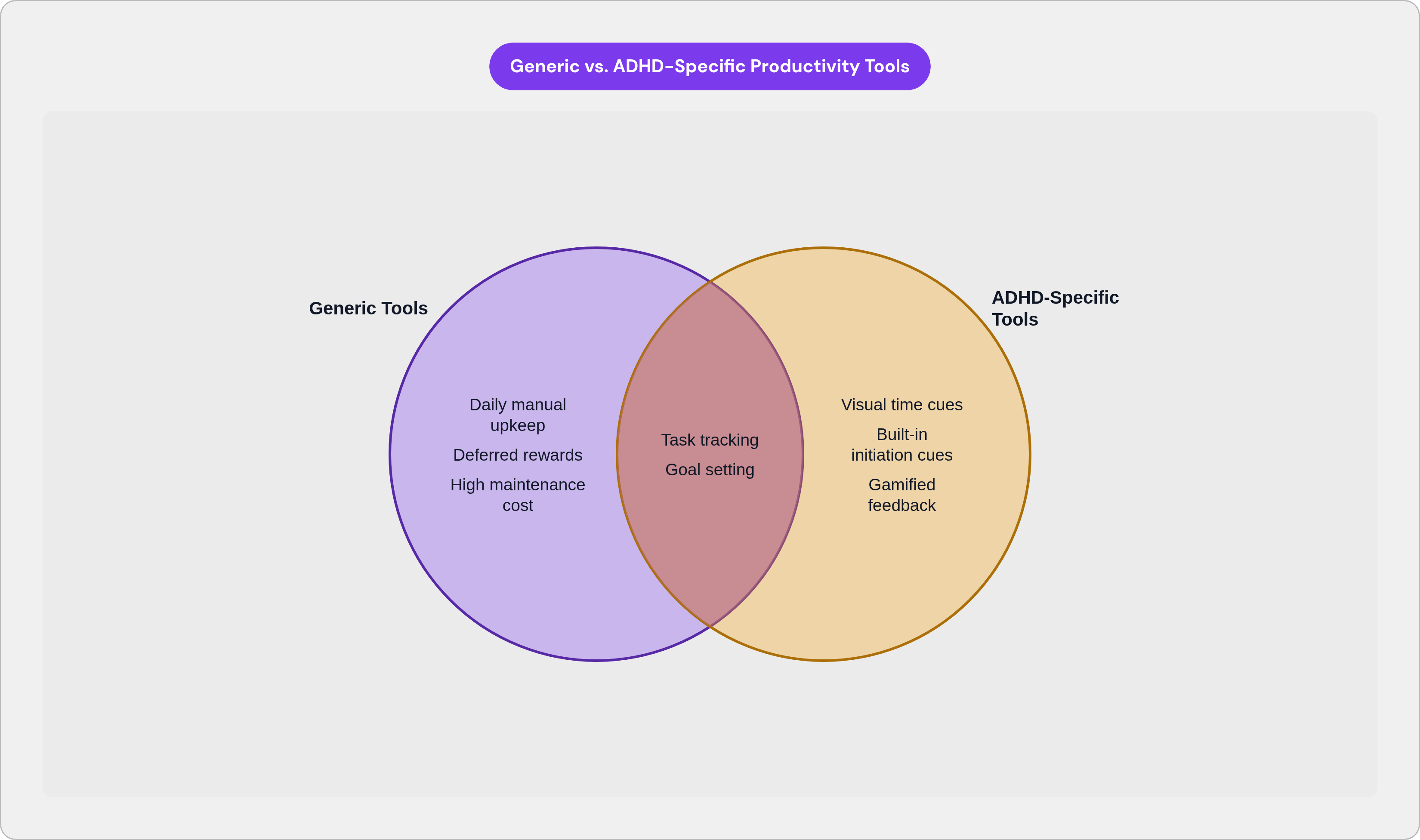
Standard productivity systems share assumptions so deeply embedded that their designers probably never articulated them: that the user can hold a plan in working memory across a full day, self-initiate without external cues, tolerate low-stimulation tasks long enough to finish them, and maintain a system requiring ongoing daily upkeep. These assumptions are, precisely, what executive dysfunction undermines. The mismatch is structural, not motivational.
The maintenance trap is particularly insidious. Any system requiring daily manual input, a habit log to fill in, a planner page to write, a dashboard to update, becomes yet another task to initiate. Because initiation is often the hardest part for ADHD, the tool designed to solve the problem becomes another source of avoidance. The planner gathers dust. The app sends notifications that go unread. The person concludes they are not a "systems person" and gives up.
That conclusion is wrong. The system failed not from lack of discipline but from a design mismatch. The irony is that tools marketed most aggressively toward productivity tend to carry the highest maintenance overhead — selecting against the very population that needs external scaffolding most. ADHD-specific design looks different in practice: time rendered visible and spatial rather than abstract, low entry cost with value delivered before significant setup is required, built-in cues rather than reliance on internal recall, and immediate feedback loops rather than deferred rewards.
The useful filter for any tool in this space: does it reduce the number of things the ADHD brain has to hold, decide, or initiate? Or does it quietly add to that list?
Making Time Visible: Tools That Solve the Time Blindness Problem Directly
Time blindness is a clinically recognized sub-symptom of ADHD describing an impaired ability to sense elapsed time and to estimate future duration. Its downstream effects are measurable: missed deadlines, chronic lateness, prioritization that ignores actual urgency, schedules that look reasonable at 9 a.m. and are unrecognizable by noon. Because it is a perceptual problem, its solutions need to be perceptual. The goal is to convert time from something abstract and invisible into something the eyes can track without the brain having to calculate.
The Time Timer does exactly this. Its patented red disk shrinks visibly as time elapses, so you can watch remaining time disappear rather than mentally estimate it. An internal cognitive demand becomes an external perceptual cue. It comes in desk, wall-mounted, and app formats, and that variety matters more than it might seem: the format requiring the least additional behavior to consult is the one that actually gets used.
Tiimo extends this principle into full-day planning. The app translates an abstract schedule into a color-coded visual timeline with icons and progress indicators, so "what comes next" stops being a question the user must hold in working memory and becomes something visible at a glance. Its pre-built routine templates for morning and wind-down directly address the paralysis that arrives when a system demands you construct structure before delivering any value. Tiimo won the iPhone App of the Year award in 2025, which signals mainstream reach, though what actually matters is the underlying design logic and whether it matches how a specific person's brain navigates time.
The Pomodoro Technique, timed work intervals separated by short breaks, is familiar enough to need no lengthy treatment. It is also worth considering whether the standard 25-minute interval actually fits a given person's attention profile. That number is an arbitrary default, not a neurologically determined optimum. The technique is most useful when the interval is treated as a variable rather than a rule.
How Dopamine Shapes ADHD Motivation and What Gamified Tools Do About It
The relationship between ADHD and dopamine is one of the better-supported findings in the field. fMRI research by Plichta and Scheres demonstrated reduced ventral striatal activation during reward anticipation in ADHD patients, meaning the neural circuitry that generates motivation in response to future rewards fires less reliably. The practical consequence is not a general absence of motivation but a specific deficit in motivation for tasks whose rewards are delayed, abstract, or small.
Researchers call this motivation inconsistency. The same person who cannot complete a ten-minute form will spend six hours building something in a video game. That gap is not laziness or selective effort. It is a dopamine system behaving exactly as it is built to behave: with strong engagement when rewards are immediate and concrete, with near silence when they are deferred. The inconsistency is the mechanism, not a character failing layered on top of it. To understand why this works, we need to look at what the brain is actually doing when it encounters a task with no visible, immediate payoff — and why engineering a substitute reward isn't a workaround so much as a neurological necessity.
Gamification works by engineering the immediate feedback loop that routine tasks inherently lack. Clear goals reduce planning paralysis. Visual progress indicators satisfy working memory's need to locate itself within a sequence. Experience points and rewards activate the dopamine response that motivates continuation. Multiple peer-reviewed studies have found that gamified interventions improved productivity in ADHD populations, though effect sizes vary and the strongest gains appear when gamification complements rather than replaces other interventions, including, for many people, medication.
Self-Determination Theory offers a useful long-term frame here: when external rewards are paired with competence cues, users tend to internalize the structure over time. One might argue that dependence on points and streaks is unsustainable — and that criticism is worth taking seriously. The answer is probably not indefinitely, and that is probably fine. The tool needs to carry the person through the period when intrinsic motivation alone is insufficient. After that, the calculus changes.
One calibration worth making explicit: a substantial majority of people with ADHD rate medication as their primary productivity support, with time-management apps accounting for a considerably smaller share of top-rated aids. Gamification tools are serious complements, not self-contained solutions, and any framing that implies otherwise is doing readers a disservice.
Gamified and AI-Powered Task Tools Worth Knowing About
Habitica turns a task list into a role-playing game. Completing real-world tasks advances an in-game character; failing to complete them has in-game consequences. That second element, meaningful downside, is something neurotypical productivity apps rarely include, and it turns out to matter. For a brain that needs stakes to generate engagement, the possibility of losing progress functions as an immediate motivational signal in a way that ambient guilt cannot.
Goblin Tools' Magic To-Do addresses a different failure point: task ambiguity. When a task is vague or feels overwhelming, the ADHD brain frequently cannot identify a concrete first step, and the absence of a clear entry point becomes a wall. Goblin Tools uses AI to break a loosely described task into specific, ordered next actions, including time estimates for each. The tool dissolves that condition by performing the decomposition the ADHD brain finds exhausting before it has even begun.
Morgen takes a different approach to the same underlying problem: executive-function overhead before work begins. It unifies calendar and task list into a single interface with AI-powered time blocking, connecting to a wide range of external tools including Google Calendar, Outlook, Notion, Todoist, and ClickUp. App-switching is a known ADHD attention trap; each transition is an opportunity for derailment. Morgen reduces those transitions by consolidating the scheduling decisions that typically drain executive function before any actual work starts.
The shared design logic across all three: they reduce the number of decisions the user must make before beginning. When evaluating any app in this category, one question is more predictive than any other. Does it require daily manual maintenance? If it does, most ADHD users will abandon it within weeks, not because they lack discipline but because the maintenance itself becomes another initiation task.
Physical and Sensory Tools That Change the Focus Environment
The environment is not a neutral backdrop for ADHD. It is an active participant. Designing the sensory environment is a form of externalizing regulation, moving the work from the prefrontal cortex into the surrounding space so the brain doesn't have to manage it all internally. This sounds abstract until you've spent a day noticing how many attentional failures trace back to something in the room rather than something in the mind.
Noise-canceling headphones address one of the most common focus disruptors: unpredictable auditory input. Unpredictability is often more disruptive than volume; a random voice carries more attentional pull than consistent background noise because the brain cannot habituate to what it cannot anticipate. Active noise cancellation removes that variability. Beyond the acoustic effect, headphones can serve as a behavioral marker, a physical signal that a focus state has begun. Some people find this ritualistic quality surprisingly reliable, even when the headphones aren't connected to anything.
White noise machines operate on similar logic but are particularly useful where headphones are impractical, or for sleep onset, which is an area where ADHD brains frequently struggle due to the same hyperactive cognitive patterns that complicate daytime focus.
Brain.fm occupies a more specific niche. Its AI-generated audio is designed to modulate brain state rather than entertain, a distinction that matters. A 2024 study published in Communications Biology found that music with fast amplitude modulation significantly improved performance on attention tasks, with the strongest benefit in participants with higher self-reported ADHD symptoms. Brain scans in that study showed activation in the salience network, sensorimotor regions, and executive control circuits. The mechanism appears to be entrainment of neural rhythms rather than mere distraction reduction, which is why the effect differs from listening to music you happen to enjoy.
Fidget tools are routinely dismissed, and they shouldn't be. For many ADHD brains, fidgeting is a regulation mechanism that frees attentional capacity for a primary task. The optimal fidget tool satisfies a sensory need without pulling visual attention away from the work or disrupting people nearby. The goal is not stillness. It is regulated engagement.
What to Do When You Can't Start at All: Tools for Task Paralysis
ADHD paralysis is not procrastination. Collapsing the two produces genuinely bad advice. Procrastination involves a weighing of options and, at some level, a choice. Paralysis is a freeze response that occurs even when the person actively wants to begin, triggered by overload, ambiguity, or the emotional weight attached to the task. Telling someone in that state to "just start" is roughly as useful as telling someone with a broken leg to walk it off.
The 5-minute timer rule addresses this by lowering the activation threshold. Committing to work for only five minutes converts an indefinite, emotionally weighted task into a short, bounded event. The cognitive cost of five minutes is low enough that the brain can agree to it, and once momentum exists, it often carries forward without the same energy expenditure to sustain it.
Micro-stepping operates on the same principle at the decomposition level. "Write the report" is an instruction that means nothing to a brain in paralysis. "Open the document" is. The step must be concrete, small enough that failing to complete it is nearly impossible, and specific enough that no further decision is required before acting. Goblin Tools automates this for tasks where the person can't identify how to break them down, which is often precisely the situation.
Body doubling deserves attention as a mechanism, not just a technique. Working alongside another person, in the same room or over a video call, even without direct collaboration, lowers the initiation threshold because the social context provides an external regulatory cue. A 2024 study confirmed that the mere presence of another person provides an ambient signal that supports initiation and follow-through in individuals with ADHD. Focusmate operationalizes this digitally, pairing users with a remote work partner for time-blocked sessions with brief check-ins at the start and end. But how does this affect our original promise of reducing executive-function load? The effect is not shame or obligation; it is a low-level environmental signal that the brain can latch onto when it cannot generate one internally. That is a different thing from accountability, and conflating them tends to push people toward punitive interpretations that miss the actual mechanism.
Brief physical movement belongs alongside these tools. Movement raises dopamine and norepinephrine acutely, reducing the neurochemical threshold for task initiation. It requires no setup, no subscription, no maintenance.
Building a Toolkit That Actually Sticks Over Time
The most predictable failure mode after reading something like this is adopting too many tools at once and collapsing under the weight of maintaining them. Over-adoption replicates exactly the pattern these tools are meant to prevent: too much, too ambiguous, nowhere to start. There is something almost comic about it, until you've watched it happen to yourself.
The implementation principle is unglamorous. Introduce one tool at a time, and attach it to a part of the day that already exists. Habit-stacking, pairing a new behavior with an established routine, reduces adoption overhead because the trigger already fires reliably. The new tool rides an existing groove rather than cutting a new one.
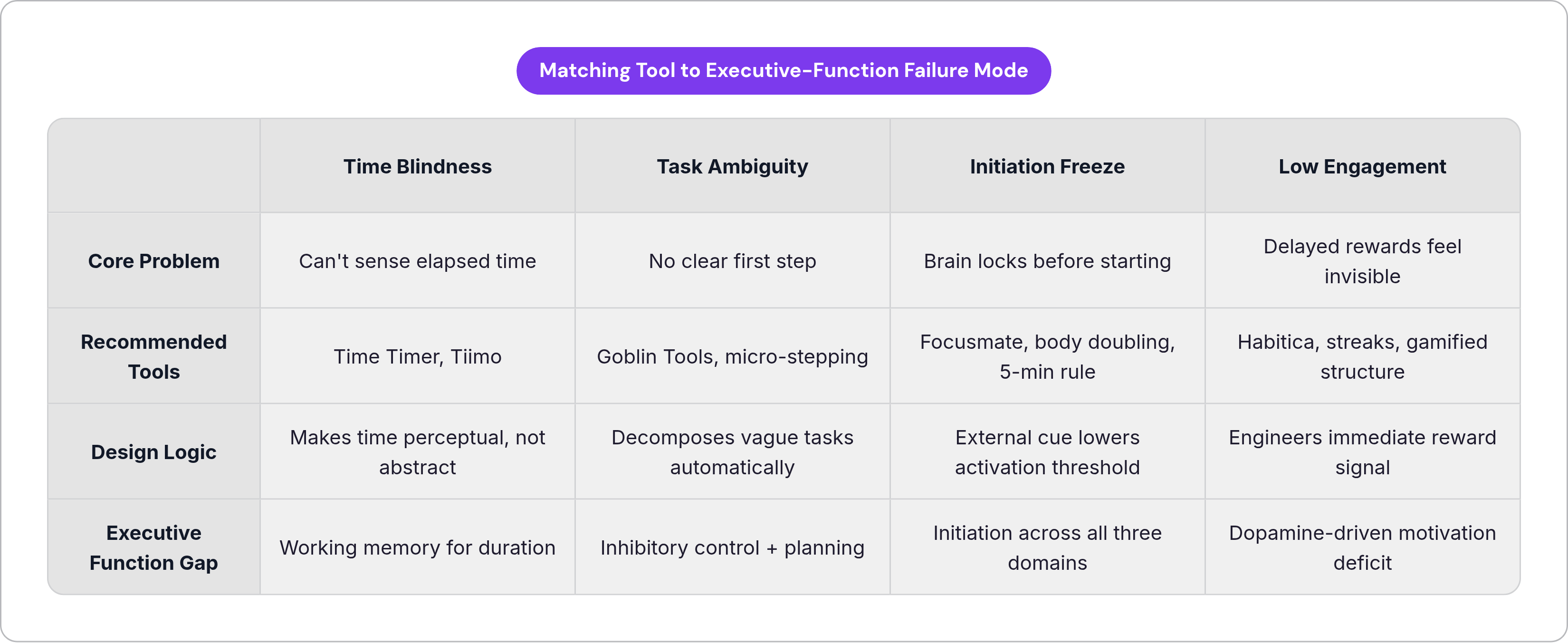
Matching tool to failure mode is more useful than attempting to build a comprehensive system. Time blindness calls for a visual timer or Tiimo. Task ambiguity calls for Goblin Tools or a micro-stepping approach. A distracting sensory environment calls for noise-canceling headphones or Brain.fm. Initiation freeze calls for body doubling, the 5-minute rule, or Focusmate. Difficulty with engagement and follow-through calls for a gamified structure built around streaks and earned rewards.
No single toolkit remains optimal indefinitely. ADHD needs shift by day, by season, by life circumstance. The goal is a flexible, personalized set of options rather than a fixed system demanding perfect adherence. What does accumulate, gradually and without much fanfare, is the neural association between a tool and a successful outcome. Each time a tool works, using it again becomes slightly less effortful. Small, consistent wins are not trivial. They are, as far as anyone can tell, how the scaffolding eventually starts to hold on its own.