Body Doubling Apps Compared
Research shows body doubling works for ADHD, but app design determines who benefits and how much.
Start with the uncomfortable part: no large-scale randomized controlled trial on body doubling for ADHD exists. Every efficacy claim in this space rests on smaller studies, self-report data, and behavioral proxies. That is not a reason to dismiss the evidence, but it is a reason to hold it carefully.
Eagle et al. (2024) conducted the first peer-reviewed academic study specifically on body doubling, surveying 220 neurodivergent participants. Approximately 85 percent reported significant improvements in task completion. The researchers described the mechanism as a "continuum of space/time and mutuality," which is a precise way of saying that shared presence, not shared goals or conversation, appears to be the operative variable. Self-report limits causal inference, but 220 participants pointing in the same direction is not a trivial signal.
Ara et al. (2025) tested something stranger and more instructive: a virtual AI body double, delivered through VR, to 12 adults with ADHD. Participants working alongside the AI completed tasks faster, reported greater perceived accuracy, and showed improved sustained attention compared to working alone. The AI condition performed nearly as well as the human condition. That finding has practical weight. It suggests that app-based and asynchronous formats are not simply a watered-down compromise; they appear to engage the same underlying mechanism. Robert Zajonc's Social Facilitation Theory (1965) anticipated something like this: mere presence, not meaningful social connection, raises physiological arousal and improves performance on well-practiced tasks.
Where things get murkier: controlled experiments from 2024 found no statistically significant performance improvement even when participants reported feeling more motivated. Researchers have also flagged that existing body-doubling tools "often suffer from rigid scheduling, lack of interaction, or limited customization," which frames the tool design problem as substantive, not cosmetic. The research is pointing toward a real effect that is not uniform, not guaranteed, and meaningfully shaped by how the format is delivered. That last point is what the rest of this piece is about.
The three structural formats that define the app category
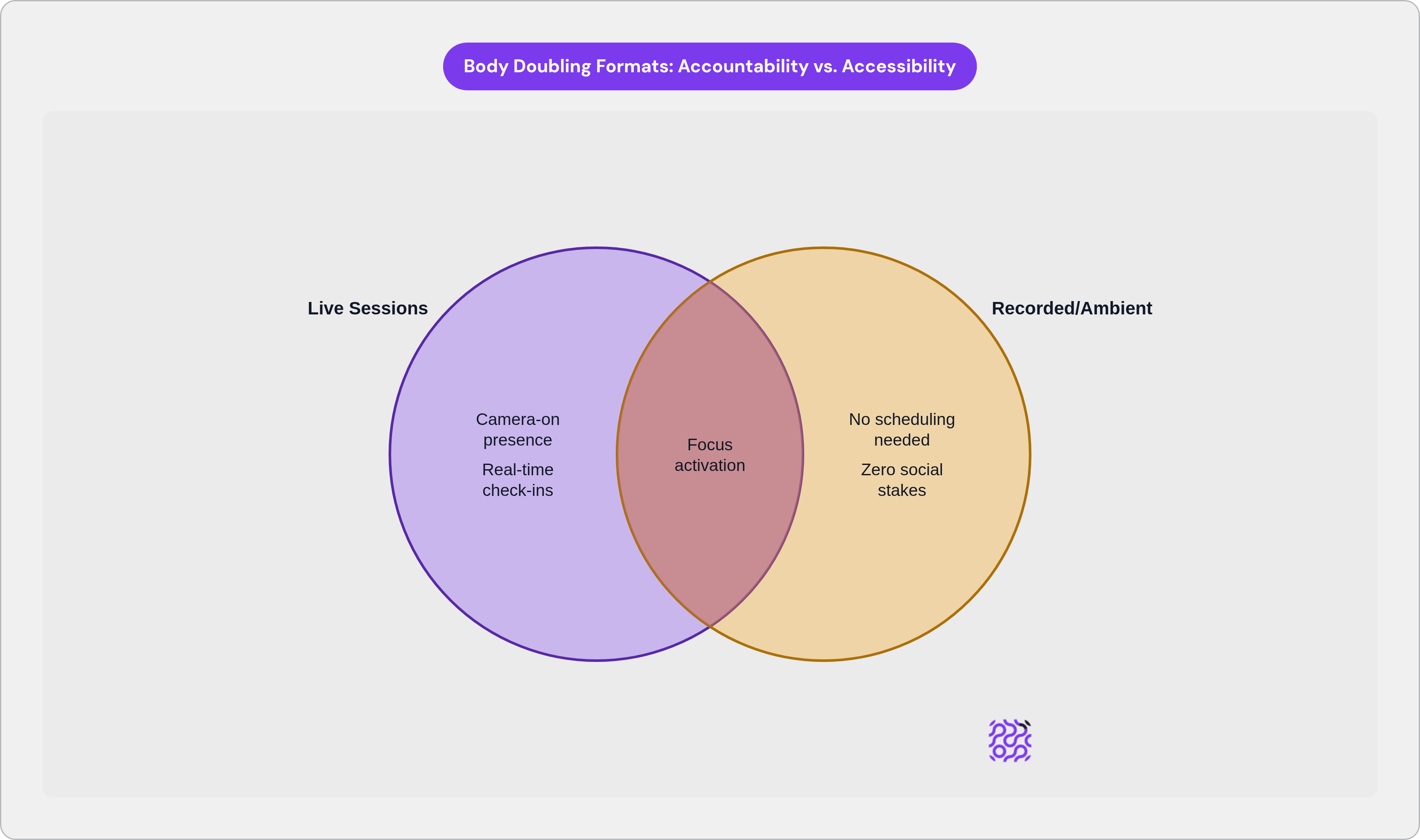
Three architectures have emerged, and the differences between them are not aesthetic. They determine who the tool works for.
The first is live one-to-one matching. One person is paired with one stranger for a timed block. You declare your goal, work, and check in at the end. Accountability is maximally concentrated; one specific person is waiting for you specifically. Diffusion of responsibility — the well-documented phenomenon in which individual accountability dilutes as group size increases — is structurally eliminated.
The second is live group rooms. A host and a small-to-medium group share a structured session. Nobody will personally notice if you quietly close the tab, but the social container of the room still provides external scaffolding. Session structure varies widely, from open co-working to facilitated Pomodoro sprints with goal-setting and debrief.
The third is recorded or ambient presence: pre-recorded video hosts, anonymous user-dots on a map, YouTube study-with-me videos. The social stakes are lowest. Nobody is waiting. The mechanism activates at lower intensity, which is either a feature or a problem depending on where a given user sits on the anxiety-productivity tradeoff.
Two secondary axes cut across all three. Session structure matters: open co-working produces a different experience than a facilitated methodology with precommitment and debrief. Community identity matters too: a general productivity crowd, an ADHD-specific community, and a student-heavy peer group each shape who shows up and what the room feels like. Platform also matters practically: browser-based and mobile-first tools are not interchangeable for anyone whose work life is fragmented across devices and locations.
Focusmate: the clearest case for 1:1 live accountability
Focusmate is the structurally simplest product in the category. You book a session, get matched with a stranger, turn on your camera, state your goal, work for 25, 50, or 75 minutes, and check in when the timer ends. Task modes accommodate different kinds of work. You can save partners you've worked well with and rebook them.
The accountability signal here is the most direct available. No group to disappear into, no facilitation layer, just one person who showed up and is waiting for you to do the same.
Pricing as of 2026: a free tier allows three sessions per week, which is enough to genuinely evaluate whether the format works for you. The Plus plan is $8 per month billed annually or $12 per month billed monthly.
User sentiment among ADHD users, remote workers, and students skews toward loyalty over time — the meaningful metric for a tool whose value compounds through consistency. The persistent friction points in user forums are no-shows and the formulaic opening ritual. No-shows are a structural risk of any stranger-matching system — a Focusmate-independent failure mode. But for someone who planned their morning around the accountability signal being reliable, one no-show is enough to derail the block. That is worth knowing before committing to the format.
Focusmate fits the person who wants the sharpest accountability signal with the least facilitation overhead. It does not fit the person who finds camera-on sessions with strangers anxiety-inducing, or who needs more structure or community than a timed pair provides.
FLOWN and Flow Club: how group session design changes who shows up and why
Both FLOWN and Flow Club run live facilitated group sessions. Their structural differences, though, produce meaningfully different experiences and attract different users.
FLOWN runs sessions of up to 60 participants. Flow Club caps at 10. That single design decision has downstream consequences for everything. A room of 60 allows a user to drop in and disappear into focus with minimal social exposure. A room of 10 is small enough that absence is noticeable, presence feels reciprocal, and the community dynamic is closer to a small recurring cohort than an anonymous crowd. Neither is superior; they serve different preferences.
FLOWN
FLOWN's sessions, called Flocks, are run by vetted, trained facilitators rather than community volunteers. That quality control produces a kind of consistency that matters more than it might initially seem: users encounter familiar faces over time, which builds ambient social continuity without requiring explicit relationship-building.
The scope extends beyond task completion. Breathwork, meditation, and planning workshops are integrated into the session catalog. FLOWN positions itself as a full focus practice rather than a productivity timer with cameras — a framing that either lands well or generates overhead depending on what a user needs. For someone who benefits from rituals around their work, the structure is the point. For someone who wants to get in, get to work, and get out, it may feel like friction.
Pricing as of 2025: $25 per month, or $19 per month billed annually. A 30-day free trial is available, and free Friday sessions are accessible without a paid plan.
Flow Club
Flow Club runs more than 2,000 sessions per week. Session variety is the product's genuine differentiator: Start Your Day sessions, weekly reviews, nighttime routines, phone-free sessions, and chat-only rooms for users who will not turn on a camera. That option is baked into the design rather than an unofficial workaround — a meaningful signal about who the product is built to accommodate.
Hosts are community volunteers, not vetted staff. A member can become a host after roughly 10 sessions. That model builds community investment, but session quality is structurally variable in a way FLOWN's model avoids. A user's experience depends partly on who is running that day's session.
Pricing as of July 2026: $33 to $40 per month at standard rates, making Flow Club the most expensive option in this comparison. A 50 percent discount is available for students and non-profit workers. Members who host a qualifying number of sessions can access a host discount of up to 50 percent, which is a real lever for engaged users willing to take on that role.
At full price without a discount, the cost is a genuine barrier to evaluate before committing.
Deepwrk: what an ADHD-specific community actually changes about the experience
Deepwrk is built explicitly for adults with ADHD. The distinguishing claim is not accountability in the abstract; it is accountability alongside people who share a specific cognitive experience and understand executive-function challenges from the inside rather than around them.
On most body-doubling platforms, community is incidental to the product. On Deepwrk, community is the product. Partner matching on Focusmate is random. Sessions on FLOWN include anyone who booked. Deepwrk's community identity is deliberate, and for users where that shared vocabulary matters, the difference is real. Describing why you spent 45 minutes deciding to start a task lands differently in a room where everyone in it has done the same thing.
Sessions integrate structured productivity methods directly: Pomodoro technique, timeboxing, precommitment, and monotasking are built into the session design rather than left to the user to impose on unstructured co-working time. That structure is closest to FLOWN's facilitation model, applied specifically to the task-initiation challenges characteristic of ADHD.
Pricing as of 2026: $19 per month or $12 per month billed annually. A seven-day free trial requires no credit card. There is no permanent free tier.
At $12 per month annually, Deepwrk sits below Flow Club at every price point and below Focusmate Plus only at the monthly rate. The value calculation, though, is not purely financial. The ADHD-specific framing that attracts one user will feel unnecessary or exclusionary to another. Someone who does not identify with the ADHD label, or who prefers not to center their neurology in a work context, may find the community identity a mismatch rather than a draw. That is a note about fit, not a flaw in the product's design.
dubbii: what the recorded-presence format offers, and where it stops working
dubbii was built by the team behind ADHD Love, and its design reflects that lineage. The app is phone-first, native on iOS and Android. Most competitors are browser-based. That is a structural choice worth taking seriously: a mobile-first tool lives where many ADHD users already spend fragmented time, rather than requiring a deliberate desktop work context that may not be available or sustainable.
The core format is pre-recorded video. Hosts Rich and Rox complete tasks on screen alongside you. The platform also includes live group sessions and quiet focus rooms, but the recorded presence is the distinctive feature and the clearest departure from every other product in this comparison.
The feature set targets specific ADHD barriers rather than generic productivity. Tasks are broken into micro-steps, which addresses initiation resistance at a finer grain than a 25-minute Pomodoro block. Scheduling nudges are available for one-off and recurring tasks. A PDA (Pathological Demand Avoidance) mode is included, which is rare in the category and consequential for a subset of users for whom structured demands create their own form of resistance.
Pricing as of 2026: a free version allows one task. The paid subscription is approximately $4.99 per month or $29.99 per year, the lowest paid price point in this comparison.
The structural limitation is direct: a recorded video is presence without accountability. Nobody is watching to see whether you stayed at the desk. For users whose active ingredient is the social consequence of being observed, the recorded format will not replicate what a live one-to-one session provides. That is a constraint built into the format, not a deficiency in dubbii's execution.
For users where the opposite holds — where the social stakes of a live camera session generate enough anxiety to prevent starting at all — removing those stakes is the feature. dubbii is designed for that group, and the micro-step structure and PDA mode suggest the designers understand exactly who they are building for.
Free and low-cost options for readers who want to try the format before paying for it
StudyStream
StudyStream runs 24/7 live video rooms: cameras on, microphones off. The experience most closely resembles working in a library, a room of people visibly present and working, without conversation or social obligation. The platform was built by Cambridge and King's College London graduates, passed through Y Combinator in 2021, raised approximately $2.1 million, and reports having reached 4 million students alongside a Discord community of 450,000 members.
A free tier is available with some session-length limits. Premium access is approximately $10 per month. The user base skews toward students. That is relevant: peer identity shapes the texture of the room, and whether a student-heavy community feels motivating or mismatched depends on the individual.
FocusLive
FocusLive is zero overhead. No camera, no scheduling, no social interaction. Users appear as an anonymous dot on a 3D globe alongside other people currently working. The entire feature is the ambient awareness that real people are working right now. It is fully free and requires no account commitment.
For a reader who finds cameras, strangers, and scheduling to be the actual barriers preventing them from testing the format at all, FocusLive is the most defensible first step.
Discord body-doubling communities
Informal Discord servers with voice rooms, structured sprints, or camera-on video exist across a range of communities. Format and quality vary entirely by server. The strongest communities tend to be organized around a specific type of work or shared identity, which provides both consistency and social coherence. There is no cost; the barrier is finding the right community rather than paying for it.
YouTube and the ambient presence floor
YouTube study-with-me videos represent the lowest barrier in the category. Free, available at any hour, requiring nothing of the viewer. They carry a modest version of the social facilitation effect, enough for some users, not enough for others. They will not provide accountability; nobody is watching whether you close the tab. For a user who simply needs the felt sense of company to activate focus, they can be sufficient. Given that the social cost is zero, they are the obvious place to start before evaluating anything else.
The spectrum from a YouTube video to a live one-to-one session is genuinely wide. Somewhere on it is the right amount of social friction for a given person's nervous system. The research cannot locate that point for any individual. That is still work the person has to do themselves, through use rather than analysis.