Pomodoro Technique Variations for ADHD
The standard Pomodoro timer doesn't match how ADHD brains actually focus—here's how to redesign it.

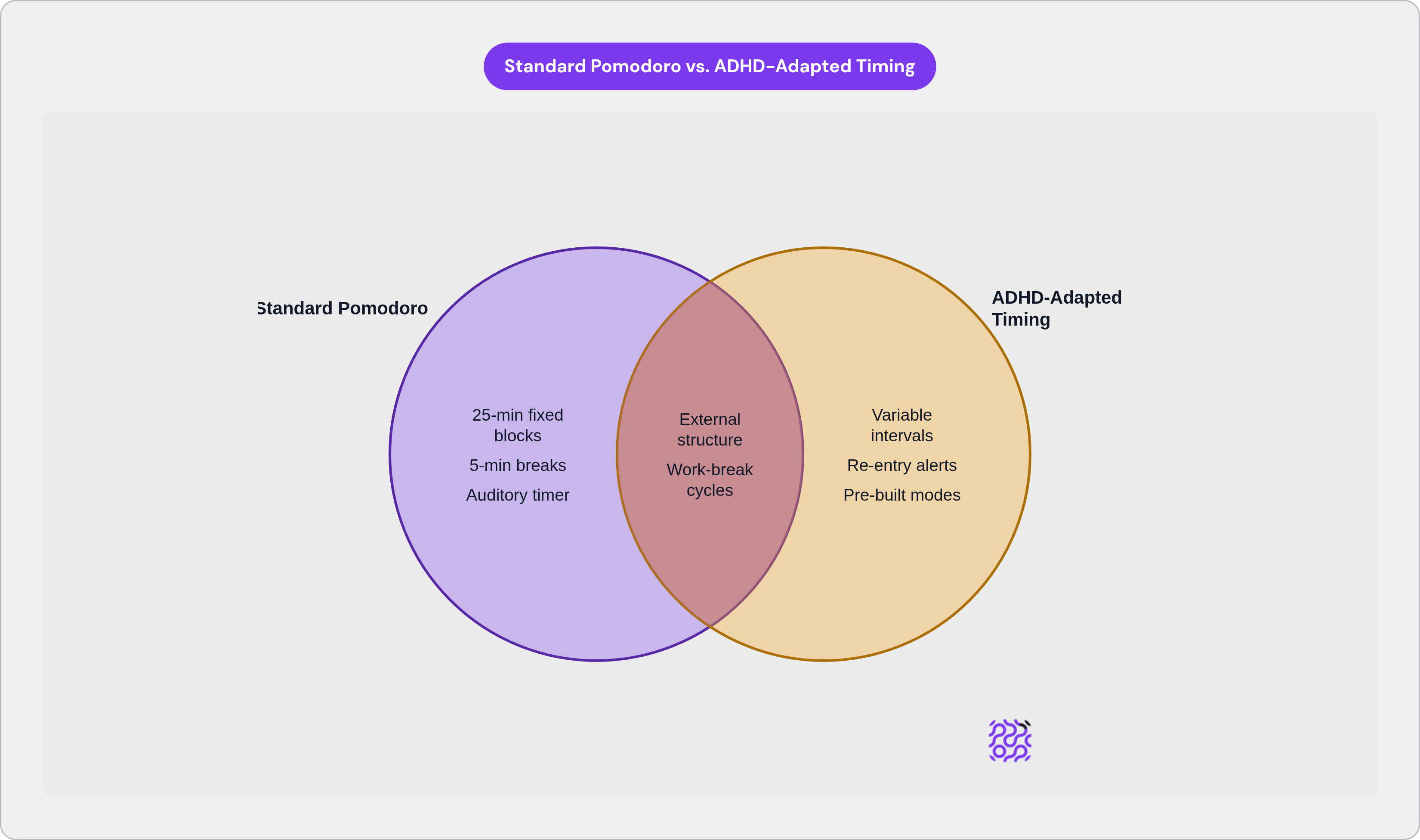
Francesco Cirillo developed the technique in the late 1980s, naming it after a tomato-shaped kitchen timer he used as a university student. The structure is deliberately spare: 25 minutes of focused work, a 5-minute break, repeated; after four cycles, a longer break of 15 to 30 minutes.
The underlying logic holds up, at least on paper. External time boundaries reduce the cognitive overhead of deciding when to start and when to stop. A ticking clock substitutes for internal motivation — something neurotypical adults generate reliably enough but that is structurally unreliable for ADHD brains. Breaking a large task into a series of short, bounded commitments lowers the perceived cost of beginning, and the planned break offers a reset before attention fully depletes.
For ADHD specifically, this architecture has documented appeal. External time tools and structured work-and-break cycles appear in ADHD-focused clinical literature as targeted interventions for time blindness and task initiation difficulty, including in Stanford guidance on managing ADHD-related time perception problems, as cited by Life Skills Advocate. The scaffold, in principle, fits the problem. The specific dimensions of that scaffold are where the trouble starts, and it took me longer than I'd like to admit to see why.
How ADHD Attention Actually Works, and Why It Doesn't Fit a 25-Minute Window
Dr. Russell Barkley coined "time blindness" to describe something more precise than poor scheduling: a temporal myopia in which the farther a deadline sits in time, the less neurologically real it feels. Dopamine dysregulation disrupts accurate time estimation at a systems level, not as a character flaw but as a structural feature of how the ADHD brain processes future-oriented information.
Executive dysfunction reshapes the attention curve in a way the standard Pomodoro ignores entirely. Many ADHD brains require 20 to 40 minutes just to reach deep focus, working through internal resistance before settling into concentration. A 25-minute block cuts the session at precisely the moment deep work is beginning. The person who finally arrives at focus finds the timer ending.
Hyperfocus runs the opposite direction. ADHD brains often struggle to initiate, then lock in with unusual intensity once engaged. A forced break at an arbitrary interval interrupts a cognitive state that took significant effort to reach. The standard technique treats all attention states as functionally interchangeable; they are not.
Timer anxiety is a failure mode that productivity literature rarely addresses with any seriousness. For a meaningful subset of ADHD users, a visible countdown doesn't create structure; it creates surveillance. Attention migrates to the clock and away from the task — an outcome arising not from distraction in the ordinary sense but from the very tool designed to prevent it.
Break derailment may be the most practically destructive issue of all. Many adults with ADHD report that once a break begins, re-entry simply doesn't happen. The five-minute break becomes a scroll, a snack, a conversation, then an hour. A 2025 ADDitude survey of 1,859 adults with ADHD found that 56.59% named procrastinating on important tasks as their single most common problem — which means that re-entry failure is hardly incidental. A method that repeatedly collapses at re-entry trains avoidance as surely as it trains focus.
Each of these failure modes is survivable in isolation. In combination, they aren't. So if the standard format consistently undermines the people it most appeals to, what does a better-fitted version look like?
Short-Interval Pomodoro (10 to 15 Minutes) for Low-Activation and Aversive Tasks
The logic is direct. If 25 minutes feels too large to start, reduce the commitment until it doesn't. Ten to fifteen minutes clears that bar for most people, and with nothing large enough to negotiate against, there is nothing left to negotiate.
The structure: 10 to 15 minutes on, 5 minutes off. More frequent breaks are a feature here, not a concession to weakness. ADHD brains generally require positive reinforcement more frequently than standard productivity frameworks assume; each completed block is a small, real win. Accumulating those wins within a single session sustains engagement better than one long block with a single payoff at the end. Klarity Health explicitly recommends this format for low-medication periods and task initiation difficulty.
Best-fit contexts include aversive tasks with no inherent interest, early morning before medication reaches full effect, and the first task of any day when activation cost is highest. These are precisely the moments when a standard 25-minute block produces the most staring at a blank screen.
One nuance worth naming: short-interval Pomodoro is a launch pad, not a permanent operating mode. Once started, some ADHD brains extend naturally into longer focus without any prompting. Imperfect momentum is categorically better than paralysis.
Extended Intervals (45 to 60 Minutes) for Creative Work and Hyperfocus-Prone Sessions
If the 25-minute block ends before focus has fully arrived, the solution is a block long enough to make the ramp-up worthwhile. A 45 to 60-minute interval clears the 20-to-40-minute activation window and provides genuine working time on the other side of it. FlowSpace Focus notes that most ADHD adults perform better within 45 to 60-minute work blocks, and PsychCentral observes that the standard 25-minute interval may be insufficient for people who require a longer runway into concentration.
Hyperfocus adds a specific design consideration. Klarity Health recommends scheduling longer sessions of 60 to 90 minutes when hyperfocus is anticipated, paired with a gentle transition alert five minutes before the break. An abrupt timer ending is experienced very differently from a five-minute warning. The brain receives a signal that a break is approaching, rather than a sudden interruption of state.
Best-fit contexts are creative work, high-interest projects, afternoon peak-performance windows, and tasks requiring genuine depth. Break length should scale accordingly — 10 to 15 minutes rather than five — and the same five-minute warning principle applies in reverse at break's end. A brief signal that work is resuming is meaningfully easier to act on than a cold start.
Variable-Interval Approaches That Eliminate In-Session Decision Fatigue
Telling an ADHD brain to "adjust the timer as needed" creates a new open-ended executive decision inside every session. Open-ended executive demands are precisely the mechanism through which ADHD-related paralysis operates. Raw flexibility is a trap here, not a feature.
The practical answer is pre-built modes, decided in advance during a calm moment. Three is a workable number. An admin or aversive-task mode: 10 to 15 minutes on, 5 off. A standard work mode: 20 to 25 minutes on, 5 off. A deep-focus mode: 45 to 60 minutes on, 10 to 15 off. AcademyNC describes this approach as choosing from options with a known track record rather than constructing a system from scratch at the moment of highest cognitive friction. I have found, more than once, that the act of choosing between three named options is the difference between starting a session and abandoning it before it begins.
Timer framing belongs here too. FocusBreaks recommends treating the timer as a gentle check-in rather than a hard stop. Repositioning the countdown from a deadline to a prompt directly addresses timer anxiety and changes the psychological relationship to the break that follows.
A secondary benefit of pre-labeled modes is low-effort self-monitoring. Noticing which mode you reach for on a given day is a rough but useful signal of where your energy actually is, with no formal tracking system required.
The Flowtime Technique as an Alternative to Interval-Based Timing
Zoe Read-Bivens developed Flowtime in 2016 as a direct response to Pomodoro's interruption of flow states. The mechanics differ in kind, not just degree. Work until concentration naturally wanes; then break for roughly one-fifth of the preceding work session: 30 minutes of work yields a 6-minute break, 90 minutes yields 18. No fixed intervals, no externally imposed stopping points.
For certain ADHD profiles, this is the better fit. The pattern of difficult initiation followed by extraordinary depth once engaged is accommodated rather than fought. Flowtime rides the wave of hyperfocus instead of severing it.
A 2025 study from Maastricht University (Smits, Wenzel & de Bruin, n=94 university students) offers a relevant data point. Flowtime showed a gradual increase in fatigue comparable to self-regulated methods, while Pomodoro produced a faster rate of fatigue increase after breaks. The study did not recruit participants with ADHD, and the two-hour session length may have been too brief to surface larger differences between conditions, so the finding is suggestive rather than settled.
The critical caveat for ADHD users is this: Flowtime's vulnerability is its self-monitoring requirement. Without the external scaffolding of a fixed timer, an ADHD brain can lose track of time entirely, not from distraction but because time blindness is structural. Gentle periodic check-in reminders are essential for Flowtime to function in this population; they are what makes the whole thing work. Flowtime is a different tool suited to a different problem profile. When that distinction gets ignored, it fails the same people it was designed to help.
What the Research Actually Says About Structured Breaks Versus Self-Directed Timing
A 2025 Springer scoping review examined 32 studies across six databases. Time-structured Pomodoro interventions showed 15 to 25% increases in self-rated focus and roughly 20% reductions in mental fatigue in quasi-experimental studies, with 88% of studies reviewed reporting positive outcomes. That is a meaningful evidence base.
The population problem, however, is hard to paper over. These studies draw from general samples. ADHD-specific participants are largely absent. Extrapolating from neurotypical productivity research to ADHD clinical guidance is a reasonable starting point — but it is not the same as direct evidence, and conflating the two does real harm to people trying to build systems that actually work for them.
The Maastricht study's finding that overall productivity and motivation did not differ significantly across Pomodoro, Flowtime, and self-regulated conditions is solid. No single format reliably dominates. The fatigue-rate difference for Pomodoro is suggestive but not definitive, particularly given the population and duration constraints already noted.
What the evidence supports: external time structure helps; the specific interval matters less than using some structure; individual variation is large enough that no universal prescription holds. What remains unresolved is significant. No large-scale randomized controlled trial has compared Pomodoro variations specifically in adults with ADHD. Most ADHD-specific guidance extrapolates from general productivity research and clinical observation, and deserves to be read as such. Personal experimentation, in the face of these gaps, is not a workaround. It is the method.
Practical Rules for Building a Pomodoro System That Sticks with an ADHD Brain
Choose the interval before sitting down to work. Pre-commitment at the task-planning stage removes one live decision from the session itself, and that reduction in decision load carries a real cognitive cost for a brain that pays full price for each one.
Timer type matters more than it sounds. Silent visual timers, the time-timer style with a shrinking color field or a simple progress bar, reduce countdown anxiety. Aggressive auditory alarms that spike cortisol at the end of a block undermine the re-entry process they're supposed to prompt.
Build re-entry into the break itself. A second alert set two minutes before the break ends gives the brain time to identify exactly what it will do when work resumes, rather than time to decide whether to start. That two-minute window is the difference between returning to work and still negotiating with yourself ten minutes later.
Treat the first Pomodoro of any day as activation, not production. Even if very little gets done in that first block, beginning is the win. Holding the first interval to a different standard removes the psychological penalty that turns incomplete blocks into evidence for avoidance.
Positive reinforcement is structural, not motivational theater. AcademyNC notes that ADHD brains require more frequent reinforcement than neurotypical productivity frameworks assume. Logging completed blocks visibly, a paper tally, a checkbox, an app streak, provides the dopamine feedback the system depends on.
Adjust intervals by energy signal. If a 45-minute block consistently fails to produce re-entry, drop to 15-minute mode. Using that variation is calibration, not retreat.
Consistent background audio during work blocks, brown noise or lo-fi music without lyrics, helps some ADHD users sustain focus across longer intervals by reducing the attentional salience of environmental interruptions. Low cost, worth testing.
Any interval that consistently produces failed re-entry or repeated restarts is wrong for that task, and that's worth knowing. The goal isn't to find the correct version of Pomodoro and refine it over time. The goal is to find what actually gets you working, on this task, today — and then adjust it the next time you learn something new. That iteration is the system.