ADHD-Friendly Productivity Systems Compared
ADHD is, at its operational core, a disorder of executive function: the cluster of cognitive capacities governing planning, initiation, organization, monitoring, and sustained goal-directed behavior. Every major productivity system is, in essence, an executive function prosthetic. The question that actually matters is whether the prosthetic fits the deficit, or whether it was designed for a brain that doesn't have one.
Four impairments matter most when evaluating any productivity system against an ADHD brain, and I want to be specific about them, because the generic framing of ADHD as "difficulty focusing" obscures the mechanisms that actually make or break a system.
Working memory impairment means the brain cannot reliably hold a multi-step plan in mind while executing step one. The plan doesn't simply fade; it vanishes mid-execution, often without the person noticing it has gone. Systems that depend on the user remembering what comes next, without external prompting, are building on sand.
Task initiation paralysis is distinct from procrastination in the colloquial sense. The prefrontal cortex, which in ADHD brains shows measurably different activation patterns, struggles to generate the neurological ignition signal that converts intention into action. The task is fully understood; the intention is real; the action does not begin. This distinction matters enormously when evaluating a system, because a tool that organizes tasks beautifully but provides no initiation support has solved the wrong problem.
Inconsistent executive function is perhaps the most frustrating feature of ADHD for anyone attempting to use any system at all. Capacity is not stable across days, or even hours. A system that worked on Tuesday may be entirely inaccessible on Wednesday, for reasons that have nothing to do with effort or commitment. Rigid, prescriptive systems fail not because the person abandoned them, but because the system had no tolerance for the brain's natural fluctuation.
Time blindness means time does not feel the way a clock describes it. An hour passes with the subjective sensation of ten minutes. Deadlines that are not immediately visible carry almost no motivational weight because the future feels abstract rather than approaching. Planning tools that represent time only as numbers do not help; the numbers carry no felt urgency.
Underlying all of this is the dopamine system. ADHD brains have fewer dopamine receptors and less efficient dopamine transport, which means they require more stimulation to reach the motivational baseline that neurotypical brains access naturally. A system offering a single reward at the end of a long task is, neurochemically, asking the ADHD brain to run a marathon on caloric intake designed for a sprint.
Two complications deserve separate attention. Hyperfocus is often misunderstood as evidence that ADHD is not real; it is actually its own form of dysregulation. A 2025 study by Oroian et al. in European Psychiatry found that roughly 30% of individuals with ADHD experienced heightened productivity during hyperfocus episodes in flexible work environments, but consistently at the cost of neglected responsibilities elsewhere. Hyperfocus arrives unbidden and cannot be scheduled, which means any productivity system that fails to accommodate it will be repeatedly derailed by it.
The burnout pathways from ADHD are also more differentiated than commonly recognized. Research published in AIMS Public Health by Turjeman-Levi et al. in 2024 found that poor time management specifically predicted physical fatigue, while disorganization specifically predicted emotional exhaustion: two distinct deficits producing two distinct forms of depletion. Andreassen et al. (2016) documented how undiagnosed adults sometimes become workaholics, cycling through procrastination, perfectionism, and impulsive overcommitment in a pattern that generates chronic overwork rather than real output. The compensation strategies can be as costly as the condition itself.
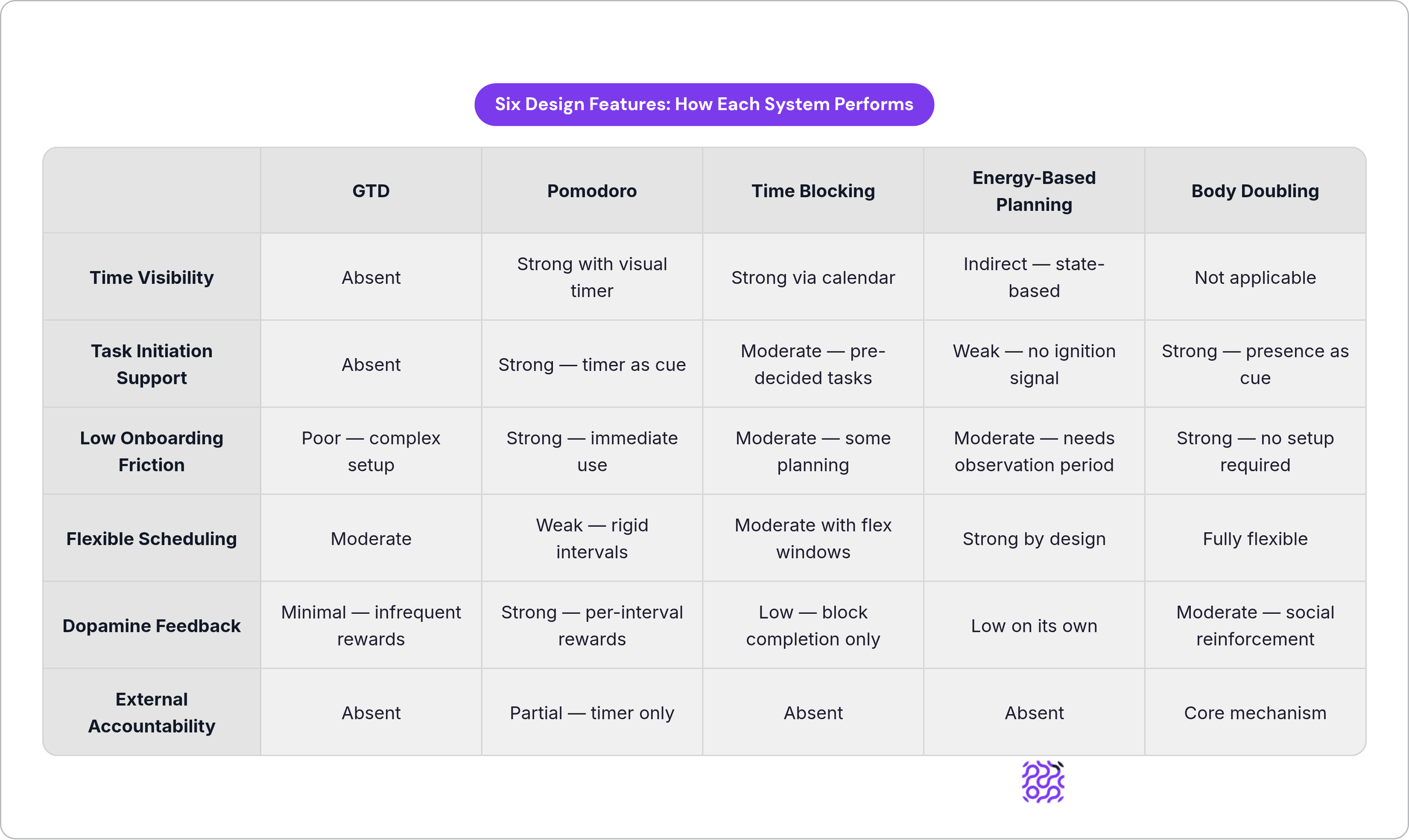
The Six Design Features That Separate ADHD-Compatible Systems from Ones That Assume a Neurotypical Brain
What follows is not a scoring rubric. It is closer to a diagnostic lens, a set of questions to ask before committing to a system. Some of these features will matter more than others depending on where a particular brain struggles most, and on a particular day. That caveat is not a hedge; it is the point.
Time visibility means representing time as a perceptual, visual phenomenon rather than an abstract number. A countdown clock that shrinks as time passes does what a digital display cannot: it makes the passage of time felt rather than merely read.
Task initiation support addresses the gap between intention and action with external cues, structured starts, or social triggers. Breaking tasks into smaller subtasks is often recommended here, but that recommendation has real limits. Subtasks still require self-generated motivation to begin. The initiation deficit is not primarily about task size; it is about the ignition signal.
Low onboarding friction matters because every additional configuration step is a potential dropout point. A system that requires an hour of setup will, for many ADHD users, never actually be used. The setup itself becomes the task that never gets started.
Flexible rather than rigid scheduling means the system can absorb a hyperfocus overrun or a failed initiation without collapsing. In a rigid schedule, one missed block invalidates everything that follows. That cascading failure is not a minor inconvenience for an ADHD brain; it frequently triggers a full shutdown for the remainder of the day.
Dopamine feedback requires frequent, small rewards distributed across a work session, not a single payoff at the end. The ADHD brain's motivational circuitry runs on regular, proximate reinforcement.
External accountability structures replace or supplement missing internal executive function with social or technological scaffolding. Another person's presence, a check-in commitment, a visible timer: these function as borrowed regulation.
No single system scores well across all six. The useful question is which gaps matter most for a specific brain, and which failures a person can tolerate and which they cannot. One broader observation: ADHD brains need more structure than neurotypical brains, but the structure must be responsive rather than prescriptive, built to meet the brain where it actually is rather than where a planner assumes it will be.
Getting Things Done: Powerful Capture Tool, Fragile Review System
David Allen's Getting Things Done operates on a single, elegant premise: remove everything from your head and place it in a trusted external system. Stop using working memory as a to-do list. Free those cognitive resources for actual execution.
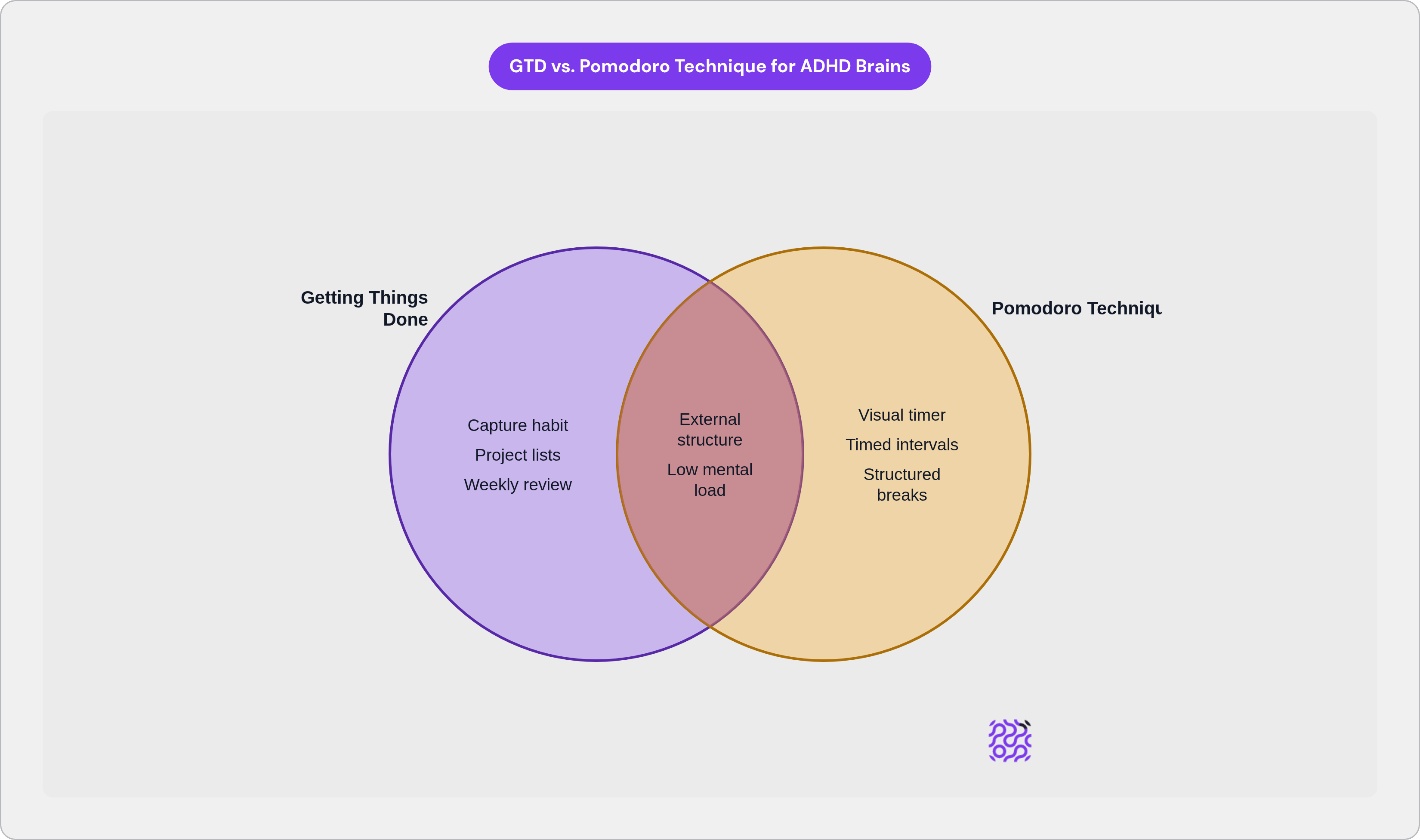
From a neurological standpoint, this is the most ADHD-relevant design principle in mainstream productivity literature. Working memory impairment is one of the most consistently documented features of ADHD, and GTD's core proposition addresses it directly. The capture habit, immediately externalizing any thought, task, or commitment rather than attempting to hold it mentally, is genuinely useful for brains that cannot rely on internal recall.
The system's onboarding demands, however, are substantial. The full GTD architecture involves contexts, projects, reference files, someday/maybe lists, and multiple levels of review. Configuring it properly requires considerable time and sustained decision-making, both of which tax the same executive function the system is meant to support. Many ADHD users invest in GTD enthusiastically, configure it partially, and abandon it before the capture habit has time to become automatic. The architecture defeats the intention.
Task initiation support is essentially absent. GTD tells you, with impressive organizational clarity, what you could do. It does not tell you when to start, provide an external cue to begin, or generate urgency around a particular item. The next action is specified; the neurological ignition is not.
The weekly review is GTD's structural backbone and its critical failure point for ADHD users. It requires sitting down, opening the system, processing every captured item, and making sequential decisions about each one, without external prompts, for an extended period. This is precisely the kind of unstructured, self-initiated, sustained cognitive work that ADHD impairs most severely. When the weekly review slips once, unprocessed items accumulate. When it slips twice, the system generates cognitive load rather than relieving it. The trusted external system becomes an untrusted pile.
Dopamine feedback is minimal. GTD's satisfactions are architectural: a clean inbox, a tidy project list, a well-organized reference system. These are real pleasures, but they are infrequent, and they require the system to be functioning well before they appear.
The practical conclusion is that GTD's capture philosophy is neurologically sound. The full GTD workflow, as written, is poorly suited to ADHD brains. Most users in this population benefit from taking the capture habit and radically simplifying, or abandoning outright, the processing and review architecture Allen intended to surround it. A partial GTD is not a failed GTD; for this population, it may be the only GTD that actually functions.
The Pomodoro Technique: How a Kitchen Timer Addresses Dopamine and Time Blindness, Until Hyperfocus Arrives
Francesco Cirillo's Pomodoro Technique is structurally simple: 25 minutes of focused work, a 5-minute break, a longer break after four cycles. Its ADHD compatibility rests not on discipline but on brain chemistry.
The timer provides an external urgency cue. It tells the brain when to start, when to stop, and when relief is coming. For a brain that cannot reliably generate its own sense of time pressure, this external structure substitutes for what the prefrontal cortex fails to produce independently. Each completed interval delivers a small, concrete reward: the timer sounds, the work stops, the break begins. This maps directly onto the dopamine deficit, offering frequent and proximate reinforcement rather than a single payoff at the end of a long session.
The technique also eliminates a decision. "How long should I work on this?" is a question that drains executive function before a task even begins. A 2019 study published in the Journal of Attention Disorders found that participants with ADHD performed significantly better on sustained-attention tasks in structured time blocks compared to open-ended work periods. The Pomodoro structure is a formalized version of that finding.
The technique scores well on task initiation support, dopamine feedback, and time visibility when a visual timer is used. Its weaknesses are flexibility and its relationship to hyperfocus, and those weaknesses are not incidental.
The hyperfocus failure mode is the system's central contradiction. A Pomodoro timer will either interrupt hyperfocus at exactly the moment productive focus has finally arrived, or it will go entirely unnoticed while an hour disappears. The same external urgency that helps initiation actively conflicts with the brain's most productive state. Adapting around this is possible but complicates the technique's core logic: if the timer becomes optional during hyperfocus, the timer's authority during initiation weakens. There is no clean resolution. It is a structural tension the technique was not designed to handle.
Several adaptations make the Pomodoro more compatible with ADHD brains. Starting with 10 to 15 minute intervals rather than 25 builds the habit on evidence from actual performance rather than an arbitrary convention. Using a visual timer, one where remaining time is represented as a shrinking area rather than a number, addresses time blindness directly. Treating the timer as a focus container rather than a hard stop, so that finishing a thought before breaking is permissible when hyperfocus is genuine, reduces the most counterproductive interruptions.
The standard 25-minute format was designed without ADHD neurology in mind. Using it unmodified often produces frustration. Using it as a starting template, then adjusting from there, is a more defensible approach.
Time Blocking: Why Pre-Deciding "What Now" Helps, and Why Every Transition Is a Hidden Executive Function Tax
Time blocking's central appeal for ADHD is the elimination of a real-time decision. When each hour has been assigned a task in advance, "what do I do next?" does not need to be answered in the moment. That question, seemingly trivial, drains executive function. Answering it repeatedly across a day compounds the depletion in ways that are easy to underestimate until they accumulate into a collapsed afternoon.
Visualizing a schedule in calendar form also makes the shape of a day concrete, which addresses time blindness in a way that a to-do list cannot. A block that occupies space on a visual calendar has a felt weight that a line item on a list simply does not.
The standard recommendation of 60 to 90 minute blocks is poorly suited to ADHD brains. Research and clinical guidance both suggest 25 to 40 minute blocks as a more realistic target, with roughly 25% added to every time estimate to account for the ADHD tendency toward optimistic duration planning. The problem is not careless estimation; it is that the future feels more compressible than it is when time perception is impaired.
The hidden cost of time blocking is transitions. Every shift from one block to the next requires three distinct executive function operations in rapid succession: stopping the current activity, switching mental contexts, and initiating the new task. For neurotypical brains, transitions are mildly annoying. For ADHD brains, they are genuinely taxing, and a day scheduled into many short blocks accumulates many transitions. The cumulative cost is real. Whether that cost offsets the initiation benefits depends on a specific deficit profile, and the honest answer is that this requires deliberate observation to discover rather than assumptions made in advance.
The most important structural adaptation is the flex window: one or two unassigned 60-minute blocks built deliberately into each day. When hyperfocus causes an overrun, the flex window absorbs it without destroying the remaining schedule. When task initiation fails, the flex window provides a second attempt. This single modification eliminates the cascading failure mode, in which one missed block invalidates the rest of the day and triggers a full cognitive shutdown. Practitioners working specifically with ADHD populations consistently identify the flex window as the difference between a time-blocked schedule that functions and one that collapses by noon.
At its most effective, time blocking also begins to converge with energy-based planning.
Energy-Based Planning: Scheduling Around What the Brain Can Actually Do, Not What the Clock Says to Do
The premise of energy-based planning is that not all tasks require the same brain, and not all moments offer the same brain. Rather than organizing work by priority or deadline, it organizes by what cognitive resources are actually available at a given moment.
This directly addresses ADHD's most persistent productivity problem: inconsistent executive function. Forcing focus when the neurological capacity for focus is depleted produces procrastination and anxiety rather than output. Aligning effort with natural capacity reduces the activation energy required to begin, which matters considerably for a brain where that activation energy is already in short supply.
A practical taxonomy commonly used in this approach divides tasks into three tiers. High-energy work, covering strategic planning, complex writing, and deep analysis, is reserved for periods of genuine cognitive availability. Medium-energy work, nuanced communication and decisions of moderate complexity, fills transitional periods. Low-energy work, routine administration and organizational tasks, absorbs the hours when sustained focus would be unrealistic anyway.
The distinction from time blocking is structural. Time blocking assigns tasks to clock positions; energy-based planning assigns them to cognitive states. The calendar becomes secondary to the match between task demand and current capacity.
What the approach does not solve, on its own, is task initiation. Knowing you are in a high-energy state does not generate the ignition signal to begin the task that state is suited for. The deficit remains. Energy-based planning also requires genuine self-awareness about personal energy patterns, and that self-knowledge takes time to develop. External tracking tools or a deliberate observation period are often necessary before the system becomes operational. For users already struggling with basic task completion, that developmental period is its own obstacle.
The most functional application combines energy-based logic with time blocking's structural scaffolding. Use the calendar to make time visible and pre-decide task sequencing; populate those blocks according to energy-state logic rather than conventional priority order. The result carries time blocking's initiation support alongside energy-based planning's tolerance for cognitive variability.
Body Doubling: The Oldest ADHD Strategy, Finally Getting a Research Record
Body doubling is working in the presence of another person who is not actively helping. The presence alone produces the effect. Someone working quietly nearby, or even visible on a video call, can enable an ADHD brain to sustain focus on tasks that prove impossible when alone.
The term was coined in 1996 by ADHD coach Linda Anderson, who observed a specific pattern: a retired executive could complete mundane administrative tasks with ease when former assistants were present nearby, but became paralyzed by the same tasks when working alone. The body double was not doing anything in particular. The calm, focused presence appeared to provide something the ADHD brain could orient toward and mirror.
The neurological explanation centers on external executive functioning. The presence of another person substitutes for the self-generated regulatory capacity that the prefrontal cortex fails to sustain independently. Dr. Manos of the Cleveland Clinic described this mechanism in January 2025 as the body double effectively lending their regulatory presence to a brain that cannot produce sufficient regulation on its own.
The evidence base is still developing, but it is developing consistently. A 2024 study of 220 neurodiverse adults found meaningful improvements in task completion and sustained attention during body doubling conditions compared to working alone. The research is not yet definitive at scale; it is, however, consistent with decades of anecdotal evidence and clinically observed patterns, and the neurological model underlying it is coherent with what is currently understood about prefrontal function in ADHD.
Against the six criteria, body doubling scores exceptionally well on external accountability and task initiation support, both of which it addresses simultaneously. It requires no setup, no configuration, no planning. It is the lowest-friction ADHD intervention available. The friction it does require is social: finding a willing partner, establishing the habit, accepting that productivity is sometimes a social act rather than a solitary one.
That last point is underappreciated. A significant cultural script around productivity frames it as an individual achievement produced in isolation. For ADHD brains, that frame is not just unhelpful; it may be actively counterproductive. Body doubling works because human presence provides regulatory scaffolding that the internal architecture does not reliably generate. The emergence of virtual body doubling platforms and co-working communities signals that the strategy has moved from informal coping mechanism to structured intervention. The research record is following, slowly, where clinical observation and lived experience led years ago.