Best Planner Apps and Systems for ADHD Women
Why the right planner works differently for women with ADHD than everyone else.
There is a particular kind of exhaustion that comes from having tried every planner on the market and concluded the problem is you. Many women with ADHD arrive at that conclusion well before they receive a diagnosis, and the tools they encounter afterward carry the weight of that history. The question worth asking is not which planner is best in the abstract, but which features address the specific ways ADHD actually disrupts planning, and whether those features were designed with this profile in mind or stumbled into usefulness by accident.
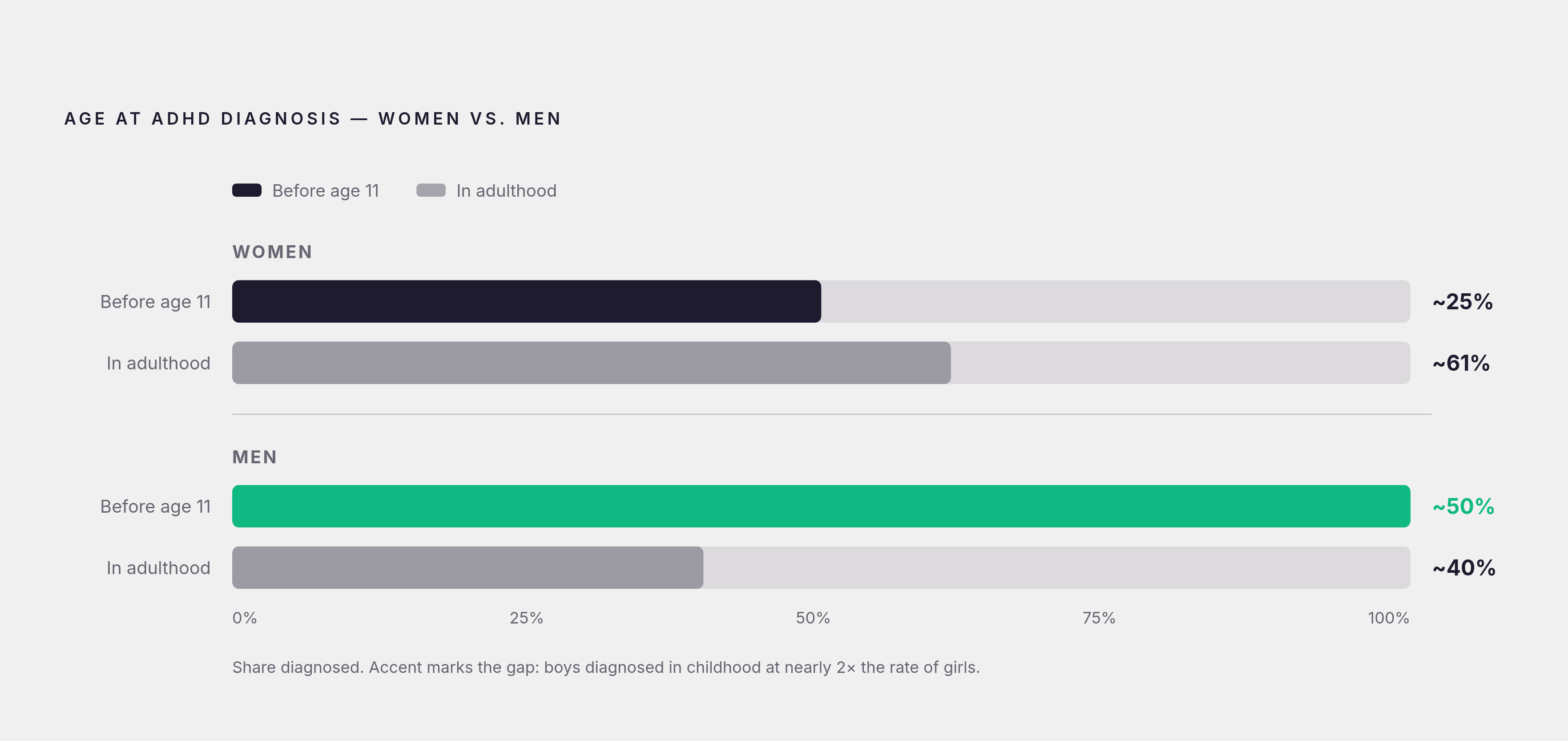
The numbers are clarifying here. Roughly 61% of women received their ADHD diagnosis during adulthood, compared to 40% of men; only about one-quarter of women were diagnosed before age 11, versus nearly half of men. Diagnosis rates among women aged 23 to 49 nearly doubled between 2020 and 2022, a surge widely attributed to social media raising awareness of inattentive presentation rather than the hyperactive-impulsive profile that historically dominated clinical recognition. Women's ADHD, as researchers and clinicians have noted, tends toward inattentiveness. Less disruptive in classroom or workplace settings; far more costly over a lifetime of being missed.
The downstream consequences matter here because they shape how women approach planning tools. Years of undiagnosed ADHD frequently produce a secondary layer of damage: chronic masking, diminished self-esteem, anxiety, burnout. Hormonal transitions compound this further. The luteal phase, postpartum recovery, and perimenopause each destabilize executive function in measurable ways, and perimenopause in particular can surface ADHD traits previously kept in check through sheer compensatory effort. A woman arriving at a planner app in her forties may be managing not just attentional deficits but a history of internalized failure, a framework that interprets any missed entry as personal evidence rather than system mismatch.
That context is not incidental. It determines which features matter and which ones cause harm.
What Actually Makes Planning Hard for Women with ADHD
Start with a concrete figure: over half of adults with ADHD identify procrastination as their single biggest obstacle. That statistic is worth sitting with before drilling into mechanism, because it names the surface symptom. Beneath it are several distinct breakdowns, and they are worth separating because different planner features address different ones.
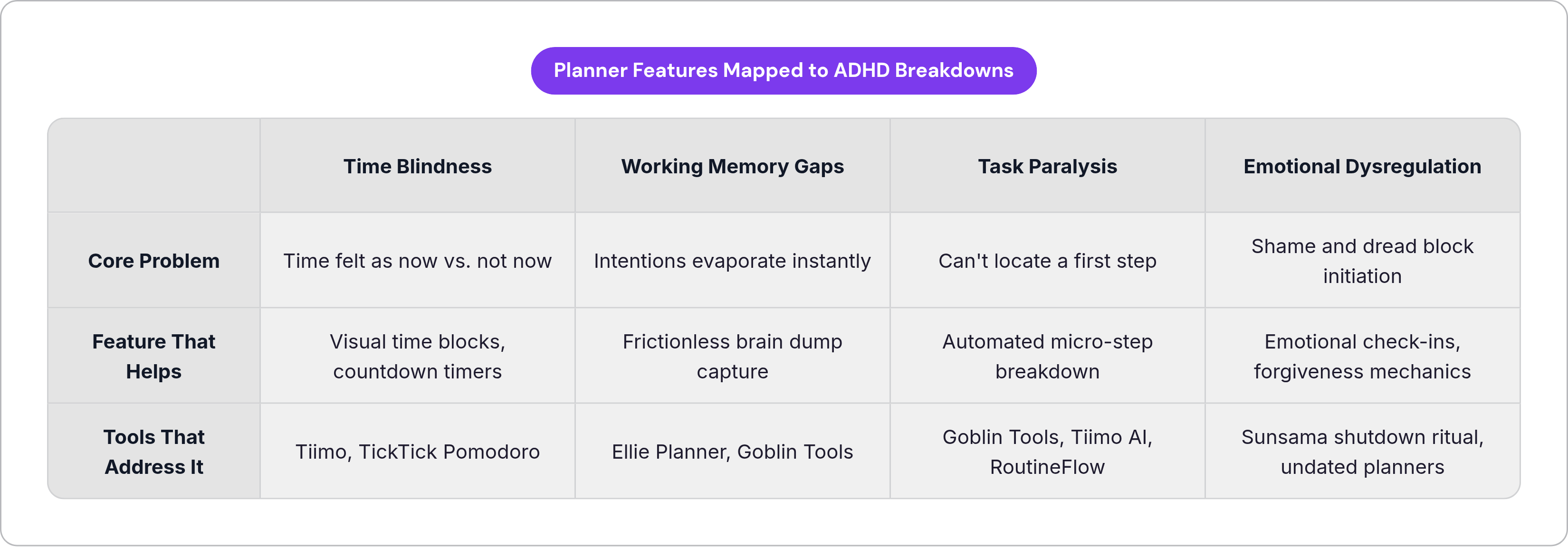
Time blindness is the first. Time, for many people with ADHD, is not experienced as a continuous flow but as two states: now and not now. A list of hourly calendar entries, 9am, 10am, 11am, carries no visceral weight. The gap between "I have three hours" and "I have forty minutes left" does not register automatically; it has to be engineered into the tool.
Working memory deficits compound this. Instructions, intentions, and priorities that are not immediately captured tend to evaporate. This is not forgetfulness in the conventional sense; it is the absence of a reliable short-term buffer. The internal monologue that says "I'll write that down in a minute" is optimistic in a way that ADHD neurology does not support.
Task paralysis follows from both. A large, undifferentiated task sits in the field of vision and produces shutdown rather than action. The problem is not unwillingness; it is that the brain cannot locate a first step that feels manageable enough to initiate. Decision paralysis operates similarly: too many open choices create the same cognitive friction as too large a task.
Emotional dysregulation is the fourth obstacle, and it is the least discussed in productivity contexts. Research finds that women with ADHD use non-adaptive emotion regulation strategies more frequently than women without ADHD symptoms, and that working memory deficits mediate this relationship. The practical implication is that planning struggles are partly emotional. The shame of a missed day, the dread before a complex task, the irritability that follows an interrupted focus state: these are regulatory failures with neurological roots, not character flaws. A planner that treats planning as purely logistical will not address them.
The masking pattern deserves mention separately. Many women with ADHD appear organized to external observers while managing enormous internal strain to maintain that appearance. Color-coded binders, meticulous calendars, elaborate systems: these can be performance, not function. The effort is real; so is its unsustainability. When the system eventually collapses, and it tends to, the collapse is attributed to personal failure rather than to the extraordinary cognitive load the masking required.
Traditional planners assume linearity: write the list, work through it in sequence, carry over what remains. That model collapses when focus drifts mid-morning, when one urgent interruption reorganizes the day, or when a single missed entry makes the entire spread feel contaminated. The structural assumption embedded in most planners is that the user is a consistent, linearly functioning agent. That assumption is the design flaw.
The Features That Make a Planner Work for This Specific Profile
Visual time representation is the most direct answer to time blindness. Spatial layouts where longer tasks occupy larger visual blocks make overcommitment visible before it happens. Countdown timers that show time depleting in real time create a felt sense of duration that a static timestamp cannot. The key distinction is between a planner that tells you what time it is and one that shows you how much time is moving.
Brain dump functionality addresses working memory directly. A low-friction capture space, available immediately, with no requirement to categorize or prioritize at the moment of capture, gets information out of volatile short-term memory without demanding executive function to process it. The organization happens later, when capacity permits; the capture happens now, when the thought exists.
Flexible time blocks over strict hourly slots give structure without punishing drift. Morning, afternoon, and evening granularity allows a day to be planned with real intentions while acknowledging that the 9am slot does not always stay 9am. Rigidity in time-blocking is not discipline; for ADHD users, it is a trap.
Task breakdown into micro-steps addresses paralysis at the initiation point. The difference between "finish the report" and "open the document and write the first sentence" is not trivial; it is the difference between a task that can be started and one that cannot. Tools that automate this decomposition remove the executive demand from the planning process itself.
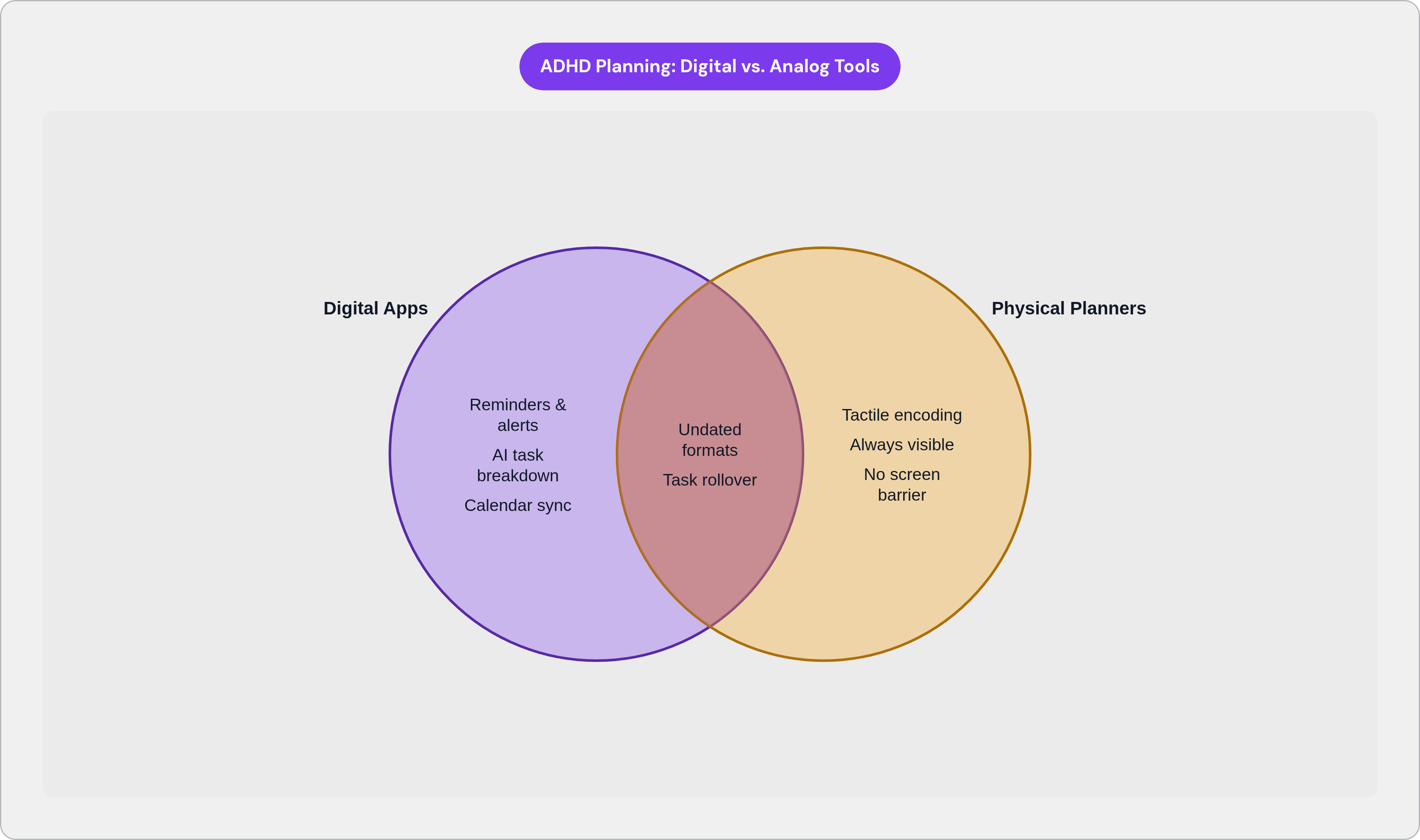
Automatic task rollover and undated pages are, in practical terms, forgiveness mechanics. They structurally remove the shame spiral triggered by a day of missed entries. This is not about lowering standards; it is about removing a design element that actively causes harm. A planner that requires continuous, unbroken use to function is incompatible with a brain that operates in cycles.
Clean, minimal design is a functional requirement, not an aesthetic preference. Visual clutter competes for attention, and attention is the constrained resource. That said, the ability to layer in color coding, stickers, or visual markers is genuinely useful for engaging the dopamine system at the moment of initiation; the baseline needs to be simple so that added elements enhance rather than overwhelm.
Dopamine-friendly mechanics, Pomodoro timers, micro-win acknowledgment, priority highlight sections, gamification, generate forward momentum at the specific moment when ADHD resistance is highest. Motivation in ADHD is not continuous; it is interest-driven and moment-dependent. Tools that create small reward cycles at the point of action are compensating for a real neurological gap.
Emotional check-in prompts reduce overwhelm at task initiation and connect the planning process to the regulatory work it actually requires. Given the research on emotional dysregulation and its relationship to working memory, a planner that ignores the emotional state of the user at the start of the day is missing a significant variable.
No single combination of these features is universally right. The goal is matching features to the specific breakdowns that affect a given user. Stacking every feature simultaneously creates its own form of overwhelm.
Digital Apps That Address These Needs and What Each One Actually Does Differently
Tiimo is the closest thing the current market has to a tool built from first principles for neurodiverse users. Its interface is built around icons, color (with over 3,000 options), and a countdown circle that shows time depleting in real time, a direct visual answer to time blindness. An AI assistant breaks spoken or typed tasks into concrete steps with time estimates attached. It won iPhone App of the Year at the 2025 App Store Awards and has accumulated over 500,000 users. A free tier is available; Pro runs roughly $8 to $10 per month. The notable gap is platform parity: the Android version exists but has lagged behind iOS in features, and integration with tools like Notion or Linear is limited for users who work in those ecosystems.
Structured is the most downloaded day planner in the App Store. It consolidates tasks and syncs Apple or Google calendars into a single visual timeline, collapsing the fragmentation problem that comes from managing tasks in one place and calendar events in another. It is praised for ease of building and ticking off routines. Available on iOS only; best for users who want visual clarity without complexity rather than depth of feature.
Ellie Planner treats Brain Dump as a first-class feature rather than an afterthought. The flow is dump everything first, organize later, with no judgment built into the interface. Tasks roll over automatically. A Focus Mode hides everything except the current task, eliminating the visual field of everything you are not doing. The rollover mechanic is the structural move that most directly removes the midnight shame spiral from the equation.
Sunsama takes a different approach entirely, positioning the planning process itself as a daily ritual. The workflow moves through reviewing the previous day, setting intentions, estimating time for each task, and time-blocking deliberately; the system warns when a day is overscheduled. A daily shutdown ritual closes the workday consciously, which is a meaningful design choice for users prone to work bleed and burnout. It integrates with Asana, Trello, Notion, Slack, Gmail, and several others, making it viable for users with complex workflows. The cost is $22 per month, or $17 per month billed annually, with no free plan. Best suited for reflective users who need ritual and accountability rather than just a place to capture tasks.
Reclaim.ai and Motion take the automation route: AI-driven scheduling that places tasks around meetings, deadlines, and priorities automatically and reschedules when things shift. For users who find manual scheduling itself to be the friction point, this is a genuinely different category of tool. The honest caveat is that losing manual control over one's schedule can trigger anxiety in some ADHD users; the feeling that the day is happening to you rather than being shaped by you is a real and legitimate concern, not an irrational preference.
Goblin Tools is not a planner in the conventional sense, and that is partly what makes it worth naming. It is free, requires no account, and attacks task paralysis directly. The Magic Todo feature breaks any task into small, concrete steps; the Compiler organizes brain dumps; a time estimator addresses the pervasive gap between how long someone with ADHD thinks a task will take and how long it actually takes. The barrier to trying it is as low as any tool on this list.
RoutineFlow applies gamification, points and rewards, specifically to routine tasks, which matters because ADHD fatigue tends to flatten motivation most severely on the repetitive and familiar. It also tracks how long tasks actually take versus how long the user estimated, building time awareness through repeated use rather than through instruction.
TickTick incorporates a Pomodoro timer, habit tracking, priority smart lists, and productivity graphs in one application. It is strongest for users who want focus tools and habit visibility inside a single environment without managing multiple apps.
Akiflow consolidates inputs from email, Slack, calendars, and project management tools into one command bar, which is a significant value proposition for users managing dispersed, high-volume workflows. The tradeoff is feature density: the same consolidation that solves fragmentation can overwhelm users who do better with simplified environments. At $34 per month, or $19 per month billed annually, with no free plan, it is also the most expensive option on this list and is better suited to professional contexts where the fragmentation problem is acute.
Physical Planners and Why Analog Still Works for Many Women with ADHD
The case for paper is not nostalgic. Writing by hand improves memory retention and cognitive processing in ways that typing does not replicate; the physical act of committing something to paper creates a different kind of encoding. For some users, that encoding is the planning.
A paper planner is also always visible. It does not sit behind a locked screen or a notification. For women whose engagement mechanism is physicality and presence rather than digital interaction, a notebook on the desk is the reminder that no app can fully replicate.
The risks are equally real. Physical planners can be misplaced. Missed days produce the same shame spiral as missed entries in a digital tool, sometimes more viscerally, because the empty page is concrete and permanent. Undated formats and layouts that do not rely on continuity mitigate this substantially.
Clever Fox offers a simple, non-distracting layout with a built-in habit tracker, a daily priority section, and undated pages in a durable hardcover. The undated format is the primary ADHD-relevant choice; it removes the structural penalty for inconsistent use.
Passion Planner uses an undated weekly layout with time blocks and is consistently recommended in ADHD communities for the same reason: the system does not break when the user misses a week.
Laurel Denise solves a specific visibility problem: month and week are shown simultaneously, so context is not lost when zooming into daily planning. For users who struggle to hold the macro picture while working in the micro, this layout addresses the working memory gap structurally.
Panda Planner was designed with productivity psychology in mind and is specifically noted for users with co-occurring anxiety, a common presentation in women with ADHD whose diagnosis was delayed.
Erin Condren LifePlanner offers multiple weekly layout options, vertical, horizontal, hourly, and dashboard, alongside goal-setting and habit-tracking sections. The structural flexibility is useful for users who need to experiment with layout to find what actually surfaces their priorities.
The analog versus digital question is not one to settle definitively. Many women with ADHD use both: paper for the emotional and reflective work, an app for reminders and integrations. The question is not which medium is better; it is which function each medium serves for a specific user.
How to Figure Out Which System Will Actually Stick
The ADHD apps market reached approximately $2.08 billion and is projected to reach $7.55 billion by 2033. The options will continue multiplying. Chasing the newest release is a less useful strategy than building a personal feature checklist anchored to the specific failures that recur most reliably.
The single strongest predictor of whether a system sticks is not quality; it is whether the tool matches the particular breakdown the user most frequently encounters. Those breakdowns are distinct, and they map to different features.
If you abandon systems after one missed day, the priority is rollover mechanics, undated formats, and structural forgiveness, not the richest feature set. The system needs to assume interruption rather than continuous use.
If you freeze at large tasks and never start, task breakdown tools matter more than calendar features. Goblin Tools, Tiimo's AI decomposition, and RoutineFlow all address paralysis at the initiation point rather than at the organizational level.
If you feel overwhelmed by inputs arriving from multiple places simultaneously, consolidation tools such as Akiflow, Sunsama, and Structured are solving a different problem than a standalone task app. The fragmentation is the issue; the solution needs to address fragmentation.
If you lose track of time entirely during the day, visual time representation and countdown mechanics are the relevant features. Tiimo's circle and TickTick's Pomodoro timer are both doing neurological work that a static schedule cannot.
If you need to feel the plan in order to trust it, analog is worth trying first, or analog paired with minimal digital reminders, rather than starting with a feature-dense app and adding friction from the beginning.
One missed day is not a system failure. The tools that build that assumption into their architecture, through rollover, undated pages, the absence of streaks to protect, are making a meaningful design choice that most productivity tools do not make. For women who arrived at planning late, after years of masking and accumulated self-blame, that structural assumption may be more important than any individual feature.
The right system is the one that removes shame and friction first. Everything else is secondary.