Demand Avoidance and ADHD
Research reveals ADHD is a stronger predictor of demand avoidance than autism.

There is a moment most people with ADHD know well: a task sits in front of them, simple by any objective measure, and nothing happens. Not because they forgot. Not because they don't care. The task is right there, the intention is real, and the body simply will not move toward it. From the outside, this looks like one thing. From the inside, it is several different things, and conflating them has caused an enormous amount of unnecessary suffering.
The most commonly applied explanation is executive dysfunction, and often that explanation is correct. But there is another phenomenon, less widely understood and far more charged, that can produce identical surface behavior while responding to almost entirely opposite interventions. That phenomenon is demand avoidance, and getting it wrong, which most people do, reliably makes things worse.
What demand avoidance actually means, and where the term comes from
The construct traces back to clinical observations in the 1980s, when Elizabeth Newson began documenting children who resisted ordinary, everyday demands to a degree far beyond typical avoidance. This was not selective compliance or strategic foot-dragging. It was a pervasive, persistent pattern in which the demand itself, regardless of content, appeared to register as intolerable. Newson labeled it Pathological Demand Avoidance, PDA.
The core features she identified have held up through subsequent research: an intense, anxiety-driven need for autonomy and control; avoidance that is situationally indiscriminate rather than targeted; resistance that escalates rather than resolves under increased pressure. The last point is worth dwelling on. In typical avoidance, applying more pressure eventually produces compliance. In PDA, it tends to produce the opposite.
The "pathological" label, however, has not held up as cleanly. A 2024 scoping review published in Frontiers in Education explicitly tracks a terminological debate in which researchers and advocates increasingly favor "Extreme Demand Avoidance" or "Rational Demand Avoidance" over the original term. The argument is substantive: "pathological" frames the response as a defect, when the evidence increasingly suggests it is a protective nervous system response to perceived threat. For people who are already carrying a decade or more of shame around avoidance, the framing they encounter in clinical language is not a trivial matter.
The avoidance is not unwillingness in any morally meaningful sense. It registers internally more like threat than inconvenience, which is precisely why appeals to motivation and willpower don't reach it.
How ADHD became central to demand avoidance research, displacing its earlier association with autism
For most of demand avoidance's clinical history, the conversation took place almost entirely within autism research. PDA was understood as a profile that appeared in some autistic individuals, and the broader public awareness of the concept — to the extent it existed at all — was organized around that association.
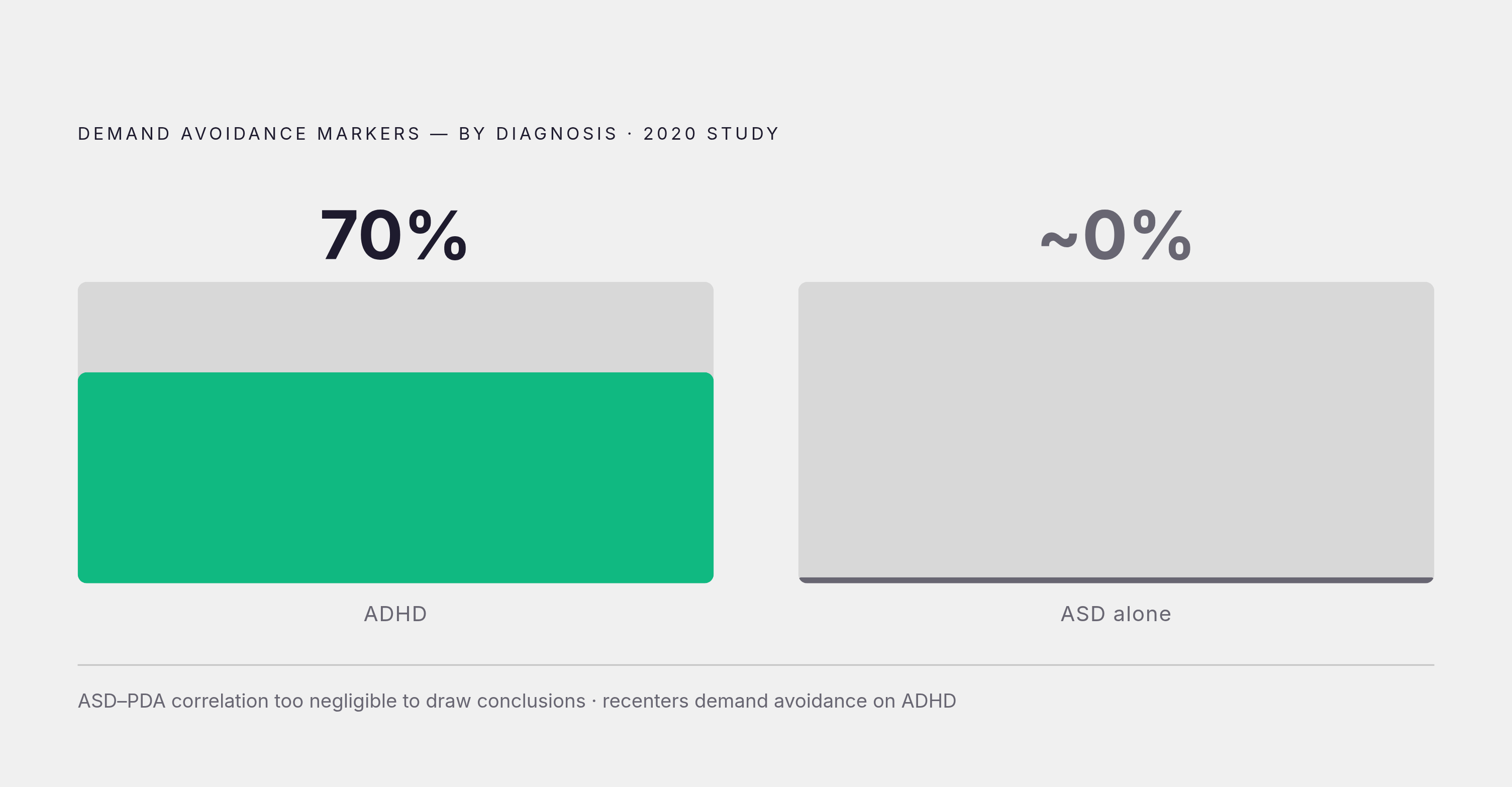
A 2020 study significantly disrupted that framing. The finding, reported by Healthline, was that having ADHD was a stronger predictor for PDA markers than having ASD. Approximately 70% of those with ADHD in the study showed markers of demand avoidance. The correlation between ASD alone and PDA was, by contrast, too negligible to draw conclusions from. This is not a minor statistical footnote; it is a reorientation of the entire conversation.
The overlap with autism spectrum conditions remains real, and many people carry both diagnoses, which complicates any clean sorting. But ADHD-specific mechanisms, particularly executive dysfunction, emotional dysregulation, and the dopamine sensitivity that underlies both, appear to be doing significant structural work in demand avoidance. The historical association with autism may have been, at least in part, an artifact of where researchers were looking.
The practical implication is pointed: if you have ADHD and have never heard of demand avoidance, the research suggests you have more reason to know about it than almost anyone else.
The neurological roots of demand avoidance in the ADHD brain
ADHD involves reduced availability of dopamine and norepinephrine in the prefrontal cortex, the region responsible for planning, prioritizing, initiating tasks, and regulating emotional responses. What complicates this further is that ADHD brains also tend to have a higher density of dopamine transporters, which aggressively reabsorb dopamine before it can sustain motivation or adequately modulate threat responses. The mesolimbic circuit, responsible for reward and motivation, runs chronically underactivated.
When a demand arrives, the prefrontal cortex is designed to assess it, weigh it against competing priorities, and modulate whatever emotional response arises. In the ADHD brain, that modulation is less reliable. The result is that ordinary demands, including ones the person sincerely wants to complete, can register as disproportionately aversive or threatening before any conscious reasoning enters the picture.
A 2024 systematic review added important texture to this: hyperactive and impulsive ADHD presentations are more strongly linked to what researchers call "warm" executive functions, those governing emotional regulation and motivation, while inattentive presentations skew toward "cold" functions like working memory and planning. Demand avoidance in ADHD likely sits at the intersection of both. The emotional threat response is a warm-executive-function failure; the inability to reason or plan a path through that response is a cold one.
There is also a developmental dimension. Research by Shaw and colleagues in 2007 found a roughly three-year lag in ADHD brains reaching peak cortical thickness: age 10.5 compared to 7.5 in controls. The regulatory machinery responsible for modulating threat responses comes online later, and in many adults may remain more taxed under pressure throughout life.
Why demand avoidance and executive dysfunction are not the same thing, even when they look identical from the outside
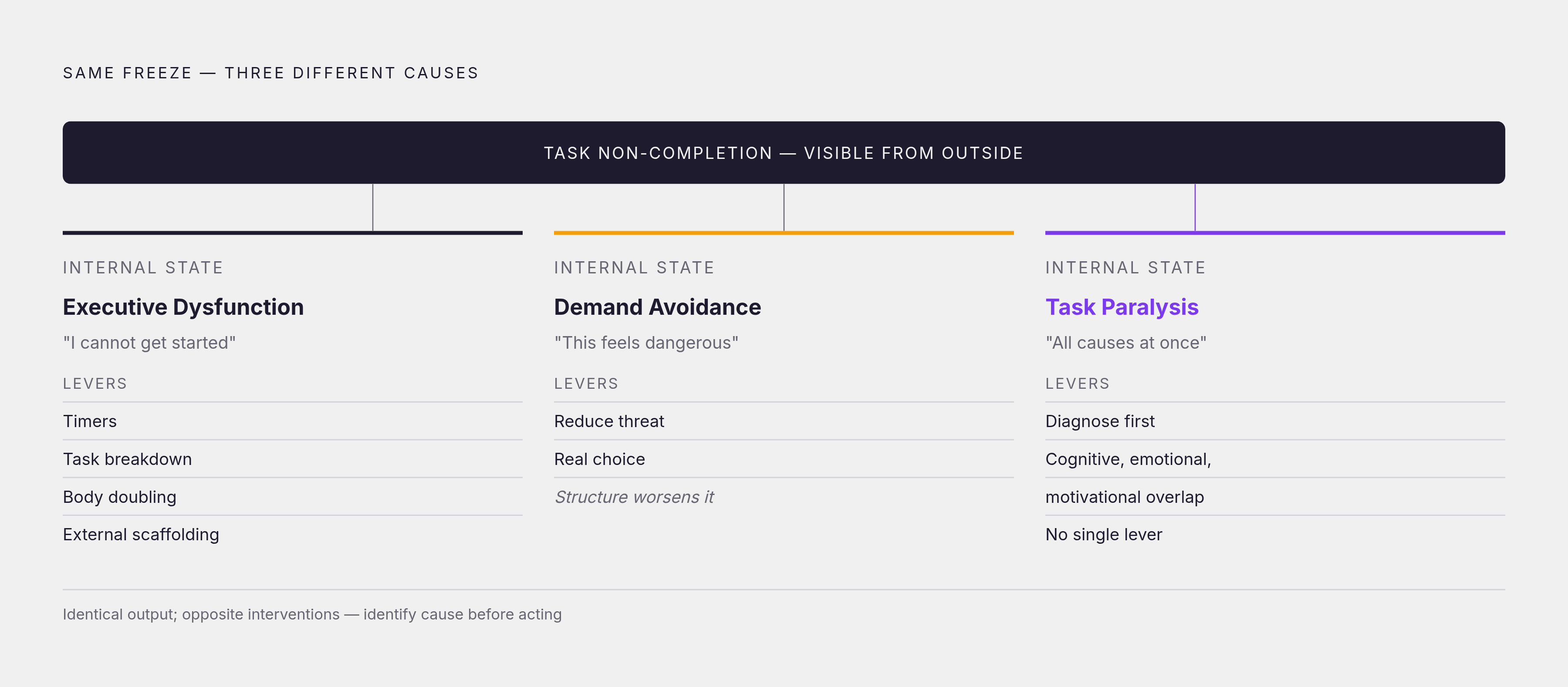
Both produce the same visible outcome. The task doesn't happen. The person appears stuck, resistant, or indifferent. But the internal experience differs in a way that is not merely academic — it determines what actually helps.
Executive dysfunction is the experience of "I cannot get started." The task itself is not threatening. It may be neutral, even welcome. The brain simply lacks the activation to initiate it, like a car engine that turns over without catching. External scaffolding, reminders, timers, task breakdowns, body doubling, reduces the cognitive load of starting and frequently works.
Demand avoidance is something else. The experience is closer to "this demand feels dangerous." There is an anxiety or autonomy-driven response to the demand itself, prior to and independent of the task's difficulty. Initiation doesn't feel merely hard; it feels intolerable or threatening. According to ScienceWorks Health, this distinction is precisely what clinical evaluations are designed to surface, because the two conditions respond to different environmental changes.
Applying executive dysfunction strategies to demand avoidance doesn't just fail to help; it typically makes things worse. More structure imposed from outside, more accountability, more urgency: these amplify the threat signal rather than reducing the activation gap. The tools are not wrong in themselves. They are wrong for this problem.
A third phenomenon worth distinguishing here is what researchers and clinicians describe as autistic inertia: difficulty transitioning into or out of tasks due to nervous system regulation, not motivation or perceived threat. According to Neuroclarity Counseling, all three can co-occur and are frequently conflated, by observers and by the people experiencing them. The relevant self-inquiry isn't diagnostic in a clinical sense; it's a question of lived experience. When I avoid, what is the internal texture of that avoidance?
Common triggers and patterns that characterize demand avoidance in ADHD specifically
One of the more disorienting features of demand avoidance is that the demand does not need to come from another person. Self-generated demands, personal goals, commitments made privately, intentions to do something truly wanted, can trigger the same response. The nervous system is not reading the source of the demand; it is reading the structure of obligation itself.
Several patterns appear with enough regularity to be worth naming. Open-ended or ambiguous instructions, where the path forward isn't clear, create enough uncertainty that the task registers as unsafe rather than merely complex. Tasks with high emotional stakes, or those associated with past failures, carry an additional charge that activates the threat response before the work even begins. Demands that feel controlling, even when the person agrees the task is necessary and worthwhile, trigger an autonomy-threat response the rational mind can't simply override.
Piling compounds all of this. When one demand follows quickly on another, the sense of accumulating obligation builds until the whole stack feels like an assault. Time pressure or the awareness that someone is waiting, rather than motivating action, intensifies the threat signal. These are not personality responses; they are nervous system responses.
The avoidance that follows has a specific emotional texture that is difficult to articulate from the inside and easy to misread from the outside. The person experiences something visceral: not reluctance, not laziness, but a "I cannot do this" that operates below the level of choice. Masking and elaborate workarounds develop over time, not from cynical strategy, but because threat management becomes an unconscious priority.
The shame loop is where this becomes self-reinforcing. The avoidance draws judgment, internal or external, which increases the emotional charge around the task, which intensifies the avoidance. Generic productivity advice doesn't enter this loop at any useful point.
Why standard productivity fixes tend to make demand avoidance worse
Standard productivity advice was designed, implicitly, for neurotypical executive function. It assumes the obstacle is cognitive load or willpower, and it addresses both by adding structure, accountability, and external pressure. For executive dysfunction, this is often the right call. For demand avoidance, it is structurally counterproductive.
Stricter deadlines increase pressure, which heightens the threat signal. More detailed task lists multiply the number of perceived demands in the visual field, which compounds overwhelm. Accountability partners who check in with urgency introduce external control, activating the autonomy-threat response. Each of these interventions, designed to solve a motivation or initiation problem, reads to a demand-avoidant nervous system as escalation.
Research on neurodivergent users, including work cited in a 2025 arxiv.org compilation drawing on Dicks (2024), found that conventional productivity tools, long static task boards and nested checklist hierarchies, specifically trigger task paralysis, fatigue, and prioritization confusion in ADHD users. The system that is supposed to organize and clarify becomes itself a source of demand.
"Just start with five minutes" fails here for the same reason it fails with task paralysis more broadly: without addressing the threat signal, the brain does not engage regardless of the size of the step. Five minutes of a threatening task is still five minutes of threat.
The mismatch is structural, not a matter of insufficient effort or insufficient advice. And this is precisely the point where distinguishing demand avoidance from executive dysfunction becomes practically consequential rather than just intellectually interesting.
Approaches that actually address demand avoidance rather than intensifying it
The guiding principle is counterintuitive relative to most productivity frameworks: reduce threat, restore autonomy, and lower the stakes of the demand itself before attempting to address the task. The sequence matters. Trying to engage the task while the threat signal is active is working against the nervous system rather than with it.
Autonomy scaffolding is one of the more reliably effective approaches. Offering real choice wherever possible, not manufactured binary decisions, but genuine alternatives with equivalent legitimacy, gives the nervous system a signal that control has not been entirely removed. Framing demands as invitations or collaborations rather than instructions matters for the same reason; the nervous system is reading for control signals in the language itself, and it is not unsophisticated in doing so. Letting the person direct pacing, sequence, and environment reduces the number of pressure points where the system registers "you have no say here."
Reducing demand density is equally important. Limiting the number of active, visible demands at any one moment, a single clearly bounded task rather than a full list, prevents the piling effect from activating before work even begins. The brain dump, getting everything out of working memory and into an external record, removes the ambient pressure of accumulated undone tasks. ADD.org cites this as a concrete ADHD coping tool precisely because the pressure of "all the things I should be doing" is its own source of demand avoidance activation.
Reframing the task relationship addresses the emotional charge before the logistics. Naming why something feels hard, connecting it to a specific past association rather than a generalized inadequacy, reduces the shame component that amplifies the threat response. Interest-based framing, connecting a demand to real curiosity or personal meaning, shifts the task from "obligation" to "exploration" in a way the nervous system registers differently.
Modified external structure that doesn't feel controlling preserves some of the benefits of accountability without the autonomy threat. Body doubling works where check-in accountability often doesn't: presence without judgment, focus without control. Voice-first interaction, speaking tasks rather than filling in forms, keeps the person in the driver's seat rather than being managed by a system. Shorter, flexible work intervals with user-chosen start times, a modified Pomodoro of ten to fifteen minutes rather than twenty-five, reduce perceived commitment and lower threat activation without eliminating structure entirely.
What doesn't transfer from executive dysfunction strategies: time pressure, consequence framing, rigid externally imposed routines, and any tool that adds more structure without adding more autonomy.
When demand avoidance, executive dysfunction, and task paralysis all show up together
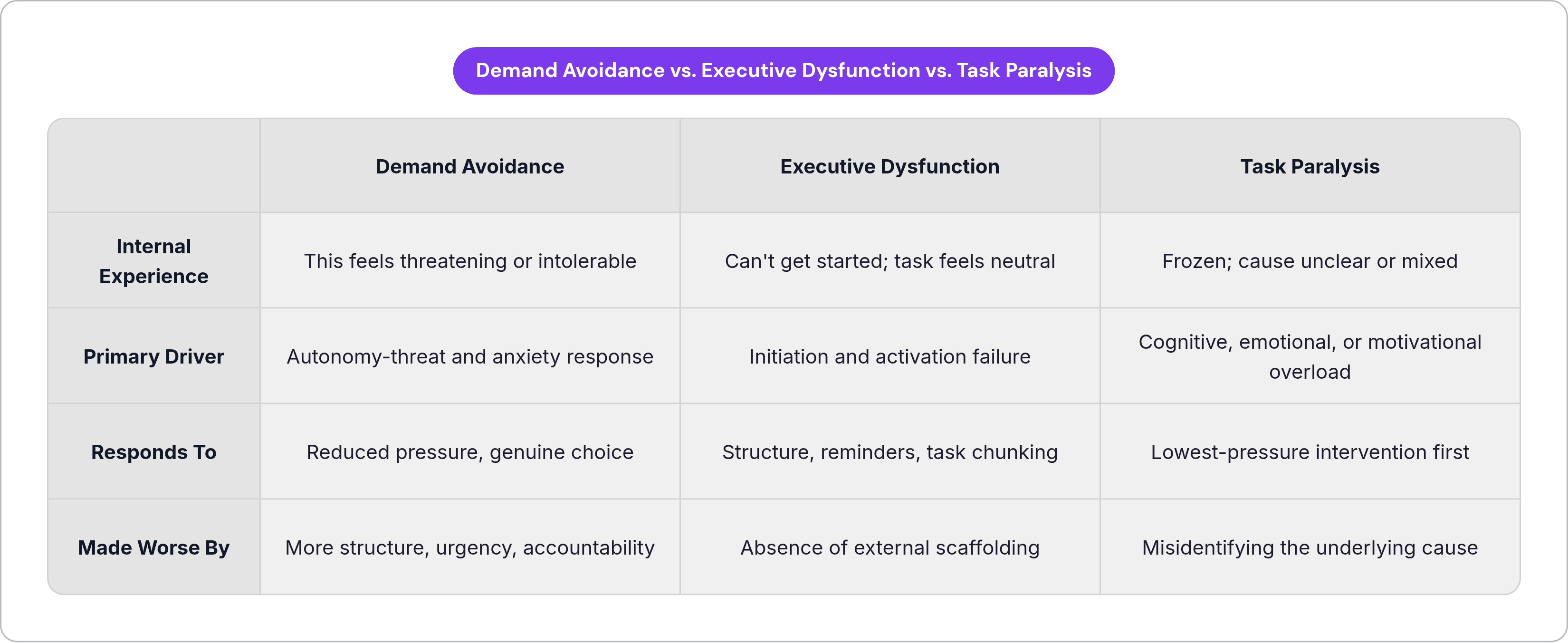
Most people with ADHD are not experiencing only one of these phenomena at a time. Executive dysfunction, demand avoidance, and task paralysis can all be active simultaneously, or they can cycle in rapid succession in ways that make the underlying cause difficult to identify. The freeze looks the same from inside and outside regardless of what's producing it.
Task paralysis functions as the convergence point: the person is frozen, but the freeze may have multiple causes. Some are cognitive — working memory overload or initiation failure; some are emotional — the threat response or accumulated shame; some are motivational — low dopamine availability in the reward circuit. Pulling on the wrong thread first makes things worse rather than better.
A practical self-inquiry that doesn't require clinical precision: when stuck, ask whether this is "I can't start" or "this feels threatening." Even an approximate answer changes what to try first. If the block feels threatening, the autonomy and threat signal need addressing before initiation strategies have any purchase. If it feels like a frozen inability with no particular emotional charge, an activation approach, task chunking, environmental reset, body doubling, is the more relevant lever. If the answer is unclear, the lowest-pressure intervention tends to be productive regardless: a brain dump, a single small real choice, a voice note capturing what's happening. These approaches tend to work for both executive dysfunction and demand avoidance without amplifying either.
The co-occurrence is also why one-size-fits-all ADHD productivity systems fail so often. A rigid architecture that helps executive dysfunction can become a source of demand avoidance the moment it starts to feel imposed. The goal in daily life is not diagnostic precision; it is developing enough self-awareness to try the right lever first, and enough flexibility to switch when it doesn't work.
What changes when demand avoidance is understood rather than judged
For the person with ADHD, naming demand avoidance as a neurological response rather than a character flaw breaks the shame loop at its root. The avoidance was not evidence of laziness. The decades of judgment, internal and external, built on that misread were factually wrong, and it matters to be able to say so clearly. Shame is not a motivational tool; it is a threat signal, and adding it to an already threat-activated nervous system is gasoline on a fire.
For the people around them, the same understanding replaces the instinct to apply more pressure with the instinct to reduce it. That is not a small shift. It is a fundamentally different intervention, and it tends to produce a fundamentally different outcome.
The practical implication compounds over time. Every interaction in which a demand is met with real autonomy and low ambient threat builds a different kind of evidence: that demands can be navigated, that the nervous system's threat read is not always accurate, and that the person is capable in ways the shame loop had obscured. That is not a cure. It is not even, necessarily, a resolution. But it is a more accurate map, and navigating with an accurate map is a different experience from navigating with a wrong one.