Executive Function Deficits in ADHD Explained
Executive dysfunction stems from dopamine deficits that make unrewarding tasks feel invisible.

Executive dysfunction is the disorder's operating condition, the thing underneath nearly every other symptom on the list. An estimated 15.5 million U.S. adults carry an ADHD diagnosis, and most of them run into some version of the same core mechanism failing on an ordinary Tuesday afternoon, when a simple task refuses to get done. The two explanations people keep reaching for instead, laziness and bad character, don't hold up once you look at what's actually happening under the hood. The sections below take the mechanism apart, deficit by deficit, and the position here is blunt: this is a biological process, and pinning it on willpower misreads what's actually happening.
What executive function actually is, and why ADHD disrupts it at the root
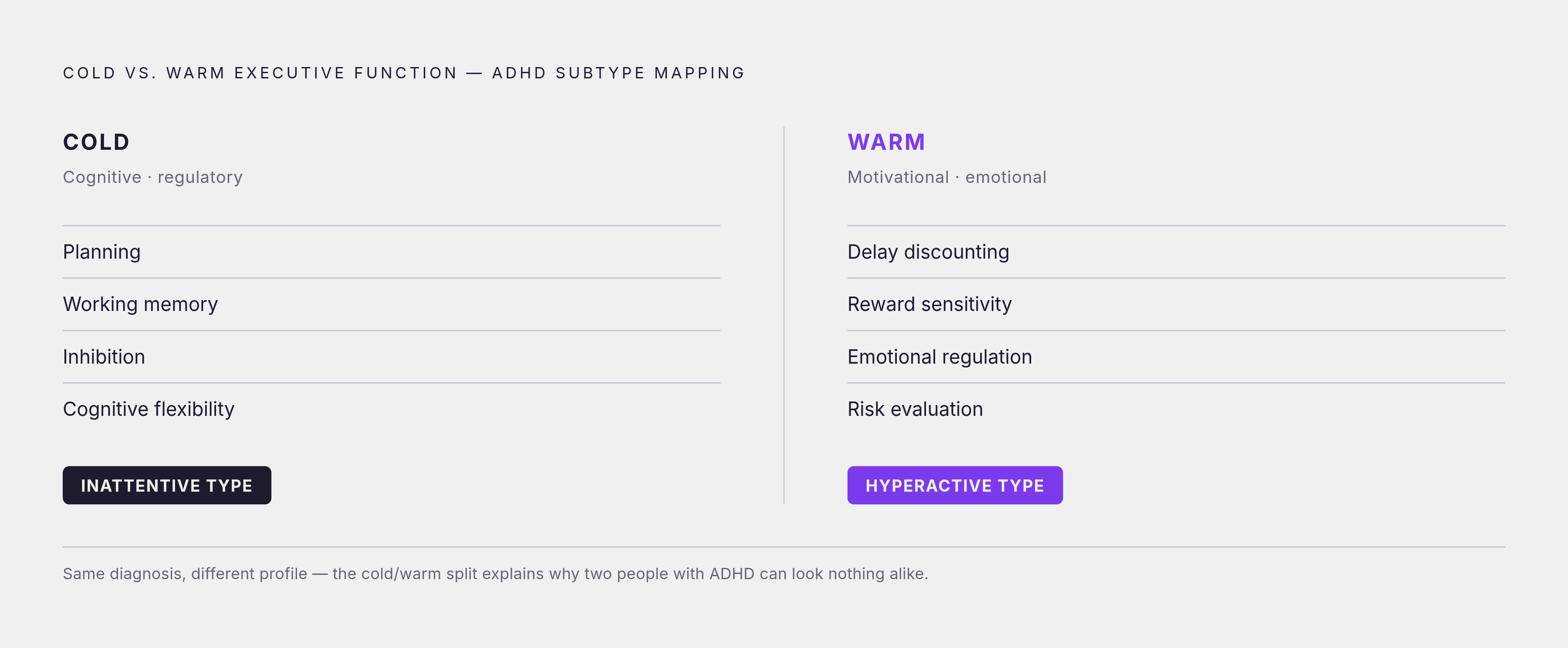
Executive functions are the cognitive processes that manage planning, initiation, sequencing, attention, and emotional regulation. Think of them as the brain's management layer, the part that decides what gets attention, when to start, when to stop, and how to hold a plan together long enough to see it through. These capacities lean on each other constantly, so a deficit in one drags the others down with it. That interdependence is the first thing generic advice misses, and it's why the sections ahead treat the deficits as connected rather than isolated.
ADHD disrupts this management layer at a structural level, and executive dysfunction is the umbrella term researchers use for the fallout. Much of that fallout traces back to dopamine: ADHD is associated with reduced dopamine activity in the brain regions responsible for motivation, attention, and reward processing. That has a strange, counterintuitive consequence. A task without an immediate payoff doesn't just feel boring to an ADHD brain; it can feel almost nonexistent, invisible in a way that has nothing to do with how important the task actually is.
A 2024 systematic review draws a useful line here, splitting executive functions into "cold" and "warm" categories. Cold EFs are the cognitive and regulatory ones: planning, working memory, inhibition, the kind of thing a neuropsychological test measures cleanly. Warm EFs are motivationally and emotionally loaded, things like delay discounting and reward sensitivity. The review found that inattentive-type ADHD maps mostly onto cold EF deficits, while hyperactive-type maps more onto warm EF deficits. That distinction explains why two people with the same diagnosis can look nothing alike day to day: one struggles to open the laptop, the other blurts out a decision they'll regret in ten minutes. Both are executive dysfunction. They're just hitting different parts of the same system.
Somewhere between 80% and 90% of adults with ADHD deal with executive dysfunction daily, which makes it the central functional challenge of the condition rather than a peripheral symptom. This is the position worth stating directly: executive dysfunction runs underneath most of the other symptoms people describe, and treating those symptoms one at a time, without naming the mechanism that produces all of them, is why so much advice never lands. Every section below builds out why the motivation framing falls apart once you look at the actual circuitry.
Working memory deficits: when the brain's whiteboard keeps getting erased
Working memory holds information in mind while it's being used. Picture a whiteboard for whatever task is in progress: the multi-step instruction, the mid-conversation thought, the number someone just said that needs to reach a calculator before it disappears. In ADHD, that whiteboard erases faster than it should and holds less at any given moment.
What does that look like in practice? Walking into a room and blanking on why. Losing the thread of a conversation mid-sentence, with no memory of where the sentence was headed. Starting step one of a task and forgetting step two before step one is even finished. Reading a paragraph and reaching the bottom with almost nothing retained, so the eyes did the work but the brain didn't. Sitting in a meeting, trying to formulate a response, and losing track of what was just said in the process of trying to respond to it.
Long-term recall in ADHD is often fully intact. People remember childhood details, old conversations, entire plotlines from a show watched years ago. The deficit is narrower and more mechanical: active, in-the-moment holding, the capacity to keep something suspended in mind while doing something else with it.
External capture systems, written notes, voice memos, checklists taped to the wall, function as neurological compensation for a specific capacity limit. That distinction matters more than it sounds like it should. Working memory operates under real capacity limits, and pretending otherwise just guarantees repeated failure. Here's the part that matters most: working memory deficits cascade in a specific, damaging way. Losing track mid-task produces incomplete or sloppy work, and incomplete work looks like carelessness to an outside observer. The observer sees a mistake; the actual cause was a capacity limit, and conflating the two is where most misjudgment of ADHD starts.
Inhibitory control deficits: the brake that doesn't engage on time
Inhibitory control is the brain's pause button, the mechanism that filters an impulse before it becomes an action and lets a person choose a deliberate response over an automatic one. In ADHD, that brake system has a slower response time and doesn't engage reliably.
The result shows up constantly and rarely gets read correctly by other people. Words come out before the thought behind them is fully formed. A work tab closes the instant focus wavers, without any decision being made to close it; the hand just does it. Interruptions in conversation happen not from rudeness but because the impulse to speak arrives well before the filter that would normally hold it back. Stopping a pleasurable activity, scrolling, gaming, becomes its own small battle even when the person knows full well it's time to stop. Purchases and commitments get made impulsively, followed almost immediately by regret.
A 2025 Journal of Psychiatric Research network meta-analysis covering 42 randomized controlled trials and 1,981 children and adolescents found that physical exercise, cognitive training, behavior therapy, and neurofeedback all produced significant improvements in inhibitory control. That finding does two things at once: it confirms inhibitory control as a core, measurable executive function domain, and it establishes that the deficit responds to intervention. It's trainable, which matters more than it sounds like it should, and it's also the strongest evidence in this entire piece that the mechanism runs deeper than character.
Here is where most misreadings happen: inhibitory control deficits and impulsivity in the everyday, personality-trait sense get treated as the same thing, and they are not. One is a timing failure in a neural circuit. The other is a character judgment. When a moment looks like someone not caring, or being rude, or acting careless, what actually failed was a circuit that should have fired half a second earlier and didn't. Confusing the two is not a small error; it is the exact error this piece is trying to correct.
Task initiation deficits: why starting feels harder than doing
Task initiation is the executive function that converts intention into action, the "go" signal that fires the moment a plan turns into a first physical step. In ADHD, that signal misfires or fails to fire at all, and the gap between deciding to do something and actually doing it can stretch into hours, sometimes days, even for tasks the person genuinely wants finished.
This is the actual mechanism behind what gets called task paralysis or ADHD paralysis: a specific circuit failing to activate, nothing more mysterious than that. Sitting in front of a blank document for an hour without typing a single word. Knowing a task is both urgent and simple and still being physically unable to start it. Waiting for a "right" mental state to begin, a state that, notably, never quite arrives. Then, a deadline lands and the task starts itself, because external pressure has substituted for the internal signal that never showed up.
That last pattern traces straight back to dopamine. Without a near-term reward or a clear urgency cue, the ADHD brain doesn't generate enough activation energy to move a task out of intention-space and into action. It just sits there, fully understood and fully unstarted.
What actually helps works by manufacturing that missing signal artificially, and this is where most self-help advice quietly gets it right without ever explaining why. The Pomodoro technique creates a hard time boundary that mimics deadline pressure on a much smaller scale. Breaking a task down until the first step is almost embarrassingly small reduces how much activation the go-signal needs to produce. External accountability, another person, a shared deadline, a check-in, gives the brain a cue it can't manufacture on its own. Each of these functions as scaffolding for a signal that is, for entirely neurological reasons, unreliable; the mechanism they support has little to do with willpower, whatever the productivity blogs claim.
Time blindness: living in a perpetual present with no felt sense of past or future
Time blindness gets misunderstood constantly, usually as a failure to know what time it is. That misreads the deficit entirely, and it's worth correcting up front because the wrong diagnosis leads to the wrong fix; a clock on the wall does nothing for this. The actual failure is in feeling time pass and in experiencing future moments as real enough to act on now. For a lot of ADHD brains, time flattens into two categories: now, and not now. "Later today" and "next month" end up feeling functionally identical, because neither one is happening in the present, and the present is the only thing that registers.
The daily version of this is chronic underestimation of how long things take, which produces lateness that reads as disrespect but isn't. It's hyperfocus swallowing hours with zero felt sense of their passing, so three hours vanish and it feels like twenty minutes. It's the inability to get moving on something due next week, because "next week" carries no urgency and no emotional weight in the moment. Planning a timeline by working backward from a deadline requires a felt relationship with future time, and that relationship is exactly the thing that's compromised.
This deficit connects directly to task initiation, and the connection is worth naming plainly: the urgency that finally unlocks a stalled task is, in part, a workaround for time blindness. Once a deadline arrives in the present, "not now" flips into "now," and the brain activates because the moment finally registers as real. Compensations that work make the future concrete artificially: visible clocks, timers set well ahead of the actual deadline, time-blocking, routines that chunk a day into fixed, predictable units instead of an open expanse. Someone chronically late is usually navigating a system that doesn't register time passing the way most people's does. Calling that person inconsiderate is a category error, and a fairly common one.
Cognitive flexibility deficits: why transitions and unexpected changes hit so hard
Cognitive flexibility is the ability to shift mental sets, move from one task to another, adjust when circumstances change, and recover cleanly when a plan falls apart. In ADHD, that shifting takes real effort and often happens slowly; the brain gets stuck in its current mode and resists disengaging from it, even when disengaging is clearly the right call.
A meeting gets moved twenty minutes and the entire afternoon feels derailed, wildly out of proportion to what actually happened. Switching from leisure mode to work mode stalls out even when the intention to switch is completely genuine. Hyperfocus locks a person into a task so thoroughly that any interruption produces real frustration, not mild annoyance. A strategy that clearly isn't working keeps getting used anyway, because abandoning it for something else requires a flexibility that isn't available in the moment. Moving between environments, home to office, school to home, drains more than it should and leaves a kind of static behind.
Cognitive inflexibility and emotional dysregulation sit close together here, and of the five deficits covered in this piece, this pairing is probably the most socially expensive one. When the shift fails to happen, the emotional response to that failure can escalate fast. In a workplace or a relationship, an inability to adapt quickly reads as rigidity, or mood swings, or difficulty collaborating, descriptions that miss the actual mechanism underneath entirely. Structure that reduces the abruptness of the shift itself, transition rituals, a five-minute warning before a task switch, gives the brain lead time instead of demanding it change gears instantly, which is why it tends to outperform sheer effort.
How emotional dysregulation fits into the executive function picture
Emotional dysregulation doesn't appear in the DSM criteria for ADHD, but a growing body of research places it squarely inside the "warm" executive function domain covered earlier, and it's one of the most commonly reported, most impairing experiences people with ADHD describe. The mechanism involves reduced capacity to modulate emotion once it's triggered, to control its intensity and how long it sticks around. The deficit lies in regulation, not in the raw amount of emotion felt, and that distinction is worth sitting with, because it's the one most often lost in translation.
Rejection sensitive dysphoria is the clearest example: perceived criticism or rejection triggers pain that feels enormous and resists being reasoned away, even when the triggering comment was minor or not even meant unkindly. Frustration can feel physically overwhelming, wildly out of scale with whatever caused it. Getting back to baseline after an emotional disruption takes longer than it should, and the leftover feeling bleeds into whatever comes next, contaminating tasks that had nothing to do with the original trigger. Missed deadlines and forgotten commitments, the direct output of the other deficits already covered, often trigger shame spirals that compound into a fresh round of paralysis.
Why does naming this matter so much? Emotional dysregulation in ADHD gets read, by other people and often by the person experiencing it, as immaturity, or oversensitivity, or instability. All three readings treat a capacity deficit as a character flaw. The executive function framing recasts the whole picture as a regulatory problem, which carries a different weight than a personality flaw entirely. Decades of being told to just try harder, while failing at things rooted in a real neurological deficit, build an internalized shame that becomes an obstacle in its own right, separate from the original problem. Naming the deficit accurately is the first move toward separating the failure from the self, and skipping that step is why so much ADHD advice fails before it even starts.
Why generic productivity advice fails at the level of each specific deficit
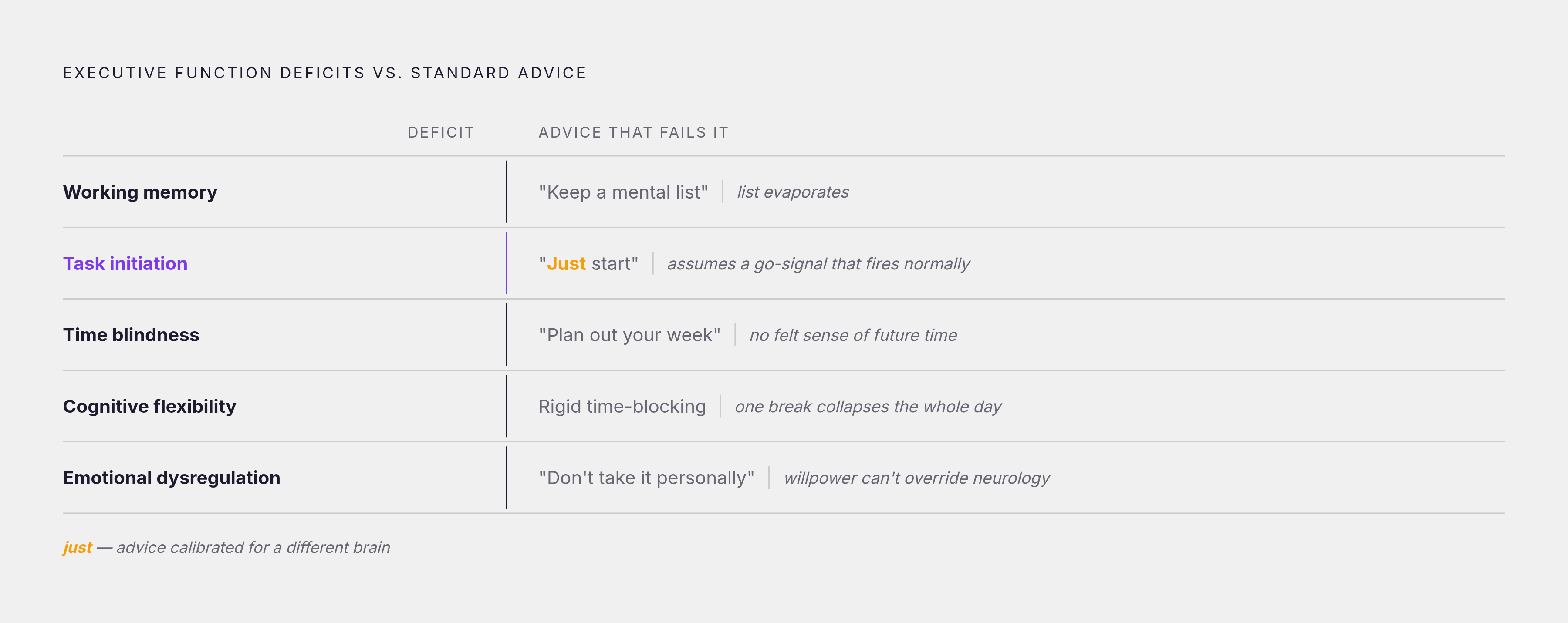
Most productivity advice assumes intact executive function. It's built for a brain that initiates on command, tracks time accurately without external props, holds a plan in working memory without it evaporating, and shifts between tasks without friction. Handing that advice to an ADHD brain is a bit like prescribing the same glasses to everyone regardless of vision: the tool might be sound in principle, it's just calibrated for a different system entirely. Here's the position worth landing on: the advice industry's biggest blind spot is that most of its ideas were never built for this brain in the first place, and no amount of trying harder closes that gap.
Line the deficits up against the standard advice and the mismatch gets obvious fast. Working memory deficits meet "just keep a mental list," and the list evaporates within minutes, leaving the person to conclude they're simply disorganized by nature. Task initiation deficits meet "just start," and the word "just" is doing all the damage there, since it assumes a go-signal that fires normally in the first place. Time blindness meets "plan out your week," and without a felt sense of future time, a week-level plan has no motivational grip on the present moment at all. Cognitive flexibility deficits meet rigid time-blocking, and the instant the schedule breaks, which it eventually will, there's no recovery mechanism built in, so the whole day tends to collapse rather than bend.
Emotional dysregulation runs into "don't take it personally," which asks a person to override a neurological response using willpower, the exact resource in shortest supply during a dysregulated moment. Lining up all five, the pattern is hard to miss: people with ADHD keep running into advice built for a different system, and no amount of trying harder fixes a mismatch at that level. So what would actually work? Any framework worth using has to start from the deficit itself: working memory, initiation, time perception, flexibility, emotional regulation, and build backward from there, rather than starting from a productivity philosophy and hoping the ADHD brain will bend to fit it. Expecting that bend is the mistake underneath most of the advice this piece has been arguing against.