What Task Paralysis Is in ADHD
The wall between intention and action is a broken dopamine circuit, not weak willpower.

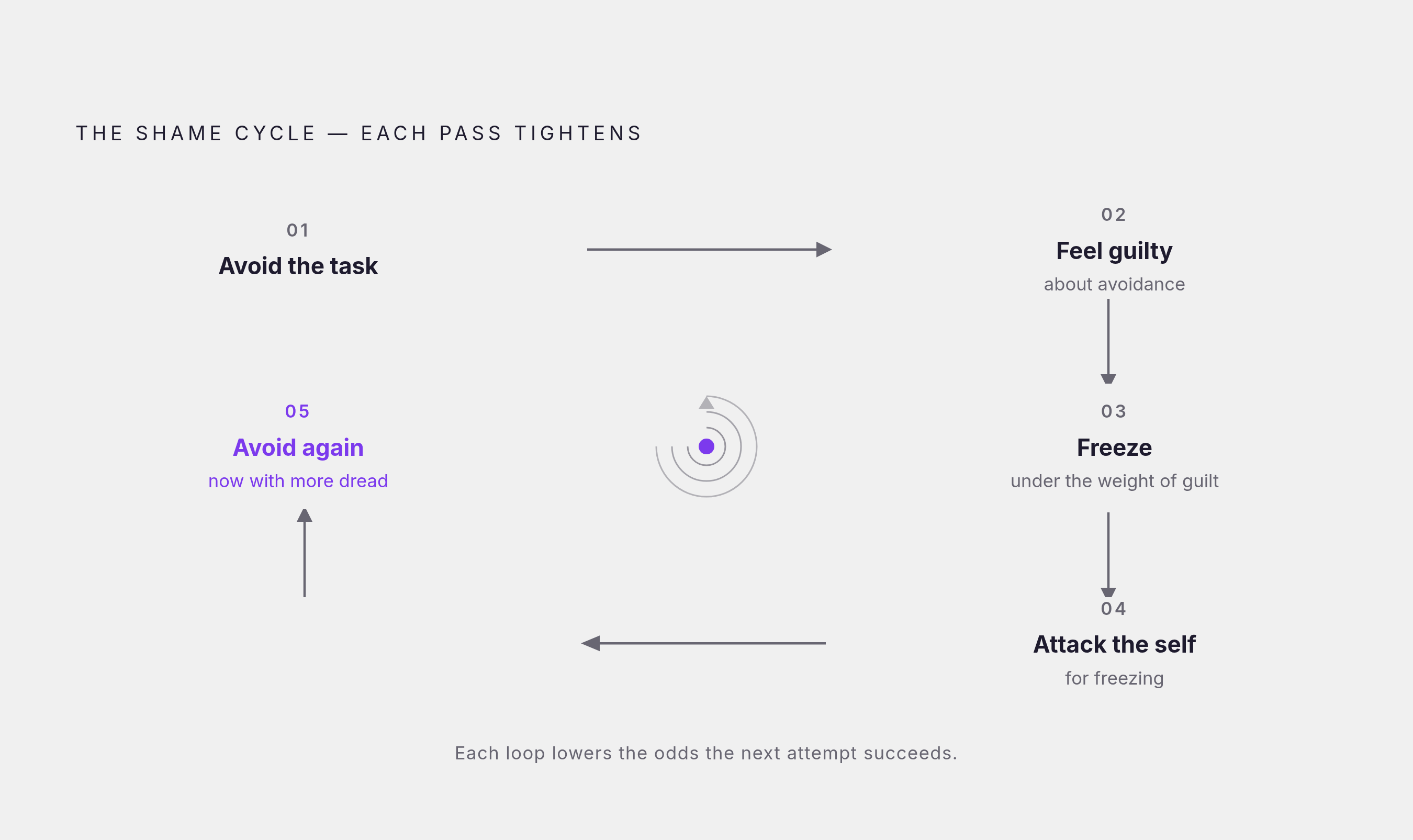
The task sits there. The deadline is understood and the consequences are known, and nothing happens anyway: not avoidance exactly, more like a wall that appears between knowing and doing. Most people's first explanation for this is some combination of laziness, weak character, or a failure of willpower, and that explanation is not just inaccurate. It actively makes the problem worse. Productivity culture has spent decades treating inertia as a moral failure rather than a mechanical one, and Daniel Dashnaw argues that this framing forces people with ADHD to carry shame on top of a neurological difficulty they did not choose and cannot simply decide away. The two burdens stack: the executive dysfunction itself, and then the self-judgment layered over it for having the dysfunction in the first place. That stacking produces a loop with its own momentum. A person avoids the task, feels guilty about the avoidance, freezes further under the weight of the guilt, attacks themselves for freezing, and then avoids the task again, now with more dread attached to it than before. Each pass through that cycle lowers the odds of the next attempt succeeding. None of this starts with character. It starts with a specific, identifiable breakdown in how the brain converts intention into motion, and the rest of this piece works through what that breakdown actually is.
Executive function
To understand why the wall appears, it helps to know what it is a wall in. Executive function is the brain's self-management system, the set of processes that decide what to do, when to do it, and in what order, and ADHD disrupts this system at a neurological level rather than a motivational one. ADDitude describes executive functions as the higher-order cognitive skills that govern planning, prioritizing, working memory, task initiation, time management, inhibitory control, and emotional regulation. Working memory is what lets someone hold a recipe's next three steps in mind while their hands are busy with the current one. Inhibitory control is what keeps a phone face-down during a meeting even though checking it feels urgent. Set-shifting is what allows a person to pause a task mid-stream, answer a colleague's question, and then return to where they left off without losing the thread. When any one of these falters, the effects appear immediately and concretely in a missed step, a blurted interruption, or a lost place in a task.
One might argue that ADHD is fundamentally a disorder of attention, since that is the word in its name. Leading researchers, including Barkley, as cited in Dashnaw's analysis, argue otherwise: ADHD is better understood as a disorder of executive function and self-regulation, with attention difficulties as one downstream symptom among several rather than the root cause. That reframing matters because it changes what the problem is actually located in. A 2025 systematic review of EEG studies in adults with ADHD backs this up at the level of brain activity itself, finding that response inhibition, sustained attention, and cognitive control, including error detection and attention allocation, are consistently affected, with measurable neural signatures distinguishing ADHD brains from neurotypical ones. Executive dysfunction, then, is the symptom cluster that explains why ADHD looks the way it does in daily life, from the missed deadline to the unanswered email to the stalled project. With that foundation in place, the next question follows naturally: of all the executive functions that can falter, which one produces the specific experience of paralysis, the dead stop between wanting to act and acting?
The specific breakdown in ADHD: why intention does not become action
Task initiation is the answer: the gap between intending to do something and actually starting it is a neurological failure of the initiation circuit, not a gap in desire or understanding. It contradicts almost everyone's intuition about how motivation works. Dr. Sharon Saline's framework describes the disconnect: people with ADHD know the task, want to complete it, and still cannot begin, because the decision to start does not automatically trigger the neural cascade that produces action. The wanting is genuine. The knowing is genuine. The bridge between them is where the structure gives way.
Why would a decision fail to trigger action? The answer runs through dopamine. ADHD is associated with differences in dopamine pathways that govern motivation and reward processing, and when a task offers no immediate stimulation or reward, the brain cannot generate sufficient drive to begin, even when the task is objectively urgent or important. Barkley's framing, as cited by Dashnaw, puts this in terms of self-activation: ADHD impairs the ability to self-activate toward future goals, particularly under low-stimulation conditions, so that initiation depends on externalized structure or a high-interest trigger to fire at all. A task does not become easier to start just because it matters more. If anything, importance without immediate stimulation can make the initiation threshold harder to clear, not easier. The 2025 Frontiers review grounds this in measurable brain activity: elevated theta power at rest, and reduced Pe, P3, and N2 amplitudes during response inhibition tasks, with further reductions in sustained attention tasks, show that this dysfunction is visible at the neural level and not just inferred from behavior.
Several factors push that initiation threshold even higher. Saline identifies overwhelm, where a task that feels too large shuts the brain down before any action occurs, and perfectionism paired with fear of failure, where shame activates avoidance before the first step is even attempted. Boredom plays a role too: a low-dopamine task simply fails to produce enough drive to begin. Time blindness compounds all of it, distorting the ADHD brain's sense of duration until every task feels simultaneously urgent and impossible. Put together, overwhelm, perfectionism, boredom, and time blindness make the paralysis stop looking mysterious. It is a predictable outcome of a circuit that requires external scaffolding to fire, confronted with a task that offers none.
How shame and stigma compound a neurological difficulty into a cycle
Knowing the mechanism answers one question but raises another: if the freeze is neurological, why does it so often come wrapped in so much self-blame? Shame does not motivate action in ADHD. This is a second mechanism, running in parallel with the first, rather than a side effect of having ADHD in a judgmental culture, and it needs to be understood on its own terms rather than treated as an emotional footnote.
Internalized stigma develops when people with ADHD absorb the public messaging that frames their difficulties as moral failures: laziness, irresponsibility, weakness. That absorption has measurable consequences. Research documents that greater ADHD symptomatology correlates positively with more internalized stigma, which in turn is linked to functional impairment, worse self-esteem, and poorer quality of life. The shame is functionally costly, in ways that compound the original executive dysfunction rather than sitting apart from it.
Dashnaw draws on Porges' Polyvagal Theory to explain why this happens at a physiological level: when the brain perceives a task as a threat to identity or safety, task paralysis becomes a dorsal vagal shutdown, a genuine freeze response rather than a decision anyone is making. That reframes the stuck feeling entirely. It is a nervous system responding to perceived threat the same way it would respond to any other danger, by shutting down rather than engaging. For people who grew up in unpredictable environments, this threshold can be lower still. Trauma and childhood unpredictability can wire tasks as tests of worth rather than neutral events, so that an unfinished task registers as "I am bad" rather than simply "I did not finish," which raises the activation threshold even higher. Saline notes that people with ADHD are considerably more likely to experience anxiety disorders, so the emotional cost of this cycle is not mild discomfort but clinically significant distress.
The loop reinforces itself with each pass: avoid, feel guilty, freeze, attack the self for freezing, avoid again, each repetition making the next attempt less likely to succeed than the one before it. What does this imply for how the problem should be approached? Shame and pressure make paralysis worse, while compassion paired with structure create the actual conditions for movement. That is not a comforting platitude so much as a direct prediction of how a threat-response system behaves when the threat is removed instead of intensified.
Why generic productivity advice fails to address initiation
If the breakdown is this specific, it should be no surprise that generic advice misses it so reliably. Standard productivity strategies assume the initiation circuit is intact, which fails to hold in ADHD, so applying those strategies without adaptation reliably produces failure and, with it, more shame. Consider the most common advice of all: just start. That instruction assumes intention and action are connected by a simple act of will, and for ADHD brains that connection is neurologically disrupted, as the mechanism described above establishes. Telling someone to just start a task is telling them to use a bridge that is not fully built.
Each of these maps directly onto a specific ADHD executive function deficit, built around the capacities that are compromised, so the advice carries real weight, and the mismatch is concrete. The gap appears in treatment outcomes: between 41 and 60 percent of adolescents receiving behavioral treatment for ADHD show little to no improvement, with lack of motivation, engagement, and reward saliency identified as key contributors. The strategy existing is not the same as the strategy being designed around the right mechanism, and that distinction is what separates an approach that helps from one that quietly fails while looking reasonable on paper.
None of this reflects a gap in effort or discipline on the part of people with ADHD. It reflects a design problem: the tools were built for a different brain. That reframing sets up the real question. If internal self-management is the thing that is broken, what would a strategy look like that did not depend on it?
Strategies designed around how the ADHD initiation circuit operates
Effective ADHD strategies share a single design principle: they replace internal self-activation with external structure, and they lower the activation energy required to begin. Each of the approaches below targets one of the specific failure points described earlier, rather than asking the ADHD brain to simply try harder at the thing it struggles to do.
Task decomposition addresses overwhelm directly. When a project feels large and undefined, the brain can panic and freeze before any action occurs, so decomposition works by shrinking the first step until it falls below the initiation threshold. The 2-Minute Rule, cited in the research and by Saline, replaces "clean the house" with "put three items away," a micro-task small enough to complete immediately and specific enough to provide a dopamine signal that builds momentum toward the next step. Saline applies the same logic with children, breaking a writing assignment into "write the title," "open Google Docs," "list three ideas," where each completed micro-step builds confidence and reduces the dread attached to the one after it. Tools can carry this load automatically rather than requiring a person to do the breaking-down themselves while already stuck. Goblin Tools' Magic ToDo function, which is free, browser-based, and requires no sign-up, takes a vague task and converts it into a step-by-step checklist, removing both the planning burden and the friction of the first move.
Time blocking and structured sprints address time blindness specifically. Because the ADHD brain cannot reliably perceive how long a task will take or how long it will feel, unstructured time itself becomes a trigger for paralysis. Time blocking replaces that uncertainty with an external, visual structure for the day, so the brain is not asked to estimate or decide in the moment how long something should take. The Pomodoro method, built around 25-minute work blocks separated by breaks, follows this same principle and is well established among ADHD practitioners as a way to impose external timing on a brain that struggles to generate it internally.
Body doubling works on a different point of failure: the ADHD brain's difficulty self-activating without an external trigger. Knowing that another person is present and working supplies exactly that kind of external motivation, compensating for a self-activation deficit that no amount of personal resolve reliably overcomes on its own. This is particularly useful against what practitioners call the wall of awful, the wave of emotional and motivational resistance that builds up in front of a dreaded task before it ever gets started. Several services now formalize this arrangement into structured, timed sessions with a work partner, among them Focusmate, Flown, and Caveday. Saline recommends the same principle for children, suggesting that working alongside a parent or peer reduces isolation and provides the external anchor that self-directed effort alone cannot supply.
Externalized decision-making targets a subtler failure point: every decision that has to be made before a task begins is another opportunity for the initiation circuit to stall out. Fewer in-the-moment choices mean less total friction standing between a person and the first step. A tiered system that limits the day to three genuine must-do items externalizes the work of prioritizing, so a person is not forced to re-decide what matters most every time they sit down. Consistent routines accomplish something similar over a longer timeline, reducing the number of decisions required for repetitive tasks until those tasks become close to automatic.
These approaches are a direct response to a known mechanism, each one aimed at the specific place where the initiation circuit gives way, whether that is overwhelm, time blindness, self-activation, or decision load. That is the shift this entire piece has been building toward: from treating paralysis as a mystery to be willed away, to treating it as a circuit that can be understood, and worked with, on its own terms.