ADHD Body Doubling Explained
The dopamine boost from another person's presence can transform focus for ADHD brains.
Body doubling means working alongside another person, in the room or on a screen, for no reason other than that their presence changes what your brain does with the task in front of you. It's been an open secret in ADHD circles for years, and the research is only now catching up to what people already figured out by trial and error. About 15.5 million U.S. adults, 6.0% of the population, carry a current ADHD diagnosis according to 2023 CDC data, and that number almost certainly misses everyone who's never been formally evaluated. This piece is about why body doubling works, what the evidence says and doesn't say, and how to actually use it.
That 15.5 million figure needs some unpacking before we go further. Of adults diagnosed with ADHD, 55.9% got that diagnosis as adults, which means most of them spent decades navigating school and work and relationships with zero framework for what was happening in their own heads. Treatment access isn't great either: 36.5% of U.S. adults with ADHD received no treatment at all last year, no medication, no counseling, nothing, and roughly a third of those on medication ran into shortages at the pharmacy. Undertreated and underdiagnosed at the same time, a combination that's exactly what's pushed so many people toward strategies that don't require a prescription pad or a copay.
What executive dysfunction actually means for getting things done
Executive functions are the mental processes that let you plan a task, actually start it, hold your attention there, and not fall apart when something goes wrong halfway through. They're the management layer sitting above whatever skill the task itself demands. ADHD disrupts that layer consistently, not occasionally: a systematic review found a large share of adults with ADHD score below typical ranges on standard executive function tests. This isn't a bad day here and there; it's structural.
The disruption shows up differently depending on presentation. Inattentive ADHD tends to hit what researchers call "cold" executive functions, planning and working memory, the organizational side of things. Hyperactive presentation leans harder on "warm" executive functions, motivation and impulse control, the side tangled up with emotion. Same underlying vulnerability, different symptoms on the surface. A 2025 meta-analysis complicated this picture further by finding hypoactivation in the parietal lobe, which pushes the science past the old frontal-lobe-only model. Turns out the brain's executive control network is bigger than the earlier theories accounted for, and ADHD seems to touch more of it than anyone assumed twenty years ago.
Underneath all of it is dopamine. Motivation and reward circuits run on dopamine signaling, and in ADHD brains that signal runs low. A task with no built-in urgency, no deadline breathing down your neck, no obvious payoff, can feel less like something unappealing and more like something that doesn't register at all. Not boring, but invisible.
None of this is a willpower problem, and it's worth saying that plainly. The ADHD brain is missing the internal cue that would normally generate the urge to just start. Once you see it that way, the question of what a "fix" should look like changes shape entirely. If the missing piece is an internal signal, you fix it by supplying that signal externally, which is the exact mechanism body doubling runs on.
What body doubling is, and what it is not
The definition is almost too simple to trust: you work near another person whose only job is to exist in that space. Dr. Michael Manos at Cleveland Clinic calls it a form of external executive functioning, meaning the other person does regulatory work your own brain can't reliably produce on its own.
Worth being clear about what it isn't. The double doesn't need to know anything about your task. There's no check-in built in, no judgment, no accountability meeting disguised as a favor. Conversation is optional, and in most sessions it just doesn't happen.
Your double can be a close friend, a total stranger on Zoom, or, in some formats now, a pre-recorded video of someone else grinding through their own work. Presence is the active ingredient here, not relationship, and that's actually freeing once it clicks. You're not asking anyone to care about your spreadsheet; you're asking them to be somewhere near it.
Plenty of people with ADHD have been doing versions of this for years without a word for it. Homework at a parent's kitchen table instead of your own desk. Working from a coffee shop instead of the quiet apartment where you actually live. A podcast running in the background just so there's a voice in the room. Most people who did this felt a little odd about it, like they were covering for some private failing. Giving it a name changes the story. "Weird habit I can't explain" becomes "deliberate strategy with a mechanism behind it," and that reframe is worth more than it sounds like on paper.
The three mechanisms that explain why another person's presence helps
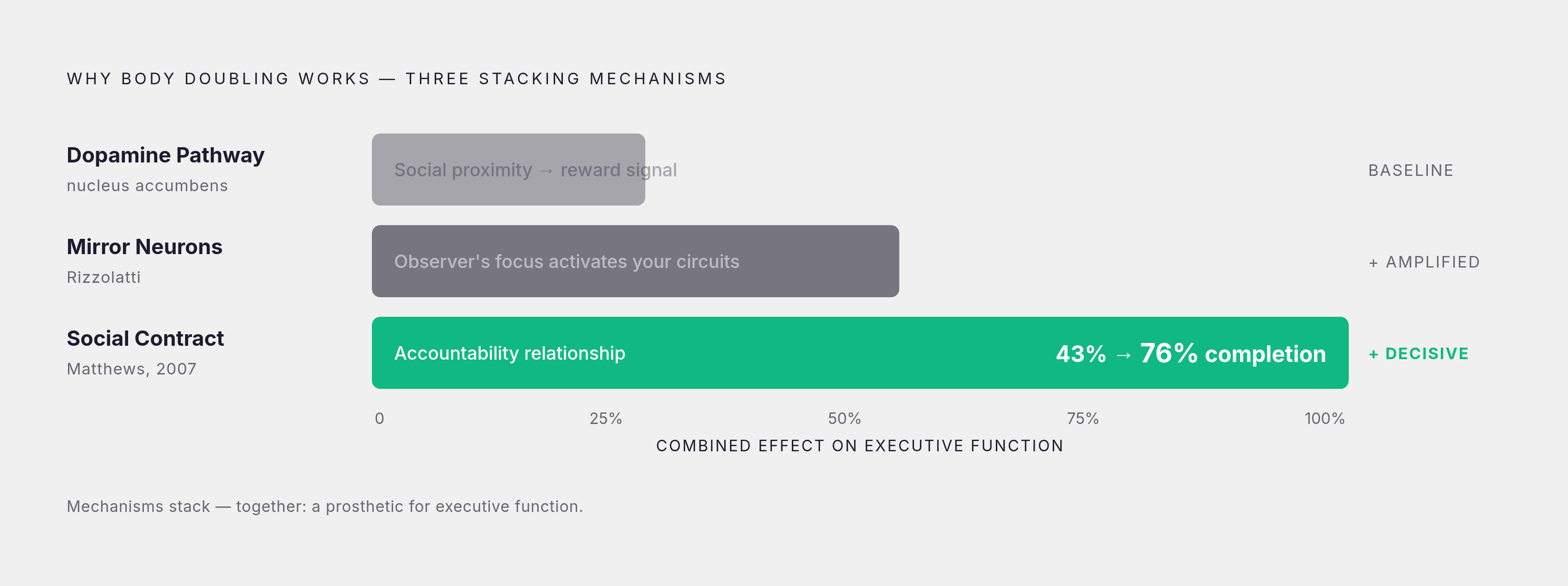
Three overlapping mechanisms drive this, and each one runs on its own separate logic.
First: dopamine pathway activation. Kopec and colleagues, in 2019, showed that social encounters activate the dopamine reward pathway in the nucleus accumbens, the brain's main reward hub. In ADHD brains, where dopamine signaling in the prefrontal cortex and striatum is already running dysregulated, another person's presence gives that circuitry a nudge, something close to the "okay, let's go" signal the brain otherwise struggles to generate on demand. The effect comes from proximity, not participation, not conversation, just proximity.
Second: mirror neurons. Giacomo Rizzolatti's research identified neurons that fire both when you perform an action yourself and when you watch someone else do it. Watching another person work, even peripherally, out of the corner of your eye, activates some of the same circuitry involved in doing the work yourself. Your double becomes a kind of behavioral mirror; their focus quietly broadcasts that concentration is happening here, in this room, right now.
Third: the social contract. Matthews, in a 2007 study, found goal completion rates jumped from 43% to 76% when an accountability relationship was in place. Body doubling rarely involves explicit check-ins, but even without them, another person's presence sets up a soft, unspoken contract. Leaving the task early feels different when there's a witness, even a silent one on a laggy video call. That external cue substitutes for the internal one that would normally keep you anchored, and for ADHD brains specifically, that substitution does real, measurable work.
These mechanisms don't run in isolation; they stack on top of each other. Sit in a busy library and you get a little ambient mirror-neuron effect for free. Body double on purpose, with intention, and you get all three firing at once, each one supplying something the ADHD brain can't reliably manufacture by itself. Put together, it functions less like a trick and more like a prosthetic for executive function, the same way glasses fill a gap in vision rather than fixing the eye itself.
What the research actually shows, and what it leaves open
The formal evidence base is young, genuinely young. The first academic study treating body doubling as a legitimate assistive technology strategy came out only recently, and it exists specifically because there was a huge gap between how much ADHD communities relied on this practice and how little anyone in academia had bothered to study it.
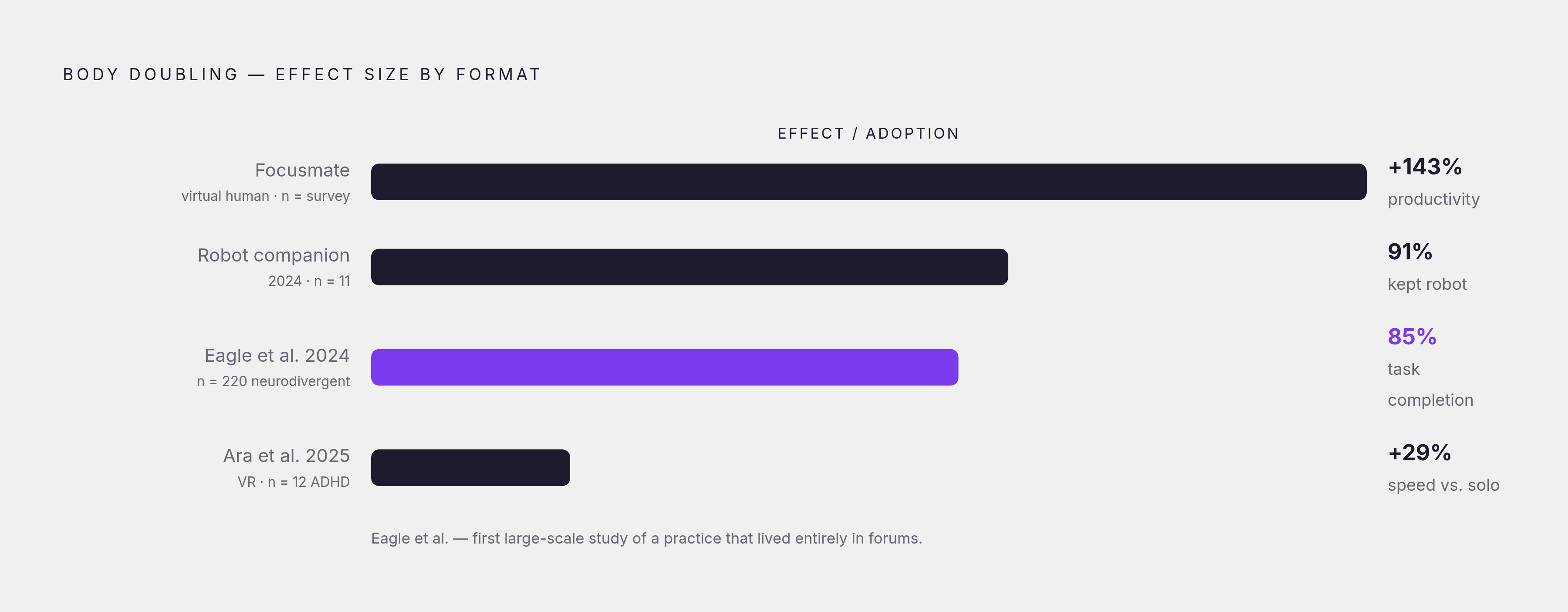
The landmark paper is Eagle and colleagues, 2024: a survey of 220 neurodivergent participants, published in ACM Transactions on Accessible Computing, found 85% reported significant improvement in task completion, the first large-scale number behind something that had lived entirely in forums and Discord servers up to that point.
A 2025 VR study by Ara and colleagues went a step further, testing 12 adults with ADHD across three conditions: solo work, working with a human double, working with an AI double. Both doubling conditions beat solo work by 27 to 30% on task completion speed, with better sustained attention in both cases too. Separately, a small 2024 study on robot companions found 10 out of 11 college students with ADHD chose to keep an attention-monitoring robot after a week, about 91% retention, which suggests this isn't strictly about human presence. Something in the felt sense of "another entity is here" seems to be doing the heavy lifting, whether that entity is a person, an AI, or a small robot sitting on your desk.
Now for the caveats, and they deserve real attention rather than a passing mention. No large-scale randomized controlled trials exist yet. Some experiments have turned up self-reported benefits without a matching statistically significant difference in objective measures, a gap Psychology Today flagged in 2025. Social cognition in ADHD isn't uniform across the population; for some people, another person's presence distracts rather than anchors, especially when anxiety is already part of the picture. And calibration cuts both directions: too much social presence spikes stress and backfires, too little doesn't generate enough activation to matter at all.
So where does that leave us? Directionally strong, growing fast, not universal. It's a tool that works well for a lot of people with ADHD, and whether it works for you specifically is something you find out by trying it, not by reading about it.
Why body doubling is especially useful for task paralysis specifically
Task paralysis is its own particular flavor of stuck. You know exactly what needs doing, and you might even want to do it, but you cannot, for reasons that feel entirely outside your control, make yourself begin. This is the failure mode body doubling is built to interrupt, more than distraction, more than disorganization, because it goes straight at initiation.
Why does this happen at all? Initiation needs an internal "go" signal, some jolt of urgency or motivation, and ADHD brains often can't produce that signal on command for low-stimulation tasks, regardless of how objectively important the task is. Body doubling supplies a substitute from outside. Another person's presence raises your overall nervous system activation just enough to lower the threshold you need to clear before you can start.
Task paralysis also compounds on itself, and this part matters. The longer you delay, the more shame piles up, and the more shame piles up, the harder starting gets. It's a loop, and it gets worse every time it runs uninterrupted. Body doubling short-circuits that loop by changing the environment around the task instead of demanding you override your own neurology through sheer effort. That distinction actually matters, because "just push through it" has never worked reliably for this population, and expecting it to work is part of what generates the shame in the first place.
This is also why so many people with ADHD can knock out a task at a coffee shop that they simply cannot touch alone at home. The environment is doing regulatory work that their own brain isn't generating on its own in that moment. Needing that external trigger isn't laziness, and it's not a weaker version of willpower than what other people supposedly have. It's a predictable consequence of how dopamine and the initiation system function differently in ADHD, and body doubling is a direct answer to that specific consequence, nothing more mystical than that.
The formats available today, from in-person to AI, and how to choose
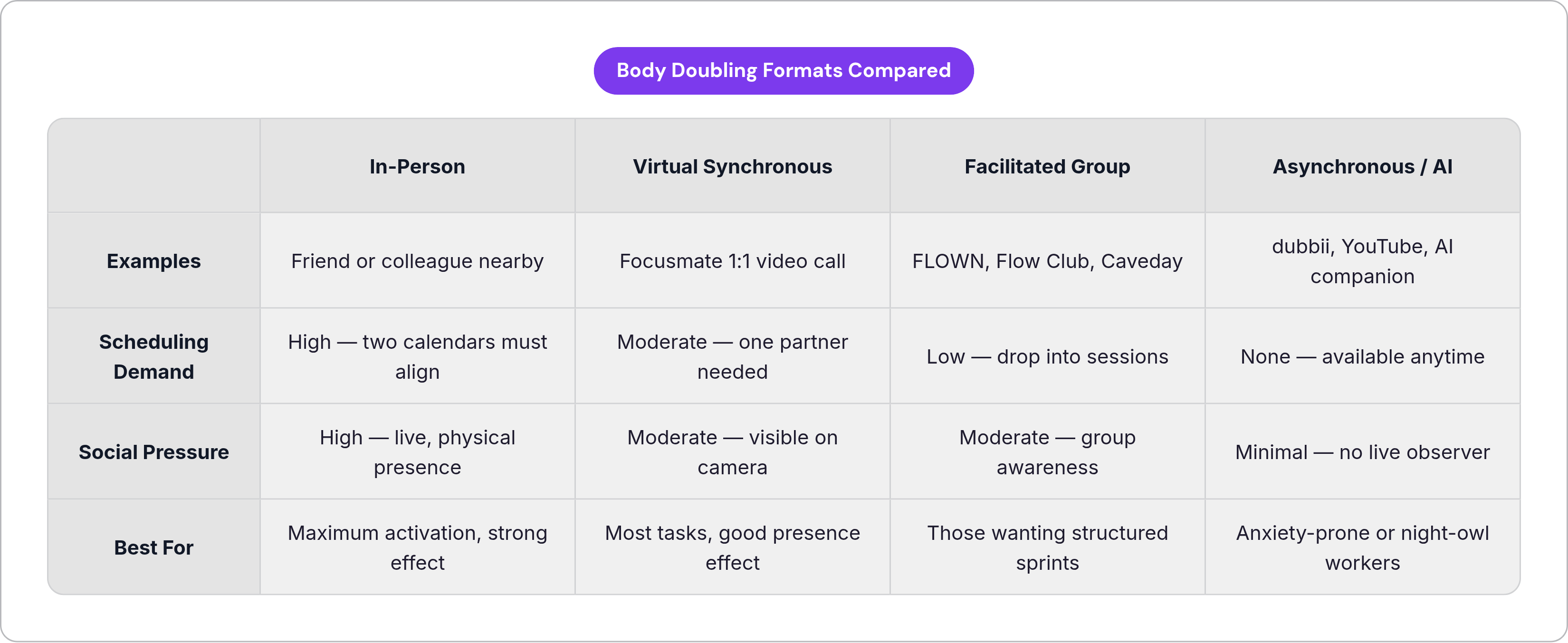
You don't need a friend willing to camp out in your living room for two hours. The format spectrum has widened a lot, especially since the pandemic normalized remote coworking for basically everyone. Eagle and colleagues framed body doubling, in their 2024 paper, as a continuum across space, time, and reciprocity, and that framework actually helps when you're trying to match a format to what you need.
On one end: in-person, synchronous doubling. A friend or colleague working nearby. High presence, strong effect, but it requires two calendars lining up. Virtual synchronous sessions, a video or audio call with one other person or a small group, come close to matching that effect for most purposes while cutting out the logistics headache entirely.
Then there are platforms built around exactly this. Focusmate pairs you with a stranger for 1:1 video sessions; the company's internal survey reports an average productivity increase of 143% among users. FLOWN, Flow Club, and Caveday run facilitated group sessions with hosts and structured work sprints, which suits people who want more scaffolding than a silent call gives them.
Asynchronous options exist too, and they strip out even more coordination cost. A platform called dubbii offers pre-recorded task walkthrough videos, so you follow along with someone completing a similar task with zero live coordination needed. YouTube's enormous stash of "study with me" and "work with me" videos does much the same job, and it's popular in ADHD communities for the obvious reason that it's free and requires no scheduling whatsoever.
AI companions are the newest arrival, and that 2025 Ara VR study found AI doubles produced task completion gains nearly matching the human condition. The appeal is obvious enough: always available, zero social anxiety, no risk of a judgmental glance from across the call. What's still unresolved is whether an AI presence holds up motivationally over weeks and months the way a human one might. Nobody's run that longer-term controlled trial yet.
Choosing among these comes down to a handful of honest questions. How much does being watched live actually trigger you versus support you? Do you have a willing human partner on hand? What kind of task are you tackling today, and how much external structure do you genuinely need to stay anchored to it? If live observation feels like pressure rather than backup, asynchronous or AI formats give you the presence effect minus the social threat. And if the real sticking point isn't the doubling itself but figuring out what to even work on once the session starts, something like Mindflow can fill that specific gap, helping you define the task and break it into milestones before the clock starts, so the session gets spent on the work instead of on deciding what the work even is.
How to set up a body doubling session so it actually works
Here's the most common way these sessions fail: you show up with no defined task, and the whole thing drifts into something vague instead of anchoring you to anything real.
Name the task before the session starts, and be specific about it. "Write the first paragraph of the report" gives your brain something to grab onto, while "Work on the report" gives it nothing. The accountability research backs this up directly: stating a goal out loud to another person raises completion rates on its own, meaning declaring intention is part of the actual mechanism, not just throat-clearing before the real work.
Pick your session length on purpose instead of defaulting to whatever feels standard. Shorter, repeated sessions tend to beat marathon ones for ADHD; a 25-minute Pomodoro-style block is a reasonable place to start for most tasks. Match the length to how hard the task actually is and how much energy you have that particular day, not to some abstract idea of how long a focused person should be able to sit still.
Cut friction before the clock even starts. Open the document in advance, and turn off notifications. Keep the physical space as low-distraction as you can manage, and if it's virtual, join a couple minutes early instead of scrambling in right at the start, since that scramble alone eats into the momentum you're trying to build in the first place.
Afterward, jot down what actually got done, even a single line. That closes the loop, and it builds a running record of small wins that compounds over weeks in a way that's easy to underrate while you're in it.
If your first attempt at a format falls flat, that's information about fit, not proof the whole strategy is broken. Try a shorter session, try a different platform, or switch from synchronous to asynchronous before writing off body doubling entirely. Mindflow's voice-first task entry fits naturally here too: define and break down the task before the session starts without typing it all out, then log progress afterward the same way.
Why needing a body double is not something to feel embarrassed about
A lot of adults with ADHD carry a quiet shame about needing this at all. It can feel like admitting you can't function the way everyone else apparently manages to, like your brain requires training wheels that everybody else outgrew years ago.
That shame is worth taking apart, because it rests on a premise that doesn't hold up. Needing external structure is a direct, documented consequence of how dopamine signaling and executive function work differently in ADHD brains. Neurotypical environments, and most neurotypical productivity advice, quietly assume a person can generate their own internal cues to start a task, stick with it, and finish. For a lot of ADHD brains, that assumption just doesn't hold, and that's not a character failure or a lack of effort. Body doubling corrects for an assumption that was never true for everyone in the first place.
Worth remembering too that this strategy didn't come out of a lab. ADHD communities used it informally for decades, long before any researcher gave it a name or ran a controlled study, because it worked well enough to spread on its own, person to person, forum thread to forum thread. The research is playing catch-up to lived experience here, and that ordering says something. It means the people doing homework at the kitchen table, working with a podcast on for company, joining a stranger's Focusmate session at midnight because that was the only way the report was getting written, were onto something real long before anybody thought to measure it.