ADHD Workplace Accommodations Guide
Most workplaces still treat ADHD like an afterthought, leaving millions without support.

Roughly 6% of U.S. adults, about 15.5 million people, now carry an ADHD diagnosis. What's less discussed is that most workplaces still treat ADHD accommodation like an afterthought bolted onto policies built for wheelchair ramps and screen readers, not for a condition that lives in working memory and task initiation. This piece walks through what that mismatch costs, what the research says actually closes the gap, and how to ask for help whether or not your employer has caught up yet. I spent months in this research, and honestly, the distance between what's documented in the literature and what companies actually do is wider than I expected going in.
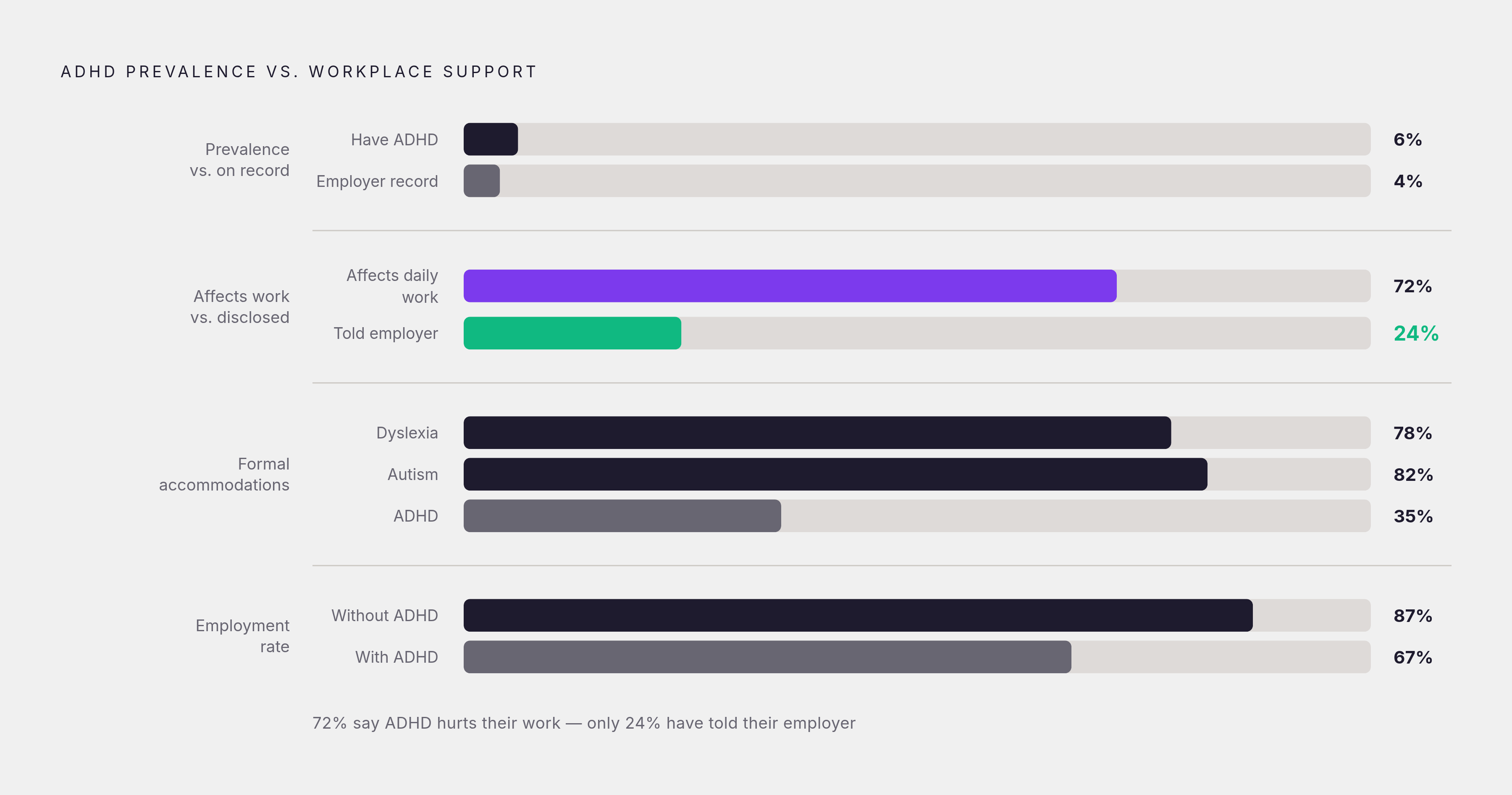
That 6% figure is up from 4.4% in 2006, according to the CDC's 2023 National Health Statistics Report and the Harvard National Comorbidity Survey Replication. Close to half of those diagnoses came after age 25, a wave driven largely by women who got missed entirely as kids, the inattentive presentation not fitting the hyperactive-boy stereotype that shaped decades of clinical criteria. Yet only about 4% of the workforce holds a formal diagnosis on record with their employer. Do the math on that gap and you start to see the shape of the problem before you even get to the accommodations question.
A 2024 Deloitte Neurodiversity at Work survey found only 24% of employees diagnosed with ADHD had told their employer, while 72% of those same employees said ADHD materially affects their day-to-day performance. People stay quiet for reasons that aren't hard to understand: fear of being treated differently, doubt that a request would go anywhere, and the fact that filling out accommodation paperwork is itself an executive function tax on someone whose executive function is already stretched thin. Add it up and most companies are undercounting ADHD in their workforce by something like fourfold.
There's a second gap sitting on top of the first one. A 2024 SHRM survey found only 35% of U.S. employers offer formal accommodations specifically for ADHD, compared with 78% for dyslexia and 82% for autism. Some of that is just structural bad luck: the accommodations that actually help ADHD brains are process changes, not equipment purchases, and process changes don't fit neatly into a benefits binder organized around physical infrastructure. Workplace design hasn't caught up with what's already understood about the condition, and that's the gap this piece sits inside.
What ADHD costs workers and employers when accommodations are absent
Start with employment itself. Only 67% of adults with ADHD are employed, compared with 87% of adults without it, according to research in the Journal of Attention Disorders. Full-time employment shows a similar split, 47% versus 62%, per NIH data. These margins show up consistently enough across different datasets that they stop looking like noise.
Job stability tells the same story from another angle. Adults with ADHD average 2.9 jobs every five years, against 1.7 for adults without the condition; they're 60% more likely to be fired at some point in their career, and roughly three times more likely to quit a job impulsively. Line those numbers up and what you're looking at is a mismatch between how these brains function and how most jobs are structured, playing out across millions of people simultaneously.
The financial toll follows directly from there. Earnings among adults with ADHD run up to 33% lower than peers without the condition globally, a gap wider than documented earnings disparities by gender or race within the same populations. The Center for Brain Health puts this at $301 billion in lost income across the national workforce annually, with per-worker productivity losses landing somewhere between $8,900 and $15,400 a year compared to colleagues without the diagnosis.
Read those numbers cold and you might conclude ADHD workers are less capable, or less committed, but that reading falls apart the moment you look at where the actual breakdown is happening. Which is where the next section goes.
Why ADHD is an executive function problem, not an attention or motivation problem
Executive function is the set of cognitive processes, working memory, inhibitory control, cognitive flexibility, that let a brain plan, organize, and regulate itself toward a goal. Russell Barkley, one of the most cited researchers in the field, has argued for decades that ADHD is a disorder of executive functioning and self-regulation. That's a meaningfully different claim than the one people make when they say someone "can't focus" or "just isn't motivated." Under Barkley's response inhibition model, weak inhibitory control is the primary driver; the forgetfulness, the disorganization, the trouble switching tasks all follow as secondary effects downstream of that.
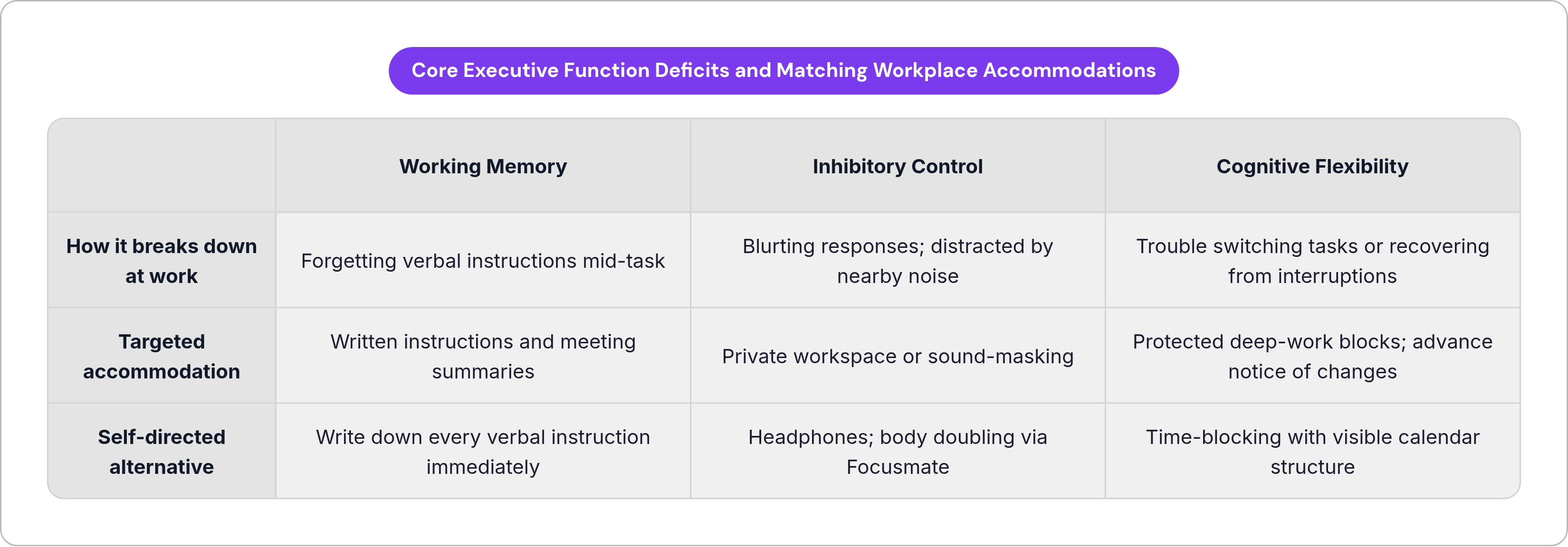
Put the three components against an actual workday and the abstraction disappears fast. Working memory deficits look like forgetting a verbal instruction thirty seconds after hearing it, or losing the thread of a task mid-execution. Inhibitory control deficits look like blurting out a half-formed response in a meeting, or losing the fight against a coworker's conversation two desks over. Cognitive flexibility deficits show up as trouble shifting from one project to another, a kind of rigidity when plans change last minute, or a hard time getting focus back after even a small interruption.
A 2024 field study of 171 employees found the ADHD-to-burnout relationship runs specifically through these executive function deficits rather than through ADHD symptoms directly. Physical fatigue was mediated by poor self-management of time, while emotional exhaustion and cognitive weariness were mediated by deficits in self-organization and problem-solving. ADHD workers aren't trying less; their internal scaffolding is working overtime just to keep pace, and that overtime is what burns them out.
Survey data from Akili and Wakefield Research, which polled 500 employed adults with ADHD in 2023, backs this up from the inside. Fifty-nine percent cited being easily distracted as a primary workplace concern, 56% reported a lack of focus and engagement, and 32% said they struggled to build relationships with colleagues. Ninety percent described making errors, having conflicts, or working extra hours because of ADHD-related challenges, and 46% had missed a deadline or meeting outright.
So if the breakdown happens at the level of executive function, the fix has to happen there too. Accommodations that hand the brain external scaffolding, instead of asking it to build that scaffolding from scratch under pressure, have a real shot at working. Accommodations that just ask someone to try harder are solving for the wrong variable.
What the research says about which accommodations actually reduce ADHD workplace impact
A 2025 University of New Hampshire study found 79.3% of respondents said ADHD negatively affected their work performance, but only 58.5% actually used any kind of workplace adjustment. Among that smaller group, the results were striking: a large majority reported reduced stress and anxiety, and most reported improved productivity. The same study flagged what doesn't help, rigid structures and open-plan offices rated among the least effective setups in the survey. A lot of standard office design works against exactly what these brains need to function.
Sort what works by the executive function deficit it's targeting, and a clearer picture starts to form than if you just treat accommodations as one flat list.
Written instructions and meeting summaries matter more than they sound like they should for working memory specifically. Verbal information evaporates fast for an ADHD brain; a written record externalizes it before it disappears entirely. A 2023 Atlassian study of 5,000 knowledge workers found meetings without written action items produced substantially less follow-through of meetings that had them. That's a cheap fix with a measurable payoff. Asynchronous status updates cut the real-time cognitive load of verbal recall, and shared task-tracking systems with explicit priorities beat informal verbal assignments that depend on someone remembering what they were told in a hallway three hours earlier.
For time blindness and task initiation, flexible or protected deep-work blocks came out among the most valued accommodations in the UNH study. Time-blocking gives the brain an externalized visual structure that tells it what to do and when, cutting decision fatigue right at the moment initiation friction tends to spike. Remote or hybrid arrangements solve two problems at once, removing commute-driven time pressure while also reducing open-office distraction. Breaking a big project into milestone check-ins instead of one looming due date addresses both time blindness and the overwhelm that drives avoidance in the first place.
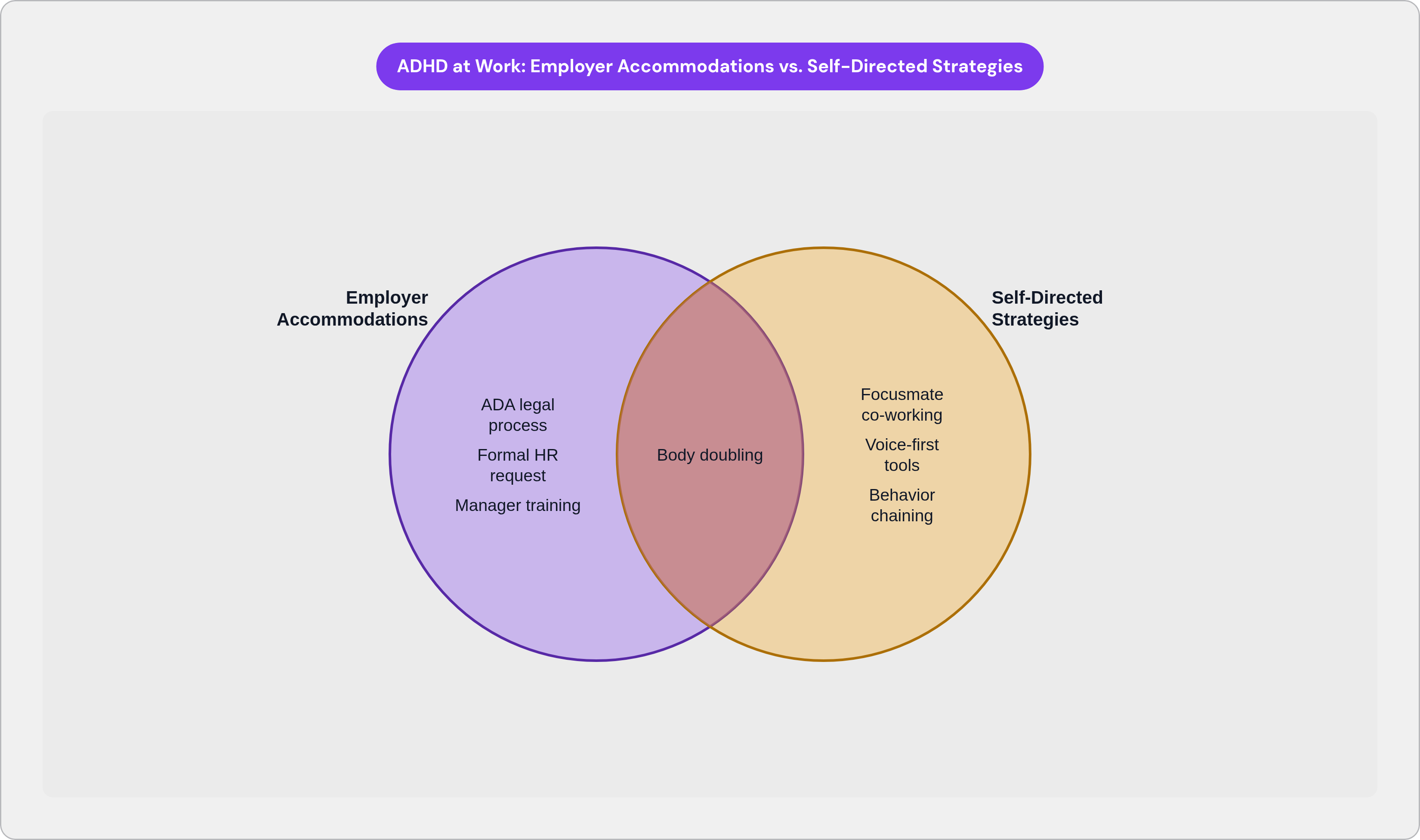
For distraction and sensory overload, the fixes get more physical: private workspace, sound-masking, or just permission to wear headphones without having to explain why. Cutting exposure to open-plan seating and hot-desking matters here too, since both rated consistently low in the UNH data. Body doubling, working alongside another person either in person or over video, externalizes motivation and cuts procrastination without needing any formal paperwork.
Then there's the human factor, which might matter more than everything listed above. Ninety-three percent of employees with ADHD in the Akili/Wakefield survey rated having a supervisor who understood how to support them as more valuable than any office perk on offer. Clear, explicit communication from managers matters because ambiguity multiplies the cognitive cost of every task downstream of it. Short, regular check-ins beat long infrequent reviews, since a tighter feedback loop catches drift before it compounds into a missed deadline.
None of this is complicated in principle. It's structural support standing in for internal regulation that isn't reliably available on demand.
How to request accommodations at work — what to say, what to expect, and what your rights are
The fear comes before the logistics, every time. Deloitte's survey found fear of bias and doubt that a request would even get approved were the top reasons people stayed quiet, and that fear deserves to be named honestly before anyone hands you a script for sounding confident about it.
Legally, in the U.S., ADHD qualifies as a disability under the Americans with Disabilities Act when it substantially limits a major life activity, which for most people diagnosed with it, it does. Employers with 15 or more employees have to provide reasonable accommodations unless doing so creates undue hardship for the business. The law describes this as an interactive process: employer and employee are both required to engage in good-faith dialogue, which entitles you to an actual conversation rather than a one-way petition where you ask and then wait and hope. The "reasonable" standard is also why framing your ask around low-cost process changes, written summaries, flexible scheduling, async updates, tends to move faster than framing it around anything that sounds like new infrastructure.
Start with HR if your company already has a formal accommodations process, or start with your direct manager if the relationship is solid and the ask is small enough to handle informally. Before either conversation, write out a short description of the specific executive function challenges affecting your actual job duties, not a general symptom list pulled off a diagnostic manual. Documentation from a diagnosing clinician isn't always required but it's often requested, so having it ready saves you a round trip. Bring a short list of concrete accommodations you're asking for, and keep the list process-oriented rather than infrastructure-heavy; it tends to go smoother that way.
Frame it around enablement. "Here's what helps me do my best work" lands differently than "here's what I can't do," even when the two sentences describe the exact same underlying need. If a request gets denied, or just quietly ignored, which happens more often than it should, document everything in writing, escalate within HR, and know the EEOC has a formal complaint channel if it comes to that.
And if you're not diagnosed yet, or disclosure genuinely doesn't feel safe where you work, that's a legitimate position to be in. It doesn't lock you out of everything else in this piece. The strategies in the next section stand on their own.
Self-directed strategies for ADHDers whose workplaces haven't caught up yet
Formal accommodation is still the goal here, and nothing in this section changes that. But the underlying principle from the last one, externalize the executive function work instead of trying to will it into existence through sheer effort, can be built by hand, on your own, starting today, with or without your employer involved.
Time-blocking is the clearest example. Give every part of your workday a specific block: focused work, email, breaks, transitions between tasks. Done right, it removes decision fatigue almost entirely because the brain isn't negotiating with itself over what comes next; it already knows. Pair it with a visible timer or a calendar block you can actually see, something more durable than a phone notification you'll swipe away on reflex and forget thirty seconds later.
Written systems do for working memory what a whiteboard does for a math problem too big to hold in your head at once. Write down every verbal instruction the moment you hear it, and don't trust memory to hold context under pressure, because for a lot of ADHD brains it won't, and that's not a discipline failure. An end-of-day brain dump, just getting every open loop out of your head and onto paper, cuts down the weight of carrying unfinished business home with you. Break every big deliverable into named milestone steps; overwhelming goals drive avoidance almost by design, while a sequence of small visible steps drives initiation instead.
Body doubling doesn't require a diagnosis, a workplace policy, or a single conversation with anyone. Virtual co-working platforms like Focusmate exist specifically for this, and the presence of another person, even a total stranger on a video call, externalizes motivation in a way that's fast and, frankly, a little strange the first time you try it and realize how well it works.
Morning and transition routines matter more than they get credit for. Behavior chaining, linking tasks in a fixed sequence so finishing one cues the start of the next, lowers the initiation cost at every step along the way. The night-before principle helps too: stage tomorrow morning tonight, label alarms with an explicit action instead of a vague time, and cut any task that takes more than two steps just to begin. Build the routine for your hard days, not your best ones. A routine that only survives when everything already feels manageable was never really a routine to begin with.
This is also where tools built specifically for ADHD brains earn their place, assuming they're actually solving the right problem. Generic productivity apps often add friction of their own: forms to fill out, menus to navigate, setup steps before you've even started, and that friction is exactly the kind of initiation barrier an ADHD brain tends to bounce off of. Voice-first tools like Mindflow take a different approach, letting you capture a task through talking instead of typing it into a form, which strips out a chunk of that initiation cost before it has a chance to build up. Gamified progress tracking, XP-style rewards, visible milestone completion, taps into the same dopamine loop that keeps engagement alive, something a plain static to-do list tends to struggle with. Breaking a goal into milestones, which is Mindflow's basic approach, mirrors exactly what the research above points to: chunking overwhelming goals into manageable steps is a core executive function intervention, whether it's baked into office policy or into an app on someone's phone.
What good ADHD accommodation looks like when it's working — and what it means for who gets to succeed at work
Go back to the UNH number one more time. Among workers who actually used workplace adjustments, a large majority reported reduced stress and anxiety, and most reported real gains in productivity. That's most of the group experiencing a genuine shift, and it happened without new hires or expensive equipment, mostly through written summaries, flexible hours, and managers who communicated clearly instead of vaguely.
So what does that actually tell us? The gap documented earlier, the fourfold undercount in disclosed diagnoses, the fact that only 35% of employers offer any formal ADHD accommodation at all, doesn't live in what works. What works is fairly well settled at this point: externalize the executive function scaffolding, and stress drops, output rises, burnout eases. The gap lives in who's being asked to build that scaffolding alone, on their own time, versus who gets to work somewhere it's already built into how the place runs.
One might argue that's just how workplaces evolve, unevenly, with some employees landing at better companies than others by luck more than design. But that framing misses something underneath it. An employee who happens to land somewhere with async updates, written meeting summaries, and protected focus blocks succeeds because the environment matches how their brain works, not because they tried harder than the person stuck in an open-plan office with no warning before a schedule change. Once you see accommodation as environmental fit rather than a referendum on effort, it gets harder to call workplace design neutral. Most of it, if we're honest about it, was never built with this brain in mind at all.