Focusmate Review for ADHD Users
Body doubling works for ADHD initiation, but Focusmate's design gaps leave some users stranded.
The most persistent misframing of ADHD is that it is a motivation problem. Russell Barkley's clinical work on executive functioning reframes it more precisely: ADHD is a disorder of self-regulation, the brain's capacity to govern its own behavior across time. Inhibitory control, working memory, cognitive flexibility, these deficits compound into what most ADHD adults experience not as laziness but as a specific failure to initiate. You know what needs doing. You cannot make yourself begin. Anyone who has sat at a desk for two hours without touching the task in front of them knows this is no metaphor.
Barkley's concept of "temporal myopia" explains the mechanism. ADHD behavior is governed by the immediate context, not future consequences. Deadlines that are abstract, rewards that are distant, intentions formed the night before: all of them lose motivational force at the exact moment the ADHD brain arrives at actual work. A 2024 systematic review covering 33 studies confirmed measurable executive function deficits across adults with ADHD, which matters not as a revelation but as confirmation that the clinical picture matches what ADHD adults have been saying about themselves for decades, usually while being told to try harder.
The dopamine dimension compounds this. ADHD brains tend toward lower baseline dopamine activity in the circuits supporting attention and reward prediction. Tasks without immediate, tangible payoff do not merely feel unpleasant; they can feel neurologically impossible to initiate, because the signal that bridges intention and action is attenuated at the source. Psychostimulants improve attentional deficits, but evidence that they reliably improve executive function itself remains inconclusive. That gap is not a minor caveat. It means behavioral and environmental tools carry real clinical weight even for users who are already medicated, and it is the gap that tools like Focusmate are quietly trying to fill.
How Body Doubling Addresses the Regulation Gap Focusmate Targets
Body doubling is almost embarrassingly simple as a concept: the presence of another person working provides an external scaffold that reduces the internal load required to begin. The other person does not need to help, advise, or even speak. Presence is the mechanism.
Why this works neurologically is not fully established. A 2024 ACM survey of 220 body-doubling practitioners found that it functions primarily as a self-directed, community-driven strategy, discovered not through clinical guidance but through peer networks and online communities. Research published in 2019 suggests social encounters activate dopamine pathways important for motivation and reward, which offers a plausible mechanism for why another person in the room, even on a screen, might lower the activation energy required to begin work. A secondary mechanism, the Hawthorne Effect, proposes that awareness of being observed shifts behavior toward the task at hand, though a 2014 literature review found mixed results on its validity.
Controlled studies have not produced conclusive evidence that body doubling reliably improves task performance across populations. Focusmate operates on a promising but empirically unsettled foundation. This is worth sitting with rather than dismissing. Many effective behavioral interventions preceded their mechanistic explanation by decades. But it does mean that the honest case for Focusmate has to rest on user outcomes rather than mechanism, and a fair evaluation has to account for when it fails, not just when it works.
What ADHD Users Actually Report After Using Focusmate
Community sentiment around Focusmate, across Product Hunt, G2, Trustpilot, and ADHD-specific forums, clusters around a recognizable set of experiences: it helps with task initiation, it builds routine, and it interrupts the shame spiral that often compounds avoidance. These are not trivial claims.
One Product Hunt reviewer with ADHD who cannot take stimulant medication for medical reasons wrote that Focusmate works "just as well" as Adderall for her purposes. That is a personal report, not a clinical claim, but its specificity is notable. She was not comparing productivity tools generically. She was describing a functional equivalence in her own daily life. A G2 reviewer who received an ADHD diagnosis as an adult, having cycled through every major productivity methodology available, described her first Focusmate session as "the closest I've come to staying this on-track, in focused work sessions, is with Ritalin." A Trustpilot reviewer who went undiagnosed for more than 25 years described decades of internalized self-blame and failed strategies before finding the platform.
Barkley's model would predict exactly this pattern. By converting an intention into a calendar appointment with a real person attached to it, Focusmate introduces external accountability structure at the precise point where temporal myopia erodes internal motivation. The social cost of canceling on a matched partner, even a stranger, is sufficient for many ADHD users to override avoidance in a way that a self-set reminder simply cannot replicate. The scheduling ritual is doing enormous work here, arguably more than the session itself.
Long-term use is also common in these reports, which distinguishes Focusmate from novelty tools that generate initial enthusiasm and then fade from the workflow within weeks. Many users report consistent use across months or years. Self-selected reviewers skew positive by definition, but the specificity and consistency of these accounts is difficult to attribute to placebo alone.
Where Focusmate Falls Short for ADHD Users Specifically
The most repeated complaint across ADHD community spaces is no-shows and late cancellations. A user in one productivity forum who booked multiple consecutive sessions reported two no-shows in a row. A member of an ADHD-specific community noted that after a no-show she was not successfully rematched, leaving her session window empty. For neurotypical users, a no-show is a minor scheduling inconvenience. For ADHD users, it is structurally worse: the external anchor the session was supposed to provide vanishes at the precise moment of highest need, during initiation, with no fallback. Many ADHD adults also experience rejection sensitive dysphoria at a clinically meaningful level; being stood up by a stranger, however impersonal the context, still activates it.
The silent-video-only format presents a separate barrier. Some ADHD users work better with low-level auditory stimulation and find pure silent video too stark to sustain. The camera-on requirement adds friction for users with social anxiety or sensory sensitivities, both of which co-occur with ADHD at rates above the general population. There is currently no audio-only or camera-off option, which closes the door on a meaningful subset of potential users.
Goal tracking is thin. Users consistently request more structured tools for recording what they intended versus what they completed; the check-in is verbal, social, and ephemeral, not persistent or searchable. Partner filtering is similarly limited: there is no reliable way to filter by session style, energy level, or task type, and recreating a productive pairing is largely a matter of chance.
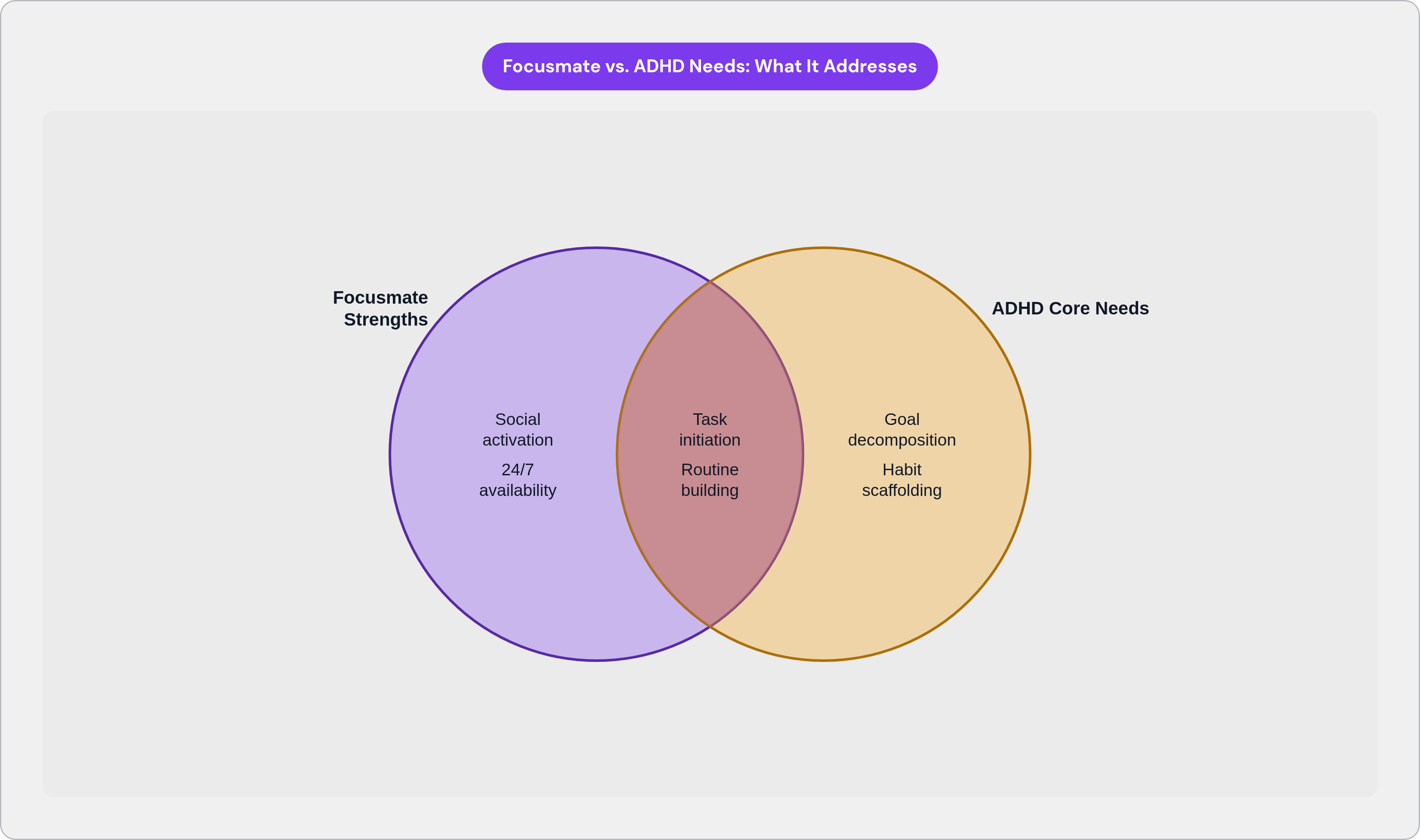
The most structurally significant limitation for ADHD users is that Focusmate delivers a session but not a system. There is no milestone tracking, no habit scaffolding, no mechanism for building on yesterday's session toward a longer-term goal. The session ends and the user returns to an unstructured environment. For users whose core friction is initiation, this is often enough. For users whose difficulties extend to planning, goal decomposition, and consistency over weeks, the ceiling arrives quickly, and the platform offers nothing beyond it.
The Kinds of Tasks and Work Styles Focusmate Actually Suits
Focusmate performs best when the task is already well-defined, can be started immediately, and requires sustained solo effort. Writing, email triage, reading, administrative processing, studying: these use cases appear most consistently in positive reviews. They share a common structure. The user arrives knowing what to do and needs only the activation energy to begin.
A 2025 study on body doubling in virtual environments identified four themes relevant to ADHD productivity: companionship through modeling, situational awareness, repetitive tasks with clear guidance, and motivation through playful feedback. Focusmate addresses the first two meaningfully and does not address the latter two at all. That is a scope description, not a condemnation.
The platform struggles when the task itself is undefined. If an ADHD user arrives without a clear intention, a common scenario given the planning difficulties that accompany executive dysfunction, the session is often spent figuring out what to work on rather than working. The ritual asks the user to state an intention; it does not help the user develop one. That is a meaningful distinction.
Session length matters more than it might appear. The 25-minute option maps naturally to Pomodoro-style attention spans and suits users who need frequent transitions to sustain engagement. The 75-minute option suits users who, once initiated, can hyperfocus and want an unbroken window to work within. The global 24/7 session pool is a genuine advantage for ADHD users with irregular sleep or work schedules, who are poorly served by accountability tools designed around conventional business hours.
How Focusmate Fits Alongside Other Tools ADHD Users Are Already Using
Focusmate addresses initiation and sustained attention within a bounded session. It does not address planning, prioritization, goal decomposition, or habit formation outside that window. This distinction is a design boundary rather than a flaw, and knowing where it falls determines whether the tool works for a given user or frustrates them.
It pairs well with any planning tool used before the session begins. Arriving with a clear, specific intention eliminates the most common cause of wasted sessions. It also pairs well with a habit tracker or streak system that gives session-level wins somewhere to accumulate and become visible over time; without that layer, the sessions feel isolated from any larger arc.
The gap Focusmate leaves is most visible for ADHD users who struggle upstream of initiation: users overwhelmed by a goal who cannot decompose it into a task concrete enough to state as a session intention. Apps designed specifically for ADHD, such as Mindflow, approach the problem from a different direction. Mindflow uses voice-first task capture, goal decomposition into milestones, and experience-point-based reward loops intended to sustain engagement between sessions and build toward longer arcs. Where Focusmate addresses "I cannot start this task right now," a tool like Mindflow targets "I do not know where to start, or how to stay consistent across weeks." For many ADHD users the stronger configuration is complementary: body-doubling accountability for execution, and an ADHD-native planning layer for everything surrounding it.
Approximately 5% of the global population has ADHD. That figure matters here because it underscores why the difference between a generic productivity tool and one built around ADHD behavioral science is not incremental.
Who Should Try Focusmate and Who Should Look Elsewhere
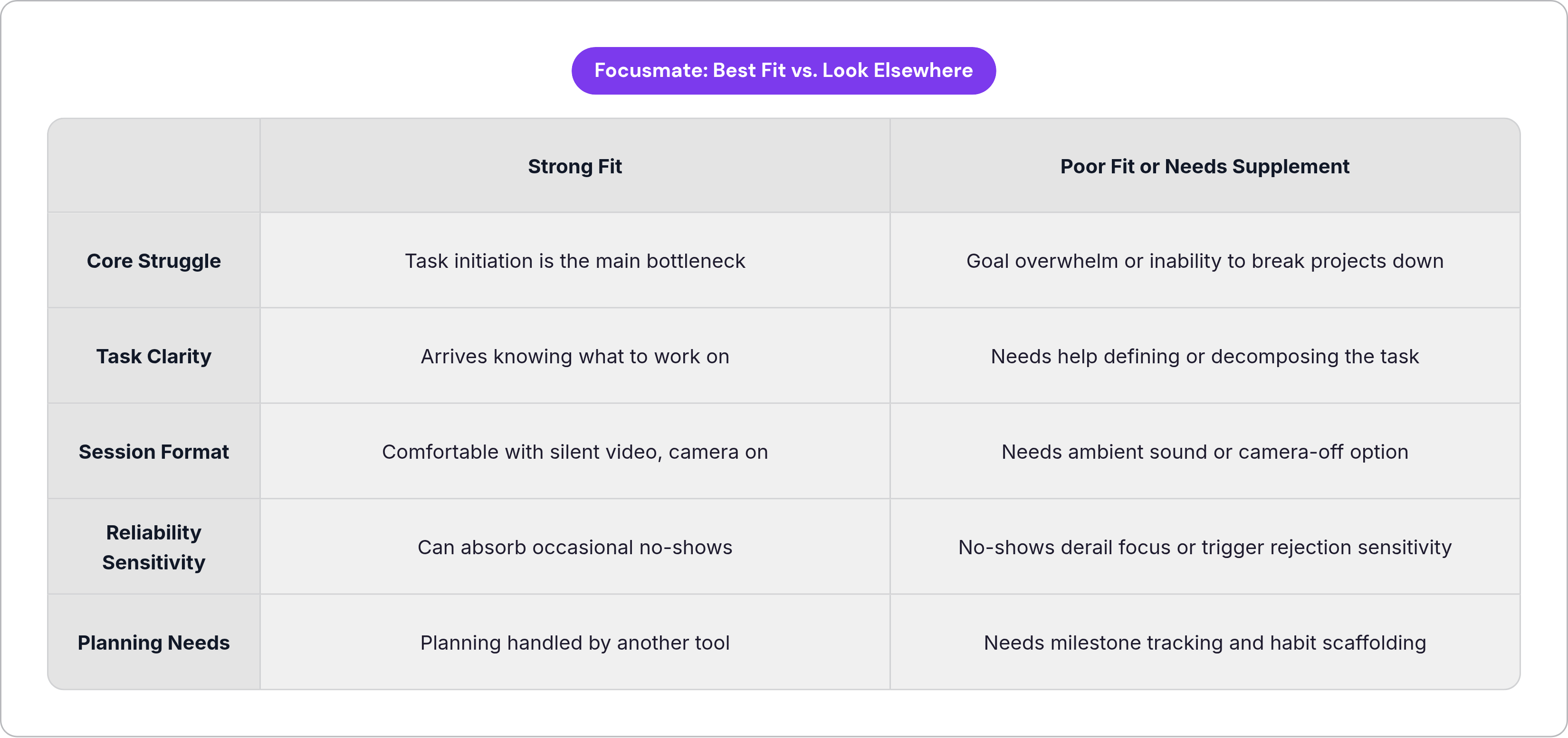
Focusmate is a strong candidate if task initiation is the primary bottleneck. If you know what needs doing and cannot make yourself start, if you work alone without ambient social accountability, if your tasks are defined enough that you can state a clear intention at the opening of a session, and if the social contract of canceling on a real person is sufficient to override avoidance, the platform is likely to deliver something useful. The free plan offers meaningful access before any financial commitment is required, which lowers the evaluation cost to nearly zero.
Look elsewhere, or supplement aggressively, if no-shows would derail your day or activate rejection sensitivity. The matching reliability issue is documented and unresolved. Look elsewhere if you need ambient sound while working; silent video is the only format available. Look elsewhere if your main struggle is upstream of initiation: goal overwhelm, inability to break a project into steps, genuine uncertainty about where to start. Focusmate will not solve this, and in some cases will surface it more sharply because the session structure demands a clarity the user does not yet have. Look elsewhere if you need habit scaffolding, streak tracking, or milestone structure to sustain consistency across weeks and months. Look elsewhere if camera-on accountability triggers anxiety rather than focus; there is no workaround within the platform.
Focusmate delivers what it promises. External accountability and social activation for a bounded window of time are not small things for an ADHD brain. For many users they are the difference between a productive hour and none at all. But the users who get the most from it arrive already knowing what they are using it for, and have addressed, or are actively addressing elsewhere, the planning and consistency challenges that fall outside its scope. The tool is specific rather than incomplete. Knowing which problem you are actually trying to solve is the prerequisite.