ADHD Paralysis Treatment Approaches and Tools
How ADHD brains freeze and what actually breaks the cycle.

A person sits down at a desk with a task that matters, every intention to complete it, and genuine consequences waiting on the other side of inaction, and still does not start. An hour passes, then three, spent in a strange adjacent state, neither working nor resting, often doing something that brings no pleasure either. That gap between wanting to act and actually moving is a measurable outcome of how the ADHD brain handles dopamine and norepinephrine in the prefrontal cortex, the region responsible for executive function. Research from Volkow and colleagues found that the prefrontal cortex, where executive function lives, receives weaker-than-optimal dopamine and norepinephrine signaling in ADHD brains, which often carry roughly 25% fewer dopamine receptors, or lower levels of available dopamine, in key regions. The practical consequence is that the brain needs a stronger signal before it will commit to engaging with a task at all.
Three documented differences in ADHD neurology stack together to produce the freeze. The first is a dopamine ignition problem: ADHD brains draw activation from interest, novelty, challenge, and urgency, and a task that is dull, important, and non-urgent trips none of those switches. Facing something complex, the brain tries to hold the goal, the steps, the constraints, and the emotional weight of the task all at once, and the coordinating system falters under that load, producing the kind of cognitive overwhelm that looks, from the outside, like someone simply not trying. Urgency does eventually generate activation. That is precisely why the deadline-crisis cycle can feel, falsely, like a working strategy.
A fourth layer compounds the first three: emotional dysregulation. Tasks are never neutral. At its most severe, paralysis functions as the nervous system treating a task as a threat. That is why "just start" advice fails so reliably. A person cannot reason their way out of a threat response any more than they can reason their way out of a startle reflex. Clinicians sometimes describe this using the term "Wall of Awful," a barrier built from the accumulated weight of past failures, rejection sensitivity, and anxiety, and the research treats it as a documented interaction between executive dysfunction and emotional regulation rather than a figure of speech.
Ordinary procrastination comes with a payoff of avoided discomfort, but ADHD paralysis produces no such payoff: the frozen hours bring no pleasure, and the person experiencing them frequently cannot explain, even to themselves, why movement will not come. A task that is important but not urgent, familiar but not interesting, and abstract rather than concrete hits none of those levers, which makes it close to a perfect recipe for paralysis. None of this describes a deficient brain in need of correction so much as a brain running on a different activation schedule, one that the rest of this piece treats as the starting condition for every strategy that follows.
How shame compounds the freeze
The paralysis itself might cost an afternoon. Each frozen hour becomes evidence in an internal case file: lazy, broken, wasting potential. Decades of that evidence accumulate into the harsh inner critic that shows up almost universally in adults diagnosed with ADHD later in life. Why does this matter beyond the emotional toll? Because shame does not sit passively alongside the paralysis. It feeds it.
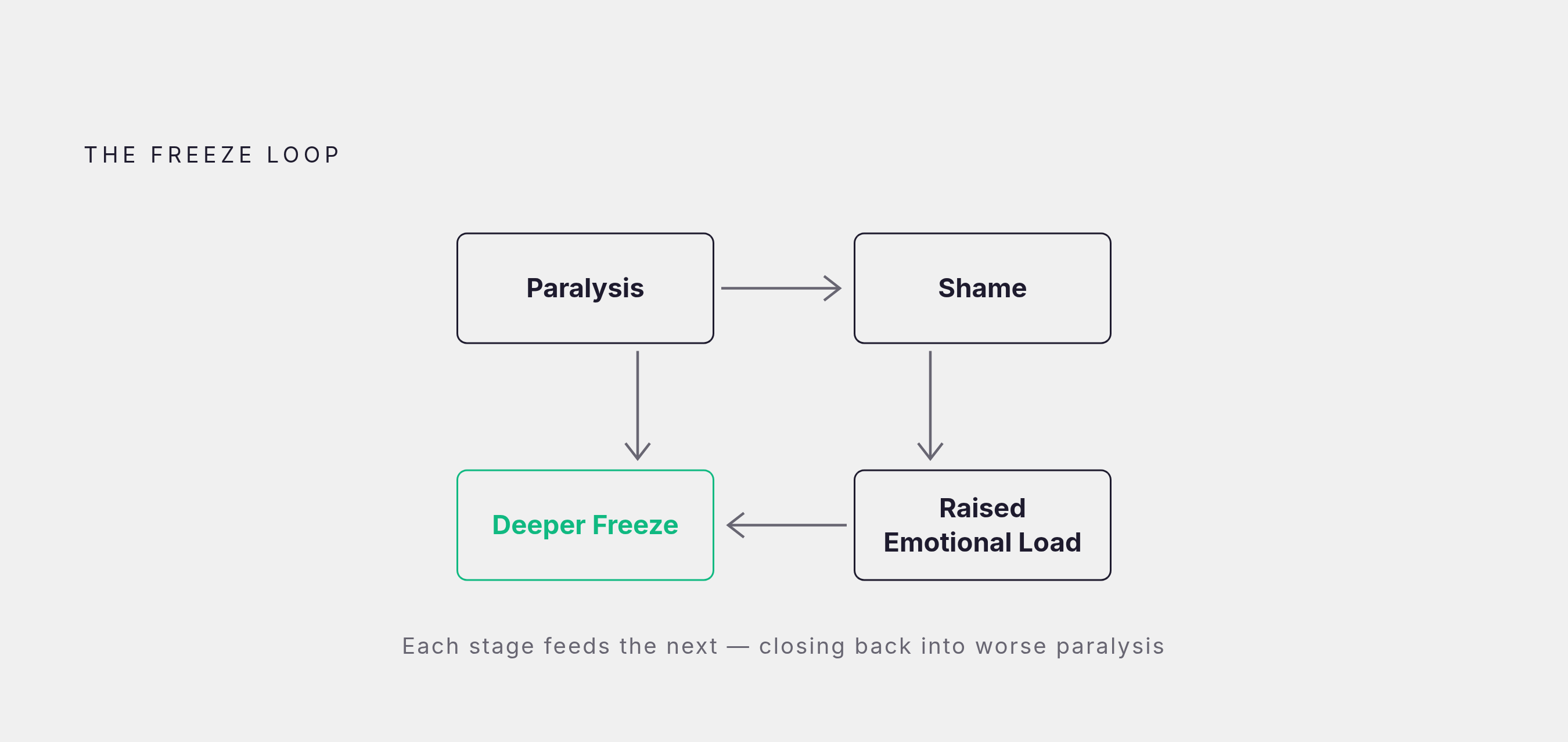
The mechanism runs in a loop: paralysis produces shame, shame raises emotional load, raised emotional load deepens the freeze, and the deeper freeze produces worse paralysis next time. That loop does not stay contained to isolated bad days. It feeds directly into ADHD burnout, the kind of exhaustion that follows from running a nervous system in a near-constant low-grade threat state. When mainstream productivity systems fail an ADHD user, the user tends to blame their own character rather than the tool's design: guilt over unfinished tasks, overwhelm from long lists, judgment from software that penalizes missed deadlines with red flags and overdue counters. A tool built without ADHD in mind can unintentionally reinforce the very shame and anxiety that worsen executive dysfunction in the first place.
That raises an important question about who absorbs the heaviest share of this cycle. Women with ADHD appear disproportionately affected by it. A 2025 paper in the journal Neurodiversity, published by SAGE, found that gendered societal expectations combined with a historically deficit-focused research base mean women's paralysis gets misread more often as a personality trait or a mood problem rather than recognized as a neurological pattern, leaving the actual mechanism untreated. The underlying biology does not change by gender. What changes is whether anyone around the person, clinician, employer, or family member, is willing to call it what it is.
Reframing the paralysis, naming it as executive function rather than character, is not a comforting platitude layered on top of the real work. It functions as a clinical intervention in its own right, because removing the self-blame removes a layer of emotional charge from the very activation threshold described in the previous section. A lower emotional charge means less for an already taxed working memory system to manage, with direct, measurable consequences for whether a task gets started. This has a practical implication for anyone evaluating tools or strategies: anything that adds a new layer of self-monitoring, a new metric to fail at, a new red number on a dashboard, will tend to worsen the cycle rather than interrupt it. Effective approaches do the opposite. They remove friction and reduce the occasions for self-reproach, which is the design standard the next two sections hold every strategy against.
The shared design principle behind every approach that works
Strip away the branding, the apps, and the acronyms, and nearly every intervention that reliably helps with ADHD paralysis shares a single underlying logic: do not try to summon motivation, lower the threshold the brain needs to clear before it will act, and add structure from outside the person rather than demanding it be generated internally. Instead of asking how to get herself to want the task, she can ask what switch this task needs flipped, and how to flip it artificially."
The ADHD brain gets activation from interest, novelty, challenge, and urgency. An effective intervention installs one of those switches artificially when the task itself fails to generate it on its own. This explains precisely why "try harder" and "just start" fail as advice. They target the wrong variable entirely, treating the problem as a shortage of willpower and asking the person to manufacture more of a neurochemical signal that the brain is not, in that moment, producing.
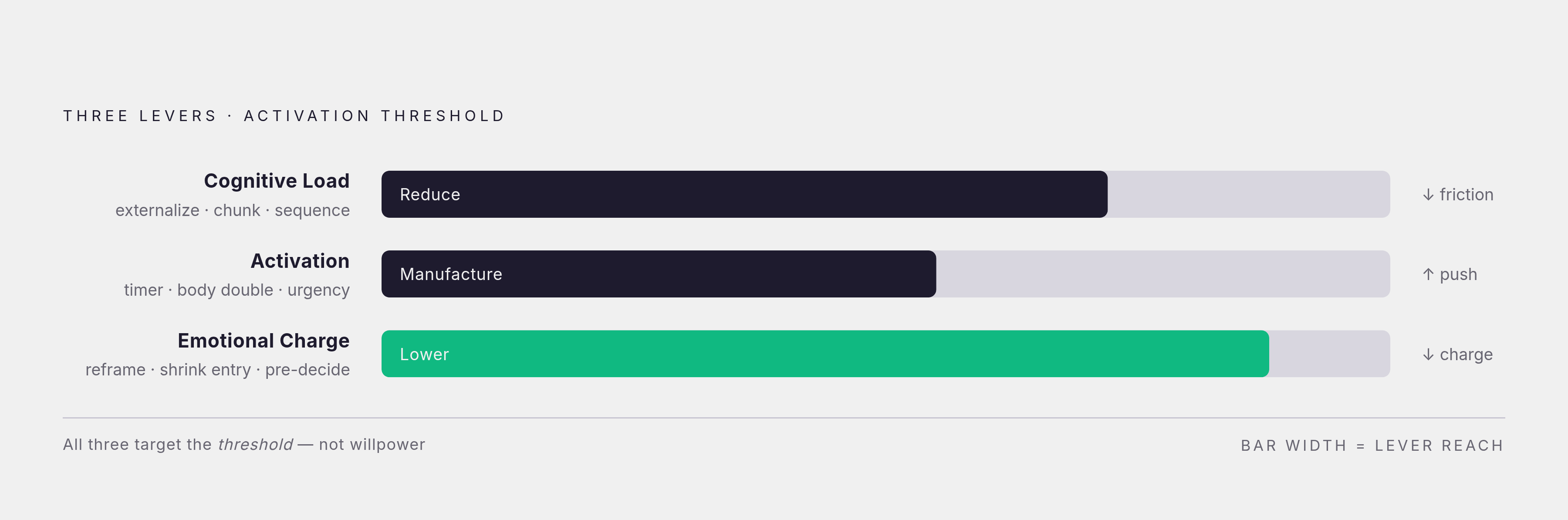
Three levers remain open to any intervention, behavioral or technological. One is reducing the cognitive load a task places on working memory, through externalizing information, chunking steps, or pre-sequencing decisions. Another is manufacturing an external activation signal, a timer, a witness, a body double, a reward pulse, something the task cannot generate on its own. The third is lowering the emotional charge attached to the task, through reframing, shrinking the entry point, or eliminating decision points in advance so there is nothing left to deliberate over in the moment.
A well-documented example of this logic in action comes from implementation intentions, the practice of specifying exactly when and where an action will happen. A 2011 study by Gawrilow and colleagues found that a statement like "Tuesday 9:15, at the kitchen table, I open the form" measurably outperforms a vaguer commitment like "this week I'll deal with the form". The specificity does the cognitive sequencing work that ADHD intention-keeping cannot reliably do unassisted. Waiting to feel ready fails because the feeling in question is the exact thing the neurochemistry is not supplying. Self-criticism fails because it deepens the freeze rather than resolving it. Elaborate planning sessions fail most insidiously of all, because they produce a beautiful system and no started task, planning itself being an excellent paralysis-compatible way to look productive while avoiding the task entirely. Everything in the next two sections gets evaluated against this same standard: does it lower the threshold, or does it just ask for more effort in a nicer font.
Behavioral strategies that lower the activation threshold directly
The strategies that hold up under this standard share a common shape: they externalize structure the brain cannot reliably generate internally, shrink the entry point to something small enough to clear the threshold, or manufacture an activation signal the task itself lacks. Several of them work better layered together than used alone.
Micro-starts work by deliberately avoiding the scale of the actual task. The instruction is never "do the report" but "open the document," and never "clean the kitchen" but "put one dish in the sink". The logic here deserves unpacking, because it is counterintuitive: the paralysis is not guarding the task, it is guarding the threshold. Once a person is in motion, momentum frequently carries them further than the original commitment required. That is why a two-minute commitment works disproportionately well relative to its size. It lowers the activation barrier just enough for momentum to take over from there. The smallest next action should be physical, specific, and completable inside five minutes. "Write the report" functions as paralysis fuel precisely because it is abstract and open-ended. "Open the document and type the first sentence" works because there is nothing left to interpret.
Externalizing working memory before it collapses addresses the second mechanism described earlier. Writing the first three steps of a task down in plain language, open laptop, open the folder, read the last email, converts fog into a sequence and spares a working memory system that is already struggling with the job.
Body doubling stands out as one of the most consistently endorsed strategies within the ADHD community, and the mechanism behind it maps directly onto the dopamine gap. A person present, whether physically in the room or visible on a video call, creates external activation and accountability that targets the deficit at its source rather than asking the person to generate that activation internally. It does not require a formal accountability partnership to work. A coworking café, a video call with a friend who is working on something unrelated, or a scheduled virtual coworking session all operate through the same mechanism.
Manufacturing the missing activation switches directly is another productive category. A timer race, framed as "how much can I do in 12 minutes," installs both urgency and novelty where neither existed before, and structured intervals carry the added benefit of giving permission to start, since the commitment is bounded ("I only have to do this for 25 minutes"). A playlist reserved for one specific task, a change of physical location, or a self-imposed deadline witnessed by another person each install one of the four activation switches that the task itself was missing. Movement offers a body-based version of the same reset: standing up, walking one lap of the room, or doing ten squats, then returning to the task within seconds of stopping, shifts the body's arousal state directly, using physical movement as a lever available even when the mind itself is what's stuck.
The "worst first" approach targets dread specifically rather than the task's difficulty. Spending a short, bounded amount of time on the most dreaded item, not to finish it, just to begin it, reduces the amount of working memory and cognitive bandwidth that dread was occupying, which frees up resources for everything else on the list. And implementation intentions, introduced in the previous section as the conceptual proof of the design principle, apply here as a concrete, repeatable practice. Specifying the when and where of a task's start does the cognitive sequencing work that ADHD intention-keeping cannot manage unaided, and a plan as specific as "Tuesday 9:15, at the kitchen table, I open the form" is categorically different from "this week I'll deal with the form".
Understanding that this paralysis is neurochemical rather than motivational clarifies why generic productivity software so often fails ADHD users: it is built for brains with intact, consistent dopamine signaling, and it assumes the thing that is missing can simply be willed back into place. Tools built specifically around ADHD behavioral science take a different approach. Mindflow, a gamified coaching app, applies these same principles by lowering activation thresholds through voice-first interaction and immediate engagement loops, asking for a spoken response rather than demanding the kind of willpower the underlying neurochemistry cannot reliably supply on command.
Anchoring the day: how morning routines reduce the daily executive function tax
Every principle covered so far scales down to the first hour of the day, and mornings carry an outsized share of the total paralysis burden because of how many small activation events they demand in sequence. A consistent morning routine works by eliminating decisions before they have to be made, which matters because each decision point is itself a small activation event requiring the exact signal that ADHD neurochemistry struggles to produce on demand.
Mornings function as a documented flashpoint for this reason. Hitting snooze, losing track of time while getting ready, feeling overwhelmed by the sheer number of steps required just to leave the house, each of these represents a separate reinitiation event, a fresh moment where the brain has to clear the activation threshold all over again before moving to the next step. Stacked back to back before a person has even had coffee, these small thresholds add up to a disproportionate share of the day's total executive function tax.
The measure of a good morning system is not how comprehensive it looks on paper but how few decisions a person has to make before the day's first real task is already underway.
Sources
- ADHD and Decision Paralysis: Overwhelm in a World of Choices
- ADHD Task Paralysis: Why You Can't Start (Even When You Want To) (2026)
- ADHD Task Paralysis: Why You Freeze and How to Break Free
- Executive Dysfunction & Task Paralysis: Symptoms & Fixes
- ADHD Task Initiation Strategies: A Clinical Guide to Overcoming Task Paralysis