ADHD Overwhelm at Work Coping Strategies
How ADHD brains struggle to filter priorities in modern offices.

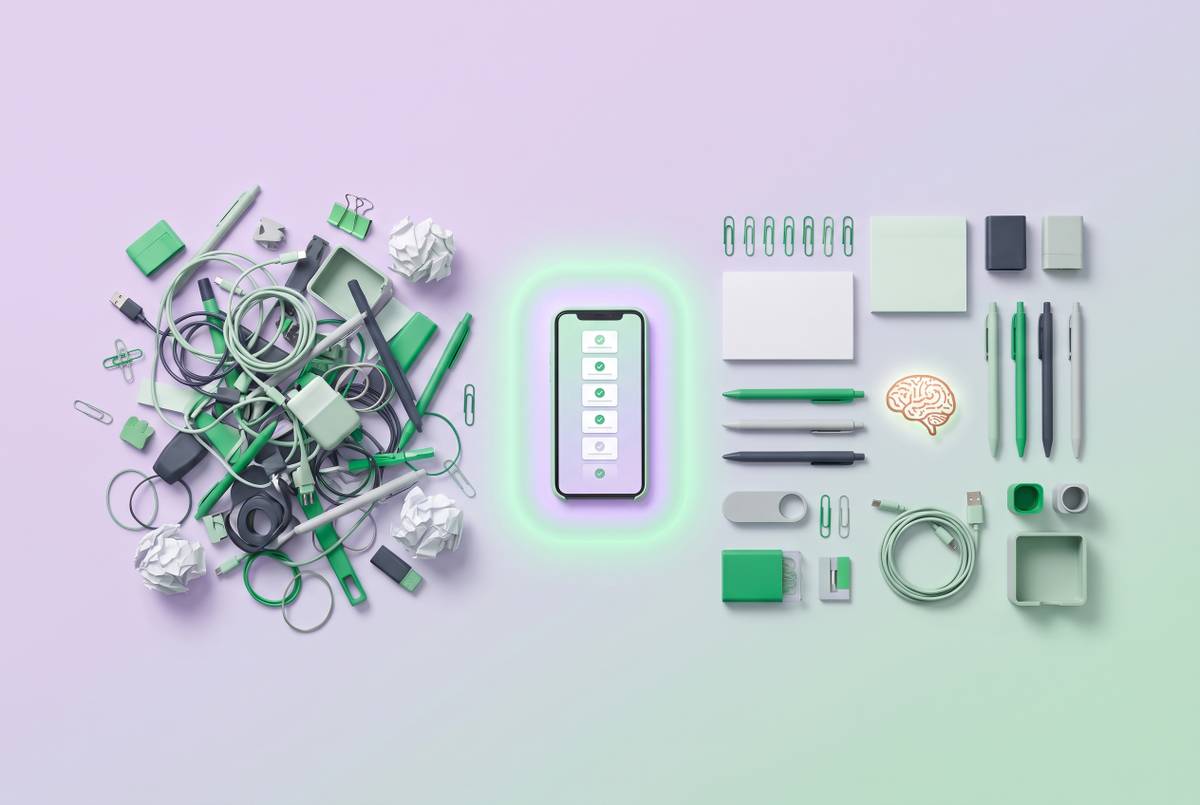
A task sits untouched on the list for three days because every other item on that list is screaming at the same volume and the brain cannot find the one that matters most. That sensation, the inbox and the Slack pings and the half-finished spreadsheet all arriving as equally urgent, is what happens when the prefrontal cortex, the part of the brain that handles planning, prioritizing, and impulse control, runs on a different operating system than the one productivity culture assumes. The ADD Resource Center states the mechanism: the issue is not how much is coming in but the absence of a working internal ranking system, which makes overwhelm a filter problem rather than a workload problem.
That filter failure splits into four recognizable patterns, each tied to a different piece of executive function breaking under load. Cognitive overwhelm happens when working memory, already smaller and less stable in ADHD brains, fills past capacity and a thought gets dropped mid-task, the thing someone stood up to go do, forgotten by the time they reach the next room. Emotional overwhelm follows from the same brains experiencing feeling more intensely, with fewer built-in brakes to slow the reaction down, so a minor setback can trigger a fight-or-flight response that shuts off rational problem-solving. Logistical overwhelm occurs on multi-step tasks, filing taxes, running a project with five moving pieces, because sequencing and holding the big picture together draw on the same executive circuits already stretched thin. Sensory overwhelm is the physical layer: overlapping conversations, fluorescent lighting, the open-plan office hum, all become close to intolerable once the brain's capacity to filter input is already maxed out.
Executive dysfunction and the overwhelm accelerator of the modern workplace
None of this happens in a vacuum, and the modern office is arguably the worst possible environment for a brain that struggles to filter and sequence. The default conditions of most jobs now, constant interruption, fragmented attention across a dozen small demands, and workloads spread across multiple ambiguous projects at once, target precisely the functions ADHD brains are least equipped to sustain. That is not a coincidence so much as a mismatch between how offices are built and how this brain actually works.
Consider what a normal workday asks of attention. But ADHD workers hit the cognitive load ceiling first, and they hit it repeatedly, often several times before lunch, because the recovery time needed to reset after each interruption is longer when the filtering system was already working at capacity. One might argue that everyone feels overloaded by modern work, and that is true.
The counterintuitive twist is hyperfocus, the flip side of overwhelm rather than its opposite. Some ADHD workers, confronted with a task that happens to click, will lock into hours of intense, uninterrupted focus on that one thing. A single day of hyperfocus does not cancel out the three days before it that were lost to scattered attention. It just makes the overall pattern harder for other people to interpret, and harder for the ADHD worker to explain.
Where executive dysfunction causes the most occupational damage
Not every executive function deficit does equal damage at work. Research by Chan and Langberg, published in the Journal of Occupational Rehabilitation and drawing on 100 participants with ADHD, found that hyperactivity and impulsivity, along with time management problems specifically, were the most consistent predictors of poor workplace outcomes. Four very different outcome measures, one shared predictor.
Why would time management and impulsivity carry more weight than, say, organization or motivation? A plausible answer is visibility. Showing up late to a meeting, interrupting a colleague, missing a deadline, these are externally observable failures that managers notice and document. They translate directly into formal consequences like written warnings or stalled promotions. Organization and motivation deficits tend to stay quieter day to day, but they still erode outcomes, just through a slower and less visible channel, friction that builds across the whole job rather than surfacing as a single flagged incident.
A separate line of research on executive function deficits and job burnout adds another layer to the picture: EF deficits mediate the relationship between ADHD and burnout. That is a specific and important claim. It means burnout in ADHD workers is not simply a proportional response to working too many hours or carrying too much volume. EF deficits are the actual mechanism carrying ADHD symptoms into exhaustion, not an incidental side effect of working hard. Understanding which specific functions break down, time management and impulse control most consistently, and which mediate the worst long-term outcome, burnout, gives a much sharper target for intervention than a vague sense that someone with ADHD "struggles at work."
Why standard productivity advice makes ADHD overwhelm worse
Given that sharper target, so much standard workplace advice still misses it. Most productivity systems were not built for brains that lack a reliable internal prioritization function, so they fail ADHD workers because the advice assumes a starting point that is not there.
The to-do list is the cleanest example of this mismatch. It lays out the full scope of everything pending, all at once, with no built-in sequence, no timing, and no cue for which item to touch first. For a brain with a working internal ranking system, that is a manageable inventory. For a brain without one, it is not a reduction of overwhelm but a direct cause of it, every item on the page competing for the same spotlight with nothing to organize them.
What gets labeled procrastination from the outside is, in the ADD Resource Center's framing, almost always something closer to activation failure. The person is stuck at the starting line, unable to generate the internal push needed to begin, which looks identical to avoidance from across the room but comes from a completely different place. Telling that person to just start, to push through, to try harder, treats a neurochemical bottleneck as a motivational one. Effort cannot substitute for dopamine and norepinephrine that are not firing the signal properly.
Decision fatigue makes the mismatch worse in a way most productivity advice never accounts for. Systems built around constant micro-decisions load that cognitive cost right at the moment the brain most needs the friction removed, not added. That is the opposite of what's needed, and it explains why so many well-intentioned planning systems get abandoned within a week.
Strategies that work with the ADHD brain's actual architecture
If certain functions do not run reliably inside the brain, the fix is to move those functions outside it. That is the single design principle for every strategy that holds up for ADHD at work: externalize prioritization, sequencing, memory, and activation, rather than demanding the brain generate them internally.
Brain dumping addresses cognitive overwhelm directly. When working memory starts overflowing, writing or speaking every pending thought, task, and worry into an external system frees up the limited and unstable capacity ADHD brains have to hold things in mind. The ADD Resource Center treats this as a first-response move specifically for cognitive overwhelm, not a general planning technique.
Calendar scheduling replaces the to-do list as a sequencing tool. Assigning each subtask its own day and specific time slot gives the brain an external cue for what comes next, instead of asking it to generate that sequence on its own. A calendar used this way turns into something closer to a script, no longer a source of overwhelm. The decision of what to do next has already been made in advance, so the only job left is to follow it.
Radical task shrinking targets activation failure head-on. A task like "work on the presentation" is vague enough to stall most ADHD brains before they begin. Shrinking it down to something like "open the slide deck" lowers the bar to almost nothing, because the rule is not to plan the whole task but to name its first physical action. That specificity does the work that motivation would otherwise have to supply.
Body doubling, working alongside another person, in the same room or over video, each on separate work, creates a form of social accountability that substitutes for an internal motivation deficit. Focusmate and Flown are two platforms built specifically around this model.
Environment design rounds out the list, and it deserves to be taken seriously rather than dismissed as decoration.
Low-friction, voice-first tools and the gap between intention and action
All five of those strategies share a hidden requirement: something has to capture the thought before it is lost, and that capture step is where most systems quietly fail. At that point the tool gets abandoned, because the friction at the entry point was too high for a brain already running short on activation energy.
Voice input solves that specific problem. It offloads the thought from working memory the moment it is spoken, before it has a chance to slip away, and it skips every formatting or sequencing decision that would otherwise stall the brain before it even starts.
That points to a clear design rule for anything meant to help with ADHD: capture first, organize later. The tool does the organizing. The person does not have to.
Smart speakers and other voice-activated systems already apply a version of this, offering consistent, automated support for reminders and routines without asking for constant manual setup, which lowers the memory demand on the user by handling it externally. Mindflow builds a fuller version of the same idea into a complete companion system: voice-first conversation as the primary way of interacting, goals broken down into guided milestones the user can track session by session, and an XP structure that supplies the kind of external reward signal an ADHD brain often cannot generate on its own. The friction that causes most productivity apps to get downloaded, used twice, and quietly deleted is the exact friction this kind of system is built to remove.
The real test of any tool meant for this purpose comes down to one question: how fast does a thought get from the brain into the system? Speed of capture is close to the whole thing, because every extra second of friction is a chance for the thought, or the motivation to act on it, to disappear.
Gamification and the dopamine signal that drives ADHD engagement
Capture alone does not solve the deeper motivational gap, and this is where gamification enters the picture, as a response to a specific, documented neurochemical shortfall. ADHD is linked to lower activity in the brain regions responsible for motivation, attention, and reward. A task that is not immediately interesting can trigger resistance wildly out of proportion to how important that task actually is. The brain is short on the internal signal that would normally make starting feel worthwhile.
One might object that earning points for basic tasks feels childish, or that it trivializes real work. That objection has the relationship backward. The need for externalized reward in ADHD is a documented feature of how the brain's motivation circuitry runs. Tools that ignore that need are the ones leaving the user unsupported. Tools built around it are simply built around how the brain in question actually operates.
How internalized shame makes overwhelm worse
None of the mechanisms described so far operate in isolation from how a person feels about struggling with them in the first place, and that feeling is often shame. Shame does more than sit alongside ADHD overwhelm at work. It actively feeds it: self-blame raises the activation cost of attempting any task. A person who has internalized the belief that falling behind reflects laziness or carelessness now faces two barriers before starting anything: the original executive function gap, and a layer of dread about confirming, once again, that something is wrong with them. Task paralysis deepens under that weight, and the paralysis itself becomes further evidence, in the person's own mind, that the shame was deserved.
Breaking that loop starts with the reframe this entire piece has been building toward: overwhelm is what happens when a filtering and prioritization system runs on different wiring. A missed deadline caused by activation failure is not the same event as a missed deadline caused by indifference, even though a manager glancing at a calendar cannot always tell the two apart. That distinction will not be visible to everyone, and it does not need to be, as long as it is visible to the person living through it.
Structural forgiveness means building systems, at work and in whatever tools a person chooses to use, that assume the brain will sometimes drop a thought, stall before starting, or need a calendar block instead of a to-do list, and that build around that reality instead of treating every lapse as a moral failing to be corrected through more effort. That is the throughline across every strategy this piece has covered: brain dumps, time-blocked calendars, shrinking tasks down to their first physical step, body doubling, voice-first capture, gamified reward. Each one works by asking less of the exact function that ADHD makes least reliable, and by replacing judgment about why that function is unreliable with structure that compensates for it.
Sources
- Predicting Occupational Outcomes for Individuals with ADHD: The Role of Hyperactivity/Impulsivity and Executive Functioning - PMC
- ADHD and Overwhelm: Why It Hits Harder and What to Do
- Executive function deficits mediate the relationship between employees' ADHD and job burnout
- ADHD Evidence Project
- Mindflow AI: Overcome ADHD
- Workplace and Social Support as Predictors of Job Satisfaction, Motivation, and Income in ADHD - Elizabeth SM Chan, Margaret Swarbrick, Sophia R Frontale, Sydney Baker, Cathrin D Green, Joshua M Langberg, 2026