Decision Fatigue and ADHD
Most adults with ADHD spent years undiagnosed, mistaking decision fatigue for personal weakness.

55.9% of adults currently diagnosed with ADHD in one country got that diagnosis as adults, not as kids. That figure is the whole piece in miniature: most people carrying this condition spent years, sometimes decades, wondering why ordinary choices, what to eat, what to wear, whether to answer an email now or later, felt disproportionately expensive. Roughly 22 million people in one country have ADHD across children and adults, with about 15.5 million adults currently diagnosed, and more than a third of those adults, 36.5%, are getting no treatment. Decision fatigue sits inside that gap, mostly unnamed and often mistaken for a personal failing when it is actually a predictable output of a brain running a different cost structure.
What executive function does, and what ADHD does to it
Executive function is the umbrella term researchers use for the higher-order cognitive processes that let a brain manage itself: plan, hold information, switch gears, stop itself from doing the wrong thing. Scholars studying ADHD treat executive dysfunction as the condition's defining feature, and several processes are at the core of it. Response inhibition is the brake pedal, the capacity to stop an impulse before it turns into an action. Set-shifting lets a brain move from one task or mental frame to another without getting stuck in the last one. Working memory updating holds a piece of information active long enough to use it, then swaps it for the next thing.
Current estimates find that somewhere between 80% and 90% of adults with ADHD struggle with executive dysfunction daily. That is close to the entire population carrying the diagnosis, not a symptom cordoned off to a subset of cases. A prominent line of research argues that ADHD is best understood as a disorder of executive functioning and self-regulation, not attention. That distinction changes what the fix looks like, and it is where a lot of well-meaning advice gets it wrong from the start. If ADHD were primarily about attention, the answer would be focusing harder. Since it is about self-regulation, the answer is designing systems that never ask the regulation to hold up under field conditions. Decision-making lives entirely inside that second framing. The rest of this piece treats it as an engineering problem, not a motivation problem, because that is what the research actually supports.
Why decision-making costs more for ADHD brains, before the day even gets hard
Every decision draws on working memory, cognitive flexibility, and inhibitory control to some degree, and those are precisely the three systems ADHD compromises. So even deciding what to make for lunch, whether to answer a text now, or which task to start first already carries an elevated cost before fatigue, stress, or a long day even enter the picture.
Brain imaging backs this up structurally. Neuroimaging research comparing ADHD and neurotypical adults during cognitive tasks points to elevated neural effort in the ADHD group, even when both groups arrive at similar final answers. The ADHD brain is spending more neural effort to arrive at the same output. It is spending more neural effort to arrive at the same output, the way two engines might produce identical horsepower while one burns noticeably more fuel to get there.
Dopamine is the mechanism behind that extra cost. ADHD involves documented dysregulation in dopamine signaling, and dopamine functions as the brain's internal currency for motivation, for weighing options, for actually executing a choice once it has been made. When that currency runs short, every transaction, every single decision, costs more to close out. Research on ADHD and cognitive load indicates that executive function deficits tend to emerge sooner and run deeper in ADHD brains than in non-ADHD control groups. Fatigue does not just hit ADHD brains harder. It hits earlier, and once it lands, it cuts deeper than it does for anyone else in the room.
How decision fatigue looks different depending on ADHD subtype
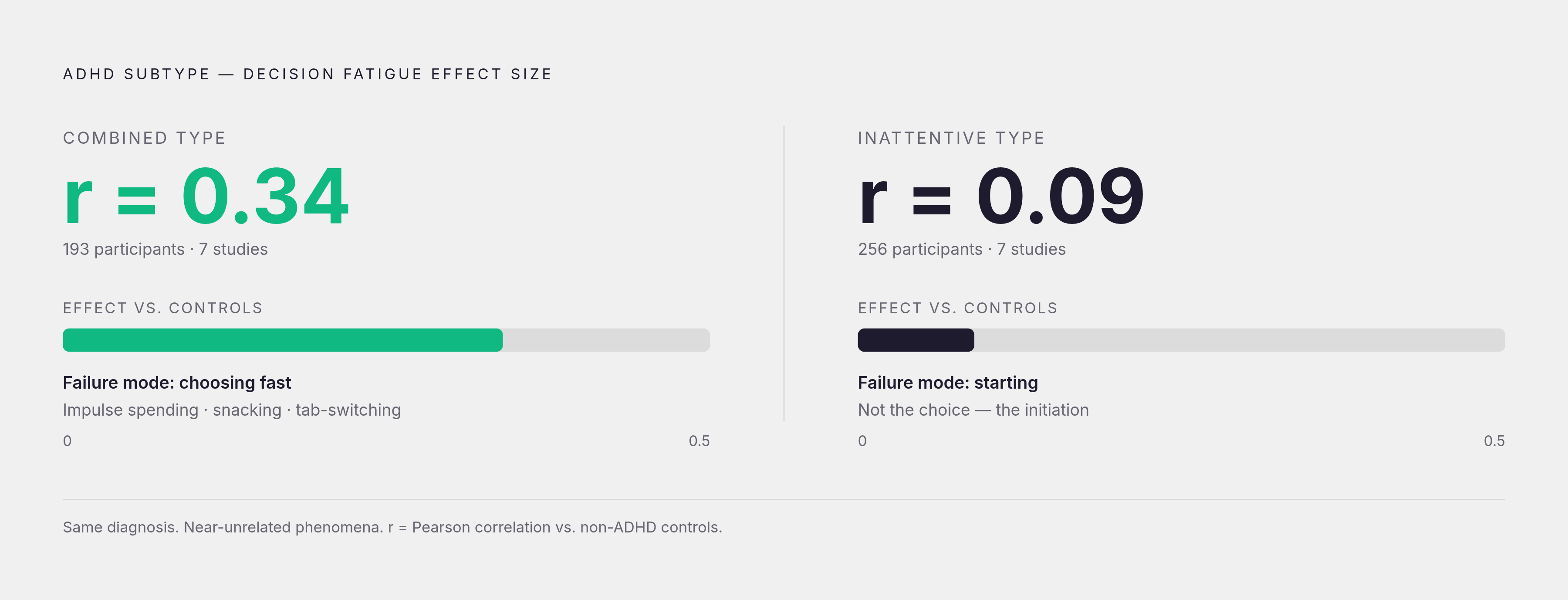
Not all ADHD decision fatigue is the same fatigue, and treating it as one uniform experience is where a lot of advice on this topic goes wrong. A pooled analysis by Marcel Schulze and colleagues looked at seven studies covering 193 people with combined-type ADHD and found decision-making performance was r = 0.34 against control groups, a meaningful gap. For combined-type, the breakdown tends to happen at the point of quick, reward-attached choices: impulse spending, snacking, clicking through one more tab. That is the "hot" executive function system, the one governing decisions under immediate reward, failing under exactly the conditions it is most exposed to.
Inattentive-type tells a different story, and it is the one most productivity advice gets backwards. The same body of research, seven studies covering 256 people, put the gap at r = 0.09, close enough to controls that the decision itself is not really where the trouble sits. What breaks is not the choosing but the starting. That has a strange side effect: a longer to-do list does not help an inattentive-type brain narrow down what to do first. It raises the cognitive load before a single decision even gets made. More options is more weight here, not more freedom, and that is why the standard advice to "just make a list" tends to backfire on this subtype specifically.
So two people can both carry an ADHD diagnosis and experience decision fatigue as two almost unrelated phenomena. One is fighting off the fast, tempting choice. The other cannot get the list open.
Where decision fatigue tips into paralysis in a real ADHD day
Adults make an estimated 35,000 decisions a day, and the overwhelming majority run on autopilot, semi-conscious, barely registering. For ADHD brains, a much larger share of those decisions demand deliberate, effortful processing, and the math does not scale evenly across the day. Standing in front of an open fridge, scanning the shelves, looping back to the same two options, stepping away, coming back again, is not indecision in the casual sense. It is a system that has run out of the working memory and inhibitory control needed to close the loop.
That failure mode splits into three recognizable shapes. Mental paralysis comes from sheer volume, too many choices or responsibilities stacked at once, until no action gets taken. Task paralysis is the inability to begin something, especially something that demands sustained attention or simply looks complicated on its face, and it needs to be kept separate from procrastination, which implies an active choice to delay. It reads closer to a freeze response, the nervous system stalling out rather than deciding to wait. Emotional paralysis is what happens when feelings, anxiety, shame, frustration, get loud enough to block forward movement.
That third category compounds fast, and this is where the mechanism actually turns dangerous. Anxiety disorders are not a rare bystander in ADHD populations. People with ADHD are up to six times more likely to experience anxiety disorders, and when that comorbidity is active, it does not sit quietly next to the paralysis. It feeds it directly, in real time, turning a stalled decision into a spiraling one.
Strategies that reduce decision load rather than demanding more willpower from a depleted system
The instinct, for a lot of people managing ADHD, is to fix decision fatigue with more discipline. That instinct is wrong, and it is wrong for a specific, mechanical reason: willpower is precisely the resource ADHD most reliably undermines, so asking for more of it is asking a system to run on a fuel it cannot reliably produce. The actual goal is fewer decisions, made at a lower cost, in real time, not better decisions squeezed out through more effort.
Deciding things ahead of time is the most direct lever available, because a choice made when the brain is rested carries a lower cognitive cost than the same choice made mid-afternoon under accumulated load. Pre-deciding meals for the week, laying out an outfit the night before, fixing a morning sequence in advance, all of that pulls live decision-making out of the exact moments when the brain has the least capacity to do it well. That is environmental design matching the tool to the actual constraint, not rigidity for its own sake.
Micro-task initiation solves a related but distinct problem, and it maps directly onto inattentive-type patterns, where starting rather than choosing is the actual failure point. The two-minute rule breaks a task down until the first step is small enough to start almost without thinking: not "clean the house," but "put three things away." The first action, however small, can lower the activation threshold for the next one, building real momentum forward. It works because it skips past the executive cost of scoping the whole task before a single hand moves.
Structured daily templates handle a third piece of the puzzle: removing the recurring question of what to do next. A fixed framework carries that decision so the brain does not have to remake it hour by hour, and good structure hits all three EF failure points at once. Limiting live choices addresses inhibition. Externalizing the day's sequence addresses working memory. Building in reset points addresses cognitive flexibility. Complex systems with heavy setup requirements get abandoned within days, almost without exception. The tools that actually stick are the ones fast enough to open, capture something, and close.
Building daily habits that reduce how many decisions the morning requires
Most conventional morning-routine advice quietly assumes a brain that does not carry ADHD's core deficits: that time is felt passing in the background, that knowing what to do next reliably turns into doing it, that a five-step sequence stays loaded in working memory long enough to run start to finish. None of those assumptions hold up against how ADHD actually functions, and that mismatch is why so much generic advice fails this population specifically, not because the people following it are somehow doing it wrong.
ADHD brains do not just fail at predictable structure by accident. They actively resist it, because routine, by definition, does not stimulate, and that is the dopamine mechanism again, appearing in a new context rather than a discipline problem dressed up as a scheduling one.
Effective habit design for ADHD works with that resistance instead of fighting it. Gamified progress, points, streaks, visible rewards, keeps engagement alive by making consistency itself dopamine-producing, rather than leaning on willpower to sustain it through sheer force. Milestones break a big behavioral change into pieces small enough to actually hit, since an overwhelming goal is one of the most common causes of paralysis and eventual abandonment. Scaffolded routines take the morning's very first decision, what to do now, and answer it before it is even asked, because the structure itself supplies the answer.
None of that amounts to a lesser version of real discipline. Small, consistent wins compound the same way they do in any behavioral change process, and for ADHD specifically, that compounding effect is a legitimate mechanism, not a comforting phrase deployed to make slow progress feel bearable.
Why reframing decision fatigue as structural (not personal) matters for ADHD identity
Everything above points at the same conclusion: decision fatigue in ADHD is a structural cost, not a character flaw, not proof of laziness, not a productivity failure waiting to be shamed into correction. From what neuroimaging research shows about elevated brain activation to what the dopamine research shows about a currency running short, the evidence traces a brain paying a documented, measurable price for nearly every choice it makes.
The shame that builds around ADHD decision paralysis gets worse specifically when the mechanism goes unexplained. Someone freezes in front of the fridge, watches a friend or coworker breeze through the identical decision without a second thought, and draws the obvious, wrong conclusion: the problem must be them personally, not their neurology. But what if the freeze was never a character defect to begin with? What if it was just a system running out of a resource it never had much of to spare?
Naming the actual mechanism does real work here, and it is not just semantic comfort. Understanding why the freeze happens removes the self-recrimination layer entirely, and that freed-up energy becomes available for something more useful: building the structure that works around the deficit, instead of waiting on willpower to close a gap it was never built to close. ADHD brains run on a different architecture, one that needs support systems built for how it actually operates, not broken machinery waiting for more effort to fix it. Decision-making, more than any single productivity habit, is where that redesign has to start.
Sources
- Frontiers | Executive function and neural oscillations in adults with attention-deficit/hyperactivity disorder: a systematic review
- ADHD and Decision Fatigue: Why Simple Choices Can Feel Overwhelming – ADD Resource Center
- ADHD and Decision Making
- Why Is Everyday Decision-Making So Exhausting With Executive Dysfunction?
- psychologytoday.com
- add.org
- adhdcentre.co.uk
- audhdpsychiatry.co.uk