Task Initiation Strategies for ADHD
ADHD initiation failure stems from broken executive function, not laziness or lack of discipline.

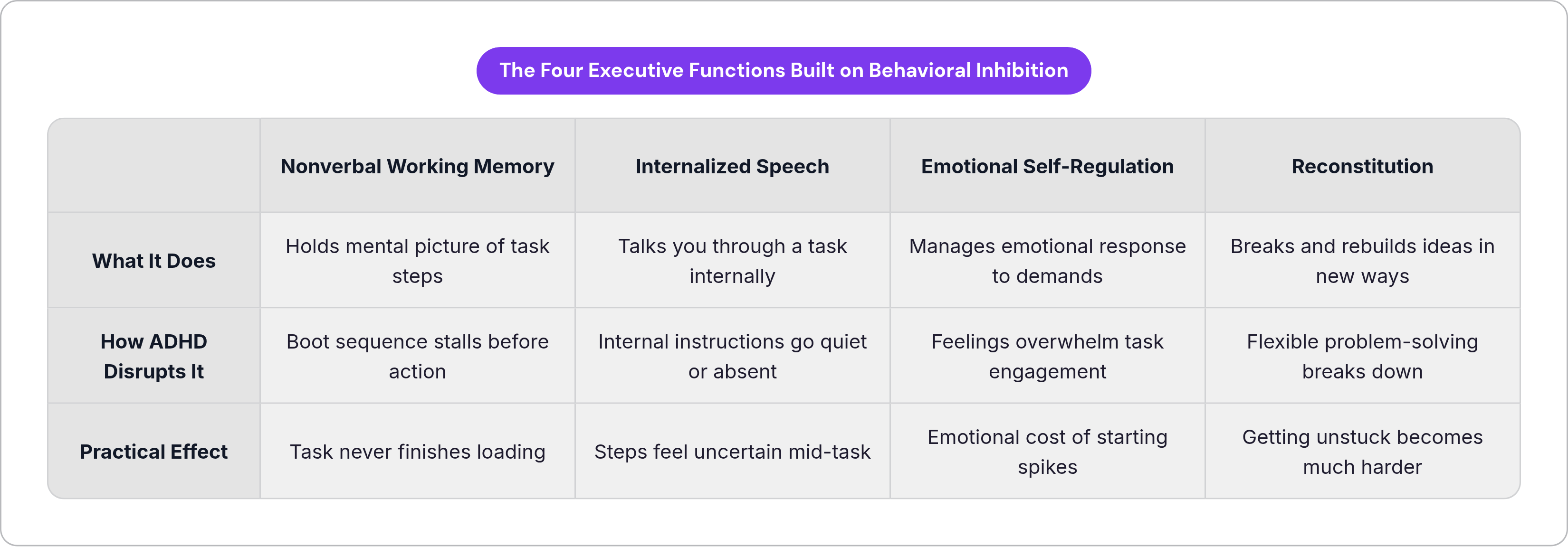
Dr. Russell Barkley built his model of ADHD around self-regulation, and one piece sits underneath nearly everything else: behavioral inhibition, the brain's capacity to pause before reacting, to interrupt an impulse mid-motion. Damage that, and every executive function stacked on top inherits the damage too. Barkley names four such functions: nonverbal working memory, the internalized speech that talks you through a task, emotional self-regulation, and reconstitution, which is basically the brain's ability to break things apart and put them back together in new ways. I keep coming back to this model because it explains something attention theories never quite got right for me. The failure to start looks like laziness from the outside, but underneath it's closer to an engine that won't turn over.
Working memory isn't just a storage bin. It's part of the actual boot sequence for starting anything, pulling up a mental picture of what needs to happen alongside the verbal instructions for doing it, and nothing physical happens until that retrieval finishes. In ADHD, working memory is reliably compromised, so the boot sequence stalls before a single action occurs. The task hasn't finished loading. Nobody chose that; it just happens, the same way a phone won't open an app until the screen finishes rendering.
There's a time piece too, and it's easy to underrate. Barkley calls it temporal myopia: behavior gets governed almost entirely by what's right in front of you, not by what's coming next week. A deadline that matters tomorrow barely registers as real today. The future doesn't pull on present behavior the way it does in a neurotypical brain, and knowing this intellectually doesn't seem to fix it on its own; you can recite the deadline out loud and still feel nothing.
Split executive functions into "cool" and "hot" categories and the picture gets sharper. Cool EFs cover planning, working memory, inhibition, and these tend to break down in the inattentive presentation of ADHD. Hot EFs cover reward processing, motivation, delay tolerance, and these get hit harder in the hyperactive presentation. The hot-EF pattern worth knowing is delay aversion: a strong, almost gravitational pull toward the reward sitting right in front of you over the one that's coming later. That's why a report due next week, or a project with no deadline pressure yet, can feel functionally invisible even when it matters more than almost anything else on the list.
A 2024 meta-analysis in Nature Human Behaviour pulled together 180 studies across seven separate EF domains. The scale alone says something: executive function impairment in ADHD is now one of the most thoroughly documented patterns tied to the condition, even though the exact mix of deficits varies a lot from person to person. What this adds up to, in practice, is a brain that isn't generating the internal "go" signal a neurotypical brain produces more or less on its own. Once that lands, the logic behind effective interventions stops looking like a grab-bag of hacks and starts looking like a system built to supply, from the outside, what the brain can't reliably make on its own.
Why conventional "just start" advice fails, and what the neurological gap actually demands
Most popular productivity advice assumes the activation system works fine. Pick one thing and start. Eat the frog first. Set yourself a deadline. Every one of these assumes that wanting to begin can reliably trigger the physical act of beginning. For a lot of ADHD brains, the wire between "I want to start" and "I am starting" just doesn't carry current the way it's supposed to.
Willpower-based advice carries a real cost here, because it locates the problem in someone's character instead of their neurology. Frame the failure to start as a discipline issue, and the task now arrives pre-loaded with shame before anything has even happened. That's a heavier weight to carry into a task that was already hard enough, and I've watched people spiral over this exact framing more times than I can count.
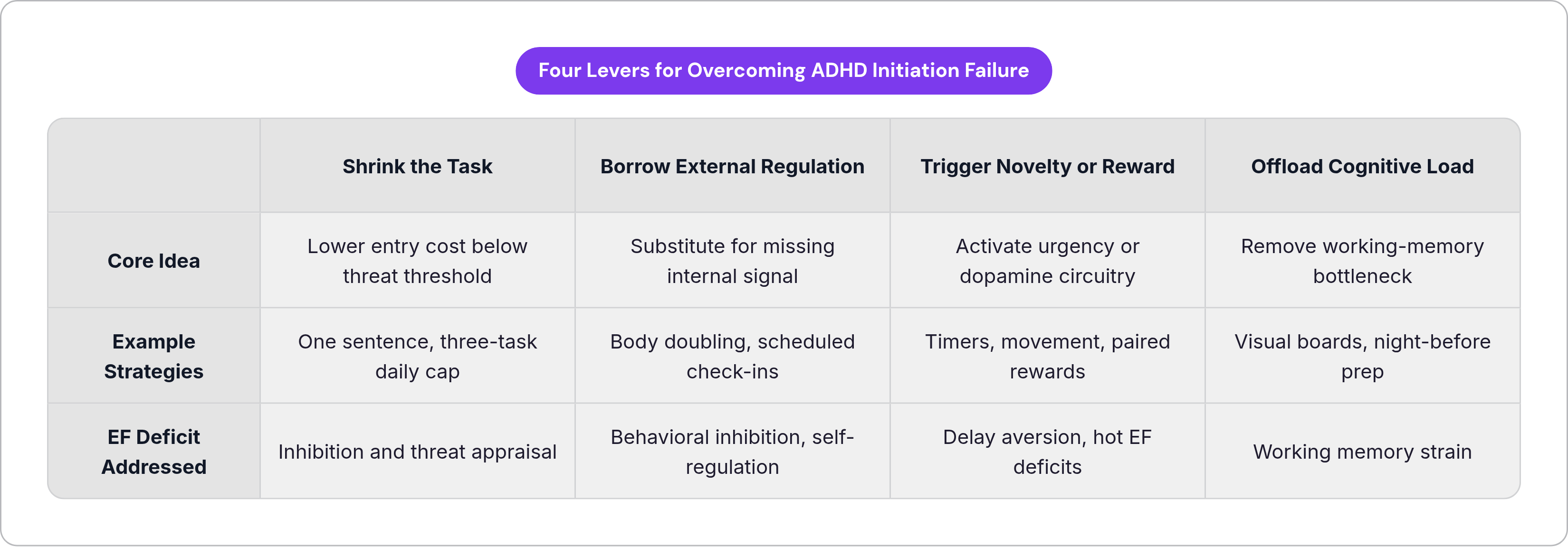
Look across the strategies that actually help ADHD initiation, though, and a pattern shows up. Nearly all of them work through one of four levers: shrink the task so it costs less to start, borrow external regulation, another person, a timer, a fixed rule, to stand in for the signal that isn't firing on its own, trigger novelty or reward circuitry through urgency or stimulation, or offload cognitive load so working memory stops being the choke point. Four levers, not a hundred scattered tips. That matters, because the goal is building the conditions a brain wired this way actually needs in order to move.
Making the task smaller than the brain's threat threshold
A large or vague task can register in an ADHD brain as a genuine threat, not just an inconvenience. Sit with that for a second, because it changes what "shutting down" actually means. The brain is running something closer to a real threat response, the kind that fires below conscious choice, than to avoidance in the casual sense people usually mean.
So the fix has to happen at the entry point, not at the level of intention. Shrink the first action until it takes almost no decision-making: "put one mug in the sink," not "clean the kitchen." "Open the document and type one sentence," not "write the report." The bar needs to sit low enough that saying no to it takes more effort than just doing it.
Why does this work? A step that small slides underneath the threat-appraisal system entirely; it's too minor to trip the alarm. And once that tiny action produces even a small sense of completion, momentum tends to follow on its own, no second act of will required.
Pair this with a hard cap: three must-do items a day, no more. Overwhelm is one of the most reliable triggers for initiation failure, and a long list creates overwhelm before a single task gets touched. Keeping domains separate, work in one space, life admin in another, health tasks in a third, helps too, since it removes the paralyzing "what should I even be working on right now" question that so often shows up right before the stalling does. ADHD productivity frameworks tend to name these together, the three-task cap, the tiny first step, cutting friction wherever it shows up, as one response to the same underlying inhibition failure. Shrinking the task handles the cost of starting. Once the task is actually in front of someone, though, a second lever starts to matter just as much: who else is in the room.
Body doubling and external accountability as initiation triggers
Body doubling means working alongside another person, in person or over video, without that person doing any part of the task or even paying attention to it. The mechanism is almost entirely about presence. Having someone nearby seems to supply a kind of ambient external regulation that internal intention alone doesn't produce for a lot of people with ADHD. The nervous system responds to social context in a way that solitary resolve just doesn't trigger.
It works even without any sense of being watched. The effect seems to hold whether the other person is silent, working on something totally unrelated, or present only as a small video window in the corner of a screen. That part still strikes me as a little strange, honestly, that a silent stranger on a screen can do something willpower can't.
Research is starting to catch up with what people using this strategy have known for a while. A 2024 study out of Malmö University tested whether an AI presence could help people with ADHD initiate and follow through on tasks the way a human body double does. Researchers building systems around this exact mechanism says something about how seriously the effect is being taken now. Virtual co-working platforms like Focusmate were built on this same insight well before the research caught up to it.
The idea extends past any one platform. Any outside presence, a scheduled check-in, a co-working session, even a voice conversation with an AI tool, can stand in for the internal regulation signal the brain isn't producing reliably on its own. That has a design implication too: low-friction, conversational interaction, the kind that feels like talking to someone rather than filling out a form, fits this mechanism far better than a typical app interface does.
Urgency, timers, and reward loops as artificial activation signals
The ADHD brain activates more readily under time pressure, so manufactured urgency works with the wiring instead of against it. That's a legitimate strategy on its own.
Timers carry a lot of the weight here. ADHD-specific versions of the Pomodoro technique often shorten the standard interval, 15 minutes instead of the usual 25, to match attention span and make the first commitment feel less intimidating. David Allen's Two-Minute Rule does something related but distinct: if it takes under two minutes, do it now, no scheduling required. For ADHD brains this works because it removes the decision-cost of "when should I start this," which is often a bigger obstacle than the task itself ever was.
Pairing a task with something pleasurable, a favorite playlist, a specific drink, a particular chair, lowers the emotional cost of beginning. This is a direct response to delay aversion, the hot-EF deficit that makes distant rewards feel neurologically discounted, and it deserves treatment as a core strategy rather than a nice-to-have. The brain needs proof that starting is worth something right now, not eventually.
Movement belongs here too. Exercise raises dopamine and norepinephrine, the two neurotransmitters most tied to ADHD attention regulation, which makes even a short burst of activity before a hard task work like a real neurological warm-up. One meta-analysis found exercise produced the strongest effect on inhibitory control among the interventions studied in children and adolescents with ADHD. The honest catch: keeping the exercise habit going turned out to be the harder problem, and that's worth saying plainly instead of glossing past it. Individual initiation strategies only carry a person so far if the same fight has to be refought from zero every single morning.
Building a morning structure that reduces daily initiation demands
Every act of starting something draws from a limited pool of mental resources. A morning routine, done well, pre-loads structure into the day so the brain isn't rebuilding its whole plan of attack every time it needs to move.
Mornings get singled out here because they tend to be the hardest stretch of the day for this population. More than 75% of people with ADHD report sleep problems, including delayed sleep phase, meaning the internal clock often runs later than the external schedule demands. A routine that ignores this and assumes someone wakes up neurologically ready to go is setting itself up to fail on day one. That's physiology, not a character flaw.
Night-before prep does real work here. Laying out clothes, packing a bag, writing tomorrow's list the evening before, all of it pulls initiation demands out of the exact moment the brain has the least fuel to meet them.
Skip the ten-step morning routine so many productivity guides push. Pick three non-negotiable anchor habits instead. Research on this approach shows that completing just those three sharply improves the odds the rest of the day goes well, largely because each one delivers an early sense of completion the brain can build on. What might those three cover? Morning light exposure, ideally within 30 minutes of waking, helps set circadian rhythm and anchors the cortisol and melatonin cycles with a concrete signal from the environment. Hydration matters more than it gets credit for: even mild dehydration, around 1.59% body mass loss, has been shown to impair working memory and raise fatigue in adults, and working memory is already the weakest link in this whole chain. A protein-anchored breakfast supports the tyrosine the brain needs for dopamine synthesis; Protein-forward breakfasts are widely recommended for this reason.
Sensory environment matters here too, more than most routines give it credit for. Sensory sensitivity is commonly reported among people with ADHD, and a loud, cluttered, stimulus-heavy morning can derail initiation before a single task gets attempted, no matter how carefully the rest of the routine was designed. Two or three anchor habits, done consistently, will beat an elaborate ten-step routine that falls apart the first time real life gets in the way.
What makes a tool or system actually stick for ADHD brains
There's a pattern worth naming directly: excited adoption of some new productivity system, followed by total abandonment within a few weeks. Most of these tools get built around neurotypical engagement patterns, and they just don't hold up against a different kind of wiring. I've lost count of the apps I've downloaded, used for four days straight, then never opened again.
Generic to-do list apps and form-based interfaces carry their own startup cost, stacked right on top of whatever cost the task already had. Before the actual work even starts, the user has to open the tool, click through menus, fill in fields, and for an ADHD brain that friction alone is sometimes enough to end the attempt before it begins.
Visual task boards, Kanban-style layouts, tools like Trello or Notion, help because they make the state of a task visible instead of requiring it to live in working memory, which, as covered earlier, is already the system most likely to be under strain.
Gamification gets waved off as a gimmick sometimes, and that dismissal misses what's actually going on underneath it. ADHD reward circuitry responds to immediate feedback, points, streaks, a visible progress bar, because these throw off an instant dopamine signal that a distant deadline just can't match. This ties straight back to delay aversion: future reward gets discounted neurologically, so immediate feedback has to substitute for it if the behavior is going to happen again tomorrow. A well-built reward loop can be the entire difference between a tool opened every day and one deleted inside a month.
Voice-first interaction matters more than it looks at first glance. Swapping typing and form-filling for plain conversation removes the tool's own startup barrier; you start working by talking, the same way body doubling works through presence. Breaking a big goal into small, visible milestones does similar work, handing the brain repeated completion signals along the way instead of one distant finish line that barely registers as real.
So what should someone actually look for in an ADHD-specific tool? Low friction to open it, feedback that shows up fast, voice or conversation instead of forms, goals broken into real steps, and rewards that land well before the finish line. A handful of platforms now build around exactly this, ADHD behavioral science, voice-first design, XP mechanics, milestone-based goals, and some have grown past hundreds of thousands of users on that basis alone. Starting from that foundation is a different game entirely than retrofitting a productivity template built for a different kind of brain.
The right setup does more work than raw willpower ever could, especially for a brain whose "go" signal doesn't fire the way the productivity industry assumes it does. Getting that right matters, and it beats another round of just try harder.