ADHD Morning Routine Strategies
Why mornings collapse for ADHD brains and how to redesign them.

Morning routines fail people with ADHD for a specific, mechanical reason: the first hour after waking demands the most from exactly the cognitive systems ADHD impairs most. Task initiation, working memory, sequencing, and time perception all have to fire at once, before the brain has finished coming online. This piece walks through why that happens and what actually works when the standard advice doesn't, building strategy by strategy from the neurology up.
The scale of this is worth sitting with for a second. A 2024 study by Staley et al. put the number relevant to that country. adults with a current ADHD diagnosis at 15.5 million, or 6.0% of the adult population. That is not a niche struggle tucked into a corner of the productivity conversation. It is a population-scale daily failure, built into how mornings are designed for brains that don't run on the assumptions most morning advice makes.
What executive dysfunction actually means when you're trying to get out the door
Executive function is a bundle of several distinct skills. It's a cluster: planning, sequencing, time management, emotional regulation, and task initiation, all of which get called on simultaneously in an ordinary morning. Take working memory first. Getting out the door means holding a running list ("pack lunch, find keys, leave by 8:15") while physically doing something else entirely, like pouring cereal or hunting for a sock. For an ADHD brain, that list doesn't stay loaded. It evaporates mid-task, which is why someone can walk into the kitchen for their keys and walk out five minutes later having made toast instead.
Task initiation is the sharper bottleneck. A person can know exactly what needs to happen and want to do it, and the brain still won't fire the starting signal. That's not reluctance. It's neurological, and it's one of the most consistently documented impairments in the ADHD literature.
Time perception compounds it. Russell Barkley's framework treats the subjective sense of time as a product of working memory itself: without it functioning well, time doesn't feel slow or fast, it feels absent. Twenty minutes and five minutes register the same until suddenly they don't, and the person realizes they're already late. Underneath both of these sits dopamine. Reduced dopamine activity in the prefrontal cortex and reward pathways blunts motivation and skews the brain's internal clock, so a task with no immediate payoff, like brushing teeth before a mirror with nothing on it, can feel genuinely impossible to start rather than merely unappealing.
A 2024 to 2025 meta-analysis in Psychiatry Research, covering 57 studies and 2,231 participants (1,062 of them children with ADHD), found consistent hypoactivation in the frontoparietal network, the circuitry most responsible for working memory and executive control. That result is not a fringe one. It's a structural finding, and it means the brain genuinely doesn't have the resources a standard morning demands. Adding more alarms, more lists, and more willpower on top of an under-resourced system doesn't fix the shortfall. It makes the shortfall worse.
Why standard morning routine advice fails people with ADHD
Most productivity advice assumes the very executive functions ADHD impairs are already up and running. "Plan the night before." "Wake up earlier." "Follow this five-step routine." Each of those instructions front-loads cognitive demand onto a system that, for ADHD brains, is precisely the one running on empty in the morning.
Complexity is the real enemy here, not the number of tasks so much as the mental weight of holding them all in sequence. A twelve-step morning routine collapses under stress not because the person gave up, but because working memory can't hold twelve steps in order while the body is also supposed to be moving through them. The "miracle morning" format, the 90-minute versions with meditation, journaling, exercise, and reading stacked end to end, fails for the same reason. Consistency across fewer steps beats ambition across many.
Then there's the motivational framing that treats missed mornings as a discipline problem. That framing misreads what executive dysfunction is. It reflects a gap in the brain's ability to execute what someone already values and knows how to do. It's a difference in how the brain initiates and sequences behavior, and treating it as a character flaw sets off a shame cycle: repeated failures get internalized as personal inadequacy, that inadequacy raises emotional dysregulation the next morning, and heightened dysregulation further impairs the very executive function needed to get moving. Generic advice doesn't break that loop. It often feeds it.
A 2026 bibliometric analysis in Discover Mental Health, reviewing 2,898 papers on executive function in ADHD published between 2015 and 2024, identified working memory and related executive function deficits as central and recurring themes across the research landscape. These aren't edge cases. They're the consensus. Which raises the real design question: not how to build a better neurotypical morning routine, but how to build around constraints that are already established and well documented, reducing cognitive load rather than asking an already-strained system to do more.
Reducing decision load the night before so the morning brain has almost nothing to decide
Night-before prep is a structural accommodation for executive function limits. It's an executive function transfer: moving decisions from a low-resource moment (the groggy first minutes after waking) to a higher-resource one (the evening, when the brain has had a full day to warm up and hasn't yet hit sleep inertia).
The moves themselves are almost mundane, which is the point. Clothes laid out the night before eliminate a decision the morning brain would otherwise have to construct from scratch. A bag packed and sitting by the door removes the frantic "where is everything" search that derails sequencing before it even starts. A coffee maker preloaded cuts one more transition out of the chain. Moving the phone charger out of the bedroom and into the kitchen adds a small piece of friction that discourages the morning phone spiral before it swallows twenty minutes. Writing tomorrow's single top priority on paper, left somewhere visible, offloads a chunk of working memory so the brain doesn't have to reconstruct the day's agenda while it's still barely awake.
Each of these is small on its own. Combined, they add up to fewer live decisions competing for a working memory system that's already depleted by sleep inertia and hasn't fully come back online. Visual schedules and physical cues work the same way, externalizing the memory an ADHD brain can't reliably hold internally. They're not reminders for someone forgetful. They're prosthetics for a system that runs differently.
One more piece matters here. Attaching a small reward to the prep itself, a favorite podcast, a few minutes of reading, gives the dopamine-driven brain an actual reason to bother with evening setup instead of skipping it for the tenth night in a row.
Designing the morning sequence itself around how ADHD task initiation actually works
The morning sequence should run three to five steps, always in the same order. It's a chain, not a menu. Fixed order matters because repetition turns the sequence into procedural memory instead of something working memory has to reconstruct daily, and procedural memory tends to hold up even on bad days when nothing else does.
Fewer steps done consistently beats a longer ideal that falls apart by Wednesday. A 30 to 45 minute routine that actually gets finished outperforms a 90-minute version that quietly stops happening after two weeks.
The first step needs to be almost absurdly small. Its only job is to get the body moving and hand the brain a completion signal it can register. Drinking a glass of water. Opening the blinds. Putting feet on the floor. None of these sound like interventions, but that's exactly what they are: "open laptop" generates the momentum that "write report" never could on its own, because the micro-step lowers the activation threshold enough for the next thing to actually happen.
Sensory anchors do real physiological work here too, not just habit-tracker busywork. Light exposure right on waking regulates circadian rhythm and speeds the shift into alertness, whether that's opening blinds or using a light therapy lamp. Cold water on the face activates the nervous system directly and interrupts sleep inertia. Morning exercise is widely discussed in the ADHD literature as supporting executive function, which places it closer to a meaningful intervention than to wellness-culture nicety.
Body doubling deserves a mention too. Getting ready alongside another person, whether that's a partner in the same room, a virtual co-working call, or even a video of a stranger doing their own morning routine, supplies external regulation that the ADHD brain's internal systems don't reliably generate alone.
What gets left out matters as much as what's included. Email, social media, and news all demand sustained attention and complex decision-making before the brain is fully online, and each one will hijack whatever limited executive function is available in that early window.
Making the routine restartable, not perfect
Perfectionism and ADHD routines don't coexist well. If skipping one step means the whole morning is "ruined," the system is built to fail the first time life gets in the way, and life gets in the way often. The actual goal is a routine that survives a bad start, a late night, or an interruption, not one that only works under ideal conditions.
Restartability should be treated as a design feature, not a fallback for weak days. That means building in a minimum viable version, something that takes ten minutes and still counts as having done the routine even when nothing else goes right. All-or-nothing thinking is a common pattern tied to how executive dysfunction and emotional regulation interact in ADHD, so designing for partial completion works within that reality. It's removing the trap that causes total abandonment in the first place.
Structure and novelty aren't actually in conflict, either. The sequence itself can stay fixed while the content inside each step varies: a different podcast during the same morning walk, a different breakfast chosen from a pre-decided category. ADHD brains need some novelty to stay engaged, and small variation inside a stable frame keeps the routine from turning aversive through sheer repetition. Rigid sameness across everything tends to breed resentment toward the routine itself.
Self-compassion belongs in this section too, and not as a soft add-on. Shame after a missed morning feeds the emotional dysregulation that ADHD brains are already prone to, so treating a failed routine as neutral data ("that didn't work today, what was different?") is a functional strategy grounded in how ADHD brains respond to shame and pressure. It's better systems thinking, the same logic an engineer would apply to a process that breaks under a known condition.
The restartable frame scales up too. Building a routine from scratch means starting with one anchor behavior and adding a second only once the first has become close to automatic. Small sequenced wins hold up better over months than a fully assembled routine launched all at once and abandoned by the second week.
How reward and gamification keep the ADHD brain engaged with a routine over time
Routines that work for two weeks and then quietly die aren't failing because of boredom exactly. Dopamine differences in ADHD mean tasks without immediate, visible payoff lose their pull fast, so a routine without a working reward signal was always going to fade once the novelty wore off, regardless of how good the design was otherwise.
This has a neurological basis worth naming. Research has found reduced dopamine receptors and transporters in ADHD, which helps explain why immediate rewards consistently outperform long-term benefits for motivation. Games work for the same reason spreadsheets don't: they deliver feedback in real time, not at the end of the quarter.
Gamification, applied deliberately, borrows that same mechanism. Points or streaks for completing the routine give a visible, accumulating signal, and streaks in particular tap loss aversion, since breaking one feels worse than never starting it did. Milestone tracking breaks a vague goal like "build a consistent morning routine" into weekly checkpoints, giving the brain regular completion signals instead of one distant payoff months away. A habit tracker on the wall or a simple check-off list externalizes progress the working memory won't hold onto reliably on its own.
Small built-in rituals do similar work. A song played only during the morning routine pairs the sequence with something pleasurable and marks its start and end clearly. A specific coffee or tea, made as part of the sequence rather than as an afterthought, functions as ritual and reward at once. Even a brief moment of journaling, or naming one thing to look forward to that day, gives the brain a small but dependable dopamine hit to work with.
Every completion deserves acknowledgment, including the partial ones. That's not indulgence. It's how the reward pathway actually learns, and skipping the acknowledgment because a morning wasn't "complete enough" undercuts the exact mechanism the routine depends on. Apps built specifically for ADHD brains, ones using voice-first interaction, level-up-style rewards, and structured milestone tracking, address this at the design level instead of leaving each person to invent their own reward architecture from nothing. The better ones apply the same feedback logic that makes games compelling to something as unglamorous as getting out of bed and drinking a glass of water.
What a realistic ADHD morning routine actually looks like, built from these principles
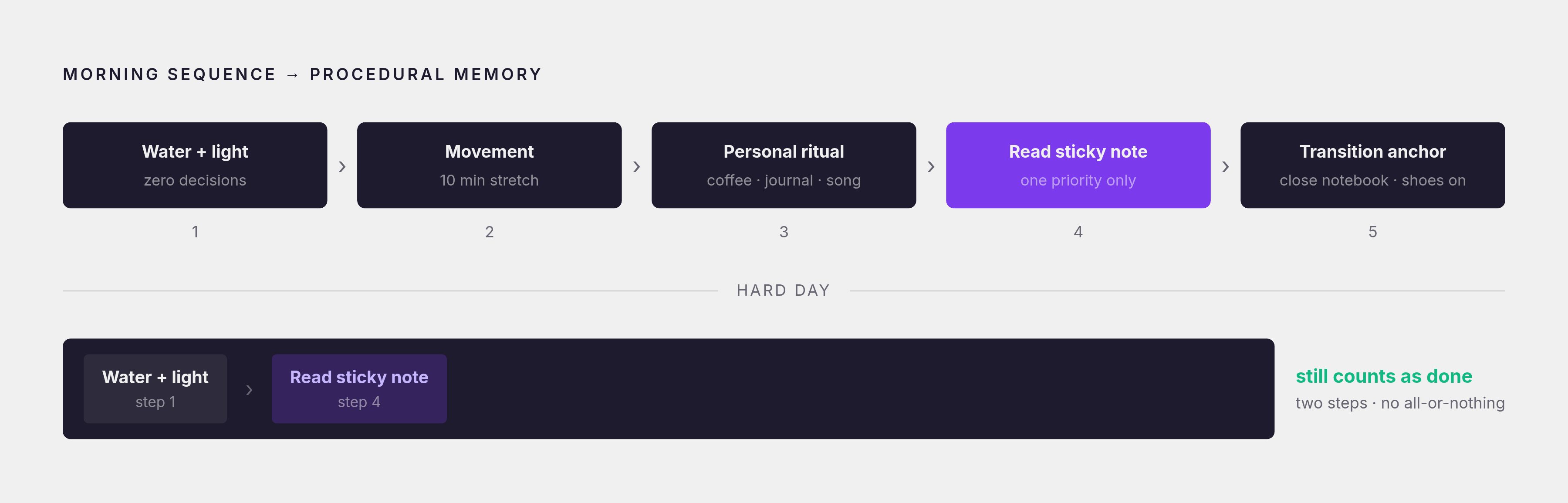
What follows is not a template meant to be copied exactly. It's an illustration of the principles above in action, and the version that actually works for any given person will shift based on their schedule, their sensory sensitivities, and which executive function deficits hit them hardest.
The night before, five to ten minutes: clothes out, bag packed, coffee maker loaded. One priority for tomorrow, written on a sticky note, placed somewhere it'll actually be seen. A small reward attached to finishing the prep, ten minutes of something enjoyable once it's done.
The morning sequence itself, 30 to 45 minutes, four to five steps and no more. Step one: water and light, a glass of water plus opened blinds or a light therapy lamp, fully automatic and requiring no decision. Step two: movement, even ten minutes of stretching or light exercise, treated as neurologically meaningful rather than optional extra. Step three adds one personal ritual, coffee, a quick journal entry, a favorite song, the piece that makes the whole sequence feel worth showing up for. Step four: reading the sticky note from the night before, the priority already decided so no working memory is required to reconstruct it. Step five: a transition anchor, a specific small action like closing a notebook or putting on shoes, that signals the routine is done and the day has started.
On hard days, the minimum viable version is just steps one and four: water, and the one priority. Everything else is optional, and the routine still counts as done. Tracking completion somewhere visible, a wall calendar, a habit app, a simple streak counter, gives the brain external evidence of progress it can't otherwise reliably sense. It's the feedback loop the dopamine system actually needs to keep the behavior going.
One rule matters more than any specific step here: change one thing at a time. If none of this exists yet, don't try to build all five steps in a single week. Pick one anchor, maybe the water, maybe the light, maybe just the sticky note, and do only that for two weeks before adding anything else. The routine compounds over time, but only if each layer is stable before the next one gets stacked on top of it.