Procrastination and Habit Formation in ADHD
Why ADHD procrastination stems from brain circuitry, not willpower.

About 22 million people in one country carry a current ADHD diagnosis, roughly 15.5 million adults and 6.5 million children, according to CHADD's prevalence estimates. Most of them have been told their procrastination is a discipline problem. That explanation is not just wrong, it's aimed at the wrong system entirely: procrastination in ADHD traces back to measurable differences in brain circuitry, not character, and telling someone to try harder is like telling someone with a broken ankle to run faster. This piece walks through why that advice fails these brains, and what the mechanism actually calls for instead.
What executive dysfunction actually means and why it sits at the root of both procrastination and failed habit attempts
Executive functions are the mental operations that turn an intention into an action: planning, initiating a task, sequencing its steps, holding information in working memory long enough to use it, and regulating the emotional noise that comes with all of it. They're the scaffolding behind everything from "start the report" to "load the dishwasher before leaving for work." When that scaffolding holds, these things happen with so little friction that most people never notice the machinery underneath.
ADHD interferes with that machinery at the level of brain circuitry, not at the level of willpower or values. That's the exact distinction most advice gets backwards. A 2024 meta-analysis in Nature Human Behaviour, pulling from 180 studies across seven executive function domains, confirmed that EF delay shows up as a transdiagnostic feature across neurodevelopmental conditions, with a moderate effect size overall. ADHD specifically showed larger delays in attention, response inhibition, planning, and working memory than typically developing peers and specific learning disorders in the comparison. That's a measured, replicated pattern, not a subjective impression.
Russell Barkley, one of the most cited researchers in the field, has argued for decades that ADHD is best understood as a disorder of self-regulation and executive functioning, not a disorder of attention or motivation in the colloquial sense. One mechanism worth naming directly is what researchers call temporal myopia: behavior gets governed by what's immediately in front of a person rather than by future demands sitting on the calendar. Research on adult ADHD has documented measurable differences in how people with ADHD estimate and reproduce durations of time, which helps explain why a deadline three weeks out can feel functionally nonexistent until it isn't.
Layer dopamine onto this. Motivation and reward circuits in the ADHD brain run on lower baseline dopamine activity, and that changes how a task without immediate payoff registers. It doesn't feel unappealing so much as it feels inert, almost inaccessible, closer to a wall than a choice. A 2026 bibliometric analysis in one behavioral health journal catalogued nearly 2,900 papers on executive function in ADHD published over the past decade, which says something about how central this framework has become to the field. None of this is a diagnosis for the reader. It's an explanation, and the difference between those two things is the entire point of this piece.
How procrastination in ADHD grows directly out of the executive function gaps just described
Procrastination doesn't appear as a diagnostic criterion in the DSM, but it shows up constantly in what people with ADHD report as their most consistent daily struggle. The correlation isn't loose, either. A 2025 study in the Scandinavian Journal of Psychology, using validated scales across 132 adults, found that higher ADHD symptom severity tracked directly with higher procrastination and lower quality-of-life scores. More specifically, the pathway from ADHD symptoms to poor quality of life ran indirectly through procrastination levels, meaning procrastination wasn't just a symptom sitting alongside the diagnosis. It was doing some of the damage itself.
But how does this happen mechanically, rather than just statistically? Anxiety, perfectionism, and avoidant automatic thoughts, the reflexive "I'll feel more ready tomorrow" kind of thinking, intensify the underlying executive dysfunction rather than sitting apart from it. Executive dysfunction rarely operates in a vacuum. The downstream effects compound from there: academic performance drops, professional relationships strain, social commitments get missed, and the risk of comorbid depression and anxiety climbs.
A 2025 study published in SAGE added another layer worth sitting with. It examined ADHD, hyperfocus, and procrastination together, and found that maladaptive daydreaming mediates the relationship between ADHD symptoms and outcomes like depression, anxiety, and stress, with hyperfocus identified as a factor in that chain. That's a more tangled picture than simple avoidance, and it settles the question this section opened with. Procrastination sits downstream of executive dysfunction, not beside it, and treating it as a standalone character flaw misses where the actual lever sits. Every strategy later in this piece depends on getting that ordering right.
Why task paralysis, the most acute form of ADHD procrastination, is not a motivation failure but a neurological traffic jam
Task paralysis is a distinct experience from ordinary procrastination. It's knowing exactly what needs to happen next, having no confusion about the steps, and still being unable to start. That gap between knowing and doing is the tell. It rules out the two explanations people reach for first, not caring and not knowing, and points instead at the initiation pathway itself.
Executive dysfunction impairs the specific processes of organizing steps, sequencing actions, and flipping the switch that starts movement, and it does this even for mundane tasks that carry no emotional weight. Loading a dishwasher can trigger the same freeze as starting a quarterly report, and that detail alone should retire the motivation theory for good. Nobody lacks motivation to load a dishwasher. People with ADHD are up to six times more likely to experience anxiety disorders, and that anxiety doesn't sit passively next to the paralysis. It feeds it. Shame does the same thing, and so does external pressure, the kind that shows up as a manager's reminder or a partner's sigh; both tend to deepen the freeze rather than break it.
Ask someone mid-paralysis what's happening internally and the description is usually some version of being bombarded by too many thoughts firing at once, with no clear way to decide which one to follow first. That's cognitive overload, not indecision, and the distinction matters because it points toward a different kind of fix. If the problem sits in initiation and sequencing, the answer has to be restructuring the process itself, not more willpower or a sterner internal talking-to. The fix is externalizing the sequence so the brain doesn't have to generate it from scratch under pressure. That's the exact design logic behind the habit strategies covered next, and it only works when those strategies get built around this mechanism instead of borrowed wholesale from neurotypical productivity culture.
Why habit formation genuinely is harder for ADHD brains and what the science says about realistic timelines
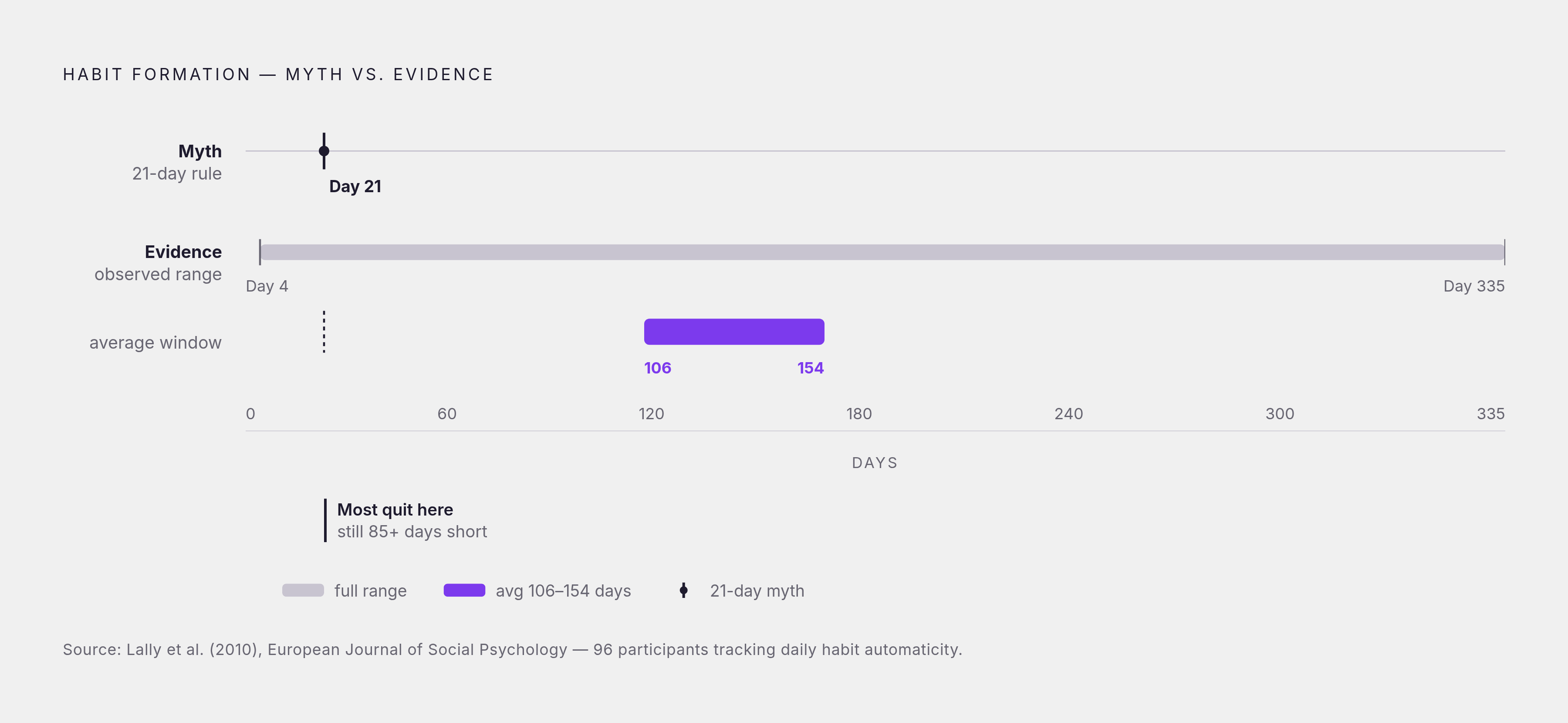
Habit formation depends on the same executive functions ADHD disrupts: organization, working memory, impulse control. That overlap is precisely why generic habit advice, the kind built for a brain with intact EF systems, tends to fall apart on contact with ADHD.
Here's a fact that surprises a lot of people: research indicates habit formation on average takes somewhere between 106 and 154 days, or roughly three to five months, for a behavior to become automatic. The full observed range in the literature stretches from 4 days to 335 days depending on the behavior and the person. The popular "21-day rule" repeated endlessly in productivity content has no solid empirical footing even for neurotypical populations, let alone ADHD ones. Treating it as a benchmark is probably the single most common reason people conclude a habit "isn't working" when it's simply early, and this is the one piece of conventional habit advice worth throwing out entirely rather than adapting.
A habit that hasn't stuck after three weeks is a habit still inside its normal formation window. Treating week three as a verdict is exactly what causes people to abandon something that was working on schedule. Time blindness compounds the problem here too: ADHD brains often struggle to sense time passing accurately, which makes it genuinely harder to feel progress accumulating even when the data would show it is. Cognitive load compounds on top of that. Each extra step tacked onto a routine adds meaningful friction, and research on executive dysfunction in ADHD consistently shows that performance suffers as task demands increase.
The structural strategies that actually reduce friction enough for ADHD habits to take hold
Every strategy in this section serves one principle: ADHD routines get built by cutting decision-making, not by reinforcing willpower. That's a different design target than most productivity advice aims for, and it's exactly why the most popular advice, just try harder, just commit, fails almost on contact.
Environmental design comes first, because it does the most work before a person even has to think. A "launch pad," a pre-staged spot where keys, clothes, and whatever the morning needs sit ready the night before, eliminates a whole category of morning decisions before they can become obstacles. Anything requiring more than two steps to start should get simplified before the habit is even attempted; if starting a workout means digging through a drawer for the right socks, that's friction worth removing at the source. Digital cues help too, but only when they're specific. An alarm labeled "leave NOW, not in 5 minutes" compensates directly for time blindness in a way a generic chime never will. Visual schedules and habit trackers matter for the same reason: they externalize the sequence so working memory isn't forced to hold it under pressure.
Anchor habits and habit stacking give new behavior a foothold. Pick one low-decision, thoroughly predictable task to open the day (drinking a glass of water, opening the blinds, making coffee) and let it signal to the brain that the sequence has begun. That anchor doesn't need to be impressive. It needs to be automatic, because its entire job is lowering the activation energy for whatever comes after it. Habit stacking works by tying new behavior to patterns already wired into the brain, borrowing their existing neurological groove instead of carving a new one from scratch.
Task shrinking addresses initiation directly. Breaking a task into micro-steps, "open the document," "type the title," "list three bullet points," gives each completed piece its own small momentum, and that momentum compounds in a way a single large goal never does. A brain dump, writing every competing thought onto paper or into a notes app, clears working memory of the burden of holding those thoughts while also trying to act on one of them. Time-structure tools like the Pomodoro method, 25-minute focused stretches followed by breaks, give time a visible, bounded shape, which addresses time blindness about as directly as a tool can.
Accountability structures round this out. Body doubling, working alongside another person either in the same room or over video, shifts the pressure from internal willpower to external commitment, and apps like Focusmate have built entire tools around operationalizing exactly that. Two or three anchor habits will outlast a ten-step morning routine nearly every time, and overbuilding at the start, not lack of effort, is the single most common reason ADHD routines collapse before they've had a chance to stick. A 2025 meta-analysis covering 30 studies examined sensory sensitivity in individuals with ADHD compared to controls, which means morning environment design, light, sound, temperature, is a genuine necessity. It's a functional variable that either supports the routine or undermines it.
Why gamification works for ADHD brains specifically and what separates it from gimmickry
Gamification solves a specific problem: ADHD brains struggle to sustain engagement with tasks that don't generate their own immediate reward. That's the dopamine gap from earlier showing up again, not a personality quirk or a preference for shiny badges, and conflating the two is exactly where most gamified apps go wrong.
Points, streaks, and level-ups supply an immediate feedback loop that the underlying task often can't produce on its own. Filing an expense report doesn't reward the brain. A streak counter ticking upward can. But not all gamification is built the same, and most of what passes for it deserves the skepticism it gets. Superficial versions, badges handed out just for showing up, don't do much beyond decoration, and they're the reason gamification has a credibility problem in the first place. Systems that actually mirror the underlying neurological need tie meaningful reward to specific, completed micro-steps, the same micro-steps discussed in the task-shrinking section above, and that distinction, reward tied to real completion versus reward tied to mere presence, is the one worth checking before trusting any tool that calls itself gamified.
This maps directly onto the habit-formation timeline covered earlier. Small wins need to compound across that 106-to-154-day window for a behavior to become automatic, and the reward system is what keeps the behavior alive long enough to survive that stretch. External accountability, body doubling, coaching check-ins, and gamified tracking are all doing the same underlying job: making invisible progress visible and reinforcing it in the moment it happens, rather than asking a person to trust that the payoff will show up eventually. ADHD coaching operationalizes a version of this too, breaking tasks into steps, running structured planning sessions, and checking in regularly, which externalizes the initiation process the ADHD brain's own executive function systems can't reliably generate alone. An app built specifically around ADHD, combining voice-first interaction to remove typing friction with XP rewards and milestone-based tracking, addresses initiation, sequencing, and the dopamine gap at the same time. That's the design logic separating tools built for ADHD from neurotypical productivity apps with an ADHD label bolted on afterward, and it's worth checking for before choosing one.
What changes when ADHDers understand the mechanism rather than accepting the label of laziness
Procrastination in ADHD is a predictable output of executive dysfunction and dopamine dysregulation. It is not a verdict on someone's character, and the research covered across this piece backs that up at every level, from the circuitry studies to the quality-of-life data to the timelines on habit formation itself.
The fact that a majority of adults with a current diagnosis, 55.9 percent according to Staley et al.'s 2024 data, received that diagnosis only in adulthood matters here. Most of these adults spent their formative years without an explanation for why standard advice never worked for them, accumulating shame in place of strategy. Understanding the mechanism functions as its own kind of intervention: it doesn't fix anything by itself, but it removes the shame that makes paralysis worse, and the research on anxiety comorbidity backs that dynamic up directly. Shame and pressure deepen the freeze. Compassion paired with actual structure is what opens a path through it, and between those two responses, only one of them does any real work.
Every strategy in this piece works for the same underlying reason. It cuts decision load, externalizes sequence, supplies reward on a timescale the brain can actually use, and stays simple enough to survive a bad executive-function day without collapsing entirely. Small, consistent wins, even imperfect ones, are what compound across that 106-to-154-day window into something automatic. The goal was never a perfect routine. It was a resilient one, and knowing why the standard advice failed in the first place is what makes it possible to choose something built for how this brain actually runs, rather than something borrowed from a system that was never designed with it in mind.
Sources
- A bibliometric analysis of executive functions in ADHD mapping trends and hotspots
- Executive function in children with neurodevelopmental conditions: a systematic review and meta-analysis | Nature Human Behaviour
- ADHD, Hyperfocus, and Procrastination: The Mediating Role of Maladaptive Daydreaming in Adverse Psychological Outcomes - Ari Nowacki, 2025
- sevenpubl.com.br
- add.org
- ncbi.nlm.nih.gov