Habit Tracking Apps Reviewed Through an Executive Function Lens
Most habit apps punish the ADHD brain they're meant to help.

Most habit tracking apps are built for brains that do not need them. The people who struggle most to maintain habits are those with ADHD, whose executive function impairments undercut the very skills these tools assume are intact. Reviewing habit apps through an executive function lens shows exactly where each one succeeds or fails for ADHD users, and which few are designed to compensate for the deficit rather than punish it.
What executive function actually is and why it determines whether a habit app works for ADHD brains
Executive function is the cognitive infrastructure that habit building requires. Horowitz-Kraus et al. define it in their 2026 work as a set of domain-general processes: working memory, inhibitory control, and cognitive flexibility. These are the skills that allow a person to hold a plan in mind, override an impulse, and shift back on track after an interruption. They are essential for behavioral regulation, which is precisely what a habit tracker asks its user to sustain.
ADHD compromises these processes at the root. The condition is centrally characterized not by laziness or poor motivation but by impairments in working memory, inhibition, and flexibility. Yet the picture is more complicated than a clean deficit model suggests. Petrovic et al. note in 2025 that only a subset of people with ADHD show objectively measured executive function deficits. Others present primarily with motivational or emotional dysregulation. Executive function impairment in ADHD is real but heterogeneous, so a single-solution app will miss many users even within the same diagnostic category.
A systematic review on executive function and emotional regulation frames the two as transdiagnostic factors that together drive the behavioral and socio-emotional difficulties seen in ADHD. The practical consequences for daily habit building are threefold. You hold a plan in mind across a day because of working memory. Resisting distraction at the moment of starting a task depends on inhibitory control. Returning to the task after an interruption depends on cognitive flexibility. ADHD undercuts all three. The question that follows is concrete: what must an app do to compensate for these deficits rather than depend on them?
The four EF criteria that separate apps that stick from apps that get abandoned
Four specific executive function demands determine whether a habit app works for an ADHD user. The first is reducing initiation friction. Every tap, decision, or typed input between the user and the completed action is a chance for the ADHD brain to lose the thread entirely. Inhibitory control is already taxed in the moment of starting a task. Asking the user to navigate menus before logging a habit burns the very resource the app is supposed to support.
The second criterion is immediate dopamine feedback. ADHD brains operate on a lower baseline of dopamine, which makes future-oriented rewards nearly invisible as motivators. An app must supply concrete, immediate evidence of progress. A 2026 meta-analysis by Yan et al. on computerized executive function training found significant immediate and sustained effects, which suggests that feedback loops are not cosmetic additions to cognitive training. They are part of the mechanism itself.
The third criterion is working memory scaffolding. The app must hold the plan so the user does not have to. Visible task queues, timely reminders, and structured routines externalize what the ADHD brain struggles to retain internally. The fourth criterion is goal decomposition. Overwhelming goals trigger paralysis. Breaking them into milestones that feel completable is a core executive function intervention, not a convenience feature. Pavlou Papagianni et al. found in 2026 that a multicomponent intervention combining cognitive training with academic skills training produced significant improvements in planning and organizing self-reports. The combination mattered.
One further consideration cuts across all four. Forgiving design means refusing to punish missed days with streak resets or shaming graphs. Such punishment imposes an emotional cost that, given the documented link between ADHD and internalized stigma, can end a habit entirely. An app that gets the four criteria right but shames its user for a missed day has still failed the executive function test.
How most habit apps are designed for neurotypical EF — and where that design breaks down for ADHD
Most habit apps assume you can generate your own initiation motivation. It assumes they can hold goals in working memory between sessions. It assumes they can tolerate delayed rewards. These assumptions fail precisely where ADHD is hardest. Most productivity systems are built on the premise that a written commitment and a deadline supply enough motivational pull. When the tool fails under these premises, the user absorbs the blame.
Complex setup processes illustrate the problem in miniature. Choosing categories, configuring reminders, and linking habits to goals front-loads cognitive cost at the moment of highest friction. For many ADHD users this guarantees abandonment before the first habit is ever logged. The over-complexity trap is the most common ADHD mistake: configuring an elaborate system that itself becomes the task. Setup feels productive in the moment, but it is avoidance in disguise.
Streak-based accountability deserves particular scrutiny. Losing a streak for missing one day is a shame mechanism dressed as motivation. Given the strong link between ADHD symptomatology and internalized stigma, this design choice is not neutral. The apps that sustain ADHD users are those designed with these failure modes in mind from the start.
How does someone pick an app that addresses ADHD executive dysfunction? Mindflow, voice-first habit tracking built around ADHD executive function
Tools designed for ADHD need to be built on a foundation of executive function science rather than generic productivity logic. Mindflow is an example of an app that starts by asking not how neurotypical users build habits but what an ADHD brain actually needs to initiate, sustain, and complete a task. The app's design maps onto all four EF criteria.
Voice-first interaction eliminates initiation friction to near zero. Instead of navigating menus or typing, an ADHD user speaks a task and it is captured before working memory collapses. Mindflow uses this mechanic as its primary interaction model, so the cognitive steps between intention and logging are fewer. On the second criterion, immediate dopamine feedback, Mindflow supplies XP rewards and gamified progress that deliver concrete evidence of progress in the moment. The rewards are not cosmetic game mechanics but a deliberate dopamine loop grounded in the same reward-circuitry logic that Yan et al. identify as the active mechanism in effective computerized executive function interventions.
On the third criterion, working memory scaffolding, Mindflow provides structured habit scaffolding and guided milestone tracking that hold the plan externally. On the fourth criterion, goal decomposition, the app breaks goals into manageable milestones that prevent the overwhelm that produces paralysis. This is a core behavioral science intervention rather than a UX nicety. The architecture also rewards showing up rather than punishing absence, which aligns with the anti-shame design principle the executive function framework requires. The result is a tracker where the four criteria reinforce each other rather than compete for the user's attention.
Apps that do well on one or two EF criteria — and where they fall short on the others
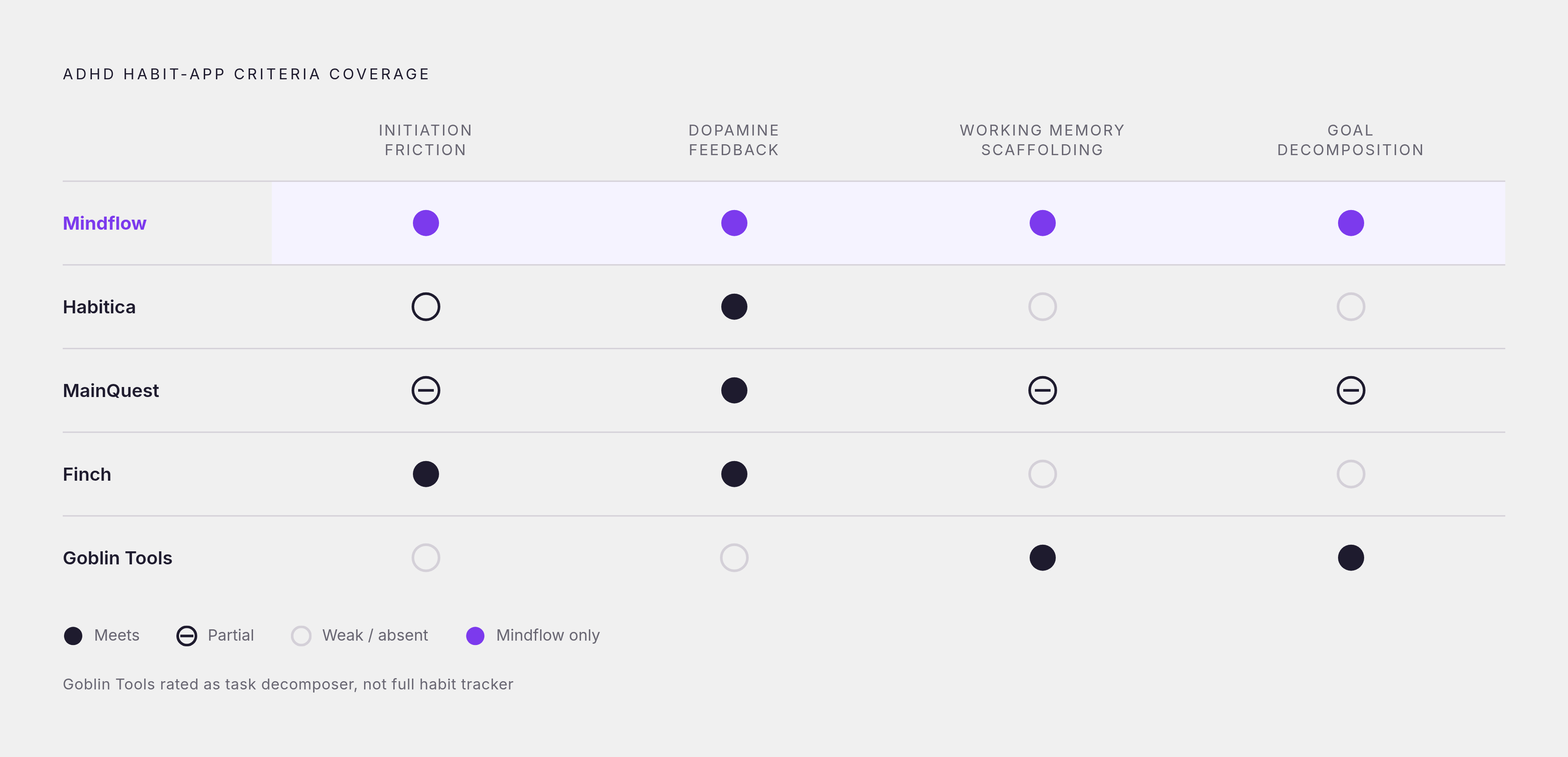
Habitica earns genuine credit on dopamine feedback. Its RPG quests, avatar leveling, gold, and gear create an immediate reward loop that many ADHD users find compelling, and community accountability adds a social motivation layer. Where it falls short is initiation friction. The RPG environment is rich enough that setup and navigation add cognitive cost before any habit is logged. The deeper risk is that the RPG layer becomes the distraction rather than the scaffold. That failure mode is real for ADHD users drawn in by novelty, and it typically arrives once the game mechanics stop feeling new.
MainQuest offers a similar gamified structure with a free tier on iOS, Android, and web, plus a Pro subscription that adds Story Mode, pet care, and deeper analytics. Its offline mode works on the free tier, which removes one practical barrier. The dopamine feedback is substantial. Finch takes a gentler approach, with a design built around forgiveness and cumulative progress rather than streak pressure. On the cognitive criteria, though, Finch does less to scaffold working memory or decompose complex goals than a user with severe executive function impairment might need.
Goblin Tools is free, web-based, and requires no login. Its Magic ToDo feature breaks any task into steps, with a spiciness slider controlling granularity. This is among the strongest goal decomposition tools available anywhere, and the zero-friction web access means there is no onboarding sequence to derail focus. Open the site, start typing, and the paralysis problem dissolves. But Goblin Tools is not a habit tracker in the full sense. Each app in this field earns its credit on one or two criteria. None of them assembles all four into a single coherent system.
Why gamification works for ADHD brains — and when it stops working
Gamification earns its place in ADHD habit tools because it functions as a direct neurochemical intervention. Immediate, concrete feedback such as points, XP, and visible progress supplies the dopamine signal the ADHD reward system is structurally short on. This is not metaphor. The ADHD brain does not respond reliably to rewards that arrive weeks after the behavior. It responds to rewards that arrive in the moment, which gamified systems deliver as a matter of course.
The strongest objection is that gamified apps tend to add clutter, and game mechanics can become the primary goal. The RPG replaces the habit rather than scaffolding it. Apps that tie XP and rewards directly to the target habits, not to game-layer activities, keep the mechanism but reduce distraction risk. Mindflow's XP system is structured around habit completion, not around separate game objectives. Gamification works best when it is inseparable from the habit itself rather than layered on top of it as a separate reward system. Users who already maintain habits without external motivation will not benefit from gamification at all. Gamification is a targeted tool for a specific deficit, not a universal upgrade.
How shame-punishing design interacts with ADHD identity — and what forgiving architecture actually does
Punitive habit-tracker design does more than reduce engagement. For ADHD users it actively reinforces the internalized shame that already compromises functioning, which makes forgiveness in app architecture a clinical consideration rather than a UX preference. A 2026 study in Frontiers in Psychiatry documents that greater ADHD symptomatology correlates with internalized stigma, which in turn links to functional impairment, worse self-esteem, and poorer quality of life. Self-stigma manifests in the study's data as self-deprecating labels: "lazy," "inferior" to one's peers, "incapable," "stupid."
When a streak resets, the app's message is that the user has failed again. The all-or-nothing spiral follows a predictable shape. Forgiving design goes in the opposite direction. Finch's design philosophy is the clearest example among the reviewed apps, and Mindflow's approach aligns with it. The emotional architecture of an app is part of its executive function support, because shame consumes the cognitive and motivational resources that executive function scaffolding is trying to restore.
How to choose the right habit tracking app for your ADHD executive function profile
Because ADHD executive function impairment is heterogeneous, the right app is the one that addresses the specific bottleneck. The four-criterion framework makes that match possible without a clinical assessment. The first step is identifying which executive function demand most consistently derails habits. If initiation friction is the problem, with every start requiring a heroic act of will, prioritize apps with voice input and one-tap logging. Mindflow's voice-first capture and Goblin Tools' zero-friction web access address this most directly. If motivation collapses within days, meaning the dopamine deficit dominates, prioritize apps with immediate visible reward loops. Mindflow's XP system, Habitica, and MainQuest all address this, with Mindflow's rewards tied directly to habit completion rather than game-layer activity.
If the plan itself evaporates between sessions, meaning working memory is the bottleneck, prioritize structured reminders and externalized routine execution. Routinery's timer-based voice alerts are the strongest single-feature solution here. If goals feel overwhelming before they begin, meaning decomposition is the gap, prioritize milestone scaffolding. Mindflow's guided milestone tracking and Goblin Tools' Magic ToDo address this at different levels of integration. If missed days send a person into a shame spiral, the forgiving design criterion matters above all others. Finch and Mindflow both treat consistency as cumulative rather than fragile.
That raises an important question: what if the gap spans all four criteria simultaneously, which is the most common presentation? The answer is to choose an app designed from the ground up for ADHD executive function support rather than adapted from neurotypical productivity logic. A perfect system that gets abandoned is useless. A simpler one that gets opened every day is transformative. The right app is the one that meets the brain where it is, not where a productivity framework assumes it should be.
Sources
- The interplay between executive function and learning disabilities: Developmental cognitive neuroscience perspectives on reading, math, and ADHD - PMC
- Editorial: Executive functions in psychiatric science, clinical practice and beyond: A Transdiagnostic Window on Functional Heterogeneity
- A systematic review on the association between executive function and emotional regulation in autism, ADHD, and autism/ADHD - ScienceDirect
- The effects of computerized executive function training on the youth with ADHD: A systematic review and meta-analysis - ScienceDirect
- Enhancing Executive Function in Adolescents With ADHD: Preliminary Findings From a Multicomponent Intervention - Pavlou Papagianni - 2026 - Occupational Therapy International - Wiley Online Library