Emotional Dysregulation Effects on ADHD Daily Routines
Emotional dysregulation breaks ADHD routines at predictable points, not randomly.

Emotional dysregulation in ADHD isn't a mood problem riding shotgun with inattention and hyperactivity. It's a core executive function issue, and it breaks daily routines at specific, predictable points, not randomly. Name those points and a routine can be built to survive them instead of collapsing every time one gets hit.
Most public conversation about ADHD still centers on distractibility and fidgeting. Emotion regulation rarely gets billed as a defining feature, even though a 2026 systematic review in Neuroscience & Biobehavioral Reviews, covering 22 articles published between January 2013 and October 2024, found executive function difficulties and emotional dysregulation consistently linked across ADHD presentations. Not occasionally linked. Consistently. Some current models go further: some current models argue emotional impulsivity belongs alongside inattention as a core symptom, not something that trails behind it.
That reframing matters past the level of diagnostic nitpicking. When dysregulation gets treated as a side issue, the daily breakdowns it causes get chalked up to laziness or a bad attitude, "just a rough morning," instead of a mechanism that can be studied and worked around. And if emotional dysregulation really is a core executive function deficit, its disruptions should follow a pattern. Which means they can be anticipated, and routines can be built around that pattern instead of pretending it doesn't exist.
How the executive function system connects emotion and daily behavior
Executive function isn't one thing. It covers several related cognitive processes: working memory, inhibitory control, and set-shifting (the ability to move flexibly between tasks or mental states). Some researchers add a fourth category under the "hot EF" label: emotion regulation and reward-based decision-making, the part of executive function that runs hot because it's tangled up with feeling, not just thinking.
Each of the three "cold" domains does a specific job in keeping a routine intact. Working memory holds the plan in mind while it's being carried out, so losing track of it mid-task means losing the thread entirely. Inhibitory control suppresses the intrusive emotions and impulses that would otherwise yank attention somewhere else. Set-shifting is what lets someone recover after an interruption or an emotional spike, restarting the routine instead of stalling out inside it.
A 2025 study of 176 women between the ages of 20 and 30 (82 with ADHD, 94 without) found that working memory and task-shifting deficits specifically mediated the relationship between ADHD symptoms and emotional dysregulation. That word, mediated, is doing real work. It means the dysregulation doesn't just sit next to the executive function problems, it runs through them. A spike in frustration degrades working memory. Degraded working memory collapses the plan. The collapsed plan feeds right back into more frustration. That's a loop, not a coincidence, and it's worth sitting with the difference: a coincidence you can shrug off, a loop you have to break somewhere.
This isn't just self-report data either. A 2025 Frontiers in Neuroscience review of 68 EEG studies found consistent electrophysiological markers in adult ADHD, including elevated theta power and reduced P3 and N2 amplitudes during response inhibition tasks. Cognitive control and error detection show up as measurably different on a scan, not just described differently on a questionnaire. And this isn't rare or occasional: an estimated 80 to 90% of adults with ADHD deal with executive dysfunction on a daily basis. That's not a bad week. That's the baseline.
Where in the daily routine emotional dysregulation actually strikes
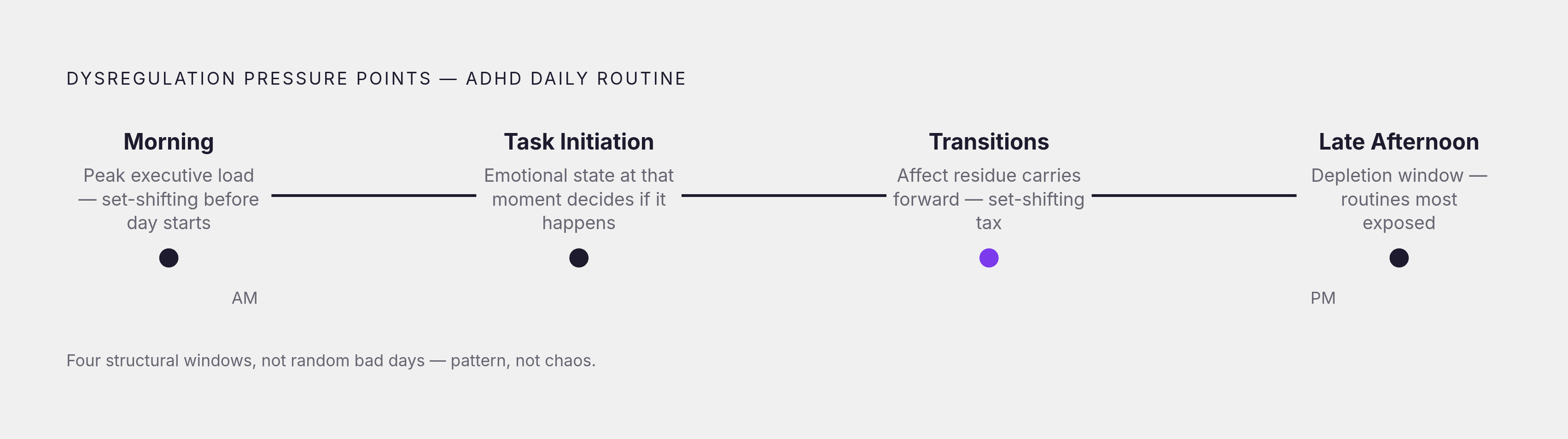
Unstructured time acts as an amplifier. Without something external holding the shape of the day, ADHD symptoms, procrastination, decision paralysis, background stress, tend to get worse, not better. But even the structured stretches of a day have weak points, and they cluster at the same predictable spots almost every time.
Mornings carry the heaviest executive function load of the whole day. Waking up, washing up, eating, getting out the door: each transition demands a fresh round of set-shifting. Any friction along the way, a sharp exchange with someone at breakfast, a missing set of keys, a sock seam that feels wrong, drains inhibitory control before the day has properly started. Time blindness makes this worse. If sensing elapsed time is already hard, the emotional derailment doesn't register until the whole schedule has already come apart.
Task initiation is its own weak point, separate from the task itself. The gap between knowing what needs doing and actually starting it is where a lot of ADHD routines die quietly. Emotional state at that exact moment predicts, more than almost anything else, whether the task happens at all. A boring task paired with anxiety or irritation is far more likely to get avoided than started. Vague goals make this worse: "be more productive" hands an ADHD brain nothing to grab onto, while a specific, bounded goal cuts down the emotional friction of getting moving in the first place.
Transitions between tasks carry what amounts to a set-shifting tax. Every switch is a small disruption, and emotional residue, leftover frustration, leftover excitement, leftover disappointment, carries into whatever comes next. A 2025 study in PLoS ONE documented greater affect variability in ADHD, both within a single day and across days, and linked those swings to worse social functioning and more internalizing and externalizing symptoms.
By late afternoon or evening, the depletion window opens. Executive function resources aren't infinite, and the accumulated emotional weight of the day leaves routines most exposed right when energy is lowest. Evening wind-down, prep for the next day, sleep hygiene: these are usually the first things dropped. Research puts measurable emotion regulation impairment at approximately 48 to 54% of pediatric ADHD cases, and the disruptions don't scatter randomly across the day. They stack up at the same structural pressure points, morning, initiation, transition, evening, over and over.
The shame spiral that turns one disruption into a lost day
ADHD brains show larger, faster emotional swings than neurotypical brains. A setback that most people absorb and move past without much thought can register as a genuinely significant emotional event here. That difference in scale is where the spiral usually starts, and it's worth being blunt about what most people get wrong: this isn't an overreaction to a small thing. It's a proportionate reaction to a nervous system that processes the thing at a different amplitude.
The sequence tends to run the same way. One missed transition triggers a self-critical thought. The self-critical thought raises negative affect. Rising negative affect further compromises inhibitory control, so the next task, already harder to start, fails too. Shame deepens. All-or-nothing thinking, which shows up often in ADHD, turns a single broken morning routine into a verdict: the whole day is lost. And because that belief shapes behavior for the rest of the day, it tends to become true on schedule.
Alexithymia complicates the recovery. A 2025 controlled study in PLoS ONE found women with ADHD reported higher levels of emotional dysregulation, alexithymia, and negative affect than women without ADHD. Alexithymia means difficulty naming or recognizing one's own emotional state, which makes the spiral harder to interrupt. It's tough to catch a feeling before it derails behavior if the feeling isn't identifiable yet.
Standard first-line treatments don't fully solve this, and that's the part worth stating plainly: medication alone is not enough here. Co-occurring emotional dysregulation tends to resist medication and behavioral therapy alone, which means self-management structures aren't optional extras, they're doing work that clinical treatment isn't fully covering. The cost isn't contained to the day itself, either. Dysregulation spills into relationships, into stress management, into how someone copes generally, so a lost day doesn't just end, it adds friction to the next cycle before that cycle has even started.
Why routine structures designed for neurotypical brains fail at exactly these moments
Most productivity systems quietly assume emotional regulation is stable. Make the plan, follow the plan, treat disruptions as external and occasional, a sick day, a canceled meeting, not something baked into the operating system itself.
That assumption is exactly where these systems break for ADHD brains, where emotional disruption is internal, frequent, and structurally predictable. A system built without that in mind fails at the same spots every single time, and rigid schedules make it worse: once the schedule breaks, and it will, all-or-nothing thinking treats the entire system as a failure instead of treating one broken link as, well, one broken link.
Long morning checklists carry the same flaw in a different shape. More items means more initiation demands, more working memory load, more surface area for something to go emotionally sideways. And the generic advice to "just build better habits" ignores that habit formation itself gets interrupted by affect variability: missing one day triggers shame, and shame makes missing the next day more likely, not less. This is the part most advice gets backwards. It tells someone to white-knuckle through the twelve-item list rather than shrink the list so it survives contact with a bad morning.
Research on 52 college students with learning disabilities or ADHD found that effective coping strategies were multidimensional, cognitive, behavioral, psychological, and socio-environmental all at once, not reducible to a single planning method or a single checklist format. The design implication follows directly. Useful structure for an ADHD brain has to anticipate emotional disruption ahead of time, build in recovery without attaching punishment to it, and cut friction rather than add more steps to climb over.
What structure actually looks like when it's built around emotional disruption
Anchoring routines to something automatic, rather than to a clock, removes a decision point that would otherwise have to survive an emotional spike. Habit stacking, attaching a new behavior to one that already runs on autopilot, cuts the initiation demand down because there's no moment where a choice about "when to start" has to get made under pressure. Three non-negotiable morning tasks beat a twelve-item checklist for the same reason: fewer decision points, less surface area for something to go wrong.
Transitions deserve to be designed on purpose, not left to chance. A short burst of physical movement between tasks works as both a physiological reset and a cognitive buffer. Physical activity before or between work sessions has been shown to stabilize emotional states and sharpen focus. A named transition ritual, a specific sound, a short walk around the block, a glass of water poured and drunk slowly, externalizes the set-shifting cue that an ADHD brain has trouble generating from the inside on its own.
Goals should be specific enough to remove the guesswork at the exact moment of starting. "Answer emails before lunch" gives the brain a clear finish line. "Be more productive" gives it nothing at all. Breaking a large goal into milestones addresses the overwhelm that triggers avoidance in the first place, since each milestone is a small, completable unit that doesn't require the entire plan to stay loaded in working memory at once.
Recovery has to be built into the system, not bolted on afterward as an apology. Habit-formation research notes that missing a single day has no measurable effect on long-term habit formation, which is the basis for the "never miss twice" rule: one disruption is recoverable, two in a row is where the pattern actually breaks. Flexible routines that bend with fluctuating energy levels hold up better over time than rigid ones that shatter at the first emotional spike. Habit trackers that don't punish a missed day matter for the same reason: they remove the shame trigger that turns one rough morning into an abandoned system entirely.
Social presence helps stabilize attention during the highest-risk windows. Body doubling, working alongside another person without necessarily collaborating on the same task, showed strong results in a 2024 study of 220 neurodivergent participants, where 85% reported significant improvement in task completion. A 2025 VR study with 12 adults with ADHD tested both human and AI-based body doubling against working alone across a complex task. The mechanism traces back to social facilitation theory: the mere presence of another person raises arousal in ways that support performance on tasks a person already knows how to do. That effect is especially useful during the morning and late-afternoon windows already flagged as vulnerable.
A regular weekly review, Sunday evening, say, functions as more than a productivity check-in. It's a structured moment to notice which emotional disruption points hit hardest that week and adjust the coming week's scaffolding in response. That keeps the system adaptive instead of static, which matters given that affect variability means the same trigger might barely register one week and derail an entire day the next.
How dopamine-driven feedback loops address the emotional layer, not just the task layer
ADHD is associated with differences in reward processing and motivation that make tasks without immediate feedback feel disproportionately difficult. The practical effect is direct: tasks without immediate feedback feel disproportionately unpleasant, even when they're objectively small. Answering three emails shouldn't feel like moving a piano up a flight of stairs, but for a dopamine-starved system, it can.
Emotional dysregulation and dopamine are tangled together here. When a task produces boredom or frustration and no reward signal pushes back against it, the emotional state usually wins, and the task stalls out. Gamification, points, levels, visible progress bars, addresses this at the source instead of working around it. These mechanics trigger real-time dopamine release, giving an ADHD brain the immediate feedback loop it needs to stay engaged past the first wave of resistance.
Research on progress tracking and variable reward schedules backs this up. Both tap into reward-related motivation, and both are core features of well-built gamified systems. Motivation research adds a longer arc to the picture: external rewards paired with cues that build a sense of competence can support more sustained engagement over time. The structure itself starts to feel rewarding on its own terms, shifting the motivation from extrinsic to intrinsic the longer it runs.
None of this is motivational decoration, and it's worth pushing back on anyone who dismisses it as gimmicky. XP systems and milestone tracking function as external reward signals, compensating for reduced motivation sensitivity at exactly the moments, task initiation, sustained effort, transition points, where emotional disruption is most likely to knock the routine off course. An app that delivers gamified feedback at those specific pressure points is doing something structurally different from a plain task list. It's intervening directly in the emotion-executive function loop, not just keeping a record of what got done.
What changes when you stop treating emotional disruptions as personal failures
Once emotional dysregulation is understood to disrupt routines at specific, predictable points, morning, initiation, transition, evening, those disruptions stop reading as proof of personal inadequacy. They become information instead: a signal about where the system needs reinforcing, not a verdict on character.
Shame doesn't motivate an ADHD brain. It never has, and treating it as a lever anyway is probably the single most common mistake in how these routines get designed. Shame compounds the existing executive function deficit by adding emotional weight at the precise moment those resources are already running low. Reframing a missed morning or a collapsed routine as a structural event rather than a character event isn't letting yourself off easy. It's the actual precondition for re-engaging instead of spiraling further into the same loop described earlier.
Small, partial wins, repeated daily, add up over time in a way a flawless system rarely manages to sustain, mostly because a flawless system has no plan for the day it isn't flawless. The goal was never a perfectly executed routine that never breaks. It's a recoverable one that runs consistently enough to build real momentum. Low-friction, voice-first tools matter here too, because the moment someone decides "I should get back on track" needs to demand as little executive function as possible if it's going to actually succeed.
An environment that anticipates emotional disruption, builds recovery in from the start, rewards progress instead of punishing gaps, and strips shame out of the feedback loop isn't a workaround bolted onto a broken system. For an ADHD brain, that's what a properly designed system looks like from the ground up.
Sources
- Frontiers | Executive function and neural oscillations in adults with attention-deficit/hyperactivity disorder: a systematic review
- A systematic review on the association between executive function and emotional regulation in autism, ADHD, and autism/ADHD - ScienceDirect
- A controlled study of emotional dysfunction in adult women with ADHD
- Executive Functioning and Emotion Regulation in Children with and without ADHD - PMC
- The ADHD Paralysis Trap: Why You Can’t Start—and How to Break Through — Dr. Sharon Saline
- eprints.soton.ac.uk