SMART Goal Setting for ADHD Adults
Reframe standard goal-setting to match how ADHD executive function actually works.

Executive dysfunction breaks specific, nameable cognitive functions, planning, working memory, time perception, task initiation, and standard SMART goals quietly assume all of them are intact in ADHD adults. This piece goes through each of SMART's five letters and rebuilds it around what actually happens in an ADHD brain, rather than what the framework wishes were happening. I've spent enough time in this material, both professionally and personally, to say the mismatch is a framework problem, not a motivation problem dressed up as one.
What executive dysfunction actually does to goal pursuit
Executive function is the operating system underneath goal-directed behavior. Planning, working memory, sustained attention, inhibition, self-monitoring, task initiation, time perception: all of it runs quietly in the background whenever someone tries to do something that isn't immediately rewarding. Leading ADHD research frames the condition itself as a disorder of executive functioning and self-regulation rather than an attention problem in the narrow sense. The core claim is that ADHD behavior gets governed by what's directly in front of a person rather than by future consequences — a pattern sometimes described as temporal myopia. I like the term because it names a mechanism instead of just relabeling a symptom.
So what happens once you actually sit down to set a goal? Working memory drops the goal from view the moment attention shifts, so "I'm working on this" can evaporate within minutes of starting something else, sometimes before the person even notices it's gone. Task initiation fails on its own terms too: knowing exactly what to do and being able to start doing it are not the same skill, and a lot of goal-setting advice quietly assumes they are. Time blindness means a deadline two weeks out and one two months out can feel equally unreal, right up until both have already passed. Cognitive flexibility problems mean one step going sideways can take the whole goal down with it, rather than just needing a small correction. And inhibitory control issues let distractions derail execution even when motivation is fully present, which is a distinction people without ADHD tend to miss entirely.
Goal Management Training is instructive here precisely because of what it targets. It's a structured intervention studied in ADHD populations that builds external scaffolding around planning and monitoring rather than trying to boost motivation directly. Improvements in inhibitory control held up for at least six months after treatment ended, according to the research. That's worth sitting with. SMART goals, to work for an ADHD brain, need to supply the executive function support the brain isn't reliably generating on its own. The assumption that willpower fills the gaps between the five letters is where the framework breaks down.
Making "Specific" specific enough to actually start
Most SMART advice tells you to answer the what, who, where, when, and why of a goal. Fine as far as it goes, but it doesn't go far enough. "Write the report" sounds specific: clear object, clear verb. It still leaves every micro-decision about how to begin wide open, and that open space is exactly where task initiation collapses.
A 2025 study in European Psychiatry looked at 50 adults with ADHD and found 82% reported frequent difficulty with decision-making, with 68% saying decision paralysis significantly affected their work performance. Sit with "write the report" again in light of that. Which document. Which section first. Typed or outlined. Each of those is a decision point, and each decision point is a fresh chance for paralysis to set in before a single word gets written.
ADHD-specific specificity closes those decision gaps at planning time instead of leaving them for the moment of action. "Open the proposal document and write one paragraph about the problem we're solving" closes that gap in a way "work on the proposal" never will. "Put on shoes and walk to the end of the street and back" does what "exercise more" fails to do. The first physical action in the goal should be small and concrete enough that starting it takes almost no executive effort at all. Decision fatigue is a documented, real constraint, and removing open choices at the moment of action functions as a structural accommodation, similar to a ramp, rather than a lowered bar. Naming the environment matters just as much: which device, which room, what's already open on the screen. Every bit of setup friction cleared away during planning is one less place initiation can fail later on.
Making "Measurable" work when working memory keeps dropping the thread
Standard advice on measurability says attach a number, a frequency, a clear finish line. Reasonable, but it assumes the person can hold that number in mind and check progress against it mentally. A measurement that lives only in someone's head disappears the moment attention moves elsewhere, and for a lot of ADHD adults that's a matter of minutes, not hours.
Measurement has to live somewhere external. Written down. Visible. Checked at intervals that don't rely on memory to trigger the check. In practice that means progress you can see at a glance instead of reconstruct from scratch, and tracking that takes seconds rather than minutes, because any friction in the tracking system becomes one more task the brain will avoid. Streaks, checkboxes, completion counts, they convert abstract progress into something concrete and deliver a small dopamine hit that makes the brain willing to show up again tomorrow.
Interval matters as much as format here. Weekly check-ins, the default in most goal-setting templates, sit too far apart for a brain that needs reinforcement close to the behavior it's reinforcing. Daily, or even per-task, feedback does more work. Worth measuring effort alongside outcome too. A day where the walk happened but ran shorter than planned should register as a win on the tracker, not a gap. Outcome-only measurement turns an imperfect but real effort into a recorded failure, and recorded failures are exactly what erode the will to keep tracking at all.
Setting goals that are genuinely achievable for an ADHD brain, not just technically reachable
Standard achievability asks whether a goal sits within your capabilities and resources. Reasonable question. The trouble is when it gets answered. Goal-setting sessions tend to happen during a burst of energy and interest, and the scope decided on in that high state rarely survives contact with an ordinary, low-dopamine Tuesday afternoon.
For an ADHD brain, achievability has to be calibrated against the worst predictable day, not the best recent one. That reframe changes almost everything about how a goal gets scoped, and it's worth taking seriously because the cost of getting it wrong compounds. Repeated failure to hit self-set goals builds shame over time, and shame is already a disproportionate weight for a lot of ADHD adults who spent years hearing they were lazy or undisciplined when the actual issue was a structural mismatch.
Build the buffer in on purpose, then. A goal should absorb one distraction, one bad night of sleep, one derailed morning, and still count as on track. Separate the minimum viable version of a goal from its ideal version explicitly, commit to the minimum, treat anything past that as bonus rather than baseline expectation. Reduce scope before a target gets missed, not after: scheduled review points that let the goal shrink without shame attached keep the whole structure alive far longer than a goal only ever revised in the aftermath of failure. Achievability, in the end, is partly an emotional design question. A goal that feels safe to attempt is one the brain will actually walk toward instead of quietly avoiding.
Why relevance and reward matter more for ADHD brains than any deadline
The standard question behind "Relevant" is whether a goal aligns with broader objectives. True enough, but shallow once you know what's happening neurologically. For ADHD brains, interest and reward function as closer to requirements than preferences that merely make a task more pleasant. Strip them out and motivation doesn't fade gradually; it often never switches on at all.
That's the reasoning behind a shift some ADHD-adapted frameworks make, swapping "Relevant" for something closer to "Thrilling." The operative question moves from does this goal matter to does this goal interest me enough that my brain will actually show up for it tomorrow. Small-sounding distinction, but it points at something beyond a mere workaround: when a goal connects to genuine curiosity, ADHD adults are capable of hyperfocus, sustained concentration that can outpace what neurotypical focus manages over the same stretch of time. Done right, relevance sustains motivation and doubles as the on-ramp to one of ADHD's more remarkable capacities.
What follows from that practically? If a goal doesn't generate any real interest on its own, ask whether it can be reshaped, gamified, paired with something already wanted, or in some cases handed off entirely. Reward belongs inside the structure of the goal, not promised vaguely at a finish line months out; a single payoff at the end does nothing for someone stuck at week two. Micro-rewards attached to each completed milestone do the actual work of keeping the brain engaged. And goals tied to identity, who someone is trying to become rather than what they're trying to check off, tend to hold up emotionally in a way task-framed goals rarely do.
Rebuilding "Time-bound" around time blindness and the urgency gap
Standard time-bound goals attach a deadline on the theory that a deadline creates urgency. Holds up fine for typical time perception. Falls apart for ADHD time perception, and this isn't a soft claim: research on adult ADHD has confirmed measurable differences in how ADHD adults estimate and reproduce durations of time. Future deadlines genuinely don't register as urgent until they're right on top of a person.
One deadline at the end of a goal is, functionally, no deadline at all for a brain running on temporal myopia. The urgency signal shows up eventually, just far too late to have shaped any of the behavior in the weeks leading up to it. The fix is more deadlines, spread through the timeline rather than stacked at the end. Break it into milestones, each with its own due date, so urgency distributes across the whole span instead of piling up at the finish. Each milestone deadline should sit close enough to feel real, days rather than months. Buffer periods belong in the structure from the start, not tacked on as an apology after something slips; the plan should absorb a delayed start or a missed step without the whole thing falling apart. External anchors help too: calendar events, alarms, accountability check-ins scheduled ahead of a deadline instead of arriving right at it.
The deeper shift here is philosophical as much as practical. Time-bound, for an ADHD brain, has less to do with marking an endpoint and more to do with manufacturing a string of "now moments," where each milestone makes the next step feel immediate instead of abstract. Visual timelines and countdowns earn their keep here; they translate time, naturally abstract and hard to feel, into something visible, the same way external tracking translates progress into something the brain can register.
Putting the adapted framework together: what an ADHD-designed SMART goal actually looks like
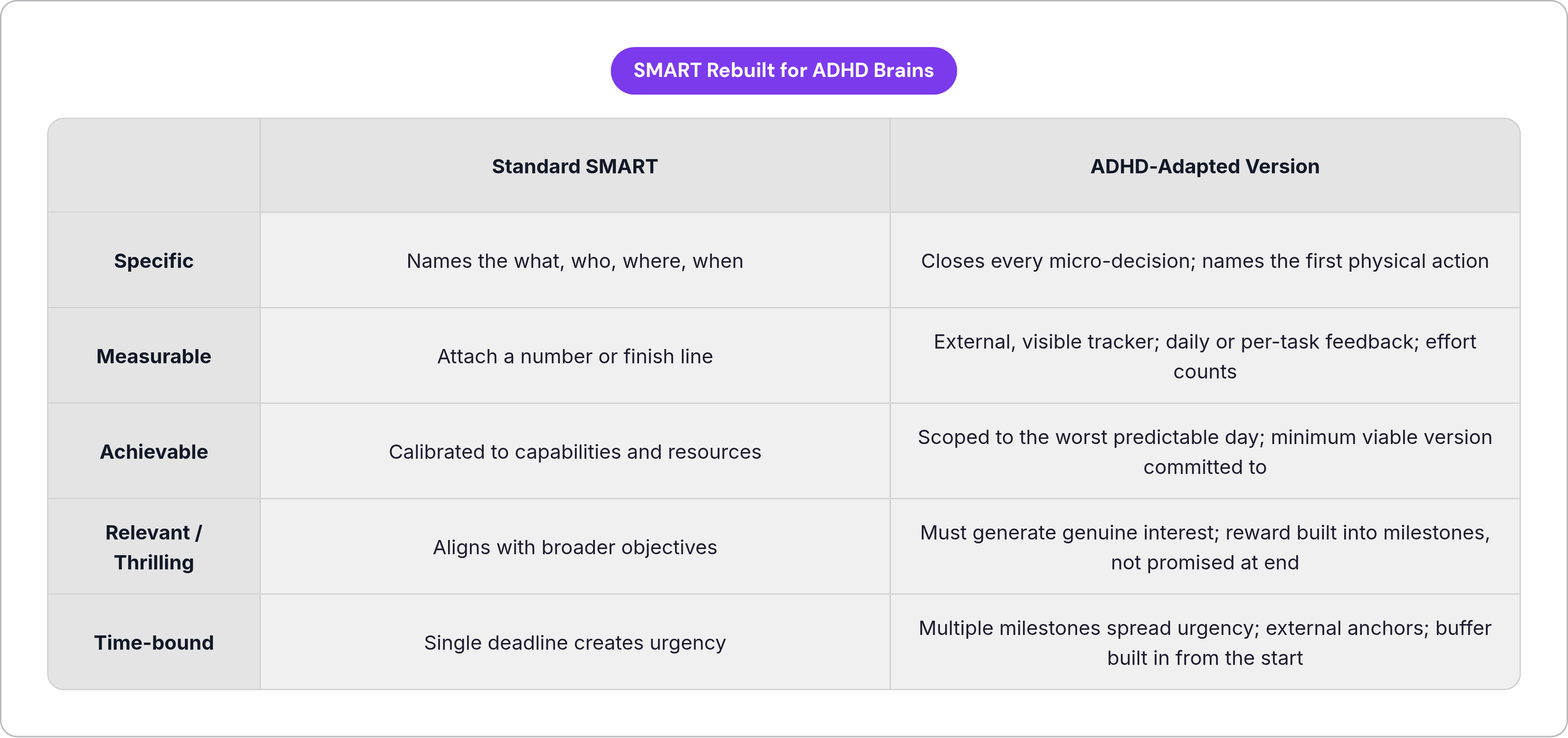
Take a goal almost everyone has set at some point: "I want to get fit." Motivating in the abstract. Completely unusable as stated for an ADHD brain, because it fails every test laid out above.
Run it through the adapted version. Specific becomes: "Walk for 20 minutes immediately after dropping the kids at school, three mornings a week, starting Monday." First action named, decision gaps closed, environment and timing locked in. Measurable becomes a checkbox in a phone note, reviewed each evening, with a three-day streak triggering a small, specific reward. Achievable means scoping to three days instead of seven, calibrated to survive a rough week, with the minimum viable version being one walk rather than the full three. Thrilling means pairing the walk with a podcast only listened to during that walk, so the walk becomes access to something genuinely wanted instead of a chore endured for its own sake. Time-bound means a milestone check at week two instead of waiting until week four, with a calendar reminder every Sunday evening confirming the plan for the coming three days.
What's missing from this version is worth noticing: willpower, vague motivation, a single distant deadline, internal memory doing the job of a tracking system. What's there instead: external structure at every stage, reward built into the behavior rather than promised later, urgency spread across weeks instead of stacked at the end, scope matched to a realistic, even pessimistic, read of capacity. This is roughly the standard I'd hold any adapted goal to before committing to it.
When adapted SMART goals still stall and what to do next
Even a carefully built goal can stall out completely, and that's worth saying plainly rather than treating every stall as proof the plan was flawed. Knowing the first step and being physically capable of taking it are, sometimes, still two different problems.
What's happening here is often closer to a freeze response than ordinary procrastination. Task paralysis in ADHD can trigger something closer to a stress reaction, where a person locks up rather than simply delays. Recognizing that as neurological rather than moral matters, because the right response to a freeze isn't the right response to laziness, and treating one like the other tends to make things worse.
A few tactics help in the moment. If "open the document" doesn't get someone moving, try something smaller, "sit at the desk," and keep subdividing until whatever's blocking it loosens up. Body doubling, working alongside someone else, in the room or on a call, externalizes the pressure to start and cuts through some of the isolation that makes a freeze feel heavier than it needs to. Short, timed sprints, ten or fifteen minutes with a built-in break, work by making the commitment feel finite instead of open-ended. A brain dump before starting, just writing out everything competing for attention, can clear enough noise to make initiation possible again.
When a goal stalls repeatedly rather than once, treat the pattern as diagnostic, not as a verdict on the person. Is the scope still too big? Has the reward or the interest drained out of it? Is the first step still hiding an unclosed decision inside it? Accountability structures, coaching, a trusted friend checking in, a structured app: these do the same thing Goal Management Training does in the research, they shift load from inconsistent internal drive onto consistent external structure. And restarting after a lapse is a skill worth practicing on its own terms, not a referendum on character. Building a restart protocol into the plan ahead of time, before any lapse happens, normalizes the disruption and strips some of the shame out of picking back up.
The daily habit layer that keeps SMART goals alive over time
A well-built SMART goal is still just a plan sitting on paper, or in a note-taking app, until something wraps daily structure around it. The same checkbox checked at the same time each evening. The same calendar reminder firing the same day each week. The same small reward landing right after the same small action. That repetition is the mechanism doing, day after day, the work motivation was never going to reliably do on its own.
That's the actual difference between a SMART goal abandoned by week two and one still standing in month three: scaffolding, built in from the start and reinforced daily instead of hoped for once and left alone.