ADHD Memory Loss Patterns and Daily Workarounds
Four memory patterns explain why generic workarounds fail people with ADHD.

Working memory is the brain's scratch pad. It's what holds a phone number long enough to dial it, keeps a set of instructions live while you carry them out, lets you track someone's argument instead of losing the thread halfway through their sentence. It runs quietly under almost everything: planning, conversation, reading, moving from one task to the next without forgetting where you left off. This piece is about what happens when that scratch pad gets undersized, and what actually helps when it does.
ADHD hits this system directly, and the research treats that as central to the condition. Behavioral and neural studies point consistently to reduced working memory storage capacity in ADHD populations. Clinical literature goes further and treats the dysfunction as etiologically significant, meaning it likely helps sustain the disorder. Adults with ADHD show measurably lower working memory capacity than peers without the condition, and that shortfall carries a fairly direct consequence: less room left over for inhibitory control, since inhibition depends on holding competing options in mind long enough to actually choose between them.
Picture an ordinary Tuesday afternoon. Less room to hold competing thoughts means it gets harder to stay on task, resist a distraction, or remember what you were doing thirty seconds after someone interrupts you mid-sentence. Working memory is one of three pillars of executive function, alongside inhibitory control and cognitive flexibility, and ADHD touches all three. Working memory deficits are the most consistently documented across the literature, which is why this piece keeps circling back to it.
Here's the wrinkle nobody likes hearing: clinical literature notes a decade of equivocal and negative outcomes from well-designed randomized trials, leaving investigators questioning why meaningful ADHD improvements aren't reliably achieved even when working memory storage capacity is enhanced. Deployment of existing capacity seems to matter more than the size of the capacity itself, which is why the workarounds later in this piece target environment and deployment.
The four memory failure patterns that show up most in daily ADHD life
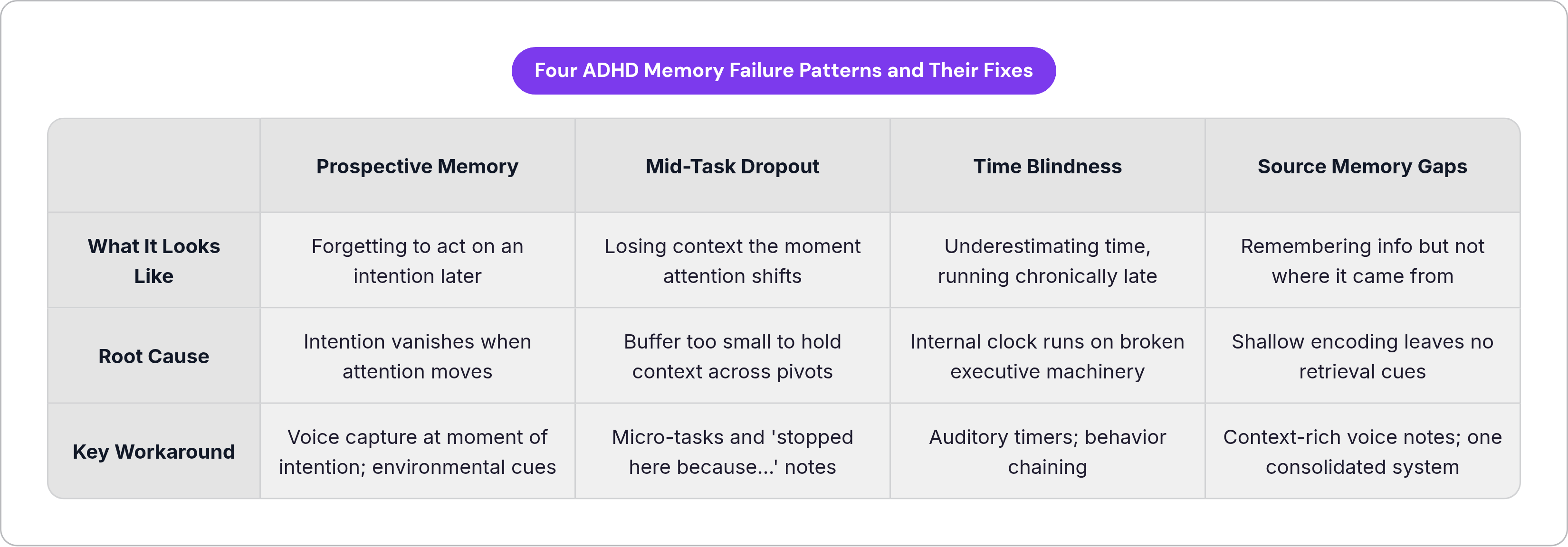
Look closely at ADHD memory complaints and they sort into four patterns. Which one you're actually dealing with matters, because the fix for one does almost nothing for another. Conflate them and you'll spend months tweaking a system that was never aimed at your real problem in the first place.
Prospective memory failures are about forgetting to do something later: take the medication, send the email, make the call. Prospective memory requires holding an intention across a time gap, and that gap is exactly where ADHD working memory runs thinnest. The task doesn't fade gradually; it vanishes the moment attention shifts elsewhere, and it often doesn't resurface until the window has already closed.
Working memory dropout mid-task looks different, and honestly it's the one that makes people feel like they're losing their minds. You open a new tab to look something up, get pulled somewhere else, and come back with zero memory of why you opened it. The buffer isn't big enough, so context drops the instant attention pivots. You can feel the thread slip in real time, which somehow makes it worse, since there's nothing left to grab once it's gone.
Time blindness gets misfiled as a scheduling problem when it's really a memory distortion. People with ADHD don't manage time poorly out of laziness; the internal clock runs on the same executive machinery as working memory, and it just fails to track elapsed time the way a neurotypical brain does. That shows up as underestimating how long something takes, losing whole hours without noticing, running chronically late despite intentions that were genuinely good an hour earlier.
Source memory gaps are the quiet cousin nobody talks about. You remember that something happened, that you heard a piece of information somewhere, but not where, when, or from whom. This traces back to encoding: information absorbed during a low-attention state gets encoded shallowly, so the retrieval cues that would normally help reconstruct context were never laid down to begin with. "I know I read this somewhere" is the classic tell, and it makes acting on good information almost as hard as never having heard it at all.
Line the four up and a pattern shows itself. The failures cluster around transitions, distractions, and time gaps, exactly the conditions where working memory and executive function get stretched thinnest. Predictable failure is failure you can actually design around.
Why generic memory advice fails people with ADHD
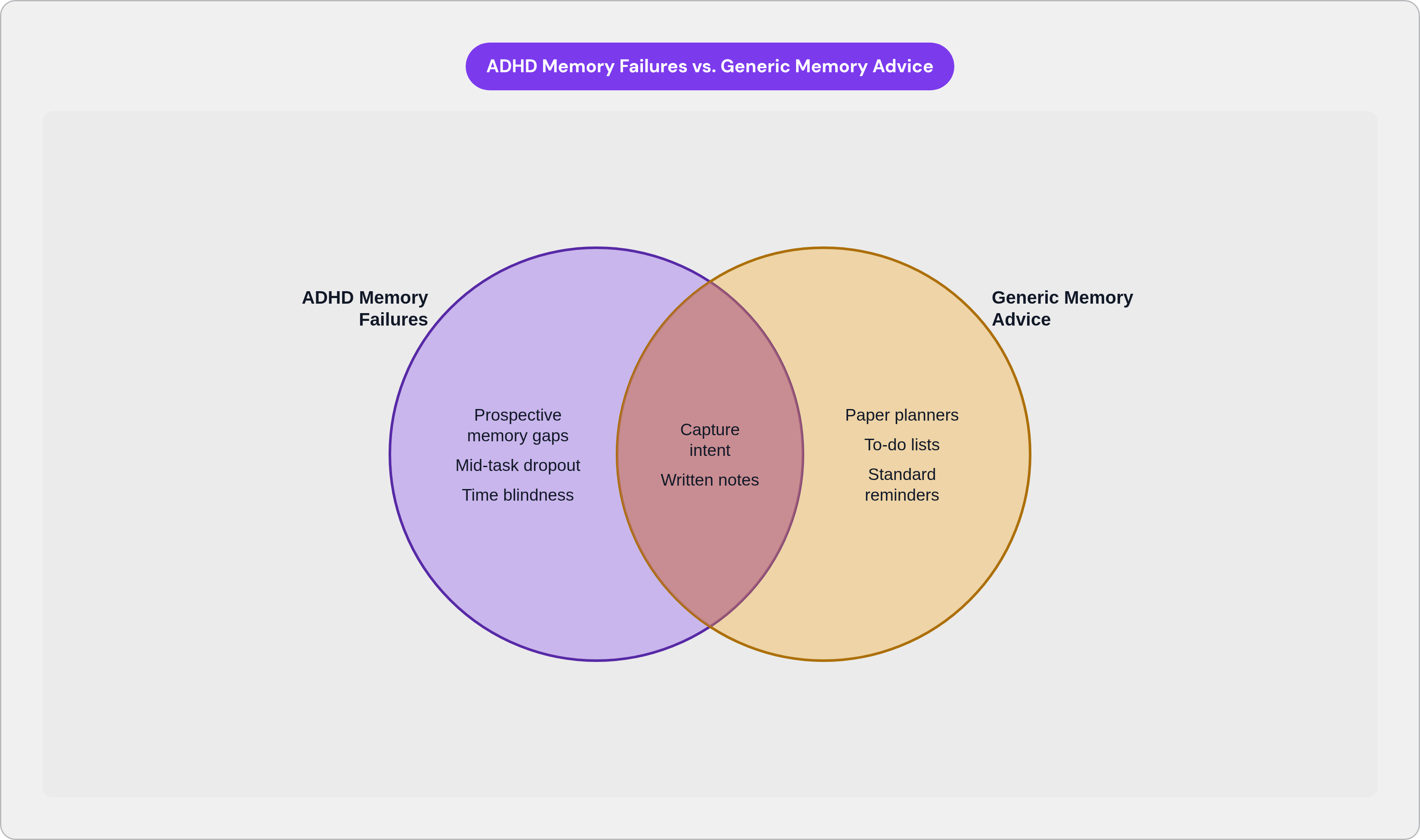
"Just write it down." "Use a planner." "Set a reminder." Each of those pieces of advice runs into trouble on contact with an ADHD brain, and the reasons hold up individually, not just as a vague complaint about willpower.
Start with friction. Every step between having a thought and capturing it is a step where working memory can drop the thought entirely. By the time you've found a pen, uncapped it, and located something to write on, the thought that triggered all that searching might already be gone. Three steps is often two too many.
Then there's the engagement problem. Planners and calendars only work if you go back to them, and for a lot of ADHD brains, out of sight really does mean out of mind, not just as a figure of speech. The system collapses because it was never built to run without active, ongoing motivation feeding it, so it stalls the moment novelty or interest fades. Nobody designed the paper planner with a dopamine problem in mind.
Overwhelm stacks on top of both. A to-do list with twenty items on it stops functioning as a plan and starts functioning as an anxiety trigger. Big, undifferentiated tasks generate avoidance rather than momentum, and ADHD brains need tasks sized small enough to actually start, not sized for theoretical completeness on some whiteboard.
There's data behind the avoidance piece too. One study on avoidant automatic thoughts found college students reporting them roughly half the time; non-college adults reported them slightly less, around 45 percent. When those thoughts showed up, distraction and avoidance reliably followed close behind. Put that next to the friction and engagement problems above and a fuller picture forms. Generic systems are built to catch a finished thought and file it away, and that's the whole design brief; it says nothing about the avoidance and dropout happening before the thought ever gets that far. Most memory tools support capture but rarely the retrieval and holding functions ADHD actually breaks. A sturdier notebook was never going to fix that, because the gap was never about the notebook.
Workarounds that match how ADHD memory actually fails
Every fix below runs on one principle: get the load out of your head and into the environment before it drops. Once a thought is gone, trying harder doesn't bring it back on command, and you can't will a vanished thread back into existence, so the design has to happen before it disappears, not after.
For prospective memory failures, capture the intention the instant it forms. Voice capture, saying the reminder out loud the second the thought lands, closes the gap between intention and record almost completely. No typing, no app-opening, no window for the thought to slip through in the meantime. Environmental cues do a quieter version of the same job: medication sitting next to the coffee maker, keys hooked onto the bag that has to leave the house anyway. A daily brain dump, writing out everything on your mind first thing in the morning, clears the queue and surfaces intentions that would otherwise get buried under the day's first few interruptions.
For mid-task dropout, build re-entry points into the work itself. Micro-tasking, breaking work into pieces small enough to finish before a distraction has time to land, creates a natural stopping point instead of a thread left dangling. A modified Pomodoro helps too, though the traditional 25-minute block isn't gospel; some people need it shorter, some longer, and the rhythm matters more than the number on the timer. Jotting "stopped here because..." at any pause hands you a re-entry point that doesn't depend on working memory rebuilding what it already lost.
Time blindness responds best to externalizing the clock entirely. Trying to sense time more accurately from the inside is a losing game for this particular brain, so stop fighting it. Auditory timers beat visual ones, since sound cuts through hyperfocus in a way a glance at a clock face just can't. Behavior chaining, linking tasks in a fixed sequence so finishing one triggers the next, cuts down on how much time estimation the task needs at all; the chain runs on completion, not clock-watching. Moving decisions to the night before takes pressure off a window we'll get into more in the next section.
Source memory gaps need richer context at the moment of encoding, since you can't retrieve detail you never captured. A voice note that says "from the meeting with Sarah, relevant to the Q3 project" hands you retrieval cues a bare note never will. Consolidating capture into one trusted system, instead of scattering notes across four apps and a notebook, cuts the search problem down substantially. Fragmented context is harder to retrieve no matter how good any single note is on its own.
The same mechanism keeps showing up across all four fixes: externalizing planning frees the limited working memory buffer for actually doing the work, instead of burning it on storage the environment could handle just fine.
How morning structure protects working memory for the rest of the day
Mornings are the highest-risk window, and there's a real physiological reason for it, not just bad luck. Dopamine follows a circadian rhythm and sits at its lowest point in the morning. ADHD brains already run on lower baseline dopamine availability, so morning is exactly where that deficit is widest. At the same moment, executive function has to handle planning, organizing, time management, and impulse control, all in the first hour awake, with the least neurochemical support of the entire day.
That's why a small disruption early, a missed alarm, an unexpected decision about what to wear, cascades so badly. Working memory is already running on fumes by 7 a.m., and it takes almost nothing to tip it over.
A protective morning routine works by cutting the number of live decisions working memory has to hold, and it does that by running on habit rather than active recall. You're not deciding what comes next; you're doing the next thing because it's what always comes next, and the deciding already happened days or weeks ago.
A few concrete pieces make a real difference here. A consistent wake time anchors your circadian rhythm and removes the unpredictability of waking at a different hour every day. Morning sunlight, ideally within 30 minutes of waking and for at least 10 minutes outdoors, helps set that same clock and raises cortisol on its natural schedule, giving you alertness without reaching for a substance to force it. Habit stacking, pairing a new behavior onto an existing one such as reviewing your task list while eating breakfast or taking medication right after brewing coffee, removes the need to remember each piece on its own. Speaking or writing down two or three key priorities before the day properly starts offloads that prospective memory demand before competing inputs show up to bury it. Brief movement, a short walk or a few minutes of stretching rather than a full workout, activates dopamine pathways and narrows the morning deficit somewhat.
Night-before prep belongs on this list too. Laying out clothes, packing a bag, making the small decisions the evening before, means fewer competing demands land in that low-dopamine window the next morning. Mornings do feel less chaotic as a result, but the deeper payoff shows up later in the day: a structured morning preserves working memory capacity for when the actual cognitive work has to happen.
Why motivation and reward are inseparable from memory in ADHD
ADHD memory failures are tied closely to how engaged or motivated someone feels in the moment. Motivation modulates encoding and retrieval directly. Things that engage the brain get remembered, while things that don't, generally don't, no matter how important they're supposed to be on paper.
The dopamine link explains why. ADHD is associated with lower dopamine activity in the brain regions responsible for motivation, attention, and reward, which means the internal signal that says "this matters, hold onto it" comes through weaker than it does in a neurotypical brain. That's a difference in signal strength, and it's worth repeating because so much ADHD self-blame traces back to missing exactly this point.
That has a direct implication for anything you try to build for yourself. A workaround can be well-designed on paper and still get dropped within two weeks, not because the person lacks discipline, but because the brain isn't getting enough signal to keep using it. Reframing that as a design problem gives you a more useful place to get stuck than treating it as a willpower failure.
Gamification, seen this way, is a structural response to a documented gap in reward signaling. XP-style rewards, streaks, milestone tracking: these create small, reliable dopamine hits that keep a system alive even when internal motivation alone wouldn't cut it. Breaking a goal into milestones matters for the same reason. More milestones means more completion events, and each one is its own small reward signal keeping the loop going a little longer than it otherwise would.
The loop matters more than any single day's performance. A system used imperfectly every day beats a perfect system used once a week, because small wins compound. Sustainment, more than optimization, is the actual goal here, and the stakes aren't abstract. Research cited by the World Health Organization found that workers with ADHD lose an average of 22 excess workdays a year to lost productivity compared to their peers. That's the real cost of a system that gets abandoned versus one that sticks around long enough to matter.
Choosing tools that work with ADHD memory rather than against it
Everything above adds up to a fairly specific set of criteria, worth naming plainly instead of leaving implied between the lines.
Capture friction has to sit close to zero. Recording a thought in more than one or two steps often means the thought is gone before the steps finish. Voice capture in particular closes the gap between thinking and recording right at the moment working memory is most likely to drop the ball. A tool should also break goals into milestones on its own, rather than leaving that figuring-out to you, since figuring out next steps is itself an executive function demand and the whole point is reducing those. Built-in reward mechanics aren't a nice-to-have either. Given how tightly engagement and memory are coupled in ADHD, a tool that doesn't sustain engagement just won't get used long enough to matter. One consolidated system beats five scattered apps too, since fragmented context multiplies the retrieval problem instead of solving it.
Most generic productivity apps miss this, and honestly, it's not entirely their fault. They're built on assumptions that hold for neurotypical working memory: that you'll return to the app reliably, remember where you left off, and generate your own motivation to keep going without much outside help. Few of those assumptions survive contact with an ADHD brain, which is why so many well-reviewed productivity apps end up in the same drawer as the paper planners that came before them.
Mindflow is one example built around these constraints from the start: voice-first capture, milestone-based goal plans, and XP-style rewards, the same three mechanisms worked through above, applied together instead of piecemeal. It's used by more than 100,000 people, though whether the combination holds up for any given person is something to test against the criteria above; the reasoning behind the design matters more than any single adoption number.
The point runs bigger than one tool, though. The right tool is whichever one gets built around how ADHD memory actually fails, so that using it costs the least executive function overhead possible. Feature-list length on a landing page has little bearing on that fit. ADHD memory difficulties are real, patterned, and backed by a real body of research, and the fixes are just as real. Building an environment the brain can actually work with is the goal in the end.