Why Goal Setting Matters for ADHD
Standard goal-setting systems fail ADHD brains due to executive dysfunction, not lack of drive.

Here's the edited text with "Not X, It's Y" style constructions removed or restructured:
I've spent enough years reading ADHD research (and living inside a brain that fits its findings uncomfortably well) to have a firm opinion here: goal setting fails for ADHD adults not because they lack ambition, but because executive dysfunction makes the standard approach structurally hostile to how this brain runs. About 15.5 million U.S. adults now carry an ADHD diagnosis, roughly 6.0% of the adult population, and that number grew by more than a million between 2021 and 2024, per a 2024 CDC report. Work out the monthly rate and you get something like 22,000 new diagnoses a month, which is a strange thing to sit with. Globally, prevalence sits closer to 3.1% by meta-analytic estimate, though clinicians who study underreporting and late diagnosis put the functional rate closer to 4 or 5%. Most of these adults spent years running neurotypical productivity systems on a brain that was never built to run them, and that mismatch is what this piece tries to take apart, piece by piece.
What executive dysfunction actually means for goal-directed behavior
Russell Barkley, one of the most cited researchers in the field, has spent decades arguing that ADHD is fundamentally a disorder of executive functioning and self-regulation, something far more specific than the casual, watered-down sense in which people toss around "attention" or "motivation" at dinner parties. Executive function is the set of mental operations that let a person plan, prioritize, switch between tasks, and sustain effort toward something that hasn't happened yet. In ADHD, those operations show up inconsistently: present on Tuesday, gone by Wednesday, back again by Friday for reasons nobody can quite pin down. That inconsistency is arguably worse than a clean, stable deficit would be, because it leaves room for the accusation that the person just isn't trying hard enough. A steady limitation earns sympathy. An inconsistent one earns suspicion.
Researchers have a term for one piece of this: temporal myopia. Behavior gets governed by whatever is happening right now, with almost no pull from what's coming down the line, even when what's coming down the line matters enormously. Research on adult ADHD has found measurable differences in how ADHD adults estimate and reproduce time intervals compared to neurotypical controls; six weeks out doesn't just feel distant, it barely computes as real. A goal that far away doesn't feel motivating today, even to someone who sincerely, desperately cares about the outcome. Caring about something and being neurologically positioned to act on it turn out to be two separate systems. ADHD, in large part, is the story of the gap between them.
That gap traces back to cognitive cost more than to willpower, and this is worth sitting with for a second. Planning, prioritizing, and switching from one task to another cost measurably more cognitive energy for an ADHD brain than for a neurotypical one doing the identical task, side by side, same conditions. This one fact explains a lot of what follows: why multi-step plans stall out somewhere around step two, why rigid timelines snap the first time something goes sideways, why "just write it down" is such thin advice for a problem this deep. All of it assumes a supply of executive function that ADHD brains can't reliably produce on demand, and you can't budget for a resource that shows up when it feels like it.
How dopamine shapes what goals the ADHD brain can actually pursue
PET imaging work by Volkow and colleagues found altered dopamine reward pathways in ADHD adults. Separately, fMRI research from Plichta and Scheres showed reduced activation in the ventral striatum, the brain's reward-anticipation hub, during tasks where a payoff was expected. Meta-analytic fMRI findings put a number on it: a medium effect size, Cohen's d between 0.48 and 0.58, for ventral striatal hyporesponsiveness during reward anticipation. An ADHD brain simply doesn't light up for an upcoming reward the way a neurotypical one does. The reward still matters to the person; the signal meant to make it feel motivating just runs quieter than it should, like a radio station coming in half-static.
Lower dopamine availability means a task without an immediate payoff can feel uninteresting, or functionally invisible, no matter how important the person knows it to be on paper. Dr. William Dodson's INCUP model gives this some shape: ADHD attention activates on Interest, Novelty, Challenge, Urgency, and Passion, far more reliably than on importance alone. A task can matter enormously (career, health, money, whatever's on the line) and still get routed around entirely if it doesn't hit one of those five triggers. That's an interest-based attention system doing exactly what it's built to do, just not the system most workplaces and productivity books assume they're talking to.
So what does that mean for goal-setting specifically? A long-term goal with a distant payoff is structurally mismatched to how the ADHD brain processes reward, full stop. Telling someone to want it more, or to visualize the outcome harder, accomplishes little, because the actual problem sits in the reward architecture rather than in the strength of the desire. The goal's architecture has to change instead, and that's the thread the next few sections pull on, one at a time.
Why the standard SMART goal framework actively works against ADHD brains
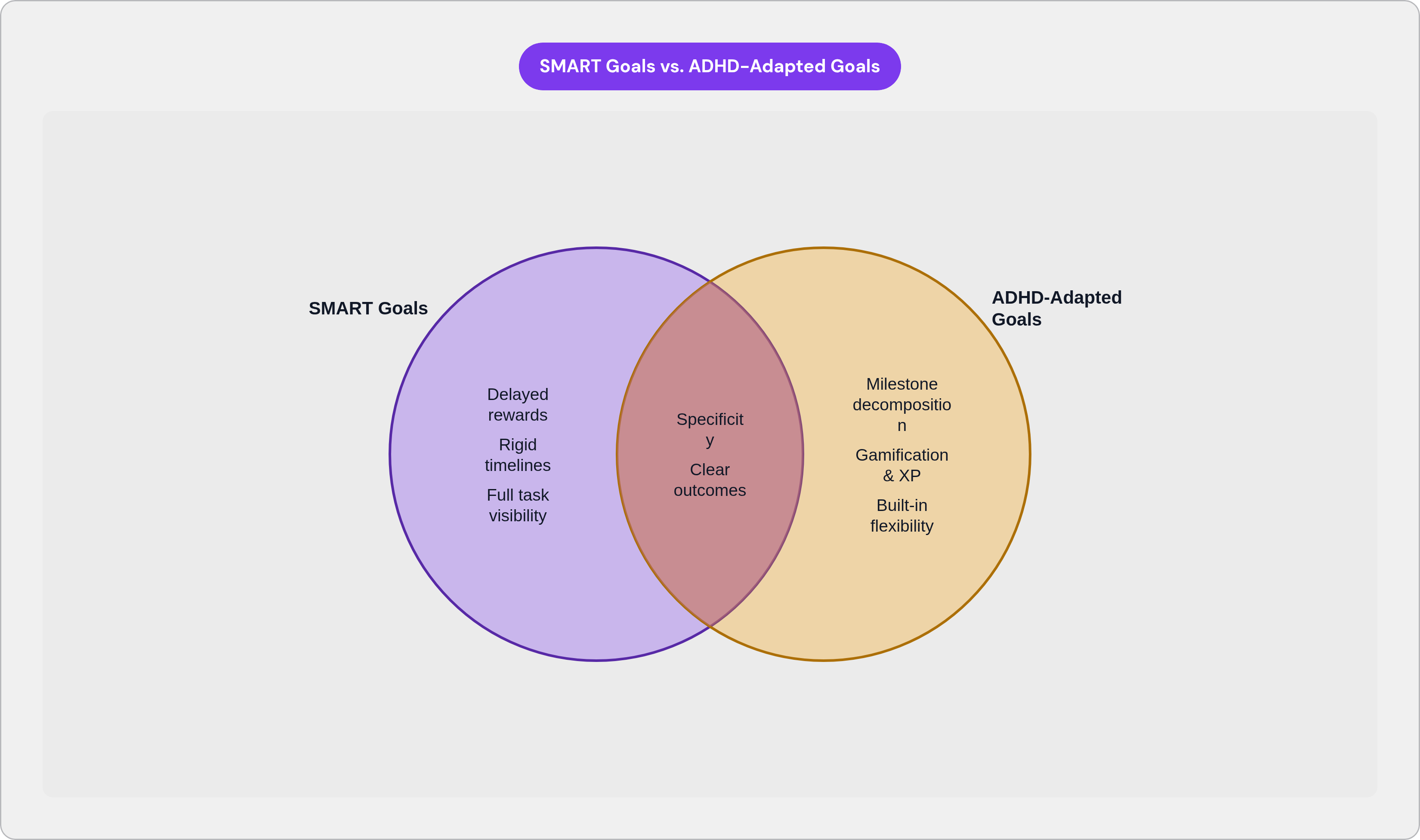
SMART goals assume a brain that can hold a future timeline in working memory, stay motivated through weeks of delayed reward, and translate an abstract multi-step plan into sequenced daily action. None of that is reliably available in ADHD, which is exactly why so many ADHD adults have a drawer (or a Notes app, or a dead Trello board) full of specific, measurable, time-bound goals they never once executed.
Take "I will run three times a week." Specific, sure, and it checks every box the framework asks for on paper. But it still depends on initiating an unchosen task, at a low-stimulation moment, with zero immediate reward attached, three separate times, in three separate weeks, with nothing but future health to show for it in the meantime. Fixing the vagueness doesn't fix the framework. The real barrier was initiation under low arousal, and specificity does nothing to touch that particular wall.
Then there's the overwhelm trap. Present a large goal as a single unit and the ADHD brain doesn't start planning; it freezes. The trouble isn't the goal's ambition so much as the visible gap between now and done, a gap too wide to generate enough activation energy for a first step. The whole staircase appears at once, and staring at forty stairs is a wildly different experience from being told to take one.
Rigid timelines make this worse. Temporal myopia means a deadline three weeks out barely registers, right up until it flips overnight into something catastrophic and immediate, with almost no useful middle ground between "irrelevant" and "emergency." And here's where the damage compounds: repeated failure to execute on goals a person genuinely wanted feeds shame, and shame suppresses initiation even further. Over time, the standard model manufactures the conditions for its own defeat, again and again, until the person quietly concludes the problem was never the system, but them.
What ADHD-specific goal-setting looks like structurally
If distant reward doesn't register, the fix has to move where the reward sits, not just how big or clear the goal is on paper. Goals need to generate reward at intervals short enough for the ADHD brain to actually catch, along the way and repeatedly, almost stubbornly, rather than only at the finish line.
Milestone decomposition is the intervention itself, not a nice-to-have layered on afterward. Breaking a goal into the smallest executable next step closes the distance between now and the first hit of reward, and each completed milestone produces a small dopamine response that makes the next step easier to start than it would've been cold. Specificity still matters, but only when it's paired with immediacy. "Run 30 minutes at 6pm on Monday, Wednesday, Friday" hands the brain an environmental cue instead of asking it to summon motivation out of thin air, something "exercise more" was never going to pull off. The cue does the work willpower was never going to reliably supply.
External capture systems matter for the same reason. Writing tasks down the instant they appear, rather than trusting recall, functions as a structural necessity given how memory functions in ADHD. The ADHD brain loses individual tasks fast, sometimes within minutes, and a goal system that depends on memory to survive is one that's already failing quietly in the background before anyone notices.
Flexibility has to be built in by design, not bolted on after the first missed day wrecks the whole plan. Rigid schedules collapse the moment one thing goes wrong, because there's no slack anywhere to absorb the disruption. A qualitative study following 52 college students with learning disabilities and ADHD found that the strategies which actually worked were multidimensional, blending cognitive, behavioral, psychological, and environmental pieces together at once. No single trick carried the weight alone; it never does.
How gamification supplies the reward signal that long-term goals can't
Here's the specific gap gamification closes: a long-term goal defers its reward to a point too far off for the ADHD reward system to treat as real, and gamification inserts feedback into the empty space in between. XP points, streaks, badges, progress bars, all of it functions as frequent, low-latency reward signals standing in for the dopamine cues a distant outcome simply can't generate on its own.
Research on gamification has found that it can meaningfully increase motivation, learning, and persistence, with effects showing up most clearly in people who struggle under traditional incentive structures. The immersive quality of well-built games — the goals, the feedback loops, the achievement markers — has been linked to improvements in both engagement and follow-through on behavior. Two of Dodson's five INCUP triggers, novelty and challenge, are baked into good game design almost by definition. Leveling up keeps a task from going stale in a way a static checklist never manages.
Worth flagging, though: gamification only works when it's built around how the ADHD brain actually processes reward, with the fun serving that mechanism rather than distracting from a structure that's broken underneath it. Badges slapped onto an unchanged task list amount to decoration rather than genuine gamification. The mechanics have to function as scaffolding, and that's the real dividing line between a tool that takes the science seriously and one that's just borrowing its aesthetic.
Habit scaffolding and daily structure as the delivery mechanism for goals
A goal without daily structure is an intention with better PR. For it to survive contact with an ADHD brain, it needs to live inside a routine, so execution doesn't require a fresh act of willpower every single time it comes back around.
Anchor habits carry a lot of this weight. Attach a new goal-related behavior to something already automatic, reviewing the day's one milestone while the coffee brews, say, and the activation energy required drops sharply, because the cue becomes environmental instead of a decision that has to be remade fresh every morning. The trick is bypassing the executive function bottleneck entirely, rather than asking it to fire reliably on command.
Minimalism helps too. Two or three anchor habits tied to goals that actually matter will outperform a beautifully engineered ten-step system that falls apart the first time life gets in the way, and life always gets in the way eventually, usually on a Tuesday, usually when you least expect it. Built-in slack, margin that absorbs an unexpected meeting or a bad night's sleep, is a core requirement, not optional polish tacked on later. One disruption to a rigid sequence with no give anywhere can take down an entire day's worth of progress.
There's also the question of what actually gets tracked. A 2025 meta-analysis pooling 30 studies found significantly higher sensory sensitivity in ADHD individuals across multiple modalities, and anyone who's lived with ADHD will recognize the adjacent, quieter pattern: the inner critical voice tends to run louder and more constant than it does for most people. Logging what did get done, instead of fixating on the gaps, reinforces the routine as something working rather than something being failed at, day after day. Underneath all of it, CBT-informed self-regulation skills, the cognitive work of managing thoughts around task initiation, still matter. The environmental scaffolding does the heavy lifting, but it rests on that layer as its floor.
What a goal-setting tool built for ADHD brains needs to do differently
Most productivity apps run on an unspoken assumption: full executive function, present and available on demand, no questions asked. They surface the whole goal, the entire to-do list, and wait for the user to supply the initiation themselves. Every one of those defaults is a spot where an ADHD user falls straight through the floor.
A tool built around the research covered here has to behave differently at a few specific points. It should decompose a goal into milestones automatically, surfacing only the next step instead of the entire staircase, and deliver a reward signal at each completed step, not exclusively at the end, weeks or months later. Cutting friction at the point of capture matters just as much; voice input removes the barrier that causes so many ADHD users to abandon text-based task entry before a habit even gets the chance to form. And it needs recovery paths built in for missed days, rather than treating a broken streak as some kind of moral failure.
Mindflow was built around this exact set of constraints: voice-first capture, milestone-based goal plans, XP rewards, and habit scaffolding designed around ADHD behavioral science, currently used by many thousands of people and rated 4.9 stars. That's one implementation of the argument; the case for the approach stands apart from any single product built on top of it. What actually works for ADHD is a structure built from the ground up around how ADHD brains handle reward, initiation, and time, rather than a stripped-down copy of a neurotypical productivity app with a few badges bolted on for good measure.
Trace the gap between ambition and execution in ADHD far enough and it stops looking like a character flaw and starts looking like a design problem. Design problems, unlike character flaws, can actually be solved. That's a better place to end up than the alternative most people have been sold for years: that the problem was them all along.