Interest-Based Motivation in ADHD
ADHD brains run on interest, not importance—here's how to rewire your day around it.
An ADHD brain can care enormously about a task and still sit frozen in front of it for hours. For a brain wired that way, the ADHDer who understands how much a task matters and still cannot move looks like someone who simply isn't trying hard enough.
That reading is a misdiagnosis. Understanding the motivational architecture ADHD brains actually use, and building the day around it, is the fix.
What the interest-based nervous system is
The interest-based nervous system is a clinical framework describing a motivational pattern common in ADHD, in which activation depends not on importance but on interest, novelty, challenge, urgency, and passion. Dodson coined the phrase after decades of clinical observation: ADHD clients could accomplish nearly anything once genuinely engaged, and the barrier was never capability. The barrier was reaching engagement.
The framework draws on reward circuitry research and delay aversion theory, and it explicitly pushes back against treating executive function theory as the whole story. Neither is more authoritative than the other, and both will come up again once the five activators get unpacked individually.
The contrast with importance-based motivation is concrete. An interest-based system triggers action through engagement, so the same person can focus for hours on a passion project and stall completely on a five-minute form. That is not inconsistency of character. Neither style of motivation is superior to the other. They are different operating styles, and the rest of this piece treats them that way rather than treating the interest-based pattern as a deficient version of the importance-based one.
The neuroscience behind why interest unlocks what importance cannot
Dopamine is the neurotransmitter most tied to motivation, reward, and attention, and ADHD brains typically show dysregulated dopamine signaling that affects the ability to initiate and sustain it. A task labeled only "important" often fails to generate the dopamine signal an ADHD brain needs to engage. A task that is interesting or novel generates that signal far more reliably. The same person can hyperfocus for hours on one activity and be unable to begin another that, by any external measure, matters more.
Barkley's unifying theory of ADHD locates executive function difficulty across four domains: behavioral inhibition, working memory, internalized speech, and the regulation of emotion, motivation, and arousal. The prefrontal cortex is the region that coordinates planning, task initiation, and impulse control, and weaker activation there means the thought "I know this matters" does not generate enough neurological traction on its own to start moving.
Delay aversion adds another layer. ADHD brains tend to show lower sensitivity to rewards that are delayed and a stronger pull toward rewards that are immediate and stimulating, so a long-term payoff gets processed as barely a reward. That is a neurological difference, not a preference for taking the easy way out. The capacity for sustained focus is intact. What differs is the condition required to switch it on.
None of this means ADHDers lack internal motivation or care less about outcomes. What exactly makes the difference, then, between caring and doing? The difficulty sits in translating internal intention into external action when a task offers no interest, no urgency, and no novelty to grab onto. The bridge between wanting to and doing is.
The Five Activators
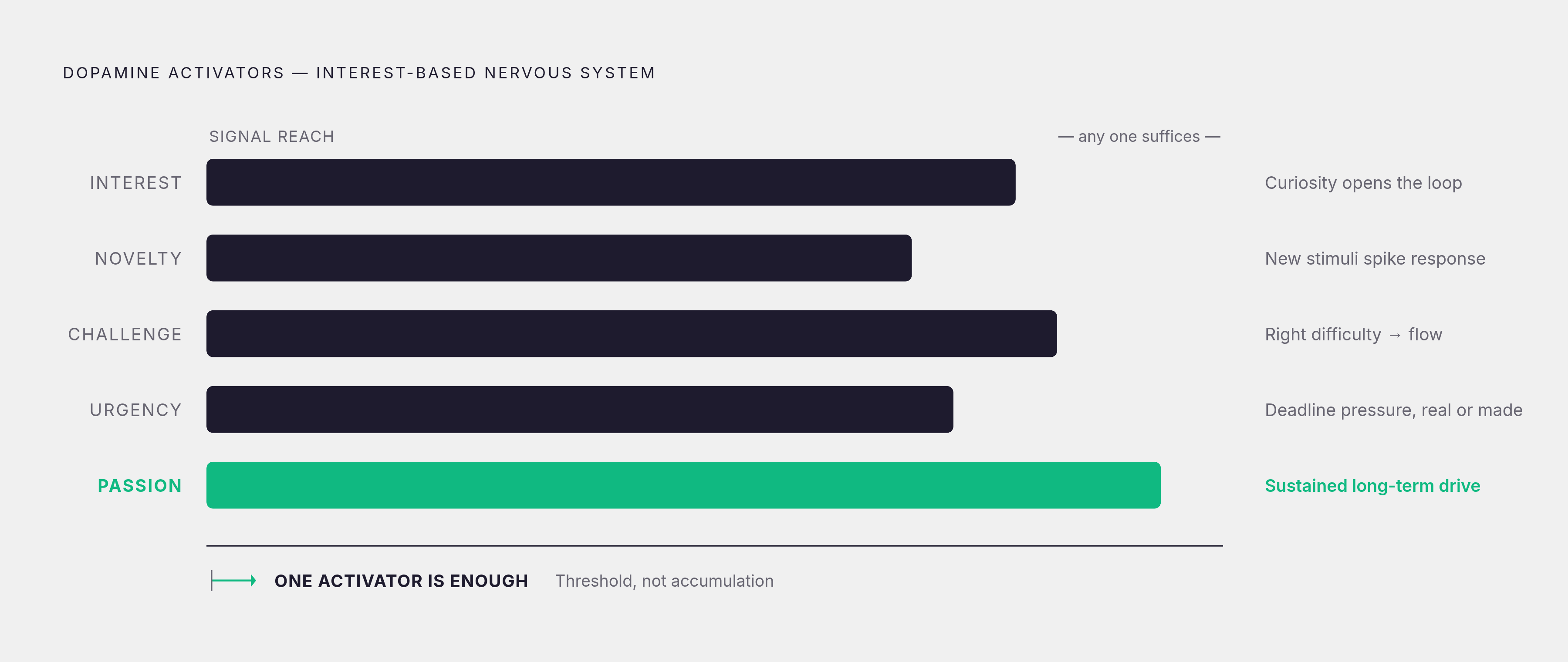
Each of the five activators does the same basic job: it supplies a dopamine signal strong enough to trigger engagement where importance alone falls short. Naming them individually turns a vague sense of "I work better some days than others" into a map that can be used on purpose.
Interest is the most direct activator. Some thread of real curiosity connects to the task and changes the brain's relationship to it, making hunting for an angle of genuine interest inside a required task a legitimate strategy.
Novelty works independently of whether the task is inherently interesting. The ADHD brain responds neurobiologically to what is new, and novel experiences trigger dopamine release on their own terms. Changing the environment, the tool, or the sequence of steps on a familiar task can restart motivation even when the task underneath has not changed.
Challenge operates through flow. The right level of difficulty, one that stretches ability without overwhelming it, creates flow states that bypass typical ADHD attention difficulties. The sweet spot in between produces intense, often surprising engagement.
Urgency is the activator most people with ADHD already recognize from experience: the last-minute deadline that produces more output in two hours than the preceding two weeks managed. A visible timer, an accountability witness, or a short self-imposed deadline can manufacture the same effect deliberately.
Passion is the activator built for the long haul. Of the five, it is the one most worth cultivating on purpose for anything that will take a long time to finish.
When all five activators are absent, starting feels close to impossible no matter how much the task objectively matters. The goal was never to stack all five onto every task, only to make sure at least one shows up.
Why years of "trying harder" produce shame
Applying a system built for importance-based motivation to an interest-based brain produces a predictable, cruel result: not a failure of effort, but an accumulation of shame, and that shame measurably worsens the very executive function it is blamed on. The neurotypical productivity framework does not merely fail to help here. It actively manufactures conditions that make starting harder than it would otherwise be.
Design assumptions decide the outcome in advance. That is a design problem, not a discipline problem, and the distinction matters because one of those framings is fixable by changing the system, while the other blames the person using it.
Years of being measured against the wrong standard leave a mark. A childhood of persistent criticism for struggles that were neurological rather than moral produces deep, often unexamined beliefs about being fundamentally defective, and that shame is the logical output of being evaluated by a standard that was never built to fit. The longer the mismatch goes unnamed, the heavier that weight gets.
The struggle was evidence of a design mismatch, not evidence of a broken brain. Naming the interest-based nervous system is an accurate map, and the next section turns to where that map leads.
Four concrete ways to engineer interest-based activation into daily tasks
Because the five activators can be deliberately built into tasks that lack them naturally, it is possible to design a workflow that generates the conditions ADHD motivation depends on, rather than waiting for inspiration or deadline panic to supply them by accident.
Novelty can be added to routine tasks without changing the task itself. The task does not need to become interesting. The environment around it just needs to carry something new.
Urgency can be manufactured. An accountability partner or a body-doubling arrangement, working alongside someone else even virtually, adds a social form of urgency that functions about as well as a hard deadline.
Challenge can be built into tasks that would otherwise offer none. Gamification is not a gimmick for ADHD brains specifically: research on reward and motivation consistently shows that rewarding immediate progress engages dopamine pathways that importance-based motivation never reaches on its own.
Tasks can also be decomposed to eliminate the paralysis that comes from vagueness. Choice paralysis sets in when a to-do list is too long or too abstract for the brain to find a foothold, and replacing "clean the kitchen" with "put three plates in the dishwasher" makes the very next step concrete enough to actually begin. Tools that automatically break vague goals into step-by-step checklists, such as Goblin Tools' Magic ToDo, a free browser-based platform that requires no sign-up, operationalize this principle with essentially zero setup friction.
Two smaller tactics round out the toolkit. The 5-Minute Rule works on a related principle: committing to only five minutes on a task strips away the brain's perception of a three-hour commitment, and that reduced perceived cost is often enough on its own to clear the activation threshold.
Designing environment and routine to sustain an interest-based workflow
Single tactics only hold up as well as the environment around them. Sustaining momentum long-term is less about any one trick and more about designing the surrounding routine so it keeps supplying activators on a predictable basis, day after day, without requiring fresh willpower each morning.
Morning routines are a useful proving ground, because they require the exact executive function skills ADHD makes difficult: time management, task initiation, working memory. The design goal is not to add more structure for its own sake but to reduce the number of decisions required to get moving. A two-track routine, built with a full version and a shorter low-energy version, removes decision fatigue on hard days by providing a preset fallback instead of demanding an improvised one; the low-energy version still counts as showing up, and that distinction matters more than it sounds for anyone prone to treating an incomplete routine as a failed one.
Front-loading dopamine works at the scale of a whole morning the same way it works for a single task: a warm drink, a favorite song, or two minutes of something enjoyable before the first obligation primes the brain to enter the rest of the day more easily. Physical movement belongs in this conversation as a structural intervention rather than a wellness suggestion tacked on at the end. Building movement into a morning or midday block is a reasonable, evidence-grounded way to support the executive functions that make initiation and sustained motivation harder in the first place, based on research covering younger age groups.
The same logic scales up to workplaces and classrooms. Shorter, time-bound sprints, frequent and immediate feedback, autonomy over how work actually gets done, and novelty or challenge built into the workflow are not lowered expectations. The interest-based nervous system does not need to be managed around or overcome through sheer effort. It needs an environment consistently stocked with the conditions it already runs on.
Tools Built for the Interest-Based Nervous System
A productivity tool suited to an interest-based brain has to be designed around how that brain actually engages: removing friction at every entry point, supplying reward signals quickly, and breaking goals into steps small enough to start, rather than expecting the user to adapt to a neurotypical workflow built for someone else's brain.
That sets a specific design bar. A usable tool needs to capture information quickly, ideally by voice, organize it automatically, send reminders that land at the right moment, avoid punishing inconsistent use, and cut the number of decisions required at every step. Voice-first interaction is an accessibility principle, because removing the friction of opening an app, finding the right form, and typing eliminates the exact activation cost that causes ADHD users to abandon conventional productivity tools before those tools ever deliver anything of value.
Gamification, when it shows up in these tools, earns its place in the interface. Each completed milestone becomes a small win, and those wins compound into consistency in a way that a single large goal, left intact, rarely manages on its own.
Mindflow is built explicitly around this set of principles: voice-first capture, gamified XP rewards, guided milestone tracking, and streaks and reminders designed around ADHD behavioral science rather than bolted onto a generic task list afterward. The research direction behind tools like this has academic backing as well: WADAQ, developed for the 22nd International Web for All Conference in April 2025 to improve cognitive and executive functioning for ADHD employees in professional settings, points toward a field moving steadily toward adaptive, personalized support rather than one-size-fits-all task management software. That shift in direction is what the next section builds on.
Reframing the interest-based nervous system as a strength, not a workaround
The thesis running through this whole piece comes down to one claim: ADHD motivation is not broken. It runs on a different system, one built around interest, novelty, challenge, urgency, and passion instead of importance and willpower, and that system has a logic of its own worth taking seriously.
The same hyperfocus that makes a five-minute form feel impossible is the wiring behind intense, sustained, creative output once the right conditions are in place. When environments are designed for interest-based activation instead of importance-based obligation, what follows is more creativity, more genuine innovation, and more follow-through, not lowered standards dressed up as accommodation. Recognizing the interest-based nervous system as a design mismatch rather than a character flaw opens up the possibility of building systems that work with ADHD neurology instead of against it, which is exactly the shift tools like Mindflow are built to support by replacing importance-based friction with voice-first interaction and gamified milestones.
The goal was never to become someone who can force an importance-based system to work. It is to build a daily life and workflow matched closely enough to the interest-based system that its real strengths, focus, creativity, intensity, appear more often than its friction does. Anyone who finishes this piece with a new question instead of a new checklist has gotten the most useful thing out of it: not "why can't I just do it," but "what conditions does my brain actually need to do this well." That second question is where designing a life that works actually begins.
Sources
- 1 The ADHD Brain: Why Motivation Feels Different Tamara Rosier, Ph.D. •
- Frontiers
- Comparative effectiveness of various physical exercise interventions on executive functions and related symptoms in children and adolescents with attention deficit hyperactivity disorder: A systematic review and network meta-analysis
- AI and Gamification for Employees with ADHD: A Tool for Enhancing Workplace Focus & Productivity
- Editorial: Deciphering dopamine dysregulation in adult ADHD