Novelty Seeking and Sustainable Productivity in ADHD
Novelty isn't distraction for ADHD brains—it's the fuel that makes tasks feel worth starting.

The ADHD brain does not resist boring tasks out of weakness. It requires a stronger signal than a neurotypical brain to register the same task as worth starting, and that difference has a measurable neurological basis. This piece walks through why novelty functions as fuel rather than distraction for ADHD, and how to build systems, including gamified apps with XP and milestone tracking, that work with that wiring.
Why the ADHD brain demands novelty to function
Novelty-seeking in ADHD gets read as a character flaw more often than it gets read as a wiring difference, and that misreading costs people years of unearned guilt. The dopamine architecture behind attention and motivation runs differently in ADHD, and it takes a stronger signal to produce the same sense of engagement a neurotypical brain gets from a routine task. The D2 receptor variant linked to ADHD affects the striatum, the brain region responsible for both motivation and bodily movement. That single fact explains two things that look like separate problems: the restless, can't-sit-still quality of ADHD and the mental wandering that occurs even when the body is still. Both come from the same underactive signal trying to find enough stimulation to register.
Research on dopamine dysregulation in adult ADHD backs this up at the level of brain activity itself: studies show reduced ventral striatal activation during reward anticipation, so the brain responds weakly to the idea of a future payoff. A deadline three weeks out, a bonus at the end of the quarter, the long-term benefit of a clean inbox: none of it lights up the reward circuitry the way it would in a neurotypical brain, because the signal that's supposed to make future rewards feel real is muted. This is worth sitting with for a moment, because it changes what the problem actually is. It is not that someone with ADHD has too little dopamine, full stop. The issue is signal strength: how strongly a given cue registers as worth acting on right now. That distinction matters because it explains why "just try harder" does nothing for a boring task. Trying harder doesn't change how loudly the brain is hearing the signal. Only changing the signal does.
How interest-based motivation differs structurally from importance-based motivation
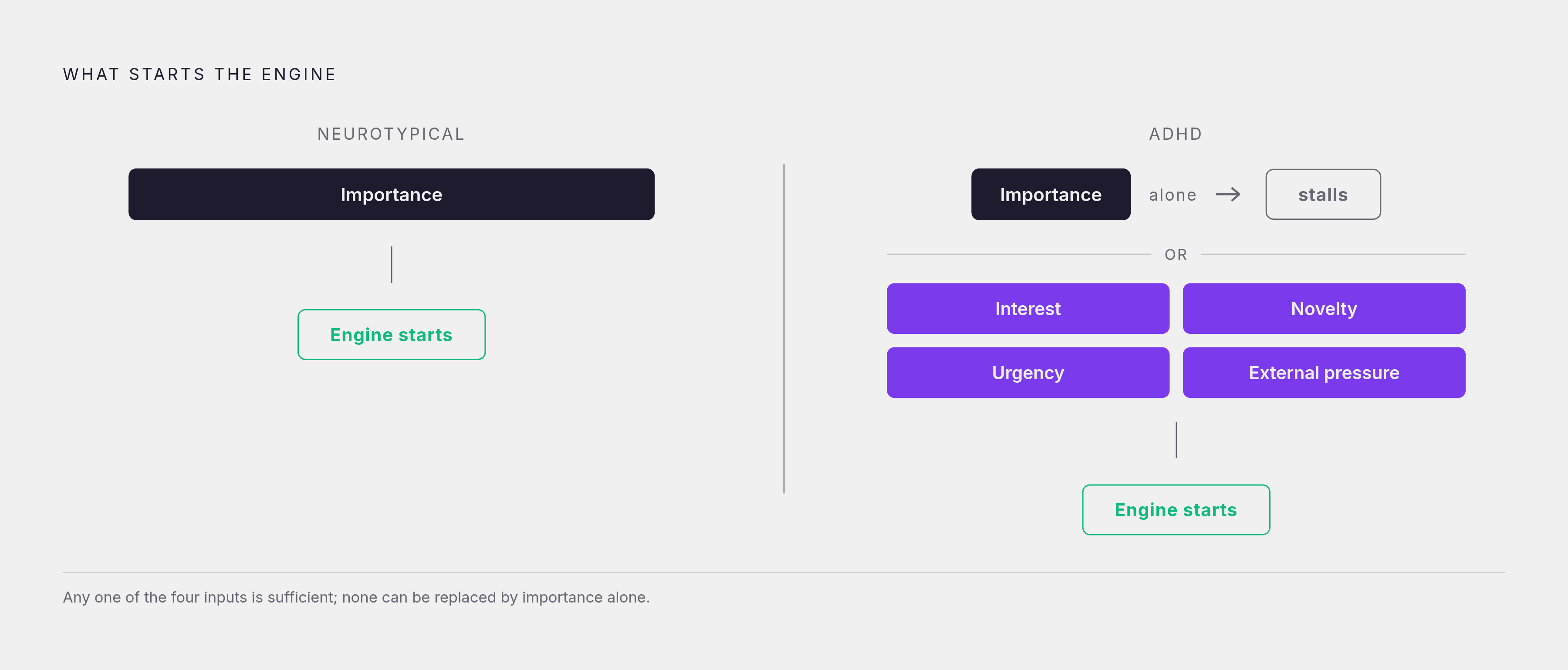
People with ADHD are not less motivated than anyone else. They run on a different set of inputs, and most productivity advice is built for the wrong input. Tamara Rosier's framework, developed through CHADD, draws a clean line between the two systems: a neurotypical brain can engage with a task simply because it understands the task is important. An ADHD brain needs interest, novelty, urgency, or external pressure before it will engage, and importance by itself does very little to move it.
The reason traces back to what dopamine actually does in the brain. It governs anticipation, the calculation that makes a person willing to start putting in effort now because the brain has priced the future payoff as worth it. When the reward circuits underrespond to distant payoffs, as the research on adult ADHD shows they do, that calculation breaks down. Future importance simply doesn't register as a reason to act today. A second factor makes this worse: the limbic system, the brain's emotional center, runs hot in ADHD. That means the discomfort of starting something boring or overwhelming generates a real emotional signal, one strong enough to override the logical understanding that the task matters. The result isn't someone choosing to avoid the laundry or the budget spreadsheet: it is a genuine failure to initiate, because neither the reward signal nor the importance signal is loud enough to beat the discomfort signal telling the brain to look away.
Mainstream advice gets this backward. If a system doesn't supply interest, novelty, urgency, or external pressure as a built-in feature, it is asking an ADHD brain to run on fuel it cannot produce on command. It's a design mismatch, not a willpower gap, and it's the reason the next section exists.
Why standard productivity systems make the problem worse
A productivity system built entirely on importance-based motivation doesn't just fail to help someone with ADHD. Standard to-do lists, time-management courses, and willpower-based frameworks all assume the brain can start a task on command once it understands the task matters, and that is precisely the capability ADHD impairs. Long lists compound the problem: instead of organizing the day, they overload working memory and read to the brain as evidence of failure rather than a workable plan.
When the tool doesn't work, the person using it absorbs the blame. The feeling is familiar to a lot of people with ADHD: shame for not trying hard enough, guilt over the half-finished list, judgment from systems that treat a missed deadline as proof of a character flaw rather than a mismatch between tool and brain. Repeated often enough, that cycle hardens into something more permanent. Rosier's CHADD research names avoidance, anxiety, procrastination, shame, guilt, and self-loathing as the tools people with ADHD often reach for instead, and all of them are exhausting without producing anything useful. Masking, the practice of suppressing ADHD traits to look more neurotypical, is a documented response to this kind of internalized stigma, and it carries real costs to mental, physical, and emotional health in both adolescents and adults.
None of this points to a flaw in the person. It points to a mismatch between how the tool is built and how the brain actually runs. The fix is redesigning the system around the biology that's actually there, not pushing harder against biology that doesn't move on command.
Feeding the novelty drive without being consumed by it
The novelty drive creates a real bind. Chasing it without any structure burns people out fast, but suppressing it entirely makes ordinary tasks feel impossible to start. Neither extreme works, which raises an obvious question: can the drive be fed on purpose, in a way that's repeatable instead of chaotic? Sustainable ADHD productivity says yes, not by reducing the need for novelty but by supplying it in controlled, predictable doses, so the drive becomes fuel for consistency instead of a force that keeps undoing it.
The Anchor + Novelty Framework gives this idea a concrete shape. Anchor Activities are the fixed parts: the same time, the same action, done every day without negotiation. Novelty Activities rotate around those anchors, supplying the stimulation an ADHD brain needs to stay engaged, without threatening the stability the anchors provide. Picture a morning routine where the wake-up time and the first fifteen minutes never change, but what fills the next hour shifts day to day. The skeleton holds. The skin changes. That's the reverse of how most people try to build routines, which is to make every piece identical and then abandon the whole thing the moment it feels stale.
Task decomposition runs on the same logic at a smaller scale. Breaking a large project into micro-tasks means the brain gets a string of small, fresh starting points instead of one long, flat slog, while the work still moves toward a single goal. The 2-Minute Rule puts this into practice directly: "clean the house" becomes "put three items away." That's small enough to start immediately, and finishing it delivers a real dopamine signal, which becomes the fuel that carries momentum into the next small step.
Practical structures that build novelty into daily work without chaos
The tactics that actually work for ADHD share one trait: they take the decision-making load off the brain instead of asking it to generate structure from nothing each time.
The three-task daily cap is one example. Standard to-do lists ignore the realities of working memory limits, executive dysfunction, and time blindness, so capping the day's must-dos at three items removes the decision-making burden that would otherwise cause overwhelm and avoidance. The constraint itself is doing the work.
Time blocking replaces an open task list with a defined slot for each part of the day, which removes the moment-to-moment question of what to do next. That decision point is exactly where ADHD executive function tends to break down, so pre-assigning each block to a task cuts the friction down to almost nothing.
A modified Pomodoro technique, using shorter sprints than the standard 25-minute block, lowers the barrier to starting because each interval feels small enough to be doable. Each sprint ends with a small sense of completion, and that frequent reward cadence matches what an ADHD brain needs: a payoff close enough in time to feel connected to the effort.
Body doubling works through co-presence. Simply having another person working alongside, even virtually, creates an external anchor that cuts down on task-drifting. Focusmate operationalizes this directly, pairing people for real-time virtual co-working sessions built around that exact mechanism.
What ties all of these together is that none of them ask the ADHD brain to invent motivation on the spot. Each one removes a decision the brain would otherwise have to make under already-depleted conditions, leaving more of its limited executive bandwidth for the actual task.
Why gamification is a neurochemical intervention
Gamified systems don't work for ADHD brains because they make dull work more fun. They work because they deliver, on a reliable schedule, the kind of immediate reward signal that a brain with underactive reward circuits can't generate on its own from payoffs that are weeks or months away.
The mechanism is specific: dopamine spikes in response to progress tracking and variable rewards, and those are the two features that sit at the center of almost every gamified system. XP totals, badges, and visible progress bars directly stimulate the same reward circuitry that runs underpowered in ADHD. Rosier's CHADD framework points to examples like "Beat the Timer" challenges, randomizers, and chore bingo cards, all of which work because the variability and playful uncertainty keep the engagement signal firing across repeated attempts, instead of wearing thin the way a static checklist does. The design rule underneath all of it is simple: rewards need to arrive fast, not after a long delay, because the payoff has to land close enough to the behavior for the dopamine signal to register as connected to the action that caused it.
Mindflow builds on this science directly rather than treating gamification as decoration layered over a standard task list. XP rewards, guided milestone tracking, and habit scaffolding form the core architecture of how the app works, not an add-on to it. Goals get broken into milestones small enough that each one completed delivers its own reward signal, and those signals compound across daily sessions into something closer to a durable habit. A simpler version of the same mechanism appears in another focus app, where staying off the phone keeps a virtual tree alive. The visual is simple and the loss-aversion mechanic is blunt, but it produces a real sense of accomplishment from short sessions without requiring any elaborate setup, which is exactly the kind of fast, legible reward loop this section is describing.
How habit formation works for ADHD brains
The 21-day rule for building a habit is wrong even for neurotypical brains, and it's actively misleading for people with ADHD. Research suggests habit formation takes closer to 66 days on average for the general population, more than triple the popular number, and the timeline often runs longer still for ADHD brains, where variability in executive function means consistency doesn't build up at a steady pace.
That timeline comes with an important corollary: missing a day does not reset the clock. What builds a habit is consistency stretched across weeks, not an unbroken streak. This matters because streak-based thinking causes people with ADHD to abandon a system entirely after one missed day, treating a single lapse as proof the whole approach has failed. A system designed around real ADHD habit formation has to build in room for that inconsistency.
Morning routines offer a useful test case for why some anchors work better than others. Early morning sunlight exposure signals the brain to stop producing melatonin and start producing cortisol, along with some serotonin, which helps regulate the circadian rhythm, something frequently disrupted in adults with ADHD. That's an anchor with an immediate neurological payoff, which is part of why it tends to stick. Pairing that with a protein-based breakfast, eggs, yogurt, a protein shake, adds a slow, stable energy release along with the amino acids the brain needs to build neurotransmitters, dopamine among them. Neither of these asks for lower ambitions. They point to something more specific: small, consistent wins compound, and each completed step reinforces the next at the level of brain chemistry, not just motivation.
Voice-first, low-friction tools as the final piece of the system
Every structure described so far, the anchors, the micro-tasks, the gamified reward loops, collapses at a single point of failure: the moment someone has to open the tool and start using it. Friction at that moment decides whether an ADHD brain engages or walks away, regardless of how well the rest of the system is designed.
The operating principle here is that friction reduction outranks almost every other design consideration. If a tool demands setup time before it delivers any value, an ADHD brain will often never make it past that setup, because the executive function cost of getting started consumes the same resource the tool exists to protect. Traditional productivity apps, with their forms, typing fields, and multi-step onboarding, impose exactly the kind of initiation demand that ADHD executive dysfunction makes expensive. They're built for a brain that can self-start on demand, which is the one capability ADHD doesn't reliably supply.
Voice-first interaction removes that barrier directly. Talking requires no formatting, no menu navigation, no blank page staring back. The brain speaks as it thinks, and the system captures it without asking for anything else first. That's not a nice-to-have convenience. It functions as an accessibility feature for a brain that struggles specifically with initiation. Mindflow's voice-first design replaces forms and typing with ordinary conversation, removing the friction layer that causes people to abandon traditional apps before they even reach the first task. Paired with its XP system, milestone tracking, and habit scaffolding, it adds up to a working version of the Anchor + Novelty principle described earlier in this piece.
The pieces come together into one requirement, not a list of separate preferences. A sustainable ADHD productivity system needs novelty built into its structure, rewards timed to arrive fast enough to register, goals broken down small enough to actually start, and a tool frictionless enough to open without first spending willpower just to begin. Generic productivity tools tend to miss this requirement because they were never built for the brain that needs it. The brain doesn't need to change to meet the system. The system needs to be built around how that brain already works.