When You Have Tried Every Productivity App and Still Cannot Function
The productivity app trap: a mismatch, not a character flaw.

The twelfth app always starts the same way: a fresh download, a burst of hope, a week of real use, then silence. That pattern is not evidence of weak willpower. For an ADHD brain, it does not, and the gap between those two outcomes is where years of app subscriptions go to die.
What activates the ADHD brain is not what activates a neurotypical one. A blank to-do list, no matter how well organized, does not supply any of that. It just sits there, correct and useless at the same time.
None of this is a character flaw. It is the predictable outcome of a mismatch, and the person using the tool usually has no way of knowing that at the time. Instead, each failed app gets filed away as one more piece of evidence that something is wrong with the person, not the product, and that misreading is where the real damage starts.
How ADHD disrupts executive function
Executive dysfunction in ADHD is well-studied and genuinely disabling in daily life, and it does not show up the same way in every person who has it. That variation is the reason a one-size-fits-all productivity app is a structural mismatch for a large share of its users, not just an occasional miss.
Executive functions are the mental processes that let someone plan ahead, start a task, hold instructions in mind while acting on them, switch between activities, and manage emotional reactions along the way. Weak working memory makes it harder to plan a multi-step task, and a distorted sense of time perception means a deadline feels abstract right up until it is suddenly urgent and there is no time left.
A study published in Neurology International looked for patterns across people with ADHD and dyslexia and found three distinct executive function profiles rather than one shared deficit. Two people can carry the same ADHD diagnosis and still have genuinely different cognitive architectures. That study is exploratory and based on case analysis, so its findings should be read as preliminary and hypothesis-generating rather than settled fact. Still, the direction it points in matches something broader happening in psychiatric research.
An editorial in Frontiers in Psychiatry makes a related argument at a wider scale: heterogeneity within a single diagnosis, and overlap between diagnoses, is now the dominant picture coming out of brain science, not something unique to ADHD. Time perception deserves a specific callout here. ADHD adults tend to underestimate how long a task will actually take and overestimate how much fits into a given block of time, a pattern that almost no standard task manager accounts for in its design.
What the tool-switching cycle costs, beyond lost productivity
The cycle of downloading, configuring, and eventually abandoning a productivity app costs more than wasted time. It functions as a shame engine, and the shame it generates worsens the same executive dysfunction the app was supposed to help with.
Generic task managers ask for exactly the things ADHD disrupts most: manual entry for every task, daily review sessions, consistent categorization, and engagement that has to be self-initiated with no outside trigger. The setup process itself acts as a filter, and it filters out the exact people who most need help organizing their time. Each abandoned app rarely registers as a bad product fit. It tends to register as one more data point in a running tally of personal failure, an interpretation that years of neurotypical productivity culture have already primed people to reach for first.
That shame response is not incidental. A 2025 counselling psychology study out of City University of Seattle looked specifically at women and late-diagnosed adults and found that shame in this group reads as the internalization of years spent being judged, blamed for their own character, and excluded for not matching gender and neurotypical expectations. Research on ADHD identity adds another layer: the most damaging psychological pattern is engulfment, where someone's entire sense of self becomes absorbed into the ADHD diagnosis, a pattern that research links to a measurable drop in quality of life.
There is a quieter cost too. The tool becomes the object of hyperfocus instead of the task it was meant to organize. Naming this loop clearly, the mismatch that causes the failure and the shame that the failure then produces, is what makes it possible to step outside it rather than start app number thirteen expecting a different result.
What task paralysis is
Task paralysis is where executive dysfunction becomes visible and immediate. It is the experience of standing in front of something that needs doing, caring about getting it done, and still being unable to start. It is a breakdown in task initiation, one of the executive functions already identified as commonly disrupted in ADHD, with a direct mechanical explanation rather than a motivational one.
Most traditional task managers respond to paralysis by doing the one thing least likely to help: showing the list again. For an ADHD brain, seeing the task and having an actual cue to begin are two separate things, and the gap between them is exactly where paralysis lives.
What tends to break the freeze is breaking the task down until the first step costs almost nothing to do. Goblin Tools, a free browser-based tool, addresses this directly through a feature called Magic ToDo, which takes an overwhelming task and splits it into smaller steps, with a "spiciness" dial that controls how granular those steps get. It is worth being clear that Goblin Tools is a general-purpose tool that happens to solve this one problem well, not a system built end-to-end around ADHD. Talking a task through out loud, including with an AI tool like ChatGPT, can do similar work: externalizing the planning process takes the load off a working memory that is already stretched thin trying to hold the whole task in mind at once.
Artificial deadlines work by the same logic, just applied to urgency instead of decomposition. Telling someone "I'm sending this to you at 3pm" creates a kind of pressure that an open-ended sense of importance never manages to produce on its own. Building the kind of daily consistency that keeps paralysis from recurring is the next one, and it depends on structure that holds up over time rather than a single clever trick.
What structure works for ADHD morning routines
Standard morning routine advice assumes a brain that perceives time passing accurately and starts tasks on command. ADHD mornings fail against that standard because the advice assumes capabilities that executive dysfunction specifically undermines from the start.
A conventional morning routine quietly demands four things at once: an accurate sense of time passing, the ability to hold a multi-step sequence in working memory, the ability to start each step without someone or something prompting it, and smooth transitions between steps without losing momentum along the way. A 2026 scoping review in Behavioral Sciences found that research on routines and habits specifically in ADHD adults is still thin, and much of the advice circulating online is borrowed from general habit science rather than tested directly in ADHD populations.
What the available evidence and clinical practice do support is a structure built around a small number of fixed anchor points rather than a tightly packed hour-by-hour schedule. Anchor activities form a consistent base to return to, while rotating in some novelty elsewhere helps keep boredom from eroding the structure. External time cues, timers, alarms, a playlist with a set length, do real structural work here. They are not a crutch for someone who should be managing time internally. They function as the clock the ADHD brain does not reliably keep on its own.
The cognitive reserve available first thing in the morning is finite and gets spent fast, so decision fatigue early in the day compounds quickly. None of this produces a perfectly optimized morning, and that was never really the goal. The actual goal is a morning that does not start the day already behind.
Gamification is not a gimmick for ADHD brains, it is the mechanism
Gamification helps ADHD users because it deliberately supplies, on a schedule, the kind of immediate dopamine feedback the ADHD brain is structurally short on. That makes it a design intervention grounded in neuroscience, not a decorative layer added on top of a real system.
Research connects ADHD to lower dopamine activity in the brain regions responsible for motivation, attention, and reward processing. Gamification works directly against that gap. One might argue that this is just decoration dressed up as science, but the research cuts the other way: adding gamified elements to computerized working memory training improved motivation, training performance, and working memory itself in children with ADHD, which suggests the mechanism is additive rather than cosmetic.
The honest counterpoint deserves space here too. But that failure mode points to a specific design problem, not a flaw in the underlying idea: gamification fails when it gets decoupled from the real-world behavior it is meant to reinforce. For an ADHD brain, they do motivational work that importance and deadlines on their own cannot do.
Voice-first and low-friction design as accessibility features, not productivity perks
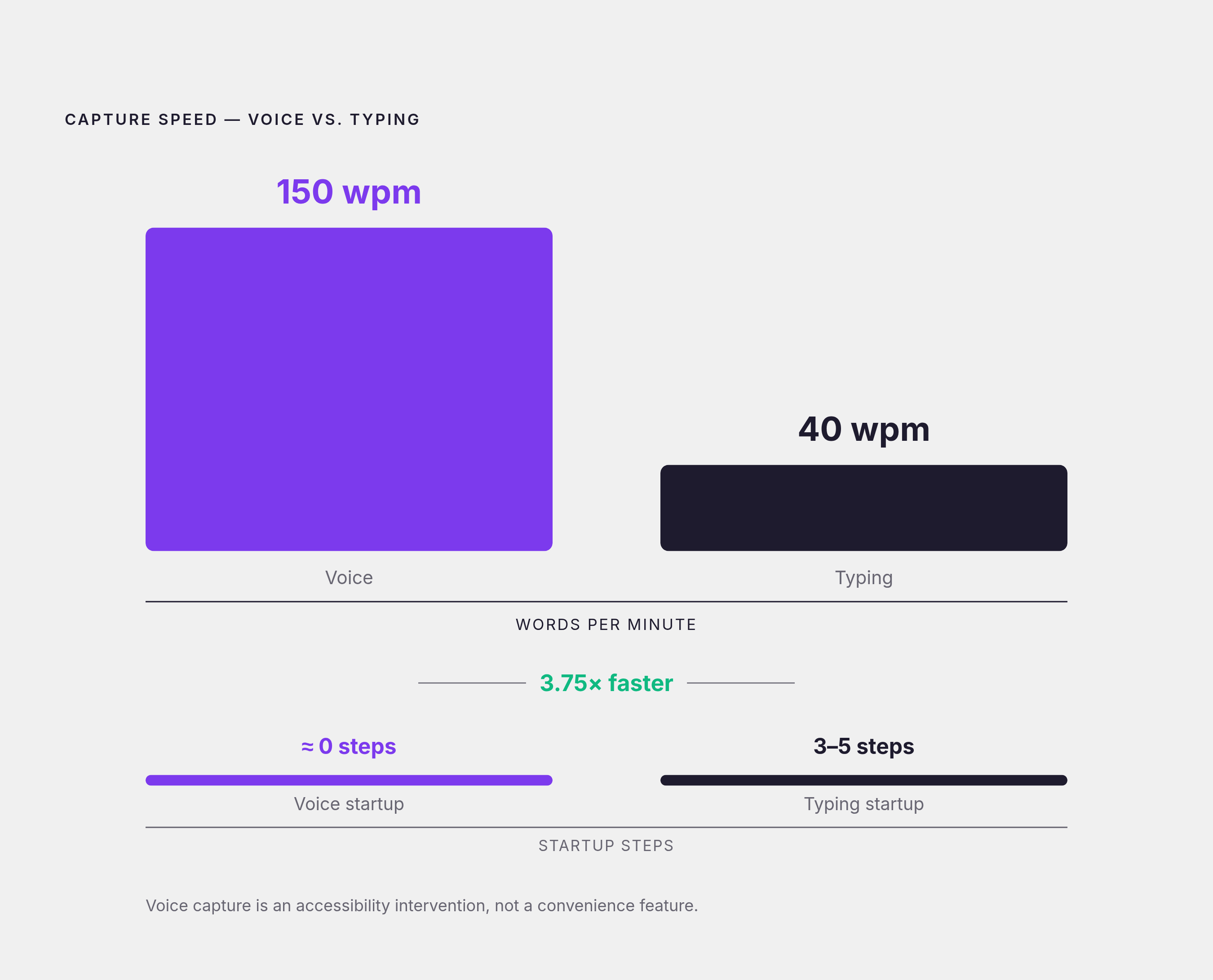
The single biggest point of failure in ADHD task management happens at capture, the moment a thought needs to be recorded before it disappears. Voice-first design solves that problem not as a convenience feature bolted onto an app, but as an accessibility intervention, because a thought that takes more than a few seconds to get down is often a thought the ADHD working memory has already let go of.
Working memory in ADHD is already under real strain, and typing makes that worse by forcing someone to hold an idea in mind while simultaneously planning and executing the keystrokes needed to record it. The numbers back this up directly: speech runs at roughly 150 words per minute, a pace that matches a fast, associative ADHD train of thought far better than typing at around 40 words per minute. Speaking also carries almost no startup cost, and that near-zero startup cost is precisely the barrier that kills task capture at the blank-page moment, before a single word gets written down.
When capture friction is high, the system does not fail because someone forgot to use it. It fails because the window between having a thought and being able to record it closes before the tool is even open. The broader tool ecosystem has started to recognize this. Microsoft Copilot is changing workplace accessibility for neurodiverse employees in a related way, summarizing long documents, drafting routine writing, and structuring complex workflows, which reduces the executive-function tax that falls disproportionately on people with ADHD in ordinary office work.
What unifies all of this is a single design principle: a tool built for ADHD needs to capture information quickly, ideally by voice, organize it automatically, send reminders at the right moment, and avoid punishing inconsistent use. Ignoring that part is what lets a single missed day collapse into permanent abandonment of the app. Punishing a missed day, through a broken streak or a guilt-inducing notification, is exactly how a neurotypical tool turns one off day into a permanently abandoned app.
Tools designed around ADHD neuroscience, compared honestly
The tools that genuinely hold up for ADHD are the ones built around how ADHD brains actually operate, not general productivity frameworks with an ADHD label added afterward. These features appear in the ones the previous sections already identified as non-negotiable: low friction at capture, immediate reward, and structure that does not collapse after one missed day.
Mindflow was built specifically for ADHD, drawing directly on executive function research and ADHD behavioral science rather than starting from a general productivity template. It is voice-first by design, letting natural conversation replace forms and typing and removing friction at exactly the capture stage identified earlier as the critical failure point. Progress runs through XP rewards and milestone tracking, the same gamification mechanism the earlier section grounded in dopamine research rather than treated as decoration. Mindflow is also built not to punish inconsistent use; a missed day gets absorbed into the design rather than treated as a broken streak. It is used by more than 100,000 people and holds a 4.8-star rating.
Goblin Tools, free and browser-based, is strongest specifically at breaking tasks into smaller steps. Its Magic ToDo feature breaks an overwhelming task into granular steps, with a dial that controls how small those steps get. It requires no account and no setup, so friction to first use is close to zero, making it a solid first option in the exact moment paralysis hits. It does not offer habit tracking, reminders, or any ongoing scaffolding beyond that single moment, solving one problem well and handing everything else back to the user.
Todoist with its Ramble feature is a general task manager with a voice input tool that turns spoken thoughts into structured tasks complete with dates and priorities. It addresses capture friction in a meaningful way but does not touch the motivation, reward, or paralysis problems that occur once a task is already captured and sitting on the list. It works better as a capture layer than as a full ADHD support system.
Body-doubling platforms such as Focusmate, Flow Club, and Flown address a different need entirely: external accountability and the sense of social presence that some ADHD users find genuinely activating. None of them offer task management, habit tracking, or the kind of ongoing daily structure an ADHD routine actually needs to hold together.
What changes when the tool fits your brain
Understanding why every past app failed is not a consolation prize.
The tool-switching cycle was never proof of a broken brain. What does carry across those different profiles is a set of design principles: low friction, immediate reward, milestone-based structure, voice capture, and external scaffolding that does not depend on the user's own initiative to hold everything together.
Because executive dysfunction varies so widely, from working memory deficits to distorted time perception to struggles with inhibitory control, a tool meant to accommodate that range needs to adapt its coaching and scaffolding to the person using it, rather than forcing the person to adapt to the tool. What drives that consistency is a system whose feedback loop actually matches how the brain works, not willpower applied with more force than before.
Breaking out of the shame loop takes a tool that does not repeat the same neurotypical assumptions that caused the original failure, one built around removing friction rather than adding features, and designed from the start around ADHD executive function instead of retrofitted onto it afterward. The shame built up over years of failing neurotypical systems does not vanish the instant the tool changes. The better question was never "why can't I make this app work." It was always "was this app ever built for how my brain actually works" and once that question gets asked honestly, the search for an answer looks different than it did before.