Accountability Partnerships and Challenges for ADHD
External structure works for ADHD because the brain cannot reliably generate it alone.

Gamified goal tracking works for ADHD adults because it replaces willpower with structure: XP points, streaks, and milestone tracking supply the external reward signal that the ADHD brain cannot reliably generate on its own. This piece covers why accountability partnerships, body doubling, and apps like Focusmate, Flow Club, Flown, and Mindflow succeed where a plain to-do list fails after a day or two, and what separates designs that help from the ones that quietly reinforce shame.
Why accountability feels harder to sustain for ADHD brains than for everyone else
Picture the task that sits at the top of the list for three days straight. The person who needs to do it wants to do it, knows the cost of not doing it, and still cannot make the first move happen. That gap between intention and action is where most explanations of ADHD go wrong, because the default assumption is that the person needs more motivation or more discipline.
Russell Barkley's model of ADHD treats it as a disorder of behavioral inhibition first, and everything downstream follows from that one failure. Attention is the symptom people notice, and inhibition is the mechanism that produces it.
That mechanism does not look the same in every person with ADHD. The deficit is not one thing. It appears differently depending on which systems are weakest in a given brain, and anyone building a support system should design around the person, not the diagnosis.
Here is the practical consequence. Caring about the task was never the problem. The system demanded sustained self-directed effort from a brain that could not reliably supply it.
What external accountability does inside an ADHD brain
If the internal system cannot reliably generate structure, initiation cues, and follow-through, the obvious move is to supply those things from outside. That is the entire logic behind accountability partnerships, and it explains why they work for ADHD in a way that goes beyond simple peer pressure. A partner, a group, or a scheduled check-in hands the brain three things it cannot consistently make for itself: a structure to slot the task into, a cue that triggers the start of work, and a jolt of dopamine that comes specifically from social engagement.
Researchers have started calling this a social prosthetic. The term fits well: body doubling, accountability partners, and community check-ins function the way a prosthetic limb functions, standing in for a system that is not reliably doing its own job. The external structure does not fix the underlying wiring. It carries the load the wiring cannot carry alone.
Body doubling is the clearest version of this. Two people work side by side, in person or over video, often on completely unrelated tasks, and something about the shared presence helps the ADHD brain start moving and keep moving. The proposed mechanism involves mirror neurons and a kind of ambient motivational scaffolding, the sense that someone else is also putting in effort right now, which lowers the activation energy needed to begin.
It would be dishonest to present this as settled science. What exists is a large convergence of anecdotal reports across communities of ADHD adults, paired with a mechanism that lines up with what is already known about social dopamine and inhibition-based executive dysfunction. That is a real limitation, and naming it directly only makes the rest of the argument more trustworthy. The claim rests on confidence rather than certainty, grounded in a plausible mechanism that has not been clinically tested.
Tools like Mindflow, which deliver voice-first coaching and track progress through XP-based streaks and milestone markers, work on exactly this principle: they externalize the structure and immediate feedback an accountability partner would otherwise provide, supplying the initiation cues and dopamine activation the ADHD brain struggles to generate on its own.
Structuring body doubling and accountability challenges in practice
Accountability for ADHD used to depend on finding a willing friend or a patient family member, but that has changed. A handful of platforms have turned body doubling into a repeatable, on-demand service, and the differences between them say something useful about how much structure a given person actually needs.
Focusmate pairs users one-to-one for timed co-working sessions with a stranger over video. Each format trades off intimacy against scale, and which one works for a given person often has less to do with the task and more to do with how much direct social pressure that person can tolerate on a given day.
Accountability challenges extend the same mechanism without the live video component. Daily check-ins, streak-based commitments, and group progress sharing recreate the external cue at scale, and they add something Focusmate-style sessions do not: public, asynchronous validation from a group. That community layer amplifies the dopamine signal further, since the reward now comes not just from having shown up but from being seen to have shown up by people tracking the same streak.
A 2025 systems paper by researcher Raghavendra Deshmukh took the idea further into software. The proposed framework runs entirely on-device, under user control, and infers attention states from lightweight behavioral signals, tab churn, periods of inactivity, app-switching, then delivers adaptive nudges, reflective prompts, and body-doubling-style co-working signals based on what it detects. The privacy-first design matters here: the system watches behavior patterns rather than content, and the user decides what it is allowed to act on.
For people whose anxiety makes a human observer the obstacle rather than the solution, a 2025 study titled "You Are Not Alone" (arXiv:2509.12153) tested body doubling inside virtual reality. VR avatars offered a middle ground, enough social presence to produce the body-doubling effect, without the specific discomfort of being watched by an actual person. That distinction turns out to matter a great deal, and it sets up the central complication the next section has to deal with directly.
Where accountability partnerships break down and make things worse
The same social presence that makes accountability work can make it actively harmful when the design gets it wrong. An accountability partnership built around judgment, rather than support, does not fail neutrally. It replicates the exact shame dynamics that drive executive dysfunction in the first place, and for a population already carrying a heavy shame burden, that is not a small risk.
The entanglement between ADHD and shame runs deep and long before any adult accountability system enters the picture. A 2026 scoping review in Clinical Psychologist found that people with ADHD consistently carry higher levels of deep-rooted beliefs about being defective, destined to fail, or fundamentally not good enough, beliefs traced back to childhoods full of persistent criticism for behavior the child could not fully control. A 2026 systematic review in Frontiers in Psychiatry extended that finding into adulthood, documenting internalized stigma that a person absorbs from the outside world and turns against themselves, and found that people with more significant ADHD symptoms reported more of it, alongside lower self-esteem and lower quality of life.
That history explains a pattern seen constantly among ADHD adults trying to use mainstream productivity tools. When the system fails, the user blames themselves. A poorly built accountability partnership can recreate this exact dynamic with a human face attached to it, which, if anything, makes it worse, not better.
The VR research on performance anxiety points at the mechanism directly: being watched by another person can push anxiety high enough that it produces task avoidance. Social accountability produces its benefit only when the social dynamic feels safe.
There is a quieter failure mode too, one that does not announce itself the way anxiety does. A scheduled check-in can produce surface compliance without sustained engagement with the underlying task, and a system that only measures the former can look successful while accomplishing nothing.
What separates helpful accountability structures from harmful ones
None of this means accountability partnerships are a bad bet for ADHD. Design decides the outcome, and a small number of concrete choices separate a structure that helps from one that hurts.
The first principle is friction at the point of entry. Anything more than that gives an already overloaded executive system one more decision to avoid.
The second principle is non-judgmental witnessing. The partner's job is to be present, not to evaluate. A well-designed check-in rewards the act of showing up and does not punish an incomplete task, because penalizing a missed session only adds a fresh layer of shame onto a system that is already shame-prone by default. This is where the Clinical Psychologist and Frontiers in Psychiatry findings become directly actionable: any accountability format that scores, ranks, or shames incompletion works against documented vulnerabilities in this population.
The third principle is sizing the commitment correctly. Overwhelming goals are one of the most common triggers for ADHD paralysis, the reconstitution failure Barkley describes, where a large goal cannot get broken down into a workable sequence. Accountability works best when the commitment is small enough to actually win. Each small win sends a dopamine signal, and that signal is what makes the next step possible, not sheer willpower carried over from the last success.
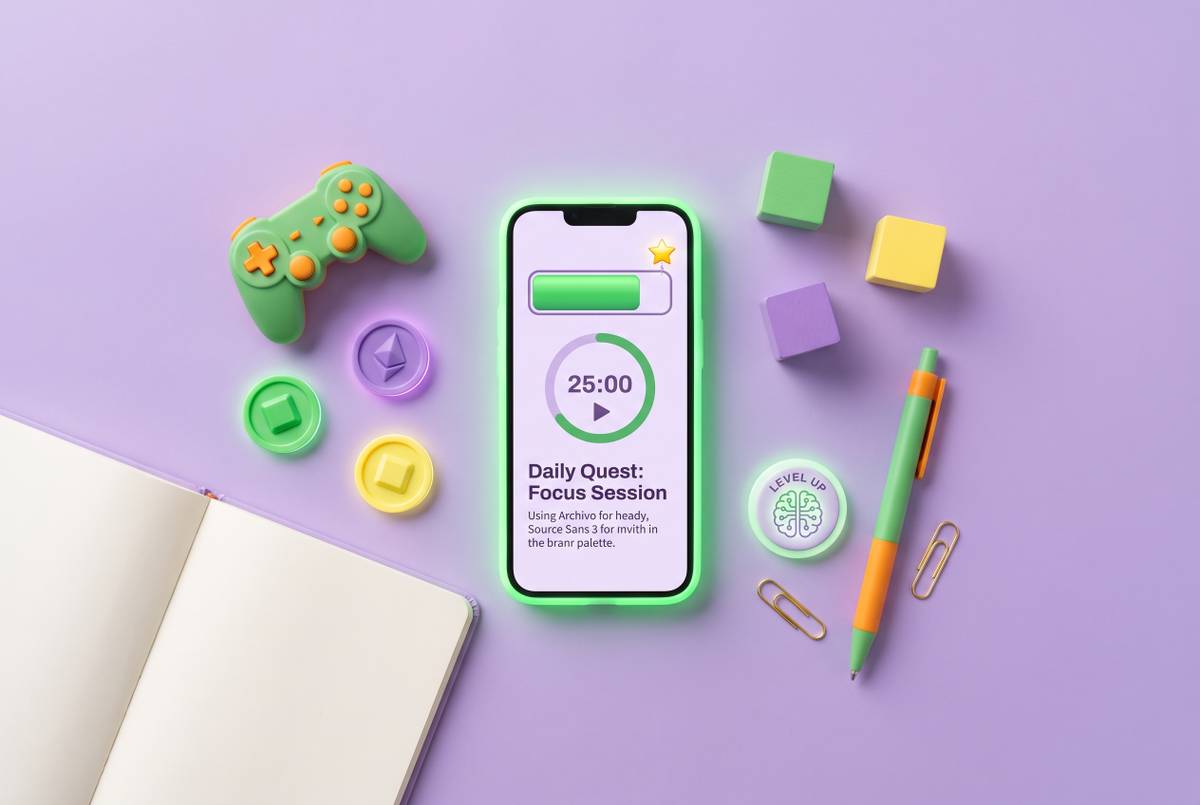
Gamification fits naturally into this picture and deserves to be taken seriously as a design tool. Points, streaks, badges, and unlockables give the brain an external reward where its internal dopamine system comes up short. Each mini-win sends a signal that reinforces the behavior that produced it. This is a design choice grounded in exactly the neuroscience this piece opened with.
The fourth principle concerns how the check-in itself gets captured. Typing demands executive function, planning what to write, holding the sentence in working memory, editing as it goes, and that demand lands hardest exactly when the brain is already depleted. Ideas tend to arrive faster than fingers can type them, and if capturing a thought takes more than a few seconds, the thought disappears, and the habit built around capturing it disappears not long after.
There is an emotional layer to all of this that structural fixes alone cannot reach. At the 2026 ADHD ICONnect conference, clinicians presented Acceptance and Commitment Therapy as a framework suited to exactly this problem, one built to address emotion dysregulation, overwhelm, rejection sensitivity, avoidance, and shame-based identity directly. This matters for an accountability tool as much as for a therapy office. Because a check-in that handles the practical side of a task while ignoring the emotional residue of having failed at it ten times before is only solving half the problem.
Building an accountability practice that compounds over time for an ADHD brain
A single accountability partnership or a two-week challenge will not carry someone through a year. What compounds is a layered daily structure, external cues stacked with small repeatable wins and low-friction check-ins, repeated until the pattern starts running on its own.
Mornings deserve particular attention, because the ADHD brain wakes up with reduced dopamine and a stretch of impaired executive function that can last well into the day. Any structure meant to activate first thing in the morning has to ask for zero decisions, not fewer decisions. A launch pad built the night before, clothes laid out, bag packed, keys sitting in one fixed spot, removes the morning's decision load entirely and lets the routine run on something closer to autopilot.
From there, a brief, voice-first check-in at a consistent time each day becomes the anchor for everything else. It signals that structured time has started, it creates a small social commitment even when the only audience is an app, and it activates the same dopamine loop that a human accountability partner would trigger through presence alone.
Mindflow sits at the intersection of these principles, combining them together. Guided goal breakdown turns an overwhelming goal into a sequence small enough to actually complete, rebuilding the steps a fragmented brain cannot reconstitute on its own. It functions less like a reminder app and more like an always-available accountability partner, built around how ADHD brains actually operate rather than how a neurotypical productivity system assumes they should.
Beyond human-centered platforms like Focusmate and Flow Club, AI-mediated accountability is increasingly built directly into ADHD-specific mobile tools.
None of the small wins in this structure are trivial on their own. A completed check-in, a milestone reached, a finished session, each one reinforces the same neural reward pathway, and that reinforcement is what makes the next action more likely than the last one was. A 2026 multicomponent intervention study in Occupational Therapy International backs this logic with data: combining computer-based cognitive training, academic skills training, and an optional parents' psychoeducation group produced measurable gains in executive function among adolescents with ADHD. Layered, structured, multi-element support outperformed any single intervention on its own.
The right accountability system is rarely the one carrying the most features. It is the one with the least friction to begin, the most forgiveness built in for a missed day, and the clearest underlying message that showing up counts more than performing it perfectly. Someone who has tried and dropped a dozen productivity systems before this one is not someone incapable of consistency. They were handed tools built for a different kind of brain. The right structure changes what is actually possible by asking for less of exactly the thing that was never reliably available in the first place, not by asking for more discipline.
Sources
- Enhancing Executive Function in Adolescents With ADHD: Preliminary Findings From a Multicomponent Intervention - PMC
- Toward Neurodivergent-Aware Productivity: A Systems and AI-Based Human-in-the-Loop Framework for ADHD-Affected Professionals
- You Are Not Alone: Designing Body Doubling for ADHD in Virtual Reality
- Frontiers