Streak Mechanics and ADHD Motivation
How gamified streaks provide the dopamine signal ADHD brains cannot generate alone.

Streak mechanics are not a gimmick borrowed from mobile games. For adults with ADHD, a well-built streak system supplies a reward signal the brain's own dopamine circuitry cannot reliably produce on its own, which is why gamified tracking apps succeed where ordinary to-do lists fail within a day or two. This piece explains the neuroscience behind that failure, then shows what separates a streak system that works from one that quietly makes things worse.
Why the ADHD brain cannot generate its own motivation signal
Tell someone with ADHD to just try harder and the advice collapses almost immediately on contact with how the condition actually works. ADHD is a problem of dopamine regulation, not a character flaw or a willpower shortfall, and that distinction changes what has to happen for motivation to show up.
The prefrontal cortex and the striatum do most of the work behind executive function, sustained attention, and reward processing, and both regions run on dopamine. In ADHD brains, these regions are underactivated. ADHD Brain Scan UK, in material updated April 2026, puts it directly: the prefrontal cortex is "not damaged or broken, it is underactivated," and needs more neurochemical fuel to reach the operating level other brains hit without trying.
Two structural features explain why that fuel runs short. Baseline (tonic) dopamine sits lower than average, so the brain needs a larger spike just to cross the threshold where a signal registers. At the same time, a denser population of dopamine transporters clears dopamine out of the synapse faster than it clears in a neurotypical brain. Put those together and the result is a weak or absent "this will be worth it" signal for any task that isn't immediately interesting, urgent, or novel.
That's why a deadline two hours away can unlock total focus, but the same task framed as a long-term improvement with no immediate payoff produces nothing but paralysis. The task hasn't changed. What changed is whether the brain can generate a dopamine signal strong enough to register as worth doing right now. Medication changes the chemistry involved in this gap, but that's a separate conversation from the one this piece is having: the question here is what happens when the task itself, not the brain's baseline chemistry, needs to supply the missing signal.
Executive dysfunction turns daily consistency into a structural problem
The same dopamine-dependent circuits that fail to generate motivation also run executive function, so ADHD doesn't just make tasks feel unpleasant to you. It disables the specific cognitive tools that consistency depends on.
ADHD touches all six to varying degrees in a given person. Picture an orchestra where every musician can play their part individually but the conductor is undersupplied: the music falls apart because the coordination layer doesn't have what it needs to hold the whole thing together.
A structural equation model published in BMC Psychology in 2026 traced how this plays out mechanically. The study found sequential indirect pathways: steeper delay discounting (valuing smaller immediate rewards over larger future ones) links to higher ADHD traits through reduced sustained attention, increased working-memory errors, and poorer decision-making. Motivational and executive problems combine to produce the outcome, and neither one alone fully explains it.
Time blindness is a direct downstream effect of that cascade. The difficulty of perceiving time passing, or connecting an action today to a payoff next month, means that growth accumulating over days or weeks simply doesn't register to the ADHD brain unless something outside the brain represents it. That's why standard goal-setting advice ("you'll thank yourself in three months") tends to fail outright: a reward three months away produces no anticipatory dopamine now, so there's nothing pulling the behavior forward today.
Decision paralysis follows the same logic and gets underestimated constantly. If every task, even a small one, draws on executive resources that are already running low, a minor choice can trigger a freeze response instead of action. None of this is a motivation problem in the colloquial sense. It's a resource problem, and it points to what has to happen next: the ADHD brain needs external structure standing in for the internal regulation it can't reliably produce on its own. This dopamine gap is why tools for ADHD brains need to work differently. Voice-first AI apps like Mindflow deliver reward feedback right away and cut the friction that tends to derail traditional productivity systems, so you get the external signal your brain needs without having to spend willpower to access it.
What streak mechanics do inside a dopamine-dysregulated brain
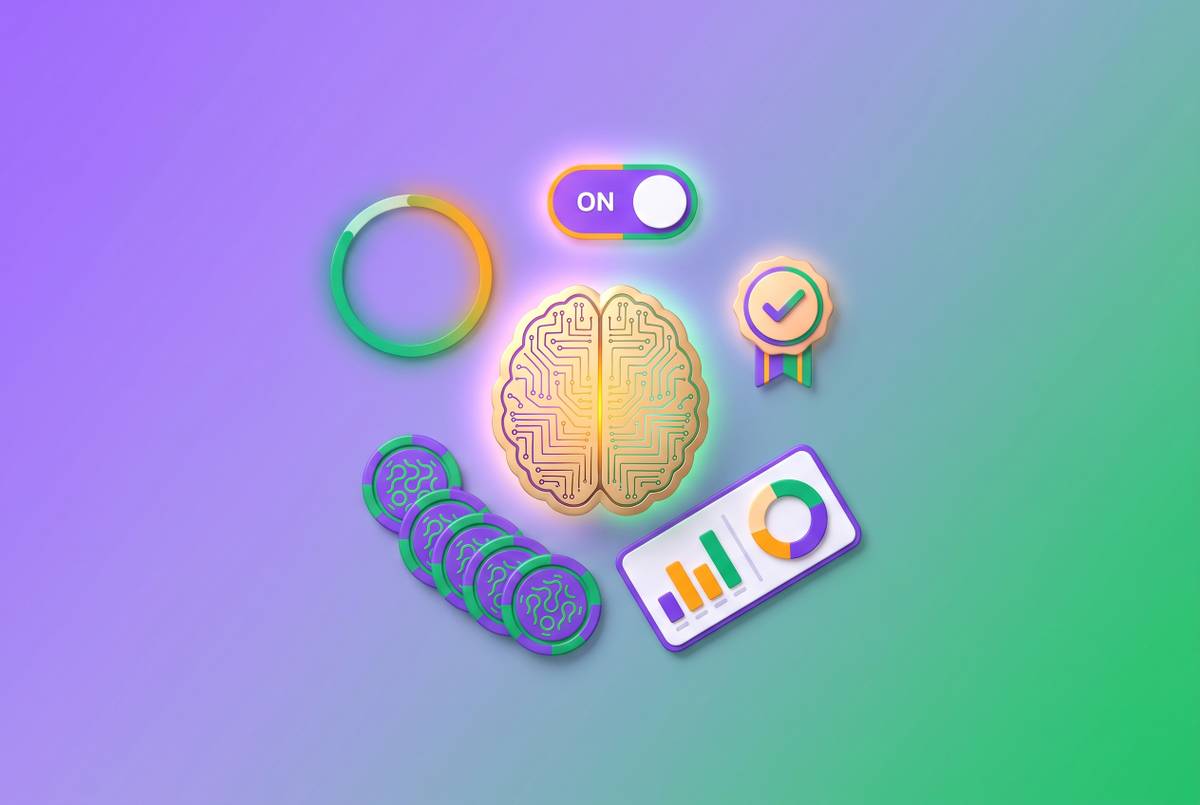
Streak mechanics work for ADHD brains because they hand the brain, from outside, the exact signal its own dopamine system fails to produce internally. A streak counter, a filling progress bar, an XP gain are prosthetic dopamine triggers, standing in for a signal the brain can't reliably manufacture on its own.
Low tonic dopamine means the threshold for registering a reward is higher than normal, so mild rewards, or rewards arriving only after a long buildup, don't do enough to move the needle. The ADHD brain needs rewards that are both stronger and more frequent to register as meaningful. A streak counter, a bar filling toward completion, a number of XP points ticking upward, each of these delivers a reward signal at the exact moment a task finishes. Compare that to an ordinary to-do list, where the only signal available is a line crossed out, a far weaker event with none of the visual or numerical weight a streak carries.
The research on gamification backs this up at a broad level. Shaz Marshall Coaching, writing in September 2025, points to a 2020 review in Frontiers in Psychology finding that gamification measurably increases motivation, learning, and persistence, with the largest gains appearing in people who struggle with traditional incentive systems. That's the population ADHD sits squarely inside.
A counter showing 14 days in a row renders accumulation in a form the ADHD brain can actually process: concrete, numerical, and happening in the present tense, rather than an abstract claim about long-term benefit. A progress bar does the same work for a goal that would otherwise stay too abstract to generate any felt urgency, turning it into a visual object the reward system can respond to immediately.
Variable and milestone-based rewards add a second layer on top of this. Neuroscience research on reward anticipation ties dopamine spikes to both progress tracking and variable reward delivery: the anticipation of what comes next, a level-up, a new milestone, an item unlocked, produces a dopamine response before the reward itself ever arrives. That's precisely the anticipatory signal that ADHD reward prediction struggles to generate for anything sitting in the future. Breaking a goal into small completable steps matters just as much as the streak mechanic itself: a task split into "open document," "add title," "write first paragraph" delivers a reward hit after each individual step, sustaining engagement across the whole task. Because executive function is undersupplied rather than absent, consistency depends on scaffolding that doesn't lean on the brain's struggling sense of time. Gamified habit apps built for ADHD use this approach, where visible milestones and daily structure stand in for vague long-term promises and replace them with progress signals that register right now.
Where standard streak design breaks down for ADHD users
Not every streak system is built the same way, and a system designed around the wrong motivation pattern can backfire on the user it was meant to help. A streak mechanic designed around neurotypical motivation patterns can backfire hard on an ADHD user, because the shame of a broken streak lands on top of a shame burden that's often already substantial, and that combination can trigger the exact avoidance the tool was supposed to prevent.
The core issue is what might be called the broken-streak paradox. A standard daily streak sets up a binary: maintain it or fail it. When the streak breaks, a sizable number of users don't pick it back up the next day. They stop doing it for good. That's a design problem, not a user failure: punishment-style mechanics run straight into the ADHD user's elevated sensitivity to shame, and the result is less engagement overall, not more. Some practitioners have started building around this directly, with mechanisms like "Streak Repair" tokens, grace periods, and "Weekend Shields" designed to preserve momentum without demanding perfect daily adherence.
Internalized stigma raises the stakes further for ADHD users specifically. A missed day isn't just a missed day. For someone whose internal narrative already includes "I can't stick to anything," a broken streak reads as confirmation of that story. A systematic review in Frontiers in Psychiatry, published in 2026, found that greater ADHD symptomatology correlates positively with internalized stigma, which in turn links to functional impairment, lower self-esteem, and reduced quality of life. Stigma also raises the barrier to re-engaging with tools and support after a lapse, through shame and embarrassment alone, so a harshly designed streak system can make it measurably harder to come back after falling off.
A second, quieter failure mode occurs in system complexity. If a streak tool demands significant setup or ongoing maintenance, you abandon it precisely on the low-executive-function days when you need it most. The system has to stay usable when executive resources are already depleted, because those are the exact days a person is most at risk of losing the habit.
None of this makes streak mechanics risky as a category. The design of the system, not the presence of a streak counter, is what makes the tool help or compound the problem it was meant to solve. That distinction sets up the practical question: what does a streak system actually need to get right.
Design principles that make streak mechanics work for ADHD
An ADHD-compatible streak system has to clear three bars at once: it has to cut friction at every point where a user interacts with it, it has to forgive missed days without letting go of accountability entirely, and it has to deliver rewards often enough to keep the dopamine loop running between major milestones. Miss any one of the three and the system tends to get abandoned on exactly the days it was built to help with.
Friction at the point of logging deserves attention first, because if recording progress takes more executive function than the task itself required, the loop breaks before it ever closes. Voice input solves a specific version of this problem: typing requires organizing a thought and entering it at the same time, and for a mind that's already racing ahead of typing speed, that dual demand becomes its own obstacle. Voice capture removes the executive-function hurdle of structuring and typing at once. VoiceType AI markets itself around solving precisely this problem for ADHD users, and people cite Apple Reminders' voice-to-reminder feature for the same reason. The underlying principle holds regardless of which product applies it: a tool built for ADHD needs to capture information fast, ideally by voice, organize it without requiring manual sorting, and avoid punishing a user for inconsistent use. Mindflow's voice-first interface is one direct application of that principle, replacing forms and typing with ordinary conversation and removing the friction point where ADHD users tend to abandon conventional apps.
Milestones need to be small enough that you can finish one inside a single sitting, so each session closes its own reward loop. An overwhelming goal can paralyze an ADHD brain before you even take the first step, but if you break a milestone down into the next small action, you get the step-by-step dopamine release that keeps you moving through the rest of the task. Mindflow's milestone tracking builds on exactly this logic: it breaks larger goals into pieces sized for a single session rather than leaving the full scope of a goal sitting unbroken in front of you.
Forgiveness mechanisms, grace periods, repair tokens, and similar features, aren't leniency bolted on as a nice-to-have. They reflect a neurologically grounded design choice, one that keeps a missed day from triggering the shame-driven abandonment described in the previous section. A streak system with no forgiveness built in is tuned for neurotypical consistency, and applying that same design to an ADHD user mismatches the tool to the brain it's meant to serve.
Several named tools from 2026 practitioner guides illustrate how these principles play out across different use cases. Habitica combines habit tracking with RPG mechanics and suits users who respond to visual progress, light accountability, and an element of play; it tends to work best for daily routines like morning habits, medication reminders, and exercise. Finch takes a similar approach, built around gamified self-care, and people recommend it for the same category of daily routine-building. Goblin Tools' Magic ToDo function takes a different angle entirely: it's free, browser-based, requires no sign-up, and automatically breaks a vague task into smaller steps, which removes the friction of simply getting started and offers an immediate, judgment-free way to find clarity without committing to a full productivity system.
Morning routines deserve particular attention here, because executive function is at its weakest point right after you wake, making the morning the highest-stakes window for any streak-based habit system. A workable morning routine builds around three to five anchor tasks rather than a twelve-step checklist, and pairs that short list with one deliberate early dopamine boost, a favorite coffee, direct sunlight, a specific playlist, timed to improve task initiation right at the start. Every decision draws on a limited pool of executive-function reserves for the day, so the goal of a morning routine is to remove as many decisions as possible before the day's real demands start arriving. Streak counters, progress visualizations, and XP gains function as prosthetic dopamine triggers rather than motivational gimmicks: they deliver an immediate reward signal at the exact moment a task closes, supplying what the dysregulated dopamine system fails to generate on its own, which is why ADHD-specific tools build their engagement mechanics around these particular feedback loops instead of generic incentive structures borrowed from neurotypical design.
Sources
- Executive and motivational pathways to ADHD traits in the general population: a structural equation model of working memory, attention, delay discounting, and decision-making
- Frontiers
- A Systems Biology Perspective on Childhood ADHD: Neurochemical Dysregulation, Brain‐Behavior Interactions, and Emerging Therapeutics - Alsoqih - 2025 - The FASEB Journal - Wiley Online Library
- Frontiers
- Executive and motivational processes in adolescents with Attention-Deficit-Hyperactivity Disorder (ADHD)