Strategies to Improve Working Memory with ADHD
Practical workarounds that reduce ADHD's working memory load.

Working memory is the brain's short-term workspace, the place where you hold a thought, a phone number, a set of instructions long enough to actually act on it. In ADHD that workspace doesn't hold steady. This piece looks at why, then walks through what actually helps once you stop trying to force it to behave like a neurotypical brain's workspace, because I've tried that route and it wastes years you don't get back.
You know the symptoms already if you live with this. The thought disappears mid-sentence. You walk into the kitchen and just stand there, blank, no memory of what you came for, and you feel a little stupid about it even though you know better. Reading the same paragraph three times gets you nothing, because the information never made it into a stable holding pattern in the first place. Working memory ties into how the brain handles emotion, so when it fails, what follows isn't just a missed task. It's frustration, sometimes shame, sometimes a spiral that outlasts whatever triggered it.
That shame gets misread constantly, by other people and by the person living it, as laziness, or as not being smart enough. I've sat in meetings mentally rehearsing an answer and lost the thread before my turn came, and that isn't a focus problem you fix by trying harder. The deficit is neurological, though it isn't fixed in place, and that's the real question underneath this whole piece: can environmental and behavioral strategies, built around how ADHD brains actually run rather than how brains are supposed to run, cut the daily cost of this in some measurable way? The research says yes, with limits.
How ADHD disrupts the executive function system that working memory depends on
Working memory doesn't sit in there by itself. It's one of three core executive functions, alongside inhibitory control and cognitive flexibility, and the three run as a linked system rather than three separate offices down the hall. Weaken one and the other two feel it almost immediately. That's part of why ADHD rarely shows up as one clean symptom; a dent in working memory ripples straight into impulse control, and into the flexibility needed to shift from one task to the next.
Research on ADHD keeps flagging working memory impairment as one of the sharper cognitive markers separating ADHD brains from neurotypical ones. It sits closer to the center of the condition than a footnote symptom riding along with hyperactivity or distractibility.
Some of this traces back to the prefrontal cortex, which runs less efficiently in ADHD brains and does a lot of the coordinating for executive function generally. That inefficiency opens a gap between intention and action: you know what you're supposed to do, you might even want to do it, but the mechanism that carries that intention into motion misfires. Multistep tasks stall right at the starting line, a short circuit at initiation more than any real resistance to the task itself.
Time blindness belongs in this same picture, and of everything here, it's the one that gets mistaken for carelessness the most. Not being able to sense how much time has passed, or how much is left before a deadline, is partly a working memory failure; the brain can't hold a running sense of where you are right now relative to where you need to be. I used to think I was bad at estimating time. Turns out I just wasn't holding the estimate anywhere.
ADHD brains process information differently, and that single fact should drive every strategy that follows. It explains why so much mainstream productivity advice just doesn't land for this population. Linear to-do lists, willpower-based focus, holding a five-step plan in your head while you execute step one: all of it assumes executive functions sit there on demand. For ADHD brains they often don't, and no amount of grit closes that gap reliably. Designing differently accomplishes what trying harder rarely does.
What the research actually shows about improving working memory capacity
Can you train working memory the way you'd train a muscle? Somewhat, yes. But the number is smaller than most productivity content wants it to be, so it's worth looking at what the studies actually found instead of what gets claimed about them afterward.
Computerized cognitive training, the kind that drills working memory tasks over and over, produces moderate gains on untrained working memory measures, with some spillover into attention and inhibitory control. Real, but modest.
Neurofeedback shows a similar shape, with a bit more staying power. Research into neurofeedback training suggests meaningful working memory improvements following sustained protocols.
Exercise is probably the most useful finding here for anyone who wants something to start tomorrow, not next quarter. A 2025 meta-analysis pooling 11 studies and 667 participants found physical activity interventions improved working memory in children with ADHD, moderate effect size, SMD = 0.51. The specifics matter: sessions of 45 to 60 minutes, spread over 8 to 12 weeks, no more than twice a week. Type of movement mattered too. Cognitive-aerobic exercise, meaning movement that also demands attention and decision-making (a soccer drill instead of a treadmill jog), beat plain aerobic activity outright. The cognitive engagement itself seems to drive the plasticity, beyond just raising heart rate.
There's a less obvious payoff buried in this research. A 2023 study using Cogmed training with 120 children found sustained improvement in self-blame, rumination, and catastrophizing following the training. Strengthening the cognitive workspace seems to ease some of the emotional weight that piles up around ADHD, alongside the logistical misses that get most of the attention. I didn't expect that connection the first time I read it, honestly. Makes sense in hindsight.
None of this should get oversold, though. Training moves the needle at the margins. It doesn't erase the underlying deficit, and treating it like a cure just sets people up to feel like failures later, when the deficit is still sitting there waiting. For most people, the bigger return comes from a different move entirely: instead of trying to expand the workspace, shrink how much of it any given task actually demands.
Reducing working memory load before a task even starts
Working memory is a limited resource. The real design question is how to spend less of what you've got on logistics, so what's left goes toward the actual work.
Externalizing is the most direct substitute there is. Write it down before it evaporates, and treat that as a literal transfer: data moving out of working RAM and onto something stable outside your skull. Categorize as you capture, too, because dumping everything into one undifferentiated list just relocates the burden to retrieval time, when you're stuck sorting through a pile trying to find what actually matters. Sort by context or energy level up front and that sorting only ever has to happen once. None of this works if the capture tool has friction built into it. A sticky note buried three menus deep in an app won't get used the moment it actually matters, and by then the thought's already gone. Ask me how I know.
Chunking works for a related reason. Break a project into the smallest nameable steps and you cut down how much the brain has to hold at once, which also sidesteps the fatigue of juggling several threads simultaneously.
Limiting daily choices matters more than it sounds like it should. Decision-making draws on the same executive resources working memory needs, so trimming the unnecessary ones, what to wear, what to eat, what order the morning happens in, frees up capacity for the decisions that actually count.
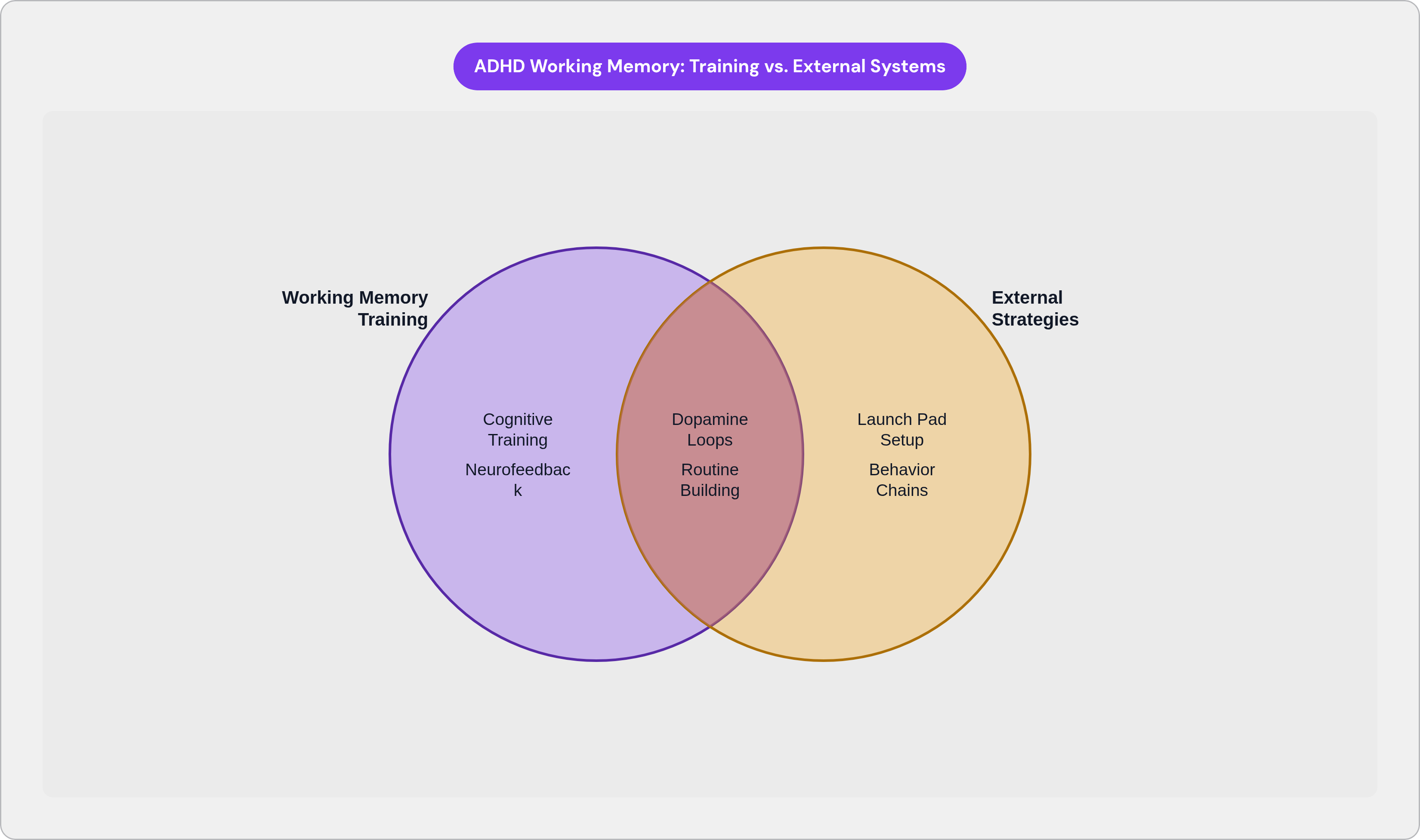
Environment carries a lot of this weight too, if it's set up right. A launch pad, one staged spot where everything needed for tomorrow's first task already sits ready, means the environment remembers so you don't have to. Visual cues work best sitting right at the point of action, not tucked into a list somewhere else entirely. Even a phone alarm can be upgraded: label it with the exact next action instead of a generic tone, and skip the step of decoding what the reminder was even for.
One rule worth building every system around: anything that takes more than two steps to start gets skipped on a hard day. Design for the hard day, not the good one. That's what makes a system reliable instead of aspirational.
Behavioral frameworks that replace working memory demands in daily routines
Routines work for ADHD brains for a specific reason. A practiced sequence moves the load out of working memory and into procedural memory, the same system that lets you drive a familiar route without narrating every turn out loud. Once a sequence goes procedural, the brain stops reconstructing "what comes next" from scratch every single time.
This matters most in the morning, arguably the roughest stretch of the day for anyone with ADHD. Executive function doesn't fully come online until 60 to 90 minutes after waking, and in that window working memory is shaky, impulse control is thin, and starting anything feels disproportionately hard. A pre-scripted routine covers exactly this low-functioning window, right when you'd need executive function the most and have the least of it available.
Behavior chains push this further. Design the routine so finishing one action cues the next automatically: brushing teeth leads into laying out clothes, laying out clothes leads into starting coffee, and the sequence carries itself forward. The environment and the prior action do the cueing, so nothing has to be held in mind at all.
There's evidence for structured approaches here too. CBT-based organizational frameworks showed roughly a 30% improvement in organizational scores in Solanto's 2011 research, and the mechanism lines up with everything above: external structure substitutes for the internal scaffolding ADHD brains don't reliably supply on their own.
Time blocking runs on the same logic, applied to the whole day. Fixed points, a fixed lunch time, a fixed start to focused work, cut down the number of real-time decisions about what happens next, moving the scheduling burden off working memory and onto the calendar where it belongs.
What gets missed constantly, though, is the reset. ADHD routines fail because there's no plan for what happens when they break, and they will break: a phone call interrupts the morning chain, or a bad night's sleep throws off the whole sequence before it starts. Every routine needs a low-effort re-entry point, one single action that picks the chain back up wherever it stalled. Finishing half a routine still counts as a win, and the ADHD brain needs a different definition of consistency than the all-or-nothing standard mainstream productivity culture keeps selling everyone.
How dopamine loops make working memory strategies stick
Knowing a strategy works and actually using it are two separate problems, and the gap between them is usually motivation, not knowledge. ADHD brains run on lower dopamine activity in the circuits handling reward and motivation, so a strategy can be completely sound on paper and still generate too little internal pull to get used on an ordinary Tuesday morning.
This connects to a pattern that shows up again and again in the literature: ADHD brains respond far more to immediate reward than to delayed benefit. A system that pays off next month, however logical, competes badly against whatever feels good right now. Worth remembering the next time a habit tracker gets abandoned by day four; that's the reward circuitry at work. I've abandoned more trackers than I'd like to admit.
Gamification works directly with that wiring instead of against it. Points, levels, instant visual feedback, all of it generates a real-time dopamine response, manufacturing the immediate payoff the brain isn't producing enough of on its own. A 2025 randomized controlled trial in Frontiers in Education found gamified interventions significantly improved sustained attention in children with ADHD, suggesting the engagement mechanism translates into functional gains beyond just being fun to use. Layering gamified elements onto cognitive training tasks has been explored as a way to sustain engagement and support the outcomes the training is designed to strengthen. The game layer ties into the same mechanism the training is trying to strengthen.
In practice this looks like a few familiar tools. Habitica turns daily tasks into an RPG, handing out experience points and in-game loot for completed habits, and it's popular in the ADHD community for the obvious reason: the reward lands immediately and the stakes stay low. Voice-first tools more broadly cut out the friction of typing or hunting through menus at the exact moment a thought needs capturing. Even the low-tech version counts here, since crossing an item off a paper list does roughly the same neurological job as any app running on a phone. There's something almost funny about that, how a strip of paper and a cheap app hit the same neurons.
That friction point deserves more attention than it usually gets, because it's often the entire difference between a system that survives and one that's abandoned inside a week. For a lot of people with ADHD, typing out a task or opening an app at the moment of capture is enough resistance to kill the habit before it forms. Voice shortens the distance between having a thought and recording it, and that shorter distance tends to decide, more than any other single variable, whether the habit survives its first week.
Putting it together: a working memory-aware daily practice
Running every strategy in this piece at once is a good way to burn out on your own system inside two weeks. I've done this. Stack a few instead, each hitting the same underlying problem from a different angle: one shoring up the environment, one replacing a behavior chain, one closing a dopamine loop. Three fronts, not ten.
Picture what a working memory-aware day actually looks like. The evening before, you stage the launch pad, write down tomorrow's three priority tasks somewhere external, and set alarms labeled with specific actions instead of a generic chime, because decisions made the night before happen while executive function is higher, rather than scrambled together in the moment they're needed most. The morning runs on the pre-scripted chain straight through that low-functioning waking window, no novel decisions required. During the actual work, one chunk gets tackled at a time, everything gets captured the second it surfaces, and time blocks handle the scheduling so none of it has to live in working memory at all. Each completion earns some small, immediate acknowledgment (XP, a checkmark, a quick spoken log), closing the dopamine loop and making the next repetition a little more likely to happen. When the day gets disrupted, the reset protocol kicks in instead of a full restart, because partial completion still counts as real progress.
Consistency beats optimization here, and the research backs it up directly. The working memory gains from exercise and from cognitive training showed up with moderate, regular engagement sustained over 8 to 12 weeks, not from the occasional burst of perfect effort on a good day. The same logic carries into behavioral systems: showing up imperfectly most days beats flawless execution once in a while, nearly every time you check.
The tool matters more than it might seem, too. A system that demands more working memory to run than it saves has defeated its own purpose before it starts. Friction-aware tools built specifically around ADHD, a physical launch pad by the front door, a habit-tracking app, a voice companion like Mindflow, function as load-bearing parts of the strategy, woven into how the system holds together.
ADHD brains need systems built for the brain that's actually running the show, and that's the whole argument, really, dressed up in research citations to make it sound more official than it is. But it holds up. I've watched it hold up in my own mornings, badly some days, well on others, and badly still beats the alternative of not trying at all.