Executive Functioning Skills Checklist for Assessment
Identify which executive function domain is actually breaking down in your ADHD brain.

Executive functioning isn't one skill. It's a cluster of distinct abilities, and once you know which one is breaking down, "I can't get anything done" turns into something you can actually work with. Naming task initiation as the bottleneck instead of blaming motivation changes what you try next, and that shift is the entire point of this piece: helping ADHD adults find the specific domain where their friction lives instead of drowning in a generalized sense of failure.
Think of executive function as the brain's management system: it sets goals, directs attention, holds impulses in check, adjusts course when a plan falls apart. Three processes anchor the whole thing. Working memory holds information in mind while you use it, cognitive flexibility lets you shift between tasks or perspectives without getting stuck, and inhibitory control suppresses an impulse or an irrelevant thought long enough to stay on track. Nearly everything else, planning, time management, emotional regulation, branches out from those three.
This system runs largely through the prefrontal cortex, one of the last regions of the brain to finish developing. That timeline matters, because it means executive function develops unevenly, and in some brains along a genuinely different trajectory than the one most productivity advice quietly assumes. Difficulty here reflects a measurable difference in how the brain manages itself, separate from questions of character. Naming the specific domain is what lets someone move from shame to strategy.
How ADHD disrupts executive function at the neurological level
ADHD's relationship to executive function runs through two neurotransmitter systems, dopamine and norepinephrine, and the pattern looks more like an inverted U than a simple shortage. Too little dopamine activity and the system underperforms; too much, and it underperforms too. So the ADHD brain often can't settle into the effective middle of that curve. This partly explains why symptoms look so inconsistent: razor focus one day, total fog the next, same brain, same person, no obvious reason for the swing.
Imaging backs this up structurally. The prefrontal cortex in ADHD brains tends to show reduced activation during tasks that demand sustained attention or planning, and PET data published in Frontiers in Neuroscience found decreased dopamine receptor availability alongside lower dopamine transporter density in ADHD samples. I keep coming back to how rarely a scan and a lived complaint line up this cleanly in this field; usually one is ahead of the other.
Researchers sometimes call what comes out of this a dopamine-motivation gap. The brain struggles to build a felt connection between effort now and reward later. That's the actual neurological reason "just try harder" fails as advice: the internal bridge between present action and future payoff isn't wired to fire the way it does in a neurotypical brain, no matter how badly someone wants the outcome.
There's a second piece here that doesn't get nearly enough airtime. The default mode network, the brain's idle circuitry that's supposed to quiet down when you shift into focused work, often fails to power down properly in ADHD. That failure to quiet is the mechanistic story behind zoning out mid-task, the eyes-open blankness that has nothing to do with effort. The switch that suppresses wandering thought just isn't flipping cleanly.
The scale of this is worth sitting with for a second. Executive function research has put the share of children with ADHD showing at least one affected EF domain in the high 80s to near 90%. Among adults, executive dysfunction shows up at similar rates on real-world self-ratings, and it's frequently missed in high-achievers who've built workarounds sturdy enough to hide the underlying struggle from everyone, including themselves. The real question is rarely whether EF is disrupted. It almost always is. The real question is which domains, and how much friction each one generates on an ordinary Tuesday.
What gets missed when struggle stays vague
Without a name for what's happening, people reach for the nearest explanation. For a lot of ADHD adults, that explanation is laziness, low intelligence, or some deeper flaw of character. Struggle happens, no framework exists to explain it, and the mind fills the gap with the harshest story on the shelf.
The numbers here deserve a slow read, not a skim. A CDC Data Brief found that 55.9% of U.S. adults with ADHD were first diagnosed in adulthood, meaning more than half that population spent decades, often their entire childhood, with no framework at all for why focus or follow-through felt so much harder for them than it seemed to for everyone else. Separately, data from huntingtonpsych.com found that 36.5% of U.S. adults with ADHD got no treatment in the past 12 months. Sit with that for a second: a huge population managing real executive function struggles with no clinical support behind them at all.
Self-assessment can't replace professional care. But when over a third of adults with the condition aren't in treatment, a tool that helps someone recognize their own patterns still holds real value on its own modest terms.
Vagueness costs more than shame, too, and it points people toward the wrong fix entirely. Someone whose actual problem is task initiation, the plain inability to start, will often reach for time-blocking apps or elaborate calendar systems built to solve planning problems instead. Those tools do nothing for an initiation problem, and when they fail, the person concludes the tool was bad, or worse, that they're simply unfixable. The issue was never named, so the fix aimed at the wrong target from the start.
The more useful question moves past "why can't I function," which has no workable answer, toward "which specific skill is breaking down, and where." That second question, you can actually do something with.
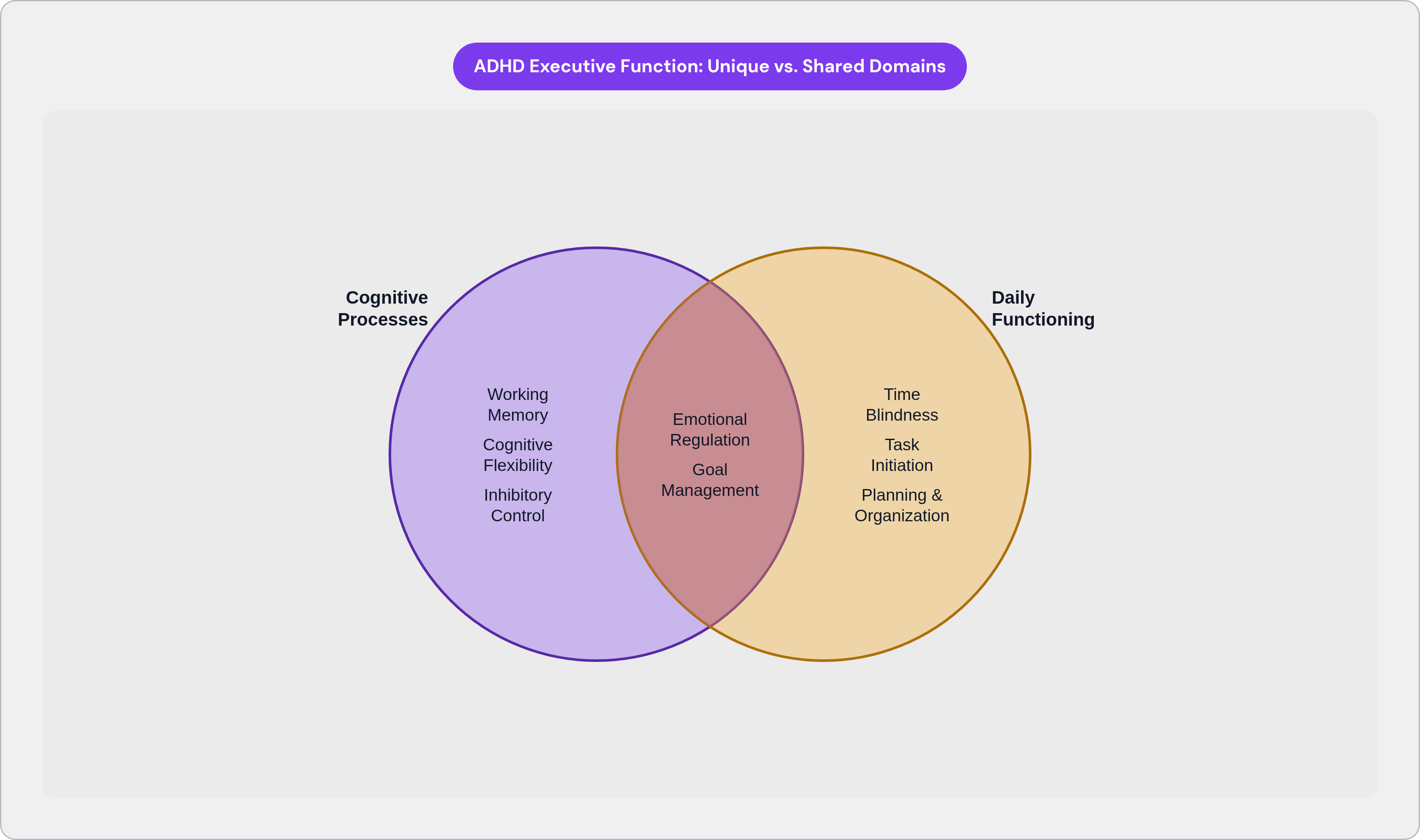
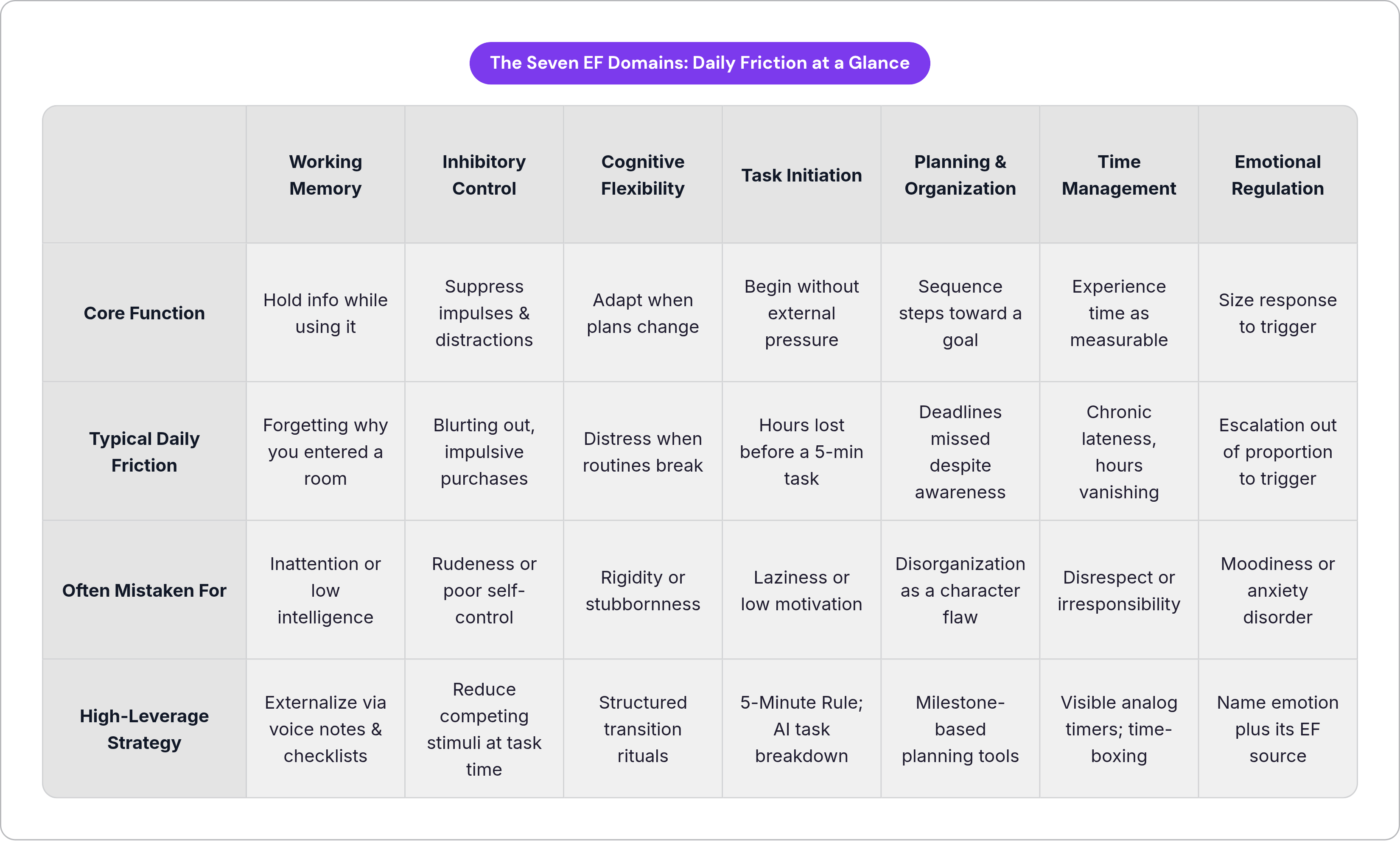
The seven EF domains the checklist covers, and what each one looks like in daily life
Working memory. This is the mental scratchpad, the ability to hold information in mind while you're actively using it. When it falters, you walk into a room and forget why you're there, mid-step, with no clear trigger. Research cited by wpspublish.com puts working memory difficulty around 62% among children with ADHD, and a 2024 meta-analysis found a moderate, consistent effect size (0.54) for working memory deficits in adult ADHD samples. Day to day it shows up as losing the thread of multi-step instructions, or re-reading the same sentence three or four times without any of it sticking.
Inhibitory control. This is the capacity to suppress an impulse or automatic response before it takes over. Research cited by wpspublish.com found roughly 27% of children with ADHD show inhibitory control difficulty specifically, though the effect compounds fast once other domains are struggling too. Day to day this looks like blurting things out mid-conversation, impulsive purchases, dropping a task the second something more stimulating wanders into view.
Cognitive flexibility, also called set shifting, governs how well you adapt when plans change. Research cited by wpspublish.com found around 38% of children with ADHD struggle here. The daily friction is real trouble switching between tasks, plus a level of distress, often way out of proportion to the actual disruption, when a routine breaks without warning.
Task initiation. This is the ability to begin a task without external pressure forcing your hand, and ADHD adults describe it, over and over, as the most painful EF gap they deal with. The engine won't start on its own, no matter how much the person cares about the outcome. The cost is stark: hours of delay before starting something that takes five minutes once it's underway, and something close to paralysis in front of open-ended work with no obvious first step.
Planning and organization. This covers sequencing: knowing what comes first, what depends on what, building a path from where you stand to where you're trying to get. When it's weak, deadlines get missed despite full awareness they're coming, projects get started from the middle because the beginning was never mapped, and physical spaces start mirroring whatever disorganization is happening internally.
Time management and time perception. This one gets misread as a character flaw more than any other domain, so it deserves its own explanation. Clinicians sometimes call it time blindness: time isn't experienced as a continuous, measurable resource, but as "Now" or "Not Now," full stop. That's not exaggeration, and it's not a choice anyone is making. The friction includes chronic lateness despite genuine intention to be on time, consistent underestimation of how long things take, and entire hours vanishing with no memory of where they went.
Emotional regulation. This is the ability to keep an emotional response sized to what actually triggered it. It's a distinct domain from mood disorders, though the two travel together often enough to be worth naming: 69.6% of adults with ADHD carry a co-diagnosis of another mental health condition, and 51.2% also have an anxiety disorder. That context matters because emotional regulation is a core executive function in its own right, arising directly from ADHD's neurology rather than trailing along as an afterthought. Daily friction here includes rejection sensitivity, frustration that escalates faster than the trigger warrants, and real trouble getting back to a task once an emotional disruption has knocked you sideways.
How to use the checklist: rating friction, not diagnosing deficiency
One boundary before going further: this checklist doesn't diagnose anything. A real diagnosis needs evaluation across multiple contexts, usually from a clinician trained to weigh developmental history against current functioning. What this checklist offers is more modest: self-knowledge, still genuinely useful within its own limits.
Rate each domain by frequency and impact, not by the worst moment you can dredge up. Everyone's got one catastrophic story, a forgotten deadline, a missed appointment that mattered, but that single episode tells you less than the pattern sitting underneath it. For each of the seven domains, two questions do most of the work: how often does this create friction, and what does it cost me when it does? A domain causing small, constant friction might deserve more attention than one responsible for a single dramatic failure.
What tends to surface from this exercise is a pattern, not a single tidy answer. Someone might find their working memory is genuinely strong, they never lose the thread of a conversation, while task initiation and time perception are where the real damage keeps piling up. That specificity changes which strategies are worth trying, and it stops someone from spending months optimizing a domain that was never actually the problem to begin with.
One case worth naming directly: the high-achiever. It's tempting to assume executive dysfunction only looks like visible chaos, but recall the figure from earlier, adults with ADHD reporting executive dysfunction on real-world self-ratings at very high rates. Plenty of people in that range look, from the outside, entirely put together. They've built compensatory systems: extra buffers, obsessive calendar habits, backup plans stacked on backup plans, all of it working overtime to keep the friction invisible to everyone but them. The checklist tends to land hardest for exactly this group, because it names a cost that's been paid quietly for years.
The output here is less a score than a ranked map: which one or two domains, supported well, would free up the most capacity everywhere else.
Targeted strategies matched to the domains where friction is highest
Working memory. Externalization does most of the work: reduce how much the brain is asked to hold onto reliably. Voice notes, single-inbox capture apps, anything that moves information out of your head and into a system you trust, cuts the load directly. Written checklists and step sequences run on the same logic, which is, not coincidentally, the same logic this article leans on for its own structure. Whether this actually helps depends on whether the capture step itself becomes another point of friction, and that's worth watching before assuming any tool has solved the problem.
Task initiation. The 5-Minute Rule, borrowed from cognitive behavioral therapy, asks for a commitment to start, not finish. The barrier is almost always activation energy rather than the task itself, so dropping the requirement to finish removes most of the resistance to beginning at all. Friction at the tool level matters just as much: tools that open fast and ask little of you before you can act tend to see more actual use than ones that don't. AI-assisted task breakdown, of the kind offered by Goblin Tools' Magic ToDo, takes on the cognitive work of figuring out where to start, often the exact step that was stalling everything downstream of it.
Time management and time blindness. Time needs to be visible and physical, not an abstract line on a digital calendar somewhere. Analog clocks, time-timer devices, visible countdowns, all give the brain something concrete to track. Time-boxing works better anchored to something external, an alarm, a body double, than relying on internally generated willpower, which ranks among the least reliable resources on offer here.
Planning and organization. Big goals need breaking into the smallest workable milestones; an overwhelming goal is one of the more reliable triggers for ADHD paralysis. Milestone-based planning, the kind of structure behind tools like Mindflow's guided goal system, keeps the next action obvious at every step, so the whole project never has to sit in your head at once.
Emotional regulation. Physical exercise carries strong non-pharmacological evidence for improving inhibitory control in ADHD, according to research Journal of Psychiatric Research, which matters here since emotional dysregulation and inhibitory control are tightly linked systems. Beyond exercise, naming the emotion alongside its EF source does real work: tracing a spiral back to a failed initiation rather than a personal failing cuts the shame and hands agency back to the person actually living it.
Cognitive flexibility. Short, predictable transition rituals between tasks signal to the brain that a shift is coming, which lowers the cost of making it. A structured warning before a required change, "in ten minutes we move to the next thing," softens the disruption the same way.
Across every domain, the same principle keeps showing up: reduce friction, externalize the system. Complexity is the enemy here, and so is any strategy that quietly assumes memory or motivation will show up on cue when you need it most.
Why tools built for ADHD brains sustain these strategies where generic apps fail
Most productivity software rests on an assumption that doesn't hold for ADHD brains: that the user can initiate reliably, plan ahead, and self-monitor without much friction. Nobody states that assumption outright, but it's baked into the design, and that alone may explain why so many well-reviewed apps get downloaded, used for four days, and quietly abandoned.
For ADHD brains, setup friction and feature complexity kill adoption faster than almost anything else. The tools that actually stick share a quality that sounds almost like an insult dressed up as a compliment: they're boring and they're fast. No onboarding flow, no decision tree, no seventeen settings demanding attention before the first real use.
Three design features line up with the neuroscience covered earlier. Voice-first input skips the typing and form-filling step that so often causes initiation failure before a task has even begun; if opening an app and typing a structured entry is itself the barrier, voice capture sidesteps it entirely. Gamification and XP-style rewards work as a dopamine-loop mechanic, grounded in the same reward-processing research from earlier, built for brains where the natural bridge between effort and reward doesn't form on its own. Milestone-based goal scaffolding breaks an overwhelming intention into the smallest next action, addressing the initiation and planning gaps this checklist exists to surface in the first place.
Some tools are built around those three principles: voice-first interaction, XP-based reward loops, and structured milestone tracking. They are worth weighing against your own experience once you've worked through this checklist and landed on specific domains, task initiation, time perception, planning, where structured support might actually help.
The checklist itself is the diagnostic step. What comes after it matters just as much: pairing that self-knowledge with a system built to meet you where the friction actually runs highest.