Cognitive Load Theory and ADHD Task Design
Cognitive Load Theory explains why ADHD brains freeze on tasks, and how to fix it.

Cognitive Load Theory is a decades-old framework from educational psychology, built to explain why students struggle with badly designed instruction. It happens to map onto ADHD task paralysis so precisely that reading the original papers feels a little uncanny, like someone in 1988 was already describing why I stare at my inbox for twenty minutes without opening a single email.
ADHD affects more than 404 million adults worldwide; in the U.S. alone, 15.5 million adults currently carry a diagnosis. Those numbers set the scale, but, the real story is mechanism, and mechanism starts with a reframe Russell Barkley has spent much of his career pushing into the mainstream: ADHD is best understood as a disorder of executive functioning and self-regulation. Take that seriously and it changes how you design a task, a tool, or a morning routine for the ADHD brain. It also, frankly, makes a lot of well-meaning advice ("just try harder," "make a list") look almost beside the point.
Three executive functions sit at the center of this. Working memory holds and juggles information while you act on it, and inhibitory control filters distraction and suppresses competing impulses. Cognitive flexibility, the ability to switch between tasks or mental frameworks, doesn't fully mature until late adolescence even in neurotypical development, so it's already a fragile system before ADHD enters the picture. Standard task design, the kind baked into most planners, project boards, and productivity apps, assumes all three are intact and available on demand, and that assumption is the mismatch. It gets worse once you factor in the neuroimaging: ADHD brains show differences in dopamine receptor availability in reward-processing regions, so the wiring meant to make effort feel worthwhile runs differently from the start.
Here's the claim this whole piece rests on: when a task demands more scaffolding than the brain can supply, the result looks like procrastination from the outside. The underlying mechanism is cognitive overload, and naming it that way changes what you'd actually build to fix it.
What Cognitive Load Theory actually says, and why it maps so precisely onto ADHD
Cognitive Load Theory, formalized by John Sweller and later expanded with Slava Kalyuga and Paul Ayres in their 2011 book, starts from a simple premise: working memory is limited, and every demand a task places on a person draws from that same finite pool. There's no separate reservoir set aside for the annoying parts of a task; it all comes out of the same account, whether you're solving a differential equation or trying to figure out which button on a cluttered app actually starts your timer.
CLT splits demand into three buckets. Intrinsic load is the complexity that belongs to the task itself, the part you can't design away, only manage. Extraneous load is friction added by bad design: confusing instructions, cluttered interfaces, steps that don't need to exist, information repeated in three formats when one would do. Germane load is the good kind, the effort spent building patterns and schemas that make the next similar task a little easier. CLT's central insight is that extraneous load is the enemy, because it eats working memory without producing any progress in return.
For a neurotypical brain, a clunky interface is an annoyance you shrug off. An ADHD brain, running under a documented working-memory deficit already, can find that same clunky interface the difference between doing the task and not doing it at all. This is closer to a ceiling than a matter of degree, since you either clear it or you don't.
The research base here is younger than most people assume, and a 2024 scoping review by Le Cunff and colleagues, published in the European Journal of Neuroscience, made the first systematic attempt to map how cognitive load gets measured in ADHD populations specifically. One finding buried in that broader body of work is almost counterintuitive: captions, generally assumed to help comprehension, have in some studies raised cognitive load for students with ADHD. More information doesn't automatically mean less load; sometimes it's just more information, competing for the same working-memory slot as everything else already sitting there.
So, CLT tells us, with real precision, what breaks. What does a task environment look like once it's built around these limits instead of around what we wish the brain could do?
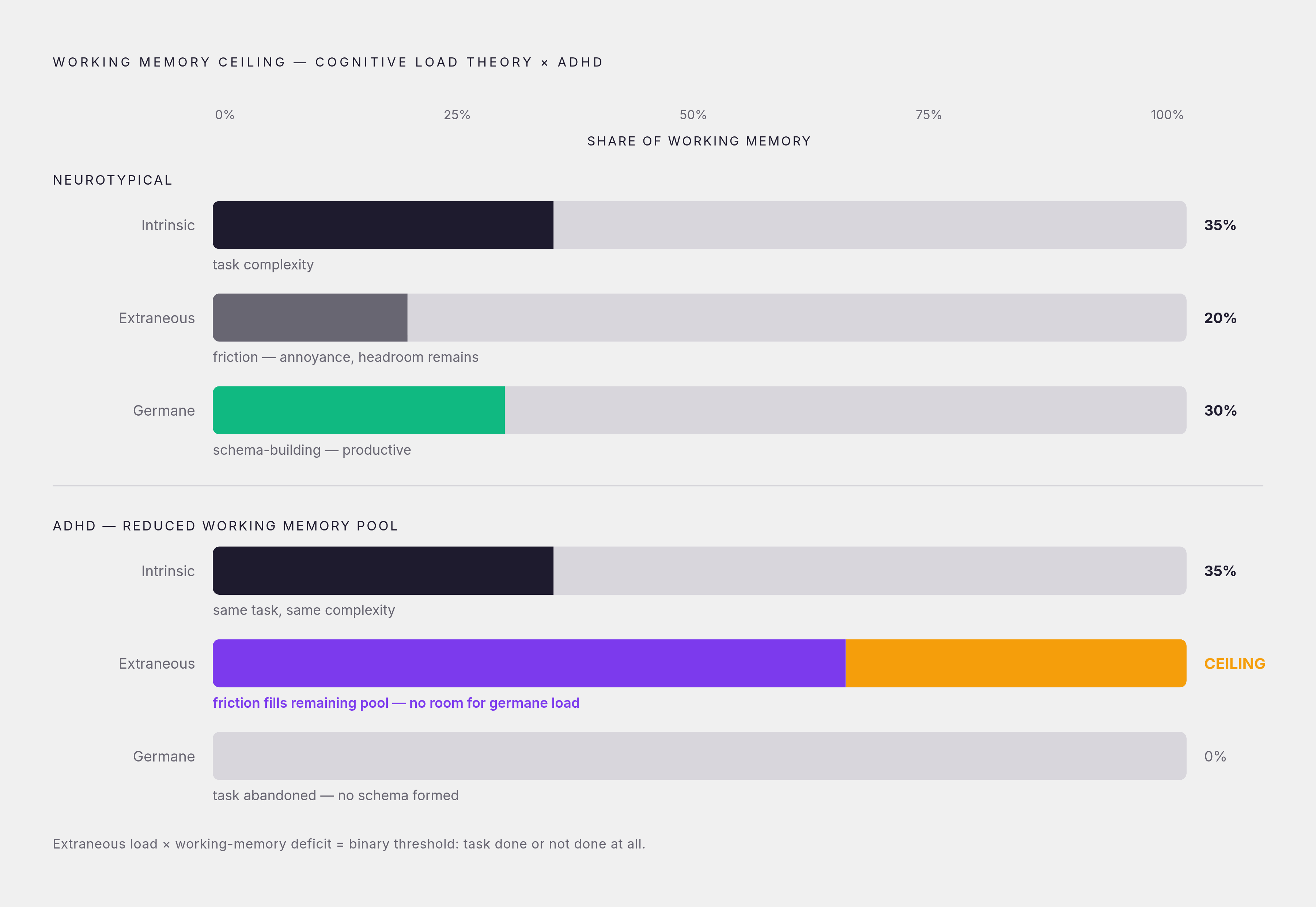
Extraneous load in practice — the specific design choices that cause ADHD paralysis
Task paralysis isn't mysterious once you look at what actually causes it. Long static task boards and nested checklist hierarchies present conditions where extraneous load accumulates — a specific kind of freeze that's common enough to have earned its own name in ADHD forums. That freeze is extraneous load, made visible.
Most tools built for ADHD users lean toward behavior correction: reminders, alarms, streak trackers that scold about as much as they encourage. What they miss is support for self-awareness and flexibility, meeting a person where their cognitive state actually sits on a given day rather than where a rigid system assumes it should sit.
A handful of design patterns keep showing up as extraneous-load generators. Multi-step instructions delivered as a wall of text force the brain to parse structure and content at the same time, which is two jobs where there should be one. Nested task lists demand that the user hold the shape of the hierarchy in mind while navigating inside it, a working-memory tax before any actual work starts. Tools that bounce a user between typing, clicking, scrolling, and checking boxes rack up switching costs with every mode change, and those costs add up faster than people assume. Vague entry points do real damage too: "work on project" carries a completely different cognitive weight than "open the document and write one sentence," even though both describe, technically, the same task.
Then there's the long static board, the kind where nothing visibly changes until something gets checked off in full, with no intermediate feedback along the way. For a brain running on a weaker dopamine response to begin with, a board like that comes close to punishing the user for opening it.
What's largely missing from the tooling landscape is a systems-level view, one that treats ADHD as an attentional modulation challenge living in the environment around the task, rather than a deficit located in the person doing it. Out of sight, out of mind, as the old saying goes; ADHD working memory doesn't reliably resurface a task that isn't sitting somewhere visible. Design has to compensate for that, since asking the user to compensate for it instead just asks the deficit to fix itself, which is a strange thing to ask of a deficit.
Four scaffolding mechanisms that reduce cognitive load for ADHD brains
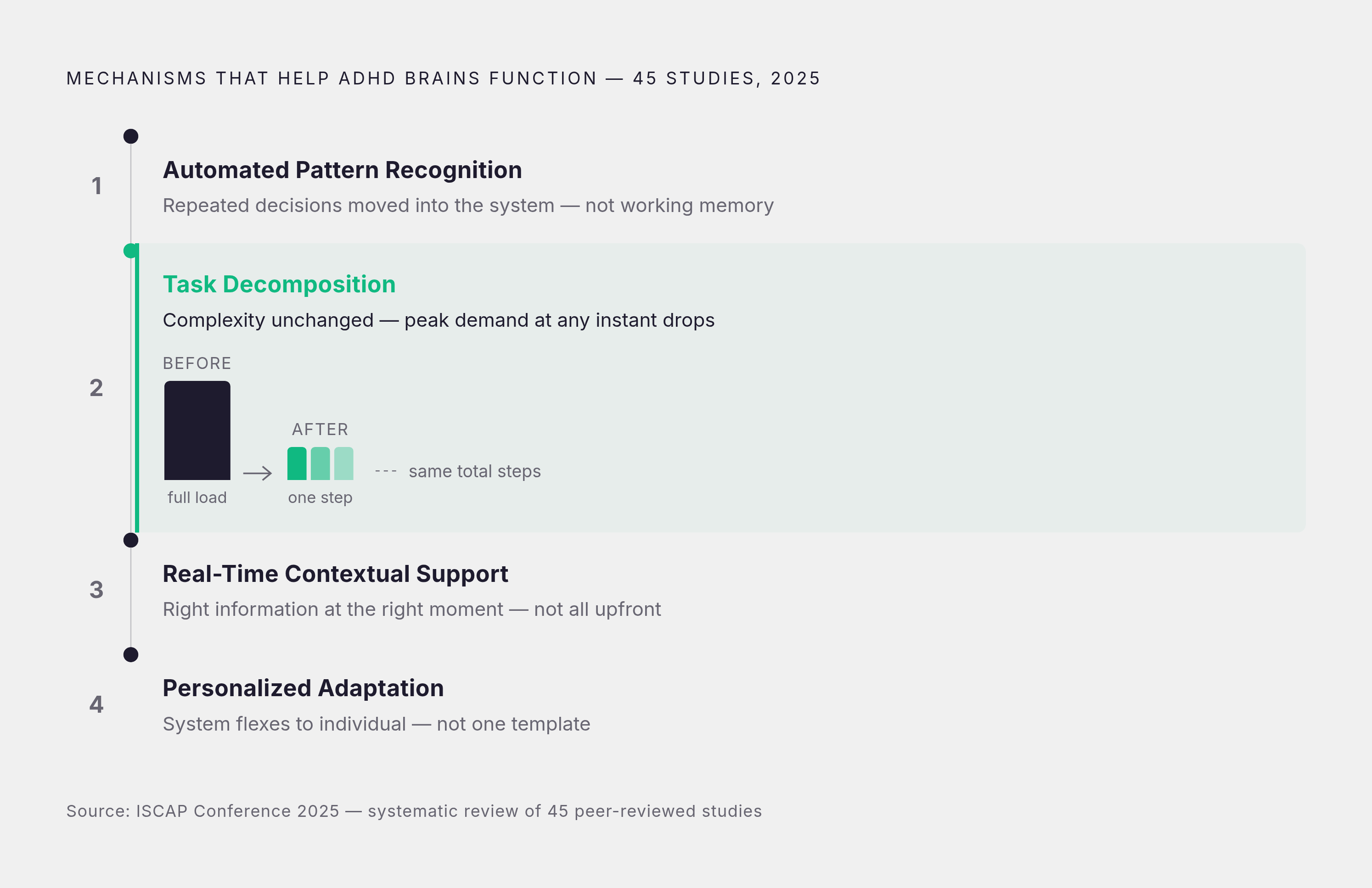
A 2025 systematic analysis presented at the ISCAP Conference reviewed 45 peer-reviewed studies and pulled out four mechanisms through which cognitive scaffolding measurably helps ADHD brains function.
Automated pattern recognition offloads repeated decisions from working memory into the system itself, so the brain isn't re-deciding the same small thing every morning. Task decomposition breaks a complex task into discrete, sequenced pieces so only one step needs to occupy working memory at a given moment. Real-time contextual support surfaces the right piece of information exactly when it's needed instead of dumping everything up front and hoping the user remembers it later. Personalized adaptation means the system flexes around a person's specific presentation rather than applying one template to everyone who opens the app.
Task decomposition is worth sitting with a little longer, because it's the most direct application of CLT to daily task design. The underlying complexity of the task doesn't change at all; what changes is timing, and decomposition spreads that load across time, so the peak demand on working memory at any single instant drops. It's a subtle distinction, but one that matters enormously in practice.
Transition rituals do something related but distinct. A consistent pre-task ritual, three breaths, writing the task name down, a short burst of movement, shifts the brain's state without costing much working-memory effort, since the ritual runs on autopilot once it's established.
Environmental design works as external working memory. Making a habit or a task physically visible, sitting on the counter, pinned to a wall, removes the burden of retrieval; the environment holds the information so the brain doesn't have to. There's a less obvious mechanism here too: auditory scaffolding through moderate external stimulation, sometimes discussed through the lens of stochastic resonance, helps some ADHD brains reach a better level of cognitive arousal. Understood this way, background noise functions as a load-management strategy rather than a distraction.
Task initiation specifically — why starting is harder than continuing, and what CLT says to do about it
Starting isn't the same problem as continuing, and treating them as one problem is where a lot of well-meaning advice goes sideways. ADHD brains need novelty, interest, challenge, or urgency to switch on; willpower doesn't bridge the gap between knowing a task exists and actually beginning it. That gap has a name in the clinical literature: task initiation.
Initiation draws on a separate stack of executive demands from the execution of the task itself. The brain has to retrieve the task from memory, form an intention to act, suppress whatever competing stimulus is currently more interesting, and, then, commit, and none of that has produced a single unit of actual work yet.
In CLT terms, initiation fails when the extraneous load of figuring out how to start outruns whatever's left in working memory. The fix has less to do with trying harder in the moment and more to do with building a zero-ambiguity entry point ahead of time, well before the moment of trying ever arrives.
A few strategies do this reliably, though rarely alone. Interest-first entry means starting with whatever part of a project is most engaging, not whatever part comes first on the page, which lowers the activation threshold without changing what the task actually requires. Energy-time alignment means scheduling the high-demand tasks for peak cognitive hours and saving the low-load ones for the troughs. The two-minute version defines the smallest possible action that counts as having started, on the logic that continuing is a much lighter lift than initiating once something's already moving. Pre-commitment, writing tomorrow's first task down tonight or setting out a physical cue, moves the retrieval cost out of the low-capacity morning window entirely.
A qualitative study of 52 college students with learning disabilities and ADHD, published in 2019, found that effective strategy use was never one-dimensional. Cognitive, behavioral, psychological, and environmental approaches worked together, and no single lever on its own did the job, which pushes back hard against the idea that one clever trick solves initiation, since it takes a stack instead. If you've tried the one-trick approach and had it fail on you, this is probably why.
Morning deserves its own note here. An estimated 75% of people with ADHD experience sleep problems, and sleep inertia means working memory and inhibitory control run at their lowest exactly when the day's first task demands them most. Any initiation design that ignores this degraded starting state is designing for a brain that doesn't exist at seven in the morning.
Chunking and sequencing — how breaking goals into milestones is a CLT intervention, not a productivity cliché
Overwhelming goals cause ADHD paralysis more often than lack of ambition does. It's easy to mistake a stalled project for a motivation problem when the real issue is that the goal's size determines how much intrinsic load lands on working memory all at once.
Chunking, in CLT terms, spreads that intrinsic load across time so it never all arrives together. Each milestone becomes a bounded task with a clear entry point and a clear exit point, sized to fit inside working memory rather than overflow it. Chunking involves more than slicing a big thing into smaller things, though, and the reason it actually works is schema formation, the germane-load process by which each completed sub-task builds a pattern the brain can run a little more automatically next time.
Good sequencing follows a few rules worth being strict about. Each step needs a single, unambiguous action: "open one tab and read for ten minutes" rather than "research the topic." Steps should fit inside one attention window, because a task spanning multiple focus cycles forces the brain to hold intermediate state in working memory between sessions, defeating the point of chunking in the first place. Visual progress markers between steps cut the need to hold the entire sequence in mind and generate the immediate feedback signal ADHD brains need to keep moving.
Habit stacking works as a sequencing tool for a related reason. Attaching a new behavior to an existing routine, brushing teeth, then taking medication, removes the working-memory cost of remembering when to do the new thing, because the trigger's already automatic.
So, what separates this from the milestone-planning advice sitting in every self-help book on the shelf? The sizing, mostly, since each chunk gets built to fit inside real, measured working-memory limits, not a general hunch that breaking things up tends to help.
Dopamine and reward loops as a load-management mechanism, not a motivational trick
ADHD brains show fewer dopamine receptors in reward-processing regions, and neuroimaging backs this up directly. The practical consequence is that delayed rewards register weakly: the internal signal meant to say "this was worth it" doesn't reach the threshold it needs to reach, a wiring difference that has nothing to do with a lack of discipline on the person's part.
There's a CLT angle here that's easy to miss. Uncertainty about whether effort is actually working is its own form of extraneous load, and it keeps the brain in a monitoring loop, constantly checking for feedback instead of committing fully to the task, drawing from the same working-memory pool as everything else.
Immediate reward signals close that loop in real time. A checkmark, a streak, an XP counter ticking up, a small completion animation: these eliminate the monitoring burden and free up working memory for the task itself instead of for wondering about the task. Gamification gets dismissed sometimes as a gimmick, dopamine candy sprinkled on top of real work, but, for ADHD brains specifically, that framing undersells it. It functions closer to genuine compensation: an externally built reward loop standing in for an internal one that doesn't reliably fire on its own.
Reduced gamma-band power in frontal regions has been linked to disruptions in dopamine-mediated reward circuits, which is part of why "just push through it" tends to fail as advice. A designed reward structure compensates for a specific, measurable gap rather than coddling anyone.
Rewards need to be immediate and tied to discrete actions, finishing one chunk, not distant and tied to a finished project three weeks out. That's the same milestone architecture from the previous section, just viewed from a different angle. And, the wins compound: each completed chunk with a clear reward signal reinforces the schema underneath it, so the germane load built up in one session becomes the automated pattern that makes the next session's initiation just slightly easier.
What a CLT-informed ADHD task environment looks like end to end
Three layers, one for each type of load, is the whole architecture once the jargon gets stripped away.
At the environment level, extraneous load gets stripped out: visible cues instead of hidden ones, a single input mode instead of five, no unnecessary navigation, a clear entry point defined for every task before the user ever needs it. At the task level, intrinsic load gets managed rather than eliminated: milestones chunked to fit inside one attention window, sequenced with unambiguous next actions, no step demanding the whole structure be held in mind at once. At the engagement level, germane load gets protected: immediate feedback after each chunk, reward signals tied to discrete completions rather than distant outcomes, transition rituals that automate the state-switching cost instead of leaving it to willpower.
A morning routine is a good place to watch all three layers work at once. Night-before preparation, laying out clothes, writing down the first task, eliminates the retrieval cost that would otherwise hit during the lowest-capacity window of the day. A micro-routine, the smallest version that still gives the day some shape, manages intrinsic load precisely when capacity runs thinnest. A built-in slack buffer absorbs the inevitable disruption (the missed alarm, the spilled coffee) without collapsing the whole sequence, and a small reward for finishing the routine, a checkmark, a sensory cue, even just a moment of satisfaction, reinforces the schema so tomorrow's version costs a little less.
Voice-first interaction is its own CLT design choice, separate from the routine example above. Speaking a task out loud instead of typing, clicking, and hunting through menus keeps the user in a single cognitive channel, cutting down on input-mode switching as a source of extraneous load. Tools that adapt to a person's shifting cognitive state reduce the monitoring burden in a similar way, offering an alternative to a static board that either gets followed perfectly or produces guilt.
An AI-powered companion built specifically for ADHD, one that combines voice capture, milestone tracking, and XP-style rewards inside one low-friction environment, applies this architecture whether or not its designers ever use the words "cognitive load." Cutting the extraneous load, chunking the intrinsic load, and reinforcing the germane load is what good task design looks like for any brain, and for an ADHD brain specifically it functions less as an accommodation bolted onto standard design and more as the baseline requirement for a fair shot at starting, let alone finishing.