Body Doubling vs Parallel Play
How presence—with or without accountability—can rewire task initiation for ADHD brains.
For adults with ADHD, the gap between intention and action is neurological, not a motivation or discipline problem, and the most effective tools for closing it work by supplying what the brain cannot reliably generate on its own: presence. I have spent years understanding this rather than blaming myself for it, and what I found points not toward better planning but toward the right kind of environmental input.
Task initiation and sustained attention are the two fault lines where ADHD executive dysfunction tends to crack first. Research cited in the clinical literature places adults with ADHD roughly ten to fifteen points below neurotypical peers on standardized executive function measures. That gap is not a motivation problem. It is neurological: the prefrontal cortex, dopamine signaling, and the mesolimbic reward pathway are all implicated, with reduced dopamine availability in the circuits responsible for driving motivation and task-starting. What the internal system cannot reliably provide, the external environment sometimes can. Presence, specifically another person in your perceptual field, is one of the oldest and most accessible environmental inputs available. This is why presence-based strategies exist as a category: not productivity hacks dressed up in neuroscience language, but tools that align with the ADHD brain's actual wiring.
Two of those tools have accumulated genuine followings in neurodivergent communities: body doubling and parallel play. They are related, often conflated, and genuinely distinct. But what if understanding how each one works — and what it asks of your brain — is more useful than treating them as interchangeable?
What Body Doubling Actually Is and Where the Term Comes From
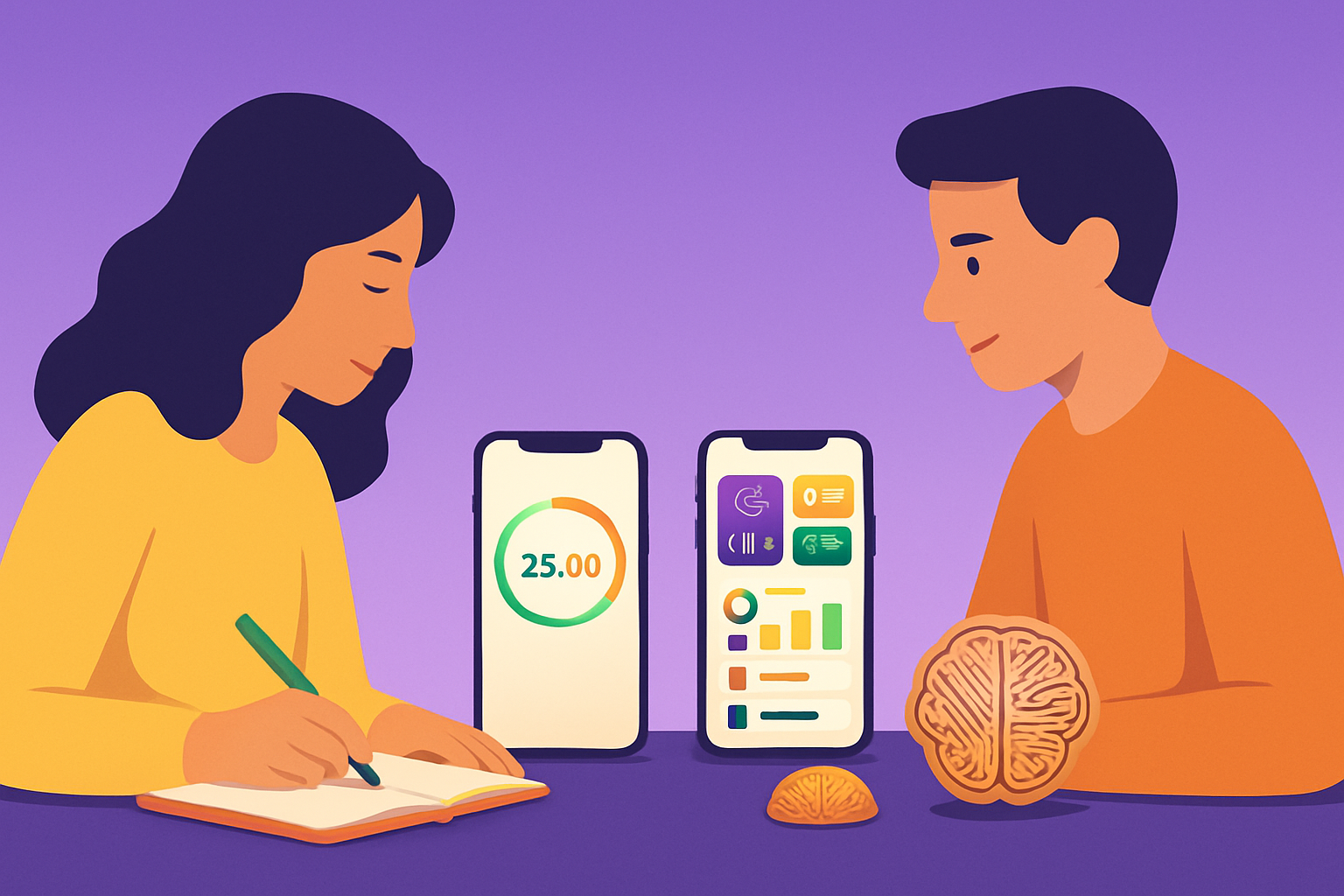
Body doubling, at its simplest, means doing a task in the presence of another person. The companion is not coaching, not assisting, not supervising. They are present. That presence is the mechanism.
The term itself is community-generated, not clinical. It emerged from ADHD coaching circles, which is important context for why formal research on it arrived relatively late. The first rigorous academic examination came from Eagle et al., published in 2024 in ACM Transactions on Accessible Computing, which surveyed 220 mostly neurodivergent participants on how and why they use body doubling. The study proposed a two-dimensional framework: one axis runs from same-time, same-space arrangements to different-time, different-space ones; the other runs from ambient companionship, where awareness of the other person is low, to performance and accountability, where there is explicit mutual expectation. This framework matters because it captures the full range of what people actually mean when they say body doubling, from a friend sitting nearby while you file your taxes to a structured virtual coworking session with stated goals and a completion check-in.
The hard-evidence base is still early. Controlled experimental studies have not yet demonstrated a statistically significant effect. What exists is consistent, substantial self-report and qualitative evidence, which is not nothing. Community evidence preceded the clinical literature by years, in this case as in many aspects of ADHD phenomenology, and the underlying psychological mechanisms were established long before the term "body doubling" appeared in any research paper.
The Psychology Behind Why Another Person's Presence Changes How ADHD Brains Perform
Robert Zajonc's 1965 paper in Science established what became the cornerstone of social facilitation theory: the mere presence of others tends to improve performance on well-rehearsed, familiar tasks. Decades of social psychology sat behind a principle that ADHD communities essentially rediscovered through trial and error. The convergence is meaningful.
To understand why this works, we must first look at the dopaminergic angle, which is more specific. Research from 2019 suggests social encounters activate the dopamine pathway, which is directly relevant given that ADHD brains have a higher density of dopamine transporters that pull the neurotransmitter back into neurons before it can fully do its signaling work. Social presence may supply a modest dopamine boost through a mechanism the brain's internal regulation fails to generate consistently on its own. A 2022 study by Wiwatowska et al. found that students procrastinated less when working in groups, with the social encounter appearing to stimulate pathways involved in self-motivation and task initiation. A 2023 qualitative study by Ogrodnik et al. on exercise and ADHD found that nearly all participants named working out with another person as a key facilitator; several used the term "body doubling" explicitly, with one describing it as "a very strong motivator."
The mechanism is layered: partly dopaminergic, partly social accountability, partly the simpler cognitive anchoring effect of another person in your perceptual field. Knowing someone can see you working raises the perceived cost of drifting, even if that person is silent, non-judgmental, and entirely absorbed in their own work. A low-level social contract forms without a word being spoken.
One significant caveat deserves attention. Zajonc's original findings also showed that social presence can impair performance on genuinely novel or highly complex cognitive tasks. The arousal that sharpens familiar behavior can overwhelm working memory when the task itself is demanding or unfamiliar. Body doubling is better suited to helping with initiation and sustained follow-through than with deep, exploratory cognitive work. Knowing this shapes when you reach for it.
What Parallel Play Is and Why It Is Not the Same Thing as Body Doubling
The term parallel play comes from developmental psychology, where it describes the stage at which toddlers play side-by-side without interacting. The adult usage borrows that structure but carries different weight. For adults, particularly neurodivergent adults, parallel play means co-presence with no expectation of interaction, output, or accountability. Two people sharing space while doing entirely separate things. The value is in the co-existence itself.
In neurodivergent community discourse, parallel play is often framed as a form of intimacy: I feel safe enough with you to be completely present without performing. There is no agenda, no check-in, no social demand to manage. This framing is not sentimental. It is functionally accurate.
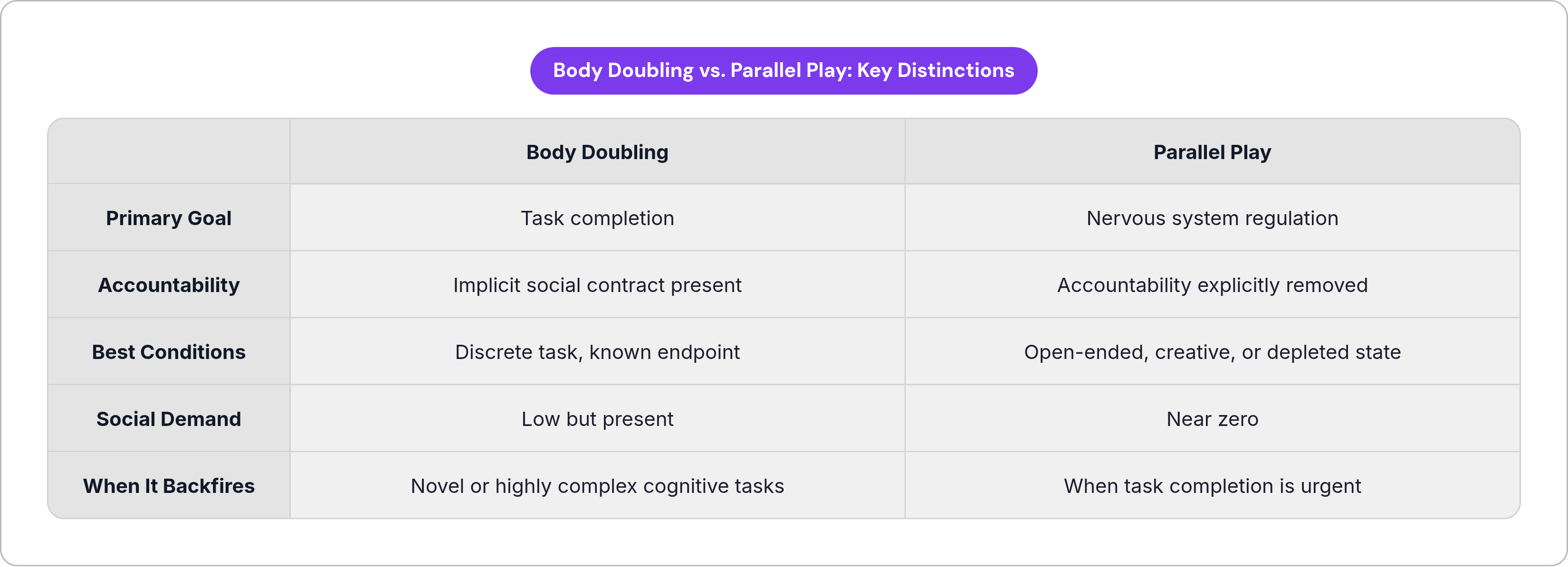
The distinction from body doubling is structural. Body doubling is goal-directed: the person is trying to complete something and uses the companion's presence as a productivity anchor. There is an implicit performance dimension, even when the companion is passive. Parallel play is presence-oriented: neither party is accountable to the other for what they produce, and the removal of that accountability is precisely the point. Body doubling imports a social contract; parallel play explicitly dissolves one.
Parallel play also carries a regulatory function that body doubling does not. For an ADHD or autistic brain already running high on social demand, the presence of another person without any requirement to mask, actively listen, or manage the other person's experience can reduce cognitive load while still providing the grounding effect of not being alone. This is a different kind of work than task completion, and it is real work.
The two can and do overlap in practice. Someone might arrive in parallel play and drift into task-focused body doubling as their nervous system settles. The categories are porous. But treating them as synonymous misses what makes each one effective.
What Each Technique Asks of the ADHD Brain, and Where Each One Fits
Body doubling performs best under specific conditions. There should be a discrete task with a known endpoint: a tax return, an email backlog, a report due by five. The barrier should be initiation or follow-through, not genuine uncertainty about what to do or how to do it. The person needs enough social capacity to tolerate even low-level mutual awareness, and some appetite for accountability, whether that means stating an intention at the start of a session or simply knowing someone is present while the work happens.
Parallel play serves a different set of conditions. The goal is regulation, not completion. The nervous system is overwhelmed, burned out, or so depleted that the implicit pressure of accountability would stall forward movement rather than create it. The activity is open-ended or creative, where the demand to produce something reportable would be counterproductive. Or the relationship context matters: parallel play with a trusted person is a low-demand way to maintain connection without spending social capital.
It is also worth considering the ADHD-specific complication of variability. Executive function in ADHD does not present consistently across days or even across hours within the same day. The technique that works on a high-capacity day may actively backfire on a low-capacity one. A person might need parallel play to regulate before they are in any position to benefit from body doubling. When used intentionally and in the right sequence, the two techniques are complementary rather than competing. The boundary between them is permeable when the person using them is paying attention.
The Virtual and Asynchronous Versions of Both Techniques
Body doubling has moved online with genuine infrastructure behind it. Focusmate, Flow Club, and Flown are the main commercial platforms; each operates on roughly the same model of joining a video call, stating an intention, working on camera, and reporting completion. Focusmate has released internal data suggesting substantially higher task completion during sessions than working alone. That figure is platform self-reported and not peer-reviewed, so it deserves to be read as advocacy data rather than independent evidence. Directionally, it tracks with what the underlying psychological mechanisms would predict.
"Study With Me" videos on YouTube represent a different format. Creators like StudyMD, who has accumulated hundreds of thousands of subscribers, and Nicole Onyia, who runs daily "work alone together" streams for a large TikTok following, have built audiences around pre-recorded or live footage of someone simply working, often with ambient sound and Pomodoro timers. These sit at the ambient, low-mutuality end of Eagle et al.'s framework. They are closer to parallel play than to accountability-oriented body doubling: the viewer is not stating goals, not checking in, not being observed. The presence is simulated, but the grounding effect appears real enough to sustain substantial community engagement.
A small 2024 study found that ten out of eleven college students with ADHD chose to retain a robot that monitored attention after one week of use, an early and preliminary signal that embodied or interactive technology-based body doubling may outperform passive video. The sample is too small to draw firm conclusions, but the direction is worth watching.
Different formats suit different internal states. A live video session with stated goals and a willing partner draws on higher social capacity and delivers more structured accountability. A Study With Me video asks almost nothing socially while still providing ambient presence. Discord drop-in servers offer flexible, low-commitment middle ground. The choice of format is itself a form of self-calibration.
How to Read Your Own State and Pick the Right Technique in the Moment
That raises an important question: which technique is actually better? The answer is that better is the wrong frame. The question is which technique matches the current state of the brain making the choice.
Three questions have held up in my experience as useful diagnostics. First: do I have a specific task I need to complete, or do I need to regulate before I can work? A known task with a clear endpoint points toward body doubling. Nervous system dysregulation points toward parallel play first. Second: how much social demand can I handle right now? Lower capacity suggests asynchronous or ambient options; higher capacity can support a live, mutual session. Third: is accountability going to activate me or paralyze me? For some people in some moments, stating a goal out loud to another person is the ignition switch. For others, in other moments, that same expectation adds a layer of pressure that makes starting impossible. Knowing which mode you are in is more valuable than having a preferred technique.
On high-capacity days, body doubling with a clear task and a willing partner or structured platform is likely the stronger tool. On low-capacity days, forcing body doubling when the nervous system actually needs parallel play tends to fail, sometimes noisily. Starting with presence without expectation often opens the door to more structured work later; the sequence matters.
Neither technique requires a perfect setup. A friend on a video call doing their own work, a Study With Me video, a coffee shop, a partner reading in the same room: these are all valid implementations. The format is less important than the function being served.
The science on body doubling specifically is still maturing. But the underlying mechanisms, social facilitation via Zajonc's framework, dopamine activation through social encounter, reduced procrastination in group settings per Wiwatowska et al., are established well enough to trust the principle while the technique-specific evidence continues to accumulate. Choosing environmental tools that work with your brain's actual wiring is not a workaround. It is accurate self-knowledge, applied strategically, which is precisely what executive function is supposed to do when it is working.